Comment Of The Day: “Morning Ethics Warm-Up, 3/6/ 2018: “Remember the Alamo” Edition” (#2: “The Option”))

Commenter Zanshin returned to expand on his answer to the hypothetical I offered a Boy Scout troop based on one of my late, lamented professional theater company’s many dilemmas over the years. Here is the situation again…

The Option

Your professional theater company has limited funds, so it offers its actors an option. They may choose a flat fee for their roles, or get a percentage of the show’s profits, if there are any, on top of a much smaller base fee.

The company just completed an extremely profitable production, the biggest hit your theater has ever had. Nine of the show’s ten cast members chose the percentage of profits option, a gamble, because most of the shows lose money. One, the star, who you know could not afford to gamble, took the flat fee for the role. After the accounting for the production is complete, you realize that every member of the cast will make $1000 more than the star, because of the show’s profits.

Question 1: What do you do?

  1. Give him the extra $1000. It’s only fair.
  2. Pay him the flat fee. A deal’s a deal.

Question 2: You remount the production, and the exact same thing happens. The actor chooses the flat fee, the show is again a huge money-maker,,and the rest of the cast will make much more than him because they chose the percentage. Do you give him the extra amount again?

  1. No. Now he’s taking advantage of me.
  2. Yes. Nothing has changed.

You can read the initial responses here, and check the poll results.

And here is Zanshin’s Comment of the Day, on the post Morning Ethics Warm-Up, 3/6/ 2018: “Remember the Alamo” Edition:

Here are my reflections on this ethical (hypothetical) issue.

Question 1: Some personal background influencing my thinking: In the early years of my career I worked at a small company (about 40 employees). After having worked there for 2 years the owners sold the company, probably for a very good price, because they decided to give every employee about $ 200 for each year that he had worked with the company. Some of my colleagues worked with them for 15 years and more.

For me it would be a nice $ 400 but to my surprise I received $ 1.000 with a handwritten note which stated something like, “We’ll give you $600 extra because we are very pleased with your performance with us. Please do not discuss this with your colleagues.”

Back to the question.

I would go for a third option. First, Pay him the flat fee. A deal’s a deal.

But at the same time, give him in some personalized way, about $500 extra.With personalized I mean, fitting the situation. Why couldn’t he gamble with his reward? For instance, his car is broke, he needs it very bad for whatever reason. Offer to pay a part of the bill, etc.

Question 2: In my opinion the set-up of the first situation (question 1) was already tainted. Just as we expect of journalists that they don’t “interview people who are drunk, drugged, impaired, or not in a mentally or emotionally stable state.” one should also not ask an employee who you know could not afford to gamble to just do that, gamble with his income. Continue reading


Afternoon Ethics Cool-Down, 2/28/18: Honors, Bribes, Blackmail, And “Ugh!”

Good Afternoon.

Actually, that’s dishonest: it’s been a terrible day, morn to now.. A catalogue retailer took an email address my wife sent them a year ago and  bombarded her account with hundreds of promotional messages yesterday, crashing her email. Then her efforts to fix the problem resulted in a Proethics system email crash that I have been trying to address for the past five hours. I finally decided to get something productive done, so I’m getting up this post while talking to my tech people. UPDATE: They just gave up.

1 Trump Tweets. Ugh. The President criticizing his own Cabinet member, in this case Jeff Sessions, in public via tweet, is horrific leadership and management practice. If I were Sessions, I would resign, It is disrespectful, disloyal, undermines morale on the President’s team, and is just plain stupid. I don’t understand how Trump had any success at all treating employees and subordinates like this. While we’re on this perpetual subject. the fact that the President would say out loud that he would have rushed the Parkland shooter without a weapon is just more evidence of a) a flat learning curve b) the lack of the usual filters from brain to mouth and c) the unethical tendency of third parties to critique the actions of others in rescue situations. No question: the resource officer who was required by policy, assignment and duty to try to intervene in the shooting deserves all the criticism he has been getting, and is accountable. But the President of the United States announcing that he is Batman is something else entirely.

My objections to the non-stop personal ridicule of our elected leader stands, but he also has a duty, as the steward of the Office, not to make himself look ridiculous.

2. An unethical boycott tactic, but I repeat myself.  The anti-gun zealots have decided to attack a free and constitutionally protected Bill of Rights advocacy group as part of the news media-assisted effort to demonize the NRA as being somehow responsible for a school shooting that none of the proposed “common sense gun reforms” would have prevented. Now the Second Amendment-gutting crowd  is using the boycott, a particularly odious weapon favored by progressives, which depends on the venality and spinelessness of corporate executives to constrict free speech. Delta Airlines announced it was ending a promotional discount with the National Rifle Association after threats and a social media campaign, then tried the weaselly explanation that its decision to stop offering discounted fares to the N.R.A. “reflects the airline’s neutral status in the current national debate over gun control amid recent school shootings.”
Continue reading

Your Boss Asks If You Have Prayed About A Work-Related Matter…What Is The Ethical Response?

This question was asked of the New York Times’ “Workologist” (It’s stuff like this that keeps me subscribed despite the paper’s disgraceful partisan bias and unocnscionable manipulation of the news):

I recently had a manager ask me if I have “prayed about” a particular situation at the office… this statement crossed a personal line with me. I am very private about my religious life. Do you have any recommendations on how I could handle this?

The question immediately reminded me of “Breach,” the film about the capture of spy Robert Hannsen (Chris Cooper), who was always urging his clerk (actually the undercover FBO agent recruited to unmask him) to pray. The “Workologist” (Rob Walker) begins by pointing out the obvious: a boss can’t demand that you pray, or fire you for refusing to. Then he adds,

Your manager can’t discriminate against you on the basis of religion, but your company can’t discriminate against him, either — by, say, forbidding him to ever mention prayer. In general, companies are supposed to make an effort to accommodate the religious practices of employees, although this can be weighed against the potential burden on the employer…Faith-related workplace conflicts and litigation have become more common in recent years. So it might be better to think about this incident in the broader context of personal expression and identity…

your best move is to make your own boundaries clear — yet also try to avoid an outright conflict. The fact that you already consider him your “worst manager” might make that difficult. But simply declaring his question inappropriate or offensive won’t help.

Instead, try something like “Well, I’ve thought about it,” and either leave it there or, if that doesn’t seem to connect, add something like “But I’m not comfortable talking about what I do or don’t pray about.” This should be delivered in a friendly-to-neutral tone. You’re not making any judgments — and neither should he.

I find that approach cowardly and dishonest. Continue reading

Morning Ethics Warm-Up, 9/16/17: Amazon Purges Reviews For Hillary, Equifax Must Die, Making Literature More Diverse, And The Red Sox Get Away With It…

GOOD MORNING!

1 “It would be wonderful, wouldn’t it?”

This is the response that the widow of writer Roald Dahl to a reporter’s suggestion that Charlie, the hero of Dahl’s “Charlie and the Chocolate Factory” (aka “Willy Wonka and the Chocolate Factory:) should be made black in a future “reworking” of the book. Recently Mrs. Dahl has claimed that Charlie was originally supposed to be black, but that her husband changed the character before the book was published. She blames his agent, who was, she says (none of this is more than hearsay) afraid that the book wouldn’t sell as well in American with a black hero. She blames “American sensibility.”

No, it wouldn’t be wonderful to start changing the races (and inevitably, genders and sexual orientations) in “reworkings” of literary classics. It would be unethical and irresponsible, as well as a defilement of the author’s visions and creations. Whatever the reason was, and we cannot know it regardless of what Mrs. Dahl now claims, Charlie was white in Dahl’s book. If he had wanted his book to be about a black child, or a little girl, or a Muslim transsexual, the author would have made it so. If someone obsessed with tribal identity politics wants to write a new adaptation under their own name so we can jeer and mock him or her, swell. But it isn’t any more “wonderful” to “rework” Dahl’s own story this way than it is to make Bob Cratchit black, or Captain Ahab black, or Bigger Thomas in “Native Son” Asian-American.

Of course, a stage or film adaptation of the book can cast it any way it chooses.

2 The major business ethics story this past week has been that data security breach by credit giant Equifax. An estimated 143 million Americans now face identity theft for the rest of their lives because the company wasn’t competent to be in the business it was in. It’s that simple. The ways in which Equifax blundered into allowing all this data to be hacked are legion, with more revelations almost daily. My personal favorite is that it neglected to install a patch that would have made its files more secure, delaying for months for no good reason.

Business analysts point out that despite this massive demonstration of ineptitude, the company is not likely to suffer more than the cost and inconvenience of a class action lawsuit or five. The companies that pay Equifax weren’t harmed by the breach, just the lives of the credit-seekers who they use Equifax to check. Nobody seems to think that even this massive misconduct will put Equifax out of business.

The company has dumped some executives, and will probably dump some more, reorganize, and padlock that barn door securely now that the horse has fled. TooLate. The company is untrustworthy, and more than that, companies like Equifax that gather personal information about innocent citizens need to be scared sick about what will happen to them if they can’t keep the information from falling into malign hands. Equifax needs to be put out of business. Its leaders and management need to be imprisoned, fined so severely that they are reduced to eating cat food, or blacklisted so their future employment is limited to bait shops and traveling carnivals. Continue reading

Ethics Alarms Baseball Ethics Special Report: The Boston Red Sox, Sign Stealing, Technology, And Cheating [UPDATED]

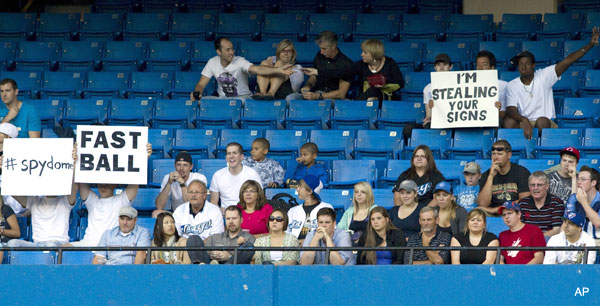
[I got the news about Major League Baseball’s announcement that the Boston Red Sox had admitted that some of the team’s employers and players had engaged in illegal sign-stealing about an hour before the Sox-Blue Jays game was scheduled. My intent was to write the post about it last night after the game. The game, however, went 19 innings and lasted 6 hours. (The Sox won, and absent this scandal, it would have been a big news story itself, one of the most important victories of the year and one that set several team records.) So the post didn’t get written, and believe it or not, I have occasional priorities and commitments that take precedent over my profit and income free ethics blog. Thus I consider the multiple e-mails and Facebook messages I have received accusing me of ducking the issue less than amusing, an unwarranted attack on my integrity. To all of those individuals, most of whom barely read the news reports, I say, “Bite me.”]

Yesterday afternoon the New York Times broke the following story, which reads in part:

Investigators for Major League Baseball have determined that the Red Sox, who are in first place in the American League East and very likely headed to the playoffs, executed a scheme to illicitly steal hand signals from opponents’ catchers in games against the second-place Yankees and other teams, according to several people briefed on the matter.

The baseball inquiry began about two weeks ago, after the Yankees’ general manager, Brian Cashman, filed a detailed complaint with the commissioner’s office that included video the Yankees shot of the Red Sox dugout during a three-game series between the two teams in Boston last month.

The Yankees, who had long been suspicious of the Red Sox’ stealing catchers’ signs in Fenway Park, contended the video showed a member of the Red Sox training staff looking at his Apple Watch in the dugout. The trainer then relayed a message to other players in the dugout, who, in turn, would signal teammates on the field about the type of pitch that was about to be thrown, according to the people familiar with the case.

Baseball investigators corroborated the Yankees’ claims based on video the commissioner’s office uses for instant replay and broadcasts, the people said. The commissioner’s office then confronted the Red Sox, who admitted that their trainers had received signals from video replay personnel and then relayed that information to Red Sox players — an operation that had been in place for at least several weeks.

As reported by ESPN, Baseball Commissioner Rob Manfred said in a statement,

“We actually do not have a rule against sign-stealing. It has been a part of the game for a very, very long time. To the extent that there was a violation of the rule here, it was a violation by one or the other [team] that involved the use of electronic equipment. It’s the electronic equipment that creates the violation. I think the rule against electronic equipment has a number of policy reasons behind it, but one of them is we don’t want to escalate attempts to figure out what a pitcher is going to throw by introducing electronics into that mix.To the extent there was a violation on either side, we are 100 percent comfortable that it’s not an ongoing issue, that if it happened, it is no longer. I think that’s important from an integrity perspective going forward.”

This is a complicated story, and part of not one complicated ethics category, but several: technology ethics, baseball ethics, cheating, and general ethics. In the interests of clarity, I’m going to cover the story in a series of short observations, each with a heading. At the end of this post, I have posted a long published essay I authored about baseball ethics within the culture of the game. Those who are not familiar with these issues, which are fascinating, might want to read that first. it is helpful background information.

Points and Observations:

  • Traditional sign-stealing in baseball is not regarded as cheating. This seems counter intuitive because of the word “stealing.” Sign-stealing refers to teams decoding the signals given by the catcher to the pitcher (regarding what kind of pitches to throw and where ), and the coach or the dugout to a batter or baserunner (in bunt and hit-and run plays). Theoretically, knowing the other team’s signals provides an advantage, as to a batter who knows that the next pitch will be a curve rather than a fastball. Usually, signs from the catcher to the pitcher are in jeopardy when there is a runner on second base. He can see the catcher’s signs as well as the pitcher can. Catchers use finger-signs in various combinations to ask for various pitches, and position their gloves to indicate where they want the balls thrown. If the runner at second can signal to the batter what the catcher has told the pitcher to throw, the batter may have an advantage.

This is why catchers often go to the pitching mound when a runner is on second base. They change the signs. The second baseman will often join them, because it is his job to know what pitch is being thrown so he can signal (usually behind his back, using his hand) to his team’s outfielders. An outside fastball makes it unlikely that the batter will pull the ball, for example.

Sign-stealing on the field, using just eyesight and hands, is what players call “the game within the game.” Joe Girardi, the Yankee manager, said in an interview yesterday that he just assumes every team is trying to steal signs, whether they are or not. Continue reading

Comment Of The Day: “The Viral Google Diversity Memo”

The perspective Ethics Alarms readers often add to topics based on their personal experiences is a often great enhancement to the discussions here. This Comment of the Day by Alex is a perfect example, as he clarifies the context of the Google diversity memo through his own observations as an employee of another large tech company.

Here is his Comment of the Day on the post, “The Viral Google Diversity Memo”:

Rather than rehash the memo or analyze it or say what is right or wrong with its reasoning, I’ll instead add my experience dealing with internal policies and “requests for comment” at a large tech (software) company – this is a direct competitor of Google, based in the Pacific NW and employing ~100,000 people (you can figure out who they are with that). My background is in Electrical Engineering with a strong focus on Computer Science, and I was hired by my previous employer just out of college after spending a summer internship with them. I worked there for 12 years, until the summer of 2016 (actually today is my one year anniversary at my new job). In my time there I can only describe diversity and HR policies around race and gender are schizophrenic, even if well-intentioned. These are my stories [insert Law and Order opening notes].

The official harassment/discrimination policy as stated in the employee handbook (which was updated every year) is incredibly vague, and this is intentional (although no one will come out and accept it publicly). We are in an at-will state, so you can be easily dismissed based on that one vague rule; and it has been used as a negotiation tactic on borderline performance dismissals to settle for a lower severance package. (“Do you really want us to state that you’re leaving for violations of the harassment policy? No? Ok, how about you settle for 2 weeks instead of 4?”) But I also have to state that the cases where I saw this section being arguably misused can be counted with the fingers of one hand. Also, I am certain that there are good intentions behind this policy, but as is the case with many well-intentioned rules, it is when the rubber meets the road that things get messy.

Every year we had to take Standards of Conduct training. Every year we had a new edition, and every year there was at least one case study dealing with gender or racial discrimination. Some years were better than others, but in general the training was terrible. If you had the cognitive abilities of a 7-year-old you could figure out what were the right responses without watching the videos or reading the policies. (The Saturday morning cartoons I watched in the 80s – G.I. Joe, He-Man, Transformers – had more complex moral dilemmas). I remember one year around the middle of my tenure when the videos and cases were actually interesting and engaging. A case that I still remember from that time is about an ambiguous situation between a male manager and a female engineer not in the same chain of command. There was a big internal debate about that one, and the next year we had the blandest possible training to avoid controversies.

The above two points are to set the stage: corporate policies are clear, you should toe the line, do not do anything that might be misconstrued, you can be dismissed for very small transgressions.

And then… well… tech companies are rebels, they thrive in chaos, and you’re expected to rock the boat. In many (may be even all) groups you can only grow so much by being a technical expert, you are expected to influence larger and larger teams as you get promoted to keep getting good performance reviews. You can be the only expert on a certain software component, but unless other people know about you and have been “influenced” by you, you are not considered good enough. This has the effect of incentivizing “visibility”. Other people and other teams should know you exist and be willing to state that you’ve had a positive impact for the company. Continue reading

An Epic And Unexpected Example Of How The Right Thing To Do Is To Undo A Bad Decision As Soon As You Realize that It Was A Mistake, And Not Worry About How Anyone Reacts, Who Says “I Told You So!”, Who Says You Shouldn’t Have Made The Mistake In The First Place, Or How Much You Are Tempted To Try To Make The Original Bad Decision Work Out Despite Knowing Deep In Your Heart That It Never Will…

I am referring, of course, to President Donald Trump firing Anthony Scaramucci as his Communications Director today.

For the first time, President Trump has given future Presidents a positive role model to emulate. Almost no Presidents, indeed, almost no executives anywhere,  have the guts and competence to do this. Of course, I don’t know if any President has made as unbelievably bad an appointment before. Lincoln appointing George McClellan as his top general for the second time comes close.

Donald Trump seldom admits mistakes. There is no other way to interpret this stunning act (I first saw it in a comment on Ethics Alarms, and I thought it was satire), no matter what the President says, other than “I screwed up big time, and I had to fix it.” Neither Obama, nor Clinton, nor either Bush, nor Reagan were ever willing to do this hardest and most humbling of management acts.

Apparently General Kelly told the President that “Mooch” had to go, and he went. This is excellent news on multiple fronts. I assumed that Kelly would eventually demand loose-cannon Scaramucci’s head—it was so, so obvious that he was a walking, talking pathogen in an already sick White House culture. I did not think Kelly would act so quickly. This speaks very well for him: Davy Crockett would have approved too. Davy’s ethics formula was “Be sure you are right, and then go ahead.” Kelly was sure, and saw no reason to wait. There was none. Every second Scaramucci remained wild and free was a second closer to the next crisis.

It is also a wonderful sign that the President took his new Chief of Staff’s advice. Wow. I now have hope that he may be persuaded to give up stream-of-consciousness tweeting.

We can use this event as yet another test to assess just how biased various pundits are.  How many will have the integrity to say, as I do, that firing a Scaramucci as soon as possible is a competent and courageous example of good management, even if it was made imperative by the President’s own  head-explodingly terrible, incompetent and irresponsible decision?  My guess is very few. What they want to do is bash Donald Trump, and this certainly gives them ammunition.

I would ask them this, however: how often have you hesitated to admit a mistake and fix it, waiting and hoping that somehow it would work out, only having to fix the problem later after the predictable catastrophe occurred? And you weren’t doing this in front of the whole nation, with a pack of hateful journalists just waiting to heap ridicule and abuse on you for doing the right thing?

President Trump deserves praise for this. And if his example is followed by managers everywhere, it will be a better world in too many ways to count.

[I thought this was over-kill, however…]


Welcome To Incompetent Leadership And Toxic Management: President Trump’s Jeff Sessions Attack

I detest bad leadership. I’ve studied leaders since I was 11, and studied management since I was 19. Incompetent leadership and inept management cripples business, the arts, sports, education, government, civilization, the world. I seldom see as horrible an example of both as in the case of President Trump’s verbal tirades against his own Attorney General,Jeff Sessions, first to Republican Senators at a White House dinner on this week,  and later in an interview with the New York Times. Sessions responded to his boss’s disgraceful behavior by saying that he intended to serve “as long as that is appropriate.”

The only reason it would be appropriate for anyone to work for a leader, executive, manager or supervisor who treats subordinates this was is patriotism. The nation has to be managed; the government has to function. Other than that, no one with honor, self-respect or a sense of responsibility should voluntarily subject themselves to the kind of abuse this President offers.  Reportedly the President insists on loyalty, but loyalty has to be minimally reciprocal. Criticizing a subordinate in public, as with the press, or in private, behind that subordinate’s back, is the equivalent of sin for any leader. It is cowardly. It’s unfair and disrespectful.  It is irresponsible, incompetent and stupid, stupid stupid. Continue reading

Morning Ethics Warm-Up: 7/21/17

Good Morning!

1. There was one of those moments in a Major League Baseball game yesterday that teaches life lessons in character, and ethics for anyone who is paying attention.

The Boston Red Sox were playing the Toronto Blue Jays in an afternoon game at Fenway Park. Boston led 3-1 in the second inning, but the Red Sox pitcher,  veteran Doug Fister, was struggling with an uncharacteristic control lapse: he walked his third batter in the inning, and also had given up a couple of hard-hit balls that suggested that a gaggle of runs and a blown lead were inevitable. Then, mirabile dictu, Fister caught a break. The next Toronto batter swung mightily and lofted an easy, lazy pop-up to the infield. If there had been one out rather than two, it would have been called an automatic out under the Infield Fly Rule. Everyone, including Fister, who is fighting to preserve his spot on the Sox roster as well as his flagging career, breathed a sigh of relief. The Toronto batter slammed his bat to the ground. Settling under a pop-up not any more difficult than those he had successfully caught as a Little Leaguer was Red Sox utility man Brock Holt, a second baseman this day. He is much admired for his versatility, energy and reliability. Holt is also trying to revive his career after a frightening, season-long battle with vertigo, as well as to show the team that he can fill a yawning void at third base.

Holt dropped the ball. It bounced off his glove, as the Toronto baserunners were charging around the bases at the crack of the bat, since there were already two outs. Two of them scored, and later two more after Fister surrendered hits in te lengthened inning, making the bounty bestowed by Holt’s muff four runs. Fister was soon out of the game, and was charged with his team’s eventual two-run loss by an 8-6 score. (Today’s headline in Boston: “Doug Fister’s Future As Starter Uncertain After Loss To Jays”).

Yet Fister never shot an angry glance at Holt. He’s played the game; he knows how mistakes and random bad luck can turn everything around in an instant. He probably has dropped a similar ball in a crucial situation: I know I’ve done it, at second base, losing a company soft-ball game. Holt trotted to the dugout, got supportive pats on the back and fanny from his team mates, and played the rest of the game with his head high and his skills on display. There is no doubt that he felt terribly about the play, but Holt  didn’t hide under a rock, rend his garments, or make a big display of anger and frustration to signal to the hometown crowd—which didn’t boo or jeer him at any point in the game.

That’s life, as my father used to say, and this is how ethical people handle life. Disaster strikes out of a confluence of factors (a very bright sun undoubtedly helped Holt miss the ball, but professional ballplayers learn to cope with the sun) and all we can do, if we are competent at life as well as fair, responsible and brave, is to accept responsibility, not make excuses, and not allow such events to diminish or destroy us. Both Fister and Holt displayed the character necessary to do that. Neither blamed the other, and no one blamed them. Tomorrow is another day.

Play Ball!

2. Professional troll Ann Coulter is having a public spat with Delta Airlines that reflects badly on both of them. Continue reading

The Tangled Ethics Of Men, Women, Sexual Harassment,Sexual Discrimination, Romance, Common Sense, And “Vive La différence!”

Mike Pence would not have a business dinner with Debrahlee Lorenzana. What’s wrong with him?

Many years ago I did a sexual harassment seminar for a New York law firm. Afterwards, the partner responsible for handling the firm’s EEOC and workplace matters told me that my ethics-based approach to the topic wasn’t sufficiently rigorous, since he believed that innocent contact between employees in the firm could spawn lawsuits. “I refuse to travel with female associates,” he told me. “I can’t be sure what they will think is harassment.”

“Wait,” I asked. “So because you’re afraid of being accused unjustly of sexual harassment, you engage in sexual discrimination?”

He sputtered something and left to arrange his sock drawer.

I think of this conversation often. I thought of it when Vice-President Mike Pence was reported as saying in 2002  that he never had a meal with a woman who was not his wife, and was promptly savaged for it by feminists and the news media. Because the new rules and practices of the workplace have developed amid contradictions and rigid doctrine rather than with attention to whether they were workable or not, Pence and that hypocritical lawyer years ago are both victims and victimizers. It is often impossible to know what ethical workplace conduct is.

The New York Times was happy to bash Pence for his candor as part of a requirement of membership in “the resistance,” but then, as is often the case for the schizoid paper, later competently and objectively examined the issue away from politics. A Morning Consult poll conducted for the paper  found that there is widespread fear of one-on-one situations, male-female interactions in the workplace.  About 25% think private work meetings with colleagues of the opposite sex are inappropriate. Almost 2/3  say it is prudent to be especially wary and sensitive around members of the opposite sex at work. A majority of women, and nearly half of men, say it’s unacceptable to have dinner or drinks alone with someone of the opposite sex other than their spouse. Continue reading