Gee, Who Could Have Ever Predicted That Marijuana Use Would Become a Problem? Me, For One…

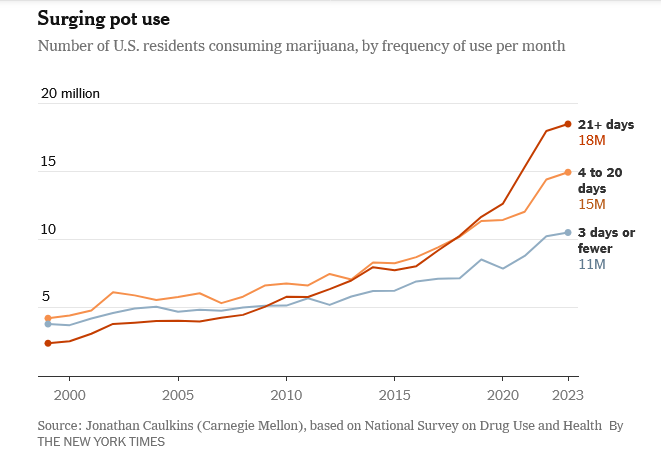
I really try not to get emotional over ethics stories, but the current Editorial Board declaration in the New York Times headlined, “It’s Time for America to Admit That It Has a Marijuana Problem” makes me want to run screaming naked into Route 395.

The U.S. had a marijuana problem a half century ago, when an earlier wave of The Great Stupid washed over the land and all manner of important lessons a healthy and functioning society needed to remember and institutionalize were deliberately tossed away because a lot of passionate, anti-establishment assholes were sure that they knew better than anyone “over 30.” I fought this destructive development from college, when I watched one of my room mates suffer short term memory loss from getting stoned morning and night; in law school, when the student running my lightboard for a production of “Iolanthe” erased all the light cues that we had taken six hours to set up because he was higher than the moons of Jupiter, all the way onto this blog. I put up with the mockery of classmates and dorm mates over the fact that I would not “try” pot (“It’s illegal” wasn’t a winning argument, so I settled on “It’s stupid and destructive.”). I drew a line in the sand with my addiction-prone wife, a former pot-head who was already an alcoholic. My fellow lawyers quickly learned not to get stoned around me because they knew I regarded buying and selling pot when it was illegal grounds for reporting them to bar authorities and respected my integrity enough to have reasonable doubts that I might not pretend that I didn’t know what I knew.

I carried the battle onto Ethics Alarms as the relentless pro-stoner propaganda was heading to victory, resulting in the legalization of the drug, the inevitable result of which the assholes who edit the New York Times have the gall now to tell us “Oopsie!” about after being a significant part of the mob mentality that inflicted it on the public, probably forever.

Back in 2011, I drafted a post that I never finished titled, “To My Friends the Pot-Heads: I Know. I’ve Heard It All Before.” It began:

“I take a deep breath every time I feel it necessary to wade into the morass of the Big Ethical Controversies, because I know it invites long and fruitless debates with entrenched culture warriors with agendas, ossified opinions, and contempt for anyone who disagrees with them. War, abortion, religion, prostitution, drugs, torture, gay marriage…there are a lot of them, and all are marked by a large mass of people who have decided that they are right about the issue, and anyone disagreeing with them is stupid, evil, biased, or all three. Contrary to what a goodly proportion of commenters here will write whichever position I take, I approach all of these issues and others exactly the same way. I look at the differing opinions on the matter from respectable sources, examine the research, if it is relevant, examine lessons of history and the signals from American culture, consider personal experience if any, and apply various ethical systems to an analysis. No ethical system works equally well on all problems, and while I generally dislike absolutist reasoning and prefer a utilitarian approach, sometimes this will vary according to a hierarchy of ethical priorities as I understand and align them. Am I always right? Of course not. In many of these issues, there is no right, or right is so unsatisfactory—due to the unpleasant encroachment of reality— that I understand and respect the refusal of some to accept it. There are some of these mega-issues where I am particularly confident of my position, usually because I have never heard a persuasive argument on the other side that wasn’t built on rationalizations or abstract principles divorced from real world considerations. My conviction that same-sex marriage should be a basic human right is in this category. So is my opposition, on ethical grounds, for legalizing recreational drugs.”

Instead of finishing and posting that essay, I posted this one, which used as a departure point a Sunday ABC News “Great Debate” on hot-point issues of the period featuring conservatives Rep. Paul Ryan and columnist George Will against Democratic and gay Congressman Barney Frank and Clinton’s former communist Labor Secretary Robert Reich. [Looking back, it is interesting how all four of these men went on to show their dearth of character and integrity. Ryan proved to be a spineless weenie, rising to Speaker of the House but never having the guts to fight for the conservative principles he supposedly championed. Frank never accepted responsibility for the 2008 crash his insistence on loosening mortgage lending practices helped seed, preferring to blame Bush because he knew the biased news media would back him up. Will disgraced himself by abandoning the principles he built his career on in order to register his disgust that a vulgarian like Donald Trump would dare to become President. Reich was already a far left demagogue, so at least his later conduct wasn’t a departure. I wrote in part,
Gee, Who Couldn’t See This Coming? Oh, Right: Just About Everybody…

Except me.

It used to be that I could count on a tsunami of comments and clicks when I aired my unalterable conviction that pot, weed, cannabis, marijuana, what ever you want to call the junk, was a blight on civilization, that legalizing it would be a big net loss on society, and that the elite advocates for legalization were selfish, irresponsible creeps who wanted their little highs at the cost of kids, the poor, and the less-than-bright harming themselves, their families, their employers and their future prospects. Once the states started giving up after the culture had pushed them into the mendacity that the drug was as harmless as Junior Mints, I gave up too. I was right, they were wrong, the embrace of stoned kids and adults would be one more malady in a nation where we have too many already, but the metaphorical genie was out of its bottle and there is stuffing it back in.

At this point in my life, the whole subject just ticks me off.

Now comes “expert” Aaron E. Caroll to explain that yes, well, we really did legalize grass before we really knew what the hell we were doing. [Gift link!] Huh! Who would have thought it? He writes,

“…we should acknowledge that policy moved faster than the evidence on public health effects. The challenge is whether we are willing to adjust course when we encounter unintended consequences…”

I wouldn’t call consequences that were completely predictable and likely “unintended.” The spoiled grown-up (sort of) college kids who just wanted their bongs had plenty of people—like me—telling them that siding with Cheech and Chong was irresponsible and reckless, but they didn’t care about kids, the workplace, side-effects, any of it. Next he writes in part,

Continue reading

Ethics Quiz: Smoking Daddy

In the YouTube video posted by “web influencer” Rosanna Pansino (over 14 million YouTube subscribers—I’m all the way up to around 230 followers in my recent return to Twitter/X!—the 39-year-old baking star smokes her dead father’s ashes in accordance with his dying wish. She says her father, dying of leukemia, wanted her to grow a marijuana plant with his ashes and then smoke him. So five years after he died, with his pot plant flourishing, Pansino lit a joint that had particles of her father in it and smoked it for the entertainment of her YouTube audience.

Classy. So tasteful.

Your Ethics Alarms Ethics Quiz of the Day…

“Is this unethical, or just icky?”

Continue reading

Ethics Quiz: Maryland’s Mass Pot Pardon

This is an ethics quiz because I recognize that I am irretrievably biased on the question of marijuana (no, I really don’t care that I’m supposed to call it “cannabis” now: bite me), which I believe should continue to be illegal, though I am under no illusions that this metaphorical horse has left the barn for good.

Maryland’s governor Wes Moore signed an executive order yesterday that pardons more than 175,000 convicted drug-abusers whose crimes were related to marijuana use. Moore said he did this “with deep pride and soberness.”

Yes, he’s proud to announce that Maryland doesn’t think violating laws is anything anyone should be ashamed of.

“Today is about equity; it is about racial justice,” Anthony Brown, Maryland’s attorney general, said. “While the order applies to all who meet its criteria, the impact is a triumphant victory for African Americans and other Marylanders of color who were disproportionately arrested, convicted and sentenced for actions yesterday that are lawful today.” This is because a disproportionate number of blacks broke the pot laws. This in turn acculturated many of them into breaking other laws with impunity as well. The progressive rule is that if laws are violated by larger numbers of a minority group than their demographic presence in the population would predict, it is discriminatory to enforce those laws.

I wonder who thought up that dodge? Whoever he or she is, it’s brilliant.

Your Ethics Alarms Ethics Quiz of the Day is…

Is the Maryland pardon fair and responsible?

Continue reading

“Gee, What A Surprise: Pot Isn’t Good For Teenagers”…The Sequel

In the same vein as the rueful post from two days ago, Ethics Alarms offers this excerpt from today’s Sunday Times without further comment, because none should be necessary…

Continue reading

Gee, What A Surprise: Pot Isn’t Good For Teenagers! Funny, I Figured That Out When I Was 16…

This post is going to be uncharacteristically short considering the seriousness of the issue, because I’m going to just get angrier and sadder the longer I think about it.

A new Columbia University study, published in the Journal of the American Medical Association (JAMA), analyzed data from more than 68,000 teens surveyed by National Survey on Drug Use and Health. The researchers found that using marijuana while not being addicted to it was “significantly associated” with psychiatric disorders. Obviously teens addicted to pot had even worse outcomes, but those who use cannabis recreationally were two to three times more likely to be diagnosed with depression and to have suicidal thoughts than those who don’t use pot at all. The researchers also found a link between cannabis use and poor academic performance, skipping school and getting in trouble with the law.

This comes as approximately as much of a surprise to me as the revelation that tobacco caused lung cancer. I figured out when I was still in high school that a little-researched drug that you inhaled and that made you instantly inarticulate and stupid was doing something to your brain, and shouldn’y be used no matter how many “friends” and celebrities told you it was “cool” and that you were a weenie for not toking up. Fortunately, being the son of a lawyer and decorated veteran who believed laws should be obeyed, the fact that pot was illegal was enough for me, as it was for most people until the revolting Sixties. That was when the Left jumped the rails and started opposing laws generally (“Steal This Book” was an Abbie Hoffman hit. Abbie was also big pot fan. And he killed himself…)

The full force of popular culture was employed to sell the idea that pot was as harmless as bubble gum despite all evidence to the contrary. Then “medical marijuana” punched a hole in coherent enforcement; state governments, as they did with gambling, decided that they would rather make money than keep the public healthy, and now a big, ugly genie is out of the bottle for good. I totally failed in my efforts to fight this damaging cultural wave: a young man who is very dear to me began using weed in his teens, and had, and continues to have, all of the problems the Columbia researchers associated with pot use.

The arrogance, foolishness, lack of responsibility and defiance of common sense that created this societal malady—as if we didn’t have enough of them already—was unforgivable, and I’m not going to forgive it, ever. Screw you all, NORMAL, Cheech and Chong, John, Paul, George and Ringo, the Not Ready For Prime Time Players, Hollywood, Barack Obama, Timothy Leary, and all the other rich and privileged pot users who didn’t care what endorsing illegal drug use would do society, kids, and especially poor and minority communities.

This wasn’t hard to see coming, but you valued your little daily highs more. Well, I’m stuck living in the dumber, less healthy and more chaotic world you created. Congratulations.

Week-Launching Ethics Warm-Up, 10/4/2021: A Happy Ending To A Pit Bull Saga, A Congressional Leader Makes My Head Explode, And More [Updated]

launch

Singer Janis Joplin died of a heroin overdose on October 4, 1970. The anniversary prompts me to make an unkind observation that I was tempted to make after reading all of the tributes and expansive rhetoric praising “The Wire” actor Michael K. Williams after he died of an overdose of fentanyl and heroin on September 6. For at least a hundred years, anyone who takes heroin does so knowing that it is addictive and frequently fatal. My attitude toward Joplin, Williams, John Belushi, Phillip Seymour Hoffman, Billy Holliday, and many other artists who have killed themselves this way involves more anger than sympathy. The world was robbed of their gifts because they were reckless. In the case of black artists, they endanger their admirers by creating a romantic aura for what is, in the final analysis, stupid and irresponsible conduct. How hard can it be not to start using an addictive substance that you know might kill you? The fact that the drug is illegal should be a big clue.

1. And speaking of the joys of recreational drugs...In a new study published in Psychological Medicine, researchers in the University of Birmingham’s Institute for Mental Health and the Institute of Applied Health Research found a strong link between “general practice recorded cannabis use” and mental ill health. Senior author Dr. Clara Humpston said: “Cannabis is often considered to be one of the ‘safer’ drugs and has also shown promise in medical therapies, leading to calls for it be legalized globally. Although we are unable to establish a direct causal relationship, our findings suggest we should continue to exercise caution since the notion of cannabis being a safe drug may well be mistaken.”

Continue to exercise caution? Who’s exercising caution? Popular culture and upper-middle class whites have been issuing pro-pot propaganda for half a century, while mocking government efforts to discourage widespread use and acceptance of another destructive recreational drug. Now nearly every state is on a path to legalize it, especially because they smell tax revenue.

Continue reading

Friday Late Morning Ethics Warm-Up, 7/30/2021: Pot, Bribes, “Advocacy Journalism,” Baseball’s Domestic Abuse Policy, And How Did A Woman Win The Gold In The Men’s Decathlon?

White rabbit 2

I often check multiple websites to see what of ethics significance occurred on given dates. This July 30 isn’t a major ethics day, though the fiasco that resulted in 1864 when the serially incompetent Union General Ambrose Burnside made his third major blunder of the Civil War in the Battle of the Crater carries a crucial leadership lesson that apparently is impossible to learn: don’t give incompetent leaders second (or third) chances to lead.

However, on one of the sites, “This Day in History,” the headline on a note reads, “1976: Caitlyn Jenner wins Olympic decathlon.” That may be politically correct, but it’s cowardly (would the trans activist mob pounce if the event was stated straight?) and absurd on its face. Bruce Jenner won the Olympic decathlon, and it was a men’s event. Caitlyn was, as far as we know, not even a twinkle in his eye. Bruce fathered children after winning the gold; the event and the other events in his life when he was a he were not magically altered by his later transgender journey, like “Back to the Future.”

1. “Nah, there’s no mainstream media bias” note of the day. Frequent commenter and invaluable tipster Steve Witherspoon sent me a link to a Jonathan Turley column I had missed. The law professor covers a lot of issues we have discussed here as he notes that “Professional ethics, it seems, has become entirely impressionistic in the age of advocacy journalism.”

It seems? There is no question about it. Turley also points out the hypocrisy of the Times with several examples, writing, “If none of this makes sense to you, that is because it does not have to make sense. Starting with the [Senator Tom] Cotton scandal, the New York Times cut its mooring cables with traditional journalist values. It embraced figures like Nikole Hannah-Jones who have championed advocacy journalism.” He also notes that “while the Times has embraced advocacy journalism, its has not updated its guidelines which state that “Our journalists should be especially mindful of appearing to take sides on issues that The Times is seeking to cover objectively.”

Read it all, and I recommend sending it to any friend or relative who calls assertions that the news media is a left-wing propaganda machine at this point “conservative disinformation.”

Continue reading

Morning Ethics Warm-Up, 4/21/2020: Groundhog Day

Hi.

I was talking with a colleague about the most relevant movie to watch these days. As readers here know, the outbreak of elected officials letting power go to their heads led me to designate Woody Allen’s “Bananas” for that honor.  (And yesterday I posited the relevance of “Airplane!” )Still, it’s hard to argue against my friend’s position that the right choice is “Groundhog Day.”

In the interest of sanity, I reject “Contagion” and especially “World War Z” or “Quaranteen.” (All good movies though.)

1. Right now it’s turned face to the wall, but today I’m putting a sheet over it…My college diploma becomes more embarrassing by the day. Harvard University has accepted nearly $9 million from the pandemic relief package. With a 40 billion dollar dollar endowment, Harvard is better off financially than the U.S. government.

[Notice of Correction: I wrote “million” instead of billion in the original post. Really stupid typo. I apologize.]

There is no excuse for the school accepting the money. It is getting widely criticized for taking it, and ought to be.

A spokesman for the U.S. Department of Education said ithat Education Secretary Betsy DeVos “shares the concern that sending millions to schools with significant endowments is a poor use of taxpayer money. In her letter to college and university presidents, Secretary DeVos asked them to determine if their institutions actually need the money and, if not, to send unneeded CARES Act funds to schools in need in their state or region.”

In an episode of Spokesman vs Spokesman, a mouthpiece for the Ivy said, disingenuously,

“By federal formula laid out in the CARES Act, Harvard was allocated $8.6 million, with 50% of those funds to be reserved for grants to students. Harvard is actually allocating 100% of the funds to financial assistance for students to meet their urgent needs in the face of this pandemic. Harvard will allocate the funds based on student financial need. This financial assistance will be on top of the significant support the University has already provided to students — including assistance with travel, providing direct aid for living expenses to those with need, and supporting students’ transition to online education.”

This is an exercise in deflection and rationalization. The only issue is that Harvard has plenty of money to do all of this without any hand-outs from the government, and many other institutions need the money more, which is an easy calculation because no institution needs money less than Harvard does. Continue reading

Gee. What A Surprise. Pot Damages Brains.

Have you ever had the experience of knowing immediately and without question that something was wrong, and have everyone around you argue, and smirk, and yell, and posture, and insult, and mock, and still know you are right, and then be ignored only to have the fact show you were right all along, as you knew you would be?

That’s been my experience with marijuana. At this point, I’m no longer angry about it, frustrated or even sad. I’m resigned. I’m not accepting, because that’s not how I’m wired. This isn’t even the only issue like this: I will not be surprised when in future years there will be other cultural suicidal decisions that I (and many others) warned about and tried to explain why they were utterly, stupidly, indefensibly wrong. We may just open the borders. We may gut the First Amendment, or try to ban guns. We may swallow the poison pill of socialism, or worse. I won’t be surprised. I have learned that the entropy of society drifts toward idiocy, ignorance and self-destruction. I know I am lucky that I was born quite a bit smarter than  my typical fellow citizen, but they are not lucky that they so, so overwhelm me and people like me when it comes to guiding our cultural ship.

The New York Times article, authored by Kenneth L. Davis, the president and chief executive of the Mount Sinai Health System and Mary Jeanne Kreek,  head of the Laboratory of the Biology of Addictive Diseases at Rockefeller University, is titled “Marijuana Damages Young Brains.”

It essentially outlines a public health crisis, and more: it explains that we are not merely legaizing but preparing to market and promote a “recreational drug” that will make the public even dumber and less intellectually capable now than they already are. They write, Continue reading