Well, there I was last night, showing my wife my favorite “Schoolhouse Rock” segment (“Interjections,” a Grammar Rock episode) and getting ready to post an evening ethics potpourri when the Disney Channel, which I only have because I wanted to see the “Get Back” documentary, kicked out. The snow storm’s aftermath had caused an outage in our phone and internet connection (at least we had power, and weren’t stuck on I-95 like hundreds of motorists in Northern Virginia were last night), and Comcast didn’t get everything back up until a few minutes ago. A totally lost day for ProEthics and Ethics Alarms, but the sage words of my friend Tom Fuller kept echoing in my brain like all the Tara lines coming back to Scarlet after Rhett walks out on her. “When you have no options, you have no problem,” Tom always says, and this was a classic example. We were snowed in, and had no communications (not even a newspaper since the second); might as well relax: Snow day!
I was able to get a head starton some items, at least. I apologize for the void…and for any comments marooned in moderation (as well as the inevitable mermaidmary comment unjustly spammed).
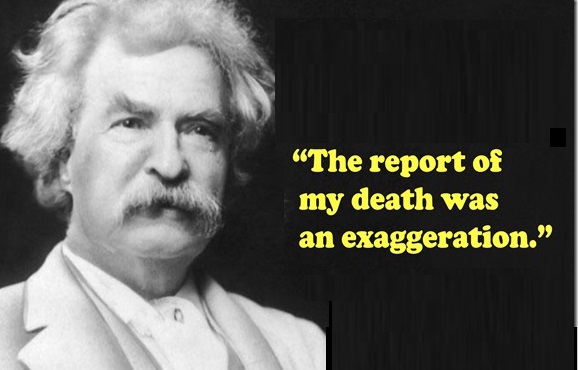
But at least I’m not dead.
[That’s the correct Mark Twain quote above, incidentally. He also said, “I do not fear death. I had been dead for billions and billions of years before I was born, and had not suffered the slightest inconvenience from it.”]
Speaking of gallimaufry, “A Heavy Dragoon” is one of the best Gilbert and Sullivan “list” songs, but you seldom hear it. Erudite is the listener who can identify all the historical figured named! The song is from “Patience,” the firs show I ever directed, and still one of my favorites. The singer in the clip above, Darrell Fancourt, played the part of the Mikado more times than anyone, and even dropped dead while playing the role.
1. In baseball history, it’s Moral Luck Day. On July 17, 1941, New York Yankees center fielder Joe DiMaggio didn’t get a hit against the Cleveland Indians, in great part due to a pait of great plays by Cleveland third baseman Ken Keltner, finally ending his historic 56-game hitting streak, the longest in MLB history then and now. Largely on the basis of the streak, though it helped that the Yankees won the pennant, DiMaggio was awarded the American League MVP award, despite the fact that Boston’s Ted Williams hit .406 that season, nearly 50 points higher than DiMaggio. In fact, Williams outhit the Yankee during the same 56-game period.
The end of The Yankee Clipper’s amazing streak was luck, and the streak itself was luck. All hitting streaks are. Baseball is the sport most governed by random chance, especially hitting: a well-hit ball can become an out if it happens to be hit within a fielder’s reach, and a ball barely touched by the bat can dribble down the baseline for a cheap hit. DiMaggio was undeniably a great hitter, but many players in baseball history were better; he just was lucky—good, but lucky—for a longer stretch of games than anyone else. Yet of all his many achievements, the 56 game streak in 1941 is the first thing baseball fans cite when assessing the greatness of Joltin’ Joe DiMaggio.
2. It isn’t what it is! Yesterday, New York Mayor Bill de Blasio said that releasing prisoners onto the city’s streets to avoid their infection by the Wuhan virus in jail had made New York City safer, saying, “We now have fewer people in our jails than any time since World War II and we are safer for it and better for it.” De Blasio’s office announced that more than 1,500 inmates had been released from city jails in three weeks, reducing the number of prisoners to its lowest level in 70 years.
The problem is that his assertion is ludicrous. De Blasio’s boast that the prisoner release made the city safer defied the evidence of the results of the prisoner release the NYC Bail reform law required in January 2020. Of those who committed felonies that were no longer eligible for bail, 19.5% were re-arrested at least once after an initial non-bail eligible felony arrest, 1,798 of 9,227 individuals were re-arrested. 2020 recidivism resulted in 1,452 major crime arrests (murder, non-negligent manslaughter, rape, robbery, felony assault, burglary, grand larceny, and grand larceny of a vehicle) vs. 681 in 2019. Meanwhile, shootings in the city were up 205% in June compared to a year earlier. Continue reading →
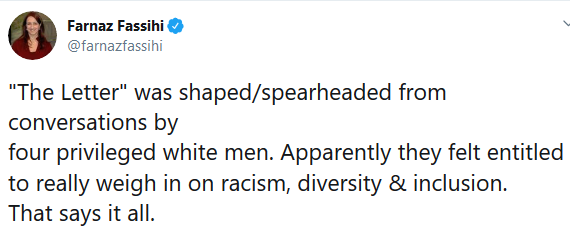
1. Re: Privilege and bit more on the Harper’s letter fiasco. At the Volokh Conspiracy, David Bernstein flags this tweet by New York Times reporter Farnaz Fassihi:
A few thoughts:
Why do I subscribe to a paper that would employ someone like this? I forget.
She’s a bigot. I just wrote a bit on the “privileged smear” on another thread:
I have to say again that I do not comprehend the “privilege” line of thought at all. In the hands of most who wield it, I find the tactic the equivalent of Butch Cassidy kicking huge Harvey Logan in the balls to start their knife fight….
I like to start the week with a clean slate, especially now, when the George Floyd Freakout finds new ways to shatter previous standards of public decorum, civic decency, and respect for nation and community. However, despite over 3,000 words in three posts today, I still had to leave several stories on the bench that I wanted to explore.
What a coinky-dink! As soon as Bill De Blasio, one of those Democratic mayors that Philip Bump says did nothing to make his city more violent, disbanded the NYPD’s anti-crime unit, the city had an explosion of shootings. Police said a total of 70 people were shot this week, compared to 26 the same week last year.
This is what more communities have to look forward to as a result of city officials across the country putting their virtue-signaling embrace of white guilt and Black Lives Matter ahead of the welfare of citizens.
Of course, corruption in New Jersey politics is hardly news, but this story is ironic as Democrats are claiming that Republican opposition to mail-in voting is motivated by a desire to suppress election participation rather than a legitimate concern about the ease of voter fraud.
“New Jersey Attorney General Gurbir Grewal charged Paterson City Councilman Michael Jackson, Councilman-elect Alex Mendez, and two other men after the U.S. Postal Inspection Service alerted the state attorney general’s office that it had found hundreds of ballots from a special election last month stuffed in a single Paterson City mailbox,” InsiderNJ reported. According to WNBC-TV, more than 3,000 ballots were set aside over voting fraud concerns in the Paterson City Council election — 16,747 were received, but only 13,557 were accepted — meaning a whopping 19%, or nearly 1-in-5, were rejected. More than 800 of the rejected ballots were invalidated because they were found tethered together in mailboxes. This was especially significant because the margins in two of the contests were razor thin.
I had a devil of time finding out the party affiliation of the politicians charged in multiple news sources. That usually means that it’s a Democratic scandal. It was.
I don’t know about you, but for me the days merge into each other of late. I didn’t realize that I had snubbed D-Day until almost midnight. My Dad used to remind me that my existence may have been due to his unexpected inability to participate in the invasion: he had been assigned as an observer, which sounded scary to me, but “luckily” the idiot who blew himself and my dad’s foot up with a live hand grenade took him off the beaches.
1. I wonder...are the same PR hacks who wrote all of the “we’re all in this together? messages about the Wuhan lockdown the ones responsible for the smarmy “black lives matter” messages various companies are putting out?
Yesterday I was watching a movie on Vice, and the CEO kept interrupting the film to blather on about social justice. He is going to host a special, and among the guests—Trayvon Martin’s mother! That tells me all I need to know about the program. Outside of the false narrative constructed around it, the Zimmerman-Martin affair holds no enlightenment about systemic racism, police, or anything else useful, other than being a fine example of how the news media and politicians exploit race whenever they can.
The ethical values breached are honesty, responsibility, and citizenship.
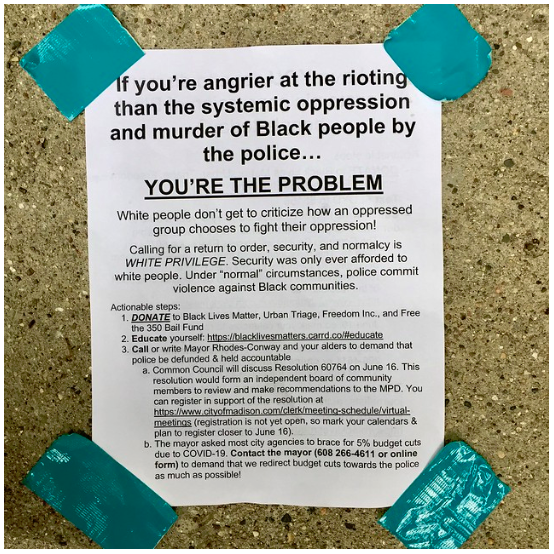
2. Ann Althouse posted this sign from her neighborhood (Madison, Wisconsin).
Yeah, that attitude will really assist the battle against “systemic racism.” Nothing builds racial trust like one race telling the other that there are some opinions it can’t express because of their race.
These are the people that the NFL, Uber, BestBuy and so many other businesses and institutions are supporting.
The ethical value being ignored are trust and integrity.Continue reading →
1. I have a theory on mainstream media bias deniers..Maybe it’s more sympathetic than they deserve, but I think people don’t notice how sloppy, incompetent and stupid reporters and pundits are because they don’t read newspapers carefully or consistently, and because other news sources are so packed with distractions and emotional manipulation (not that newspapers are not) that it’s hard to concentrate on the details. This is why I read the Times. I figure that it’s supposed to be the best, and if the best is stupid and biased (stupid makes you biased, and vice-versa), then we can be pretty sure that the rest are worse.
It is amazing how much disinformation the Times allows, or in many cases, promotes. Here’s a trivial but telling example: Sarah Lyall is a Times reporter who also writes a column reviewing thrillers in the New York Times Review of Books, wrote recently that she always wanted to be “the Henry Fonda” of a jury, “single-handedly” “exonerating” a “wrongly accused” defendant, like “Twelve Angry Men.” This is a factually and legally false description of Reginald Rose’s script. Juror 8 (Fonda) doesn’t “single-handedly” do anything except keep deliberations going. The defendant isn’t “exonerated”—all the jury does is collectively figure out that he wasn’t proven guilty beyond a reasonable doubt–you know, like OJ. And he probably wasn’t wrongly accused. In fact., he’s probably guilty. The whole point of Rose’s screenplay is that “probably” isn’t enough.
Newspapers are supposed to enlighten readers, not make them dumber. I know most people think that “Twelve Angry Men” is like mystery where someone is accused of murder and is proven innocent by a relentless sleuth, but it’s not. Did Lyall not really watch the film, meaning she was lying, or did she not understand it, indicating that she should be judged too stupid to be a reporter? The same can be said of her editor. The Times can’t get the easy things right; why would anyone trust it to analyze more complex matters more reliably? Continue reading →
…I have to rely on cute Jack Russell Terrier videos to keep me from heading to the bridge…
1. No, guys, it’s not unethical to retract a bad law. SCOTUS Justices Samuel A. Alito Jr, Thomas and Gorsuch were annoyed that the Supreme Court refused to consider the Constitutionality of a New York anti-gun law after the state not only repealed the law, but passed a law preventing a similar law from being passed again. The Supreme Court today dismissed a major gun rights case that Second Amendment activists had hoped would clarify the right to bear arms. The decision dismissing the case was unsigned, but the dissent was signed, so we also know who made up the majority. “By incorrectly dismissing this case as moot, the court permits our docket to be manipulated in a way that should not be countenanced,” Alito et al. hurrumphed. The law’s removal rendered the case moot and denied the Court an opportunity to explore whether there is a right to carry a gun outside the home.
I’d say that when the prospect of being slammed by the Court makes a state back down from an overreaching law, that’s a win. Stop complaining. Continue reading →
I think I’ll seed this post with intermittent direct quotes from this one, about the ridiculous Governor of Georgia who told his state last week that he just learned that asymptomatic people could infect others with the Wuhan virus. Such excerpts will be identified by being set in italics, with the replacement for Kemp’s name, “Georgia” or other words in bold, like this one:
Mayor De Blasio should resign over this.
Yesterday, New York City Mayor Bill de Blasiosaid he had just learned “in the last 24 hours” that the virus could infect others before people see signs.
When WNYC NPR host Brian Lehrer said that the U.S. knew “weeks and months ago that asymptomatic people can spread this disease,” the mayor contradicted him, insisting, “[O]nly in the last really 48 hours or so do [experts] feel they’ve seen evidence around the world, particularly a new study coming out of Singapore, that shows more evidence that this disease can be spread by asymptomatic people.”
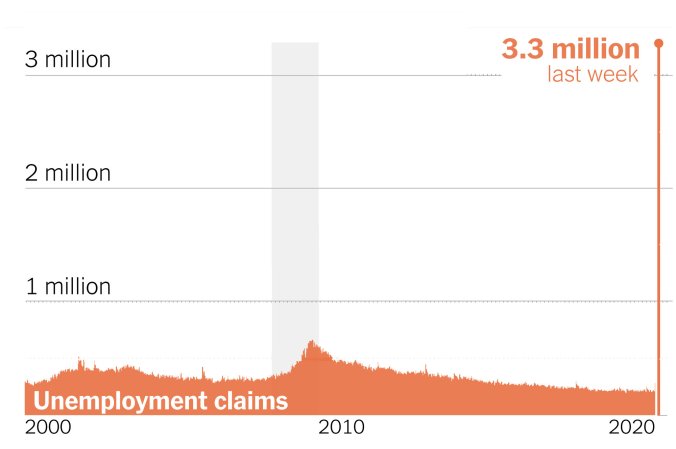
That graph above dominates the New York Times front page this morning, but not in a normal way. The graph is at the bottom of the page and covers its entire width. The long bar representing current unemployment page runs up the entire right margin; it’s a full 18 inches. This wasn’t necessary to convey the information. It was necessary to alarm readers as much as possible. The Times publisher and editors are assholes.
I have been criticized for using that vulgar word here. I think the first time I used it, ironically enough, was to describe Donald Trump when he first said he was running for President in 2012. I used the word to describe the Christian minister who announced that he was going to burn the Koran at a time when Muslim crazies were murdering Christians in retribution for every perceived insult to their religion. I don’t use the word lightly. I use it when more socially acceptable descriptors like “jerk” are obviously inadequate.
An asshole is a person who willfully and often gleefully defies positive social norms for personal gain or just because he or she can, indulging the basest human motivations and non-ethical considerations to the detriment of society. Jerks can reform; usually assholes cannot. When someone acts like an asshole but is not one, often the simple device of calling them what they are acting like will shock them back into more responsible behavior. This is why the word must remain among our ethics enforcement tools, like a gun, usually holstered, but still available when needed.
It is needed a lot right now.
As I keep reminding readers, in 2015 I wrote a post declaring that if Donald Trump were elected President, he would turn America into a nation of assholes. I was right about that, but completely mistaken about the process. I thought that Trump’s reflexive lack of ethics and civility would poison the young, who typically adopt the values and manners of prominent role models in the culture, and historically no individual exercises more powerful influence over our culture than the President. However, what we have witnessed over the past three years is an epidemic of asshole conduct by those who oppose President Trump, who actually despise him. I didn’t see that coming. The Wuhan virus emergency has especially brought their assholism (“assholery?” “assholicity?” ) into focus.
Ann Althouse said it nicely (without using the word) reacting to Joe Biden’s current strategy of tossing off incoherent insults and second-guessing regarding the President’s handling of the epidemic. She wrote in part…Continue reading →
I don’t know about you, but I feel like everything’s been one big, holiday/stress/disruption blur since I enlivened Thanksgiving dinner by keeling over. There should be law preventing Christmas and New Years from falling on Wednesdays, which effectively kills two full weeks. I’m behind on everything, and I don’t know what I could have done to avoid it…
1. Sigh. This is what we have to look forward to in 2020…Ezra Klein, the Left-biased Washington Post journalist who founded Vox, which he then staffed with all Left-biased journalists, tweeted out the link a nine-month-old Post article stating as fact that counties hosting Trump rallies saw massive spikes in hate crimes compared to counties that didn’t host Trump rallies. By Wednesday afternoon, Klein’s tweet had been re-tweeted more than 7,000 times and had more than 14,000 likes. It also polluted many Facebook feeds.
Klein didn’t tell his 2.5 million followers that the article relied on a study that had been debunked months ago by Harvard University researchers Matthew Lilley and Brian Wheaton. “The study is wrong, and yet journalists ran with it anyway,” they revealed in in Reason magazine four months ago. That’s four. 4. IV. F-O-U-R.
Lilley and Wheaton tried to replicate the original study—if a study is valid, you can do that. They discovered that “adding a simple statistical control for county population to the original analysis causes the estimated effect of Trump rallies on reported hate crimes to vanish. “Given how little scrutiny was required to reveal the flaws in the thesis that Trump rallies cause hate incidents, one cannot help but wonder whether its viral status was aided by journalists predisposed to believe its message,” the researchers noted.
Ya think?
Klein’s tweet is still up. It’s false and inflammatory, but it advances one of the key Big Lies (that would be #4), so he is running with it anyway. Do you wonder why those on opposite sides of the partisan divide have different views of reality? This kind of thing is a primary reason.
Enemy of the people.
2. The first “I don’t understand this story at ALL” of 2020:
In July 2018, Michael J. Reynolds. a New York City police officer, was in Nashville for a three-night bachelor-party trip with six other officers. At one point in the festivities, Reynolds, who is white, kicked in a black woman’s door in a drunken rage, threatening her (“I’ll break every bone in your neck…”) and her sons while calling them “niggers” and showering them with obscenities. He was arrested, tried, and sentenced to 15 days in jail with three years’ probation after pleading no contest to four misdemeanors, court records show. Nevertheless, he remains an employee of the N.Y.P.D. More than 10,000 people signed an online petition demanding his dismissal and supporting the woman whose home he invaded.
Theories? Never mind unions, due process and mandatory investigations: the incident took place a full year and a half ago. There is no excuse for this. Reynolds apologized and said that he was so drunk he doesn’t remember the episode. Oh! Then that’s OK, Officer! Let’s all forget the whole thing!
As it habitually does, the New York Times reached a false analogy, writing,
The case of Officer Reynolds is again focusing scrutiny on the pace of the Police Department’s disciplinary process. In a prominent example of how it can drag on, five years passed before Officer Daniel Pantaleo, whose use of a prohibited chokehold contributed to the 2014 death in police custody of Eric Garner, was fired and stripped of his pension benefits in August.
Ridiculous. There were legitimate issues involved in Pantaleo’s case that made the proper discipline in his case complicated and controversial. There are no reasons for controversy here. Continue reading →




 Ethics Alarms