Ethics Observations On The 2017 Hall Of Fame Vote

815-baseball-hall-of-fame-c

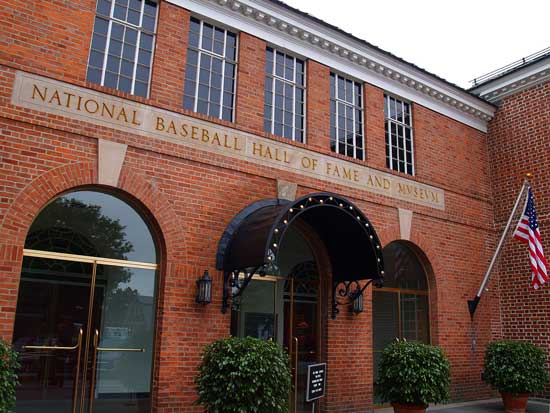
Baseball’s Hall of Fame votes were announced yesterday, and is often the case, the ethical issues raised were as interesting as the choices. The Baseball Writers Association Of America chooses who is to be enshrined; successful candidates must be on 75% of all ballots submitted, and have ten years of edibility after the initial 5 year waiting period expires.

Here were the vote totals of the players receiving significant support; the years each player has been on the ballot is the last number.

Jeff Bagwell 381 (86.2%)  (7)

Tim Raines 380 (86.0%) (10)

Ivan Rodriguez 336 (76.0%) (1)

Trevor Hoffman 327 (74.0%) (2)

Vladimir Guerrero 317 (71.7%) (1)

Edgar Martinez 259 (58.6%) (8)

Roger Clemens 239 (54.1%) (5)

Barry Bonds 238 (53.8%) (5)

Mike Mussina 229 (51.8%) (4)

Curt Schilling 199 (45.0%) (5)

Manny Ramirez 105 (23.8%) (1)

Bagwell, Raines and Rodriguez were elected. Hoffman, the all-time leader in relief pitcher saves, just missed, and will almost certainly get into the Hall next year.

Ethics Observations:

1. More than anything, it is discouraging to see Barry Bonds crossing the 50% threshold. Bonds cheated, took the integrity out of some of baseball’s most important records, has lied about it to this day, and corrupted the game. Of course he is disqualified by the character requirements for entrance to the Hall. Bond’s vote total rise is attributed to several factors, including the old, unethical rationalizations we have been reading in defense of Bonds since he was playing. The latest excuses include the influx of younger voters who never saw Bonds nor witnessed the grotesquely inflated mutant he turned himself into, more voters throwing up their hands in frustration over the problem of sifting through so many players whose PED use is rumored, likely, or insufficiently proven, and voters who find the Hall’s recent election of former commissioner Bud Selig hypocritical, since he contrived ignorance to allow Bonds and others break the rules as long as possible. None of those excuses and rationalizations justify a single vote for Bonds.

2. Ivan Rodriquez‘s election also probably helped Bonds. He was one of the greatest catchers of all time, quite possibly the greatest defensive catcher, but in Jose Canseco’s first baseball and steroid tell-all book, “Juiced,” the steroidal slugger wrote of personally injecting I-Rod with the stuff while they were Texas Rangers. The catcher never tested positive in a drug test, but Canseco’s accusation was credible, especially after Rodriquez magically gained about 25 pound of muscle and started hitting home runs. Unlike Bonds, however, the evidence against him was slim.  Jose, for example, is one of the great slime-balls in sports history. He may not be a liar, but since he admittedly wrote hisbook out of spite, he might be.

3. Ivan, in turn, was helped by the election of Jeff Bagwell. No player ever pinned steroid use on him, but Bagwell was judged a steroid-user by many because he became so muscular after starting out as a normally-built third baseman. Bagwell lifted weighs like a fiend, and clearly had a Hall of Fame level career, so keeping him out purely on suspicion seemed unfair, and was. His election slipped down the slope to boost Rodriquez, though, which in turn allowed some writers to rationalize voting for Bonds (and Roger Clemens, not as clearly guilty as Bonds, more seriously implicated than Rodriguez). Continue reading
Ethics Quote Of The Month: Secretary Of State John Kerry

mitchell-kerry_140226

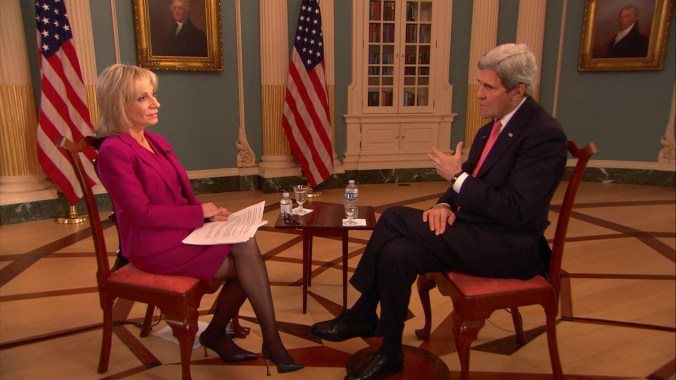
“…I’m proud of all the efforts we made to try to lead people to a peaceful resolution.”

John Kerry, in an interview on MSNBC, when asked if he had any regrets about the Administration’s handling of Syria;

The Sec. of State’s full answer:

Well again, Andrea, I’m going to have a lot of opportunities to be able to look back and digest what choices might have been made. I’m not going to do it now… Except to say to you, very clearly, that I’m proud of all the efforts we made to try to lead people to a peaceful resolution. And in fact, the only solution to Syria will be a peaceful agreement along the lines of what we laid out… and the several communiques that we issued, and the United Nations resolution that we passed. 2254. Those will be the basis for whatever happens, if they get there.

No, I’m not going to call Kerry’s statement an unethical quote, even as close as it came to making my head explode. Fortunately my expectations of John Kerry are basement-level low, from long experience. However, the latest fatuous sentiment from this veteran doofus is provocative and instructive.

In many pursuits, as we discuss here often, whether someone has done the right thing, made the ethical choice, should be evaluated on the basis of whether the conduct was competently considered and arrived at according to facts and ethical considerations before the conduct commenced. Judging its ethical nature  afterwards, when factors the decision-maker could not have foreseen or controlled have affected the result, is a fallacy: “It all worked out for the best” and thus the decision must have been ethical. This is consequentialism, and “the ends justifies the means” in its most seductive form.

A very recent example was the Republican leadership’s decision not to consider President Obama’s nomination of Merrick Garland to the Supreme Court. No, the tactic wasn’t unconstitutional or illegal. It was unethical, however: obstructive, partisan politics defying tradition and fairness. It was also, as I pointed out at the time, stupid. When Obama, knowing of the GOP’s intent, appointed not a flame-breathing left-wing zealot but a moderate-liberal judge of impressive credentials, the GOP majority in the Senate should have rushed to confirm him, knowing well that a nomination by Obama’s presumed successor, Hillary Clinton, would unbalance the Court to a far greater degree.

The GOP lucked out, as we now know. Now President Trump will fill that vacancy on the Court, with major impact on important legal disputes for decades to come. That’s all moral luck, however. The ethics verdict on the conduct still stands. It worked, but it was wrong.

Success is not irrelevant to ethics, of course. Many jobs are ethically complex because getting a desired result is part of the mission. The result and the manner of achieving it are important. If your job is to win the war, you can’t say you did an excellent job if the war was lost. Competence is still an ethical value. A successful CEO’s company does not go belly-up by definition. Government is often analogized to sailing a ship to a destination, or flying a plane, with good reason. Part of the responsibility a government leader has is to make choices that work to the benefit of  those governed, and others as well. A captain whose ship sinks cannot say afterwards, “I did one hell of a job.” Continue reading

“Start The Car!” Ethics

“Start the car!” shouts the woman in a ubiquitous IKEA TV commercial for its “Winter Sale.” She has received her receipt, and  the total is so low that she assumes there has been a mistake.  She quickly exits the store with bags of purchases, and while running calls to her husband in the car outside so he will pick her up and hit the gas before someone comes to reclaim the merchandise or demand more payment. As they drive away with what she thinks are her ill-gotten gains, she lets out a whoop of triumph.

The narration explains that IKEA’s sale prices are so low, this how you will feel.

The commercial is unethical. It trivializes and normalizes theft, and rejects the ethical values of honesty, integrity and responsibility. Apparently the ad has been running internationally for a long time (it only just started showing up in my region) and is very popular. Writes one industry commentator, “People relate to the message because at one point or another while shopping we’ve all had that feeling that we just got away with something.”

Really? I haven’t. My father didn’t either (my mom was another story.) I’ve told waitresses and clerks that they undercharged me. I’ve returned excessive change. I’ve handed back money to tellers when two bills stuck together. You don’t? What the hell’s the matter with you? Were you raised by Fagin?

Though the commercial was a hit and positively accepted in all of the nations where it was viewed, there is hope:  it also received many negative comments and complaints. An Advertising Standards Board—I cannot for the life of me find out which; the U.S. has no such board. I’m guessing Sweden— thus considered whether this advertisement breached   its Advertisers Code of Ethics.

The breach would be that the commercial isn’t socially responsible, since it represents taking merchandise from a store that hasn’t been fully paid for as normal and acceptable conduct. The Board viewed the advertisement in light of the complaints and decided that the ad was ethically inoffensive.

Guess why.

No, go ahead, guess.

Continue reading

The New York Times, And The Consequences Of Forfeiting Integrity

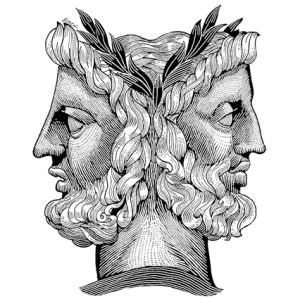
It was between Janus and the Four Season's song. "Two Faces Have I..."

It was between Janus and the Lou Christie song “Two Faces Have I…”

It would be extremely beneficial for the culture and enlightened civic discourse if there were a trustworthy, reliably objective observer with integrity and intelligence to provide fair, forceful pronouncements on the political controversies of the day. Such an observer would have to be seen as free of partisan and ideological bias, or at least show signs of actively trying to counter their effects. This, of course, is the idealized concept of what competent and ethical journalism is supposed to provide, and to the extent that any journalism organization was deemed capable of providing it, the New York Times was it.

Yesterday, the Times editors published an editorial called “The Stolen Supreme Court Seat” that was so partisan in tone and inflammatory, not to mention ridiculous, in content that it could only be taken as a biased political screed. Worse than that for the long term, however, is that the piece decisively disqualifies the Times as an arbiter of complex national issues whose judgment can ever be trusted as genuine and persuasive.  Many will argue that the Times’ biases have been blatant and unrestrained for many years, and this is true. That New York Times editorial may not be the first smoking gun, but it is the smokiest yet.

Do recall that Ethics Alarms substantially agreed with the Times in its main point that the Republican Senate’s refusal to hold hearings and consider President Obama’s nomination of federal judge Merrick Garland to fill the Supreme Court seat vacated last year with the sudden death of Justice Scalia was unethical:

“For Senate Republicans, holding hearings on President Obama’s qualified and moderate nomination for the Supreme Court is both the ethical course and the politically smart course. It is also in the best interests of the nation. In fact, the Byzantine political maneuverings by the President and the Republican leadership, by turns petty and ingenious, have handed Republicans a political chess victory, if only they are smart enough, responsible enough, and patriotic enough to grab it. Naturally, they aren’t.”

Note: unethical, but not illegal or unconstitutional. By using the inflammatory term “stolen” implying legal wrong doing, the Times intentionally adopted the language of political hacker, and Democratic Party talking points. Strike One: You cannot be trusted as objective and non-partisan when you intentionally endorse partisan rhetoric: Continue reading

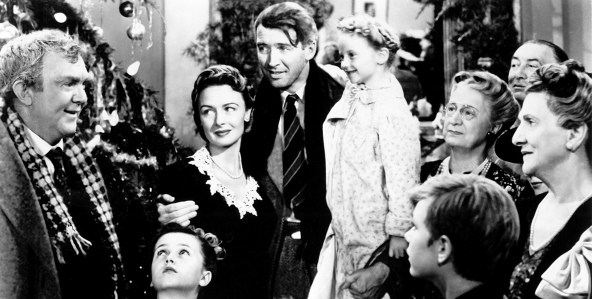
The Complete “It’s A Wonderful Life” Ethics Guide [UPDATED AGAIN! ]

 Once again, Ethics Alarms re-posts its ethics guide to Frank Capra’s 1946 masterpiece “It’s A Wonderful Life,”one of the great ethics movies of all time. It was written in 2011, and revised regularly since, including for this year’s version. I suspect we need it more in 2016 than usual.

It is fashionable now, and was even when the film was released, to mock its sentiment and optimism. On one crucial point Capra was correct, however, and it is worth watching the film regularly to recall it. Everyone’s life does touch many others, and everyone has played a part in the chaotic ordering of random occurrences for good. Think about the children who have been born because you somehow were involved in the chain of events that linked their parents. And if you can’t think of something in your life that has a positive impact on someone–although there has to have been one, and probably many—then do something now. It doesn’t take much; sometimes a smile and a kind word is enough. Remembering the lessons of “It’s a Wonderful Life” really can make life more wonderful, and not just for you.

Here we go:

1. “If It’s About Ethics, God Must Be Involved”

The movie begins in heaven, represented by twinkling stars. There is no way around this, as divine intervention is at the core of the fantasy. Heaven and angels were big in Hollywood in the Forties. Nevertheless, the framing of the tale advances the anti-ethical idea, central to many religions, that good behavior on earth will be rewarded in the hereafter, bolstering the theory that without God and eternal rewards, doing good is pointless.

We are introduced to George Bailey, who, we are told, is in trouble and has prayed for help. He’s going to get it, too, or at least the heavenly authorities will make the effort. They are assigning an Angel 2nd Class, Clarence Oddbody, to the job. He is, we learn later, something of a second rate angel as well as a 2nd Class one, so it is interesting that whether or not George is in fact saved will be entrusted to less than Heaven’s best. Some lack of commitment, there—then again, George says he’s “not a praying man.” This will teach him—sub-par service!

2. Extra Credit for Moral Luck

George’s first ethical act is saving his brother, Harry, from drowning, an early exhibition of courage, caring and sacrifice. The sacrifice part is that the childhood episode costs George the hearing in one ear. He doesn’t really deserve extra credit for this, as it was not a conscious trade of his hearing for Harry’s young life, but he gets it anyway, just as soldiers who are wounded in battle receive more admiration and accolades than those who are not. Yet this is only moral luck. A wounded hero is no more heroic than a unwounded one, and may be less competent as well as less lucky.

3.  The Confusing Drug Store Incident

George Bailey’s next ethical act is when he saves the life of another child by not delivering a bottle of pills that had been inadvertently poisoned by his boss, the druggist, Mr. Gower. This is nothing to get too excited over, really—if George had knowingly delivered poisoned pills, he would have been more guilty than the druggist, who was only careless. What do we call someone who intentionally delivers poison that he knows will be mistaken for medication? A murderer, that’s what.  We’re supposed to admire George for not committing murder.

Mr. Gower, at worst, would be guilty of negligent homicide. George saves him from that fate when he saves the child, but if he really wanted to show exemplary ethics, he should have reported the incident to authorities. Mr. Gower is not a trustworthy pharmacist—he was also the beneficiary of moral luck. He poisoned a child’s pills through inattentiveness. If his customers knew that, would they keep getting their drugs from him? Should they? A professional whose errors are potentially deadly must not dare the fates by working when his or her faculties are impaired by illness, sleeplessness or, in Gower’s case, grief and alcohol.

4. The Uncle Billy Problem

As George grows up, we see that he is loyal and respectful to his father. That’s admirable. What is not admirable is that George’s father, who has fiduciary duties as the head of a Building and Loan, has placed his brother Billy in a position of responsibility. As we soon learn, Billy is a souse, a fool and an incompetent. This is a breach of fiscal and business ethics by the elder Bailey, and one that George engages in as well, to his eventual sorrow. Continue reading

Ethics Zugswang And The Vicissitudes Of Moral Luck: The Rutgers Prof’s Scary Tweet

Careless tweets matter...

Careless tweets matter…

Rutgers University lecturer Kevin Allred tweeted,

“Will the 2nd amendment be as cool when i buy a gun and start shooting at random white people or no…?”

The University had him arrested and sent to Bellevue mental hospital for a psychiatric evaluation.

His defenders, and of course Allred, say that his tweet was just a rhetorical question to make a point. The University says that he left them no choice, or no good ones, anyway.

They both are right. This is what comes of being in Ethics Zugswang, when one is thrust into  a position where no course of action is fully responsible, fair, and ethical.

The university decided that it could not responsibly assume that the tweet was benign and not a threat. What if the school did nothing, and Allred then  took high ground and became Charles Whitman 2016? Having him arrested, however, looks unfair and like a punitive reaction to free speech. There was literally no course the university could take that was completely ethical. Rutgers sacrificed its  teacher’s dignity for the safety of the students and to protect the institution’s liability.

The other alternatives—talking to him, shrugging it off as a poorly considered social media gaffe—placed the fate of the school and perhaps many students at the mercy of moral luck. These would seem like reasonable  decisions only if the moral luck dice did not come up snake eyes. Allred didn’t say “if” I buy a gun, he said when. He added race to the equation, and there are a lot of people who seem to be losing their grip in the wake of the election. What were the odds that he meant what he wrote? 100 to 1? 1000 to 1? 5000 to 1? Is it worth the remote chance that this was a warning of an impending catastrophe not to take the safe route, and have him arrested and examined? Is it worth gambling with students’ lives? Continue reading

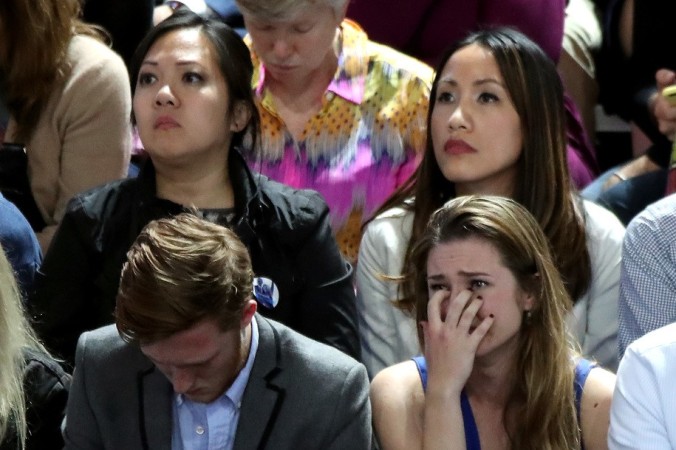
Post-Election Morning Ethics, Early Edition [UPDATED]

hillary-loses

Initial ethics observations following an amazing night in American history:

1. Give Trump a chance, and take note of those who will not.

He is now in the most difficult job in the nation at the age of 70, with less relevant experience and preparation than any previous occupant of the office. For once, it’s a good thing that he’s an egomaniac and a narcissist, because otherwise he might be perseverating in terror right now. One cannot say that he begins with the most daunting set of problems any POTUS has ever faced, but it’s close. Give him a chance. Nobody becomes President wanting to fail, and not wanting to do a good job for his country and his fellow citizens.  Begin with that, and let’s see what happens.

2. Those who are capable of being fair and objective should salute the shades of Mr. Madison, Mr. Jefferson, Mr. Adams, Mr. Hamilton and their colleagues. The Founders wanted a system that was capable of peaceful political upheaval when the public was dissatisfied and demanded change, and their unique creation was strutting its stuff last night. So much has taken place over the last year—the last eight years, really—that has undermined our democracy that it is refreshing to see its resilience and vitality. As before, I still believe that Trump is a cautionary tale about the danger when people who don’t understand leadership, ethics and government become the majority. On the other hand, it’s their country too, and the “elites” (how I detest that word) forgot that, repeatedly, shamelessly, and in many ways.

Jefferson would have reviled Donald Trump, but he would approve of the uprising.

3. Trump’s victory speech last night was widely reviewed as statesmanlike and gracious, which it was. It was also unusually coherent for him. Still, who can’t give a gracious victory speech? The effusive praise being lavished on this shows how low expectations are.

4. Hillary Clinton’s decision to not to appear in person at her headquarters and concede, also graciously, was a failure of character. On CNN, ex-Trump campaign manager Corey Lewandowski and ex-Obama flack Van Jones got in an argument over this, but for once in his life, Lewandowski  was right. Given the backdrop of Clinton and the media questioning whether Trump would “accept defeat,” the decision by Clinton was just plain wrong: unfair to Trump, unfair to her supporters, hypocritical. Continue reading

Sorry, Steve Bartman, But It’s Impossible To Leave You Alone

As the Chicago Cubs plowed their way to the World Series and a possible end to their 108 year failure to win a World Series, numerous sports writers, including some I thought were smart enough to know better, set out to prove their compassion, sensitivity and gooey caramel centers by arguing that the news media and fans should “leave Steve Bartman alone.” Bartman, for those of you who have lived in a bank vault since 2003, was the hapless young Chicago Cubs fan who unintentionally interfered with a foul ball that might have been catchable by Cubs outfielder Moises Alou in the decisive game of 2003 National League Championship Series. In a perfect display of the dangers of moral luck, Bartman’s mistake—it didn’t help that he was wearing earphones and watching the ball rather than the action on the field—began a chain of random events  that constituted a complete collapse by Chicago in that very same half-inning, sending the Miami Marlins and not the Cubs, who had seemed comfortably ahead, to the Series. Bartman, who issued a sincere and pitiful apology, was widely vilified and literally run out of town. He then became part of Cubs and baseball lore, one more chapter in the sad saga has been called “the Billy Goat Curse,” the uncanny inability of this team to win it all.

Over time, even Bartman’s tormenters came to see that holding him responsible for the team’s failure was cruel consequentialism at its worst. Alou, who had sicced the Furies on Bartman by angrily pointing at him after the incident from the field and later told everyone that with the interference, he would have caught the ball, even came out ten years later–five years!—to say that he wouldn’t have caught the ball, and Bartman wasn’t to blame. (I wrote about that epic example of barn-door locking here.) Now, NBC’s Craig Calcattera and many others are beating a new drum: nobody should write about or talk about Stave any more, because it’s so unfair. Continue reading

Don’t Feel Too Bad, Americans: Ethics Alarms Aren’t Ringing In Canada, North Korea Or Japan, Either

It’s an International Ethics Dunce parade!

donald-trump-humane-society

1. Ontario, Canada

The Windsor-Essex County Humane Society in Ontario thought it would be really clever to use the Donald Trump phrase that many believe disqualify him to be President in an ad to adopt kitty-cats. It featured a photo of Trump and said, “You don’t have to be a star to grab a pussy … cat.”

Amazing. Not one person in the chain of custody of this—I would say obviously, but when so many people miss it, I guess it’s not—offensive ad had an ethics alarm sound.  Nobody had the sense, prudence or guts to say,

“Uh, guys? Hello? You do realize that this is using a phrase describing sexual assault while alluding to the one who used it to describe sexual assault? You do realize that “pussy” alluding to female genitalia is vulgar and uncivil, right? No? Here, let me explain it to you…or hwo about this: there is no way this won’t spark criticism. Is that what you want?”

Sure enough,  the ad promoting cat adoptions this week for $50, was taken down shortly after it appeared this week.

The society offered a pathetic apology. Melanie Coulter, executive director of the humane society, “explained” it was an attempt to make light of the U.S election campaign, though it also “made light” of sexual assault, contemptuous attitudes toward women,  and obscene rhetoric.

“We are obviously sorry if people are offended by the ad — that wasn’t our attempt in the least,” Coulter said. “Our attempt was to find homes for cats that need them.” She also added that the shelter took in more than a hundred cats in the last week.

For the record, the rationalizations here are…

3. Consequentialism, or  “It Worked Out for the Best”

13. The Saint’s Excuse: “It’s for a good cause”

19A The Insidious Confession, or “It wasn’t the best choice.”

It also suggests that I need to add “We meant well” to the list as a sub-rationalization to #13.

****

contest-winner

2. Kuroishi, Japan

Continue reading

Nobody Cares, But NBC Has Been Wildly Unethical In The Trump-Bush Video Affair

nbc-peacock-ap

NBC deserves to be condemned for its conduct in many ways in reference to the Trump Pussy Tape episode, going back eleven years.

1. NBC technicians allowed Trump to continue talking without his realizing that his microphone was on. Unethical, and unprofessional, as well as a pure Golden Rule violation. Basic decency, fairness and professionalism requires that when a guest is doing this, his mistake must be  made known to him at the earliest possible time. This is the rule when someone continues to speak on a conference call believing the call has ended. It is the ethical thing to do  when you are in a bathroom stall and your opponents in a law suit start discussing strategy while they are washing their hands. I have several times, at taped seminars, begun to answer questions during a break and realized that I was still being recorded. Sometimes a technician has reminded me. Worse (but funnier) I have done a full “Naked Gun”, using the Men’s Room while wearing a live mic…and the technician dashed in to get me to turn it off, just in time. (Well, almost.) Allowing a guest to embarrass himself on tape as Trump did is despicable and unprofessional in every way.

2. NBC betrayed its own employee, Billy Bush, by not alerting him, either.  Disloyal, unfair, and uncaring.

3. Once the recording was made, it should have been destroyed as soon as anyone in authority realized the participants were speaking without knowing the mics were on.

4. Attorney Robert Barnes makes a compelling argument that NBC’s conduct violated California Penal Code 632, which criminalizes the act of any person who “without the consent of all parties” records their conversations. Of course, violating the law is also unethical. Trump might  have a just lawsuit, though the damage can’t be undone: the pussy’s out of the bag, so to speak.

5. Bush, as an NBC employee, should have been told about the recording and its contents long, long before it was made public. NBC was obligated to inform him as a basic courtesy. Continue reading