Let’s get this out of the way up front: Kris is not really Santa Clause. The sooner you understand that, the more sense the movie will make.
Now onward:
2. The bad mother and the sneaky lawyer.
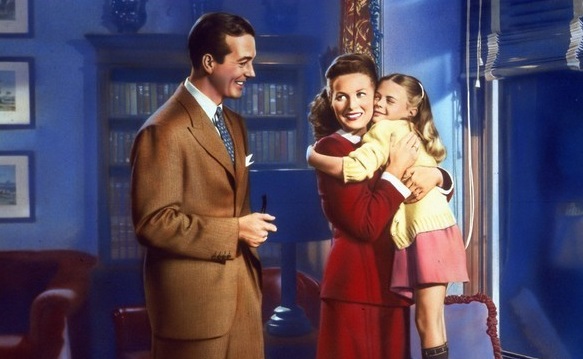
While Kris is enjoying his starring role in the Macy’s Thanksgiving Day Parade, we meet Susan Walker, Doris’s young daughter, and Attorney Fred Gailey, who lives in the apartment next door. Susan has been raised to be a joyless little cynic, the victim of an arrogant and misguided single mother who needed to read more Bruno Bettelheim ( except that Bruno didn’t write The Uses of Enchantment until 1976). Doris, as we soon surmise, has allowed a bad marriage to make her suspicious of dreams, hope, and wonder, and she is passing her own disappointment in life off to her daughter at the tender age of nine. Nice.
Lots of parents do this, I suppose, but that doesn’t mitigate how cruel and damaging it is. I remember how horrified I was at Susan’s brainwashing when I first saw the film at about the same age as Natalie Wood was in the movie. My parents, particularly my mother, surrounded my sister and I with fantasy and whimsy. They went to elaborate measures to make Santa Claus seem real, and the Easter Bunny, and the Tooth Fairy. At one point my sister, having read a story about a lollypop tree, planted a lollypop stick in the back yard. My mother pooh-poohed the idea, telling my sister that this was just a fantastic story she was believing, and that she was going to disappointed. Then, three days later, my father exclaimed as he looked out the kitchen window, “I don’t believe it! Look at that!” And there, about four feet height and covered with lolly pops of all the colors of the rainbow, was the lollypop tree.
My sister and I weren’t idiots; we knew that our parents had made the tree. But we played along, and the lesson was taught. Life is more fun and bearable if you believe in the unbelievable, and are open to a little magic in the world. Our parents gave my sister and me a gift that made us love music, literature, humor, mystery, and surprises. Doris Walker, out of ignorance, grief or anger, was an incompetent and selfish parent. ” We should be realistic and completely truthful with our children and not have them growing up believing in a lot of legends and myths like Santa Claus, for example,” she says.
And your authority for this proposition is what, Doris? Generations of children have grown to healthy, happy maturity being raised on myths, legends and fairy tales, and you, with your invaluable perspective as a department store employee, are confident in your certitude that their parents were wrong, and you are right. Wow. Continue reading →
The position here has always been that nobody has any business telling you how to spend your money. This topic usually comes up in the context of charity, as in, “How dare that individual spend money on what they think is important when they should be spending money on what I think is important!” A couple of recent developments have raised the issue in a different context, however: incompetent and irresponsible expenditures of large amounts of money.
Take “Cats,” for example. The already immortal flop film cost a reported $100,000,000 to make, and marketing costs are on top of that. It is sure to lose many, many millions of dollars, and the question becomes, “How could movie professionals make a blunder like that?”
I always assumed that “Cats” could not be a successful movie because of its purely theatrical nature. Surely the lesson of the film version of “A Chorus Line,” another Broadway musical that never should have move to the screen, was guide enough. Yet it happened. The fiasco put me in mind of other infamous and avoidable screen disasters, like 1978’s “Sgt. Pepper’s Lonely Hearts Club Band” starring Peter Frampton and the Beegees. Before the film’s release, Robin Gibb of the Bee Gees announced: “There is no such thing as the Beatles now. They don’t exist as a band and never performed Sgt Pepper live in any case. When ours comes out, it will be, in effect, as if theirs never existed.”
Good prediction. The huge MGM film with dozens of celebrity cameos was instantly and universally reviled. Even worse, a few years later, was “The Pirate Movie,” another misbegotten big budget musical. The idea here was to do a new version of “The Pirates of Penzance” but without the dialogue, plot and music that has made the Gilbert and Sullivan show popular for more than a century….and to star Kristy MacNichol, the androgynous, non-singing teen star, as the heroine. How could such a brilliant concept fail? Continue reading →
In Part I, I said I was glad that Clint Eastwood’s latest film “Richard Jewell” was bombing, because the film impugns the integrity of a now-deceased reporter simply to spice up its story. After I read some of Clint’s comments yesterday in response to the controversy, I’m even more glad. Clint said that nobody knows how reporter Kathy Scruggs got a crucial leak from the FBI, but that it could have occurred because she traded sex for information. That’s despicable.
Nevertheless, the other dud among the Hollywood releases over the weekend, “Black Christmas,” deserved to flop even more than Eastwood’s epic.
The original “Black Christmas” (1974) was released under the name “Silent Night, Evil Night.” I saw it with my sister a few days after its opening (I was amused at the ad’s catchline, “If this movie doesn’t make your skin crawl, IT’S ON TOO TIGHT!!!”) and it scared the bejesus out of both of us, but especially her: she slept with the light on for weeks, and to this day my uncanny imitations of the maniac’s phone calls upset her (so I keep doing them, of course.)
Arriving before John Carpenter’s “Halloween” and its later, cheesier rip-off “Friday the 13th,” what was soon re-titled “Black Christmas” anticipated many of the themes and techniques of the slasher genre, perhaps too well. Blessed with a much better cast than any subsequent movie of the type (Olivia Hussey, Keir Dullea, Andrea Martin, John Saxon, and Margot Kidder) and clever and gutsy director Bob Clark (“A Christmas Story,” “Porky’s”), the film was declared too disturbing by many critics. I thought it was easily the best horror movie I had ever seen, and recommended it to many friends, some of whom were not grateful after spending the following night jumping at every sound. It was very gratifying to see “Black Christmas” finally emerge as a cult film and the acknowledged inspiration for the slasher film genre (along with “Psycho,” of course.)
I saw the 2006 “sequel,” which was terrible, and had a sense of dread when I learned that Hollywood would try again. It was clear that the new film was already off to an unethical start when I saw the trailer: this was another example of producers hijacking a familiar title while making a movie barely connected to the older film it was evoking. That trick, essentially a bait and switch, always ticks me off. In the trailer for the new film, we could see that the killer wears a black robe and uses a longbow. Clark’s original famously never shows the maniac murderer at all: much of the movie is shot from his perspective (I assume it’s a he), though we see his shadow, one mad eye, and his arm at various times. We also hear him, and a more crazy-sounding killer has never been recorded.
The new “Black Christmas” takes place in a sorority house around Christmas, and there’s someone knocking off the girls. That’s about the extent of the similarity. To be fair, the advent of cell phones ruined the original film’s most iconic scare: it was the first movie in which we heard the chilling words, “The phone calls are coming from inside the house!”
The promotion of more female film directors is a feminist cause right now. There’s even a Christmas commercial where a little girl tells her parents who have just bought Disney princess toys to put under the tree for her, “I don’t want to be a princess any more. I want to be a film director!” I have always championed female directors for the stage; there is no question that there are multiple biases against them in theater, and I assume the same bias afflicts them in Hollywood. However, I do not want to see more female directors because they bring a special, feminine perspective to their work, and I really don’t want to see more female directors so they can use their plays and films as feminist propaganda vehicles. Just make a good movie, kid: if your work only stands for the proposition that women can’t just make entertaining and effective films, but have to clobber the audience with feminist tropes, you will have created a legitimate reason for the industry to be wary of female directors. Continue reading →
The two big flops among movies that opened last weekend were director Clint Eastwood’s “Richard Jewell” and “Black Christmas,” the second attempt to re-boot the 1976 slasher cult film. Both disasters have ethics lessons to teach, or not teach. Let’s look at Clint’s movie first.
“Richard Jewell” made lass that $4.5 million in its first weekend, and has also been snubbed by the various year-end awards. It is based on the now mostly forgotten story of how Jewell, initially hailed as a hero for his part in foiling the 1996 Atlanta Olympics bombing plot, was falsely accused of complicity by local law enforcement, the FBI, and the news media. Conservative outlets loved the film, but the other side of the divide focused on a subplot, as the film’s screenplay suggested that a named Atlanta Journal Constitution reporter, now deceased, used sex to persuade a source to break the story. The Journal Constitution has been attacking the film, denying that Kathy Scruggs would ever used he body to get a scoop. Her colleagues, friends and family all insist that she would not have slept with a source, and reporters around the country circled the metaphorical wagons to proclaim they were shocked–shocked!—that anyone would even suggest such a thing. Jeffrey Young, senior reporter for HuffPost tweeted, “The lazy, offensive, shitty way screenwriters so often treat female journalists infuriates me. Depicting women using sex to get stories is disgusting and disrespectful. It’s also hacky as hell. I was planning to see this movie but not anymore.’ Melissa Gomez of the Los Angeles Times wrote, “Hollywood has, for a long time, portrayed female journalists as sleeping with sources to do their job. It’s so deeply wrong, yet they continue to do it. Disappointing that they would apply this tired and sexist trope about Kathy Scruggs, a real reporter.’ Susan Fowler, an opinion editor at the New York Times tweeted “The whole “female journalist sleeps with a source for a scoop” trope doesn’t even make any sense…”
This would be damning, except that while it may not be standard practice, there are plenty of examples of female journalists doing exactly what Eastwood’s film suggests. Last year the Times—yes, Susan Fowler’s paper—reported on the three-year affair between Times reporter Ali Watkins and James Wolfe, senior aide to the Senate Intelligence Committee, and a regular source for her stories. In October, an employee of the United States Defense Intelligence Agency was arrested for leaking classified material to two reporters, and he was involved in a romantic relationship with one of them. Both reporters are still employed by their respective news organizations, the Times and CNBC, so its hard to argue that sex-for-scoops is being strongly discouraged.
Wait. what’s the matter with non-traditional casting?
Hollywood continues to presume to tell the public what their priorities and values should be, despite indisputable evidence that the entertainment industry is large run by narrow, venal, intellectually limited, under-educated people, and always has been. My now-deceased friend Bob McElwaine, who was born in Hollywood as the son of a silent film producer, was baby-sat by Clara Bow and played pick-up football games against Mickey Rooney as a child, had wonderful anecdotes about his time as a writer and publicity agent during Hollywood’s Golden Era. He often would relate these jaw-dropping tales without attribution out of loyalty and his vows of confidentiality—it was his refusal to go public with these stories that led to his memoirs being rejected by publishers. They wanted dirt, and Bob refused to spread dirt or even embarrassing anecdotes about those who had trusted him, even after the clients and employers were dead.
Bob said that he witnessed this conversation in one studio executives ‘s office while trying to stifle giggles. A producer burst in full of excitement saying he had an idea for a blockbuster film. This was during the Fifties, when biblical spectaculars were the rage. “The Lord’s Prayer!” he said. “I know just the scriptwriter for it! Can you imagine the box office?” The studio chief laughed out loud. “The Lord’s Prayer! That’s ridiculous!” he chided. “Why, I bet you don’t even know The Lord’s Prayer.” Continue reading →
1. So we can’t trust Intel, either. Good to know. Last May, Intel released a patch for a group of security vulnerabilities researchers had found in the company’s computer processors. Intel implied that all the problems were solved. The official public message from Intel was “everything is fixed,” said Cristiano Giuffrida, a professor of computer science at Vrije Universiteit Amsterdam and one of the researchers who first reported the vulnerabilities. “And we knew that was not accurate.”
Indeed, the software patch meant to fix the processor problem addressed only some of the issues the researchers had identified. A second patch, publicly disclosed by the company last week, finally fixed all of the vulnerabilities Intel had said were fixed in May…six months after the company said that all was well.
2. So they finally bullied the NFL into re-considering Colin Kaepernick. Kaepernick, the mediocre NFL quarterback whose political grandstanding before games made him an albatross for the league and any team foolish enough to employ him, has had woke “fans,” who couldn’t care less about football but who loved his race-bating and police-bashing protests, claiming that he was “blackballed” from pro football for exercising his right of free speech.
This was never true—let a grocery store clerk try that argument when he’s fired for making political demonstrations during store hours—but never mind: Kaepernick was styled as a martyr anyway. Why the NFL capitulated to bogus complaints and gave the player a showcase for NFL scouts, I cannot fathom. He’s 36, hasn’t played for three years, and wasn’t that good in 2016. If no team signs him, the NFL will be told again that it is racist and oppressive. If a team does sign him, the message will be that enough agitation can force an organization to elevate politics above its legitimate priorities.
3. This is why our politician aren’t civil, collaborative, respectful and ethical: the public doesn’t want them to be. Senator Chuck Schumer, the Democratic Minority Leader,praised Representative Peter King, the long time Long Island Republican House member who announced his retirement this week, by tweeting warm words on Twitter. “I will miss him in Congress & value his friendship,” the effusive message concluded.
For this once-standard professional reaction to a fellow Congress member’s retirement, Schumer was roundly attacked by Democrats and progressives on social media. To his credit, despite more than 10,000 mostly negative replies and even calls for his resignation, Schumer neither apologized for his tribute to a colleague nor took down the tweet. Continue reading →
Now streaming on Netflix, “The Laundromat” is an entertaining and flamboyant examination of the phenomenon and roots of international money laundering, brought to us by director Steven Soderbergh (“Erin Brockovich,” “Traffic”) using a screenplay by Scott Z. Burns. The often tongue in cheek film is narrated by actors Gary Oldman and Antonio Bandaras playing lawyers Jürgen Mossack and Ramón Fonseca , whose now defunct firm set up tax shelters and shell corporations for the rich, corrupt and criminal all over the world. Their empire was shattered by the Panama Papers data dump in 2016.
The film’s tone veers from smug to blunt as it focuses on three adaptations of true stories involving Mossack Fonseca clients, all narrated by the excuse- and rationalization-spouting lawyers, the real life versions of which tried to sue to halt the production.
“The Panama Papers” as they are now called consisted of 11.5 million leaked documents that detailed financial and attorney–client information for more than 214,488 offshore entities, many of which were legal, but that supported fraudulent schemes and other crimes. The documents were the property of Mossack Fonseca. Even now, the fall-out from the release of the documents is unclear, in large part because so many of them involve attorney-client privilege, and the rules and laws governing their legal handling are spread over many nations, laws and ethics rules. The leak itself was a crime, and the hacker responsible, who goes by the name of “John Doe,” has never been identified.
This is an international ethics train wreck, and one that is so complicated that I didn’t cover it in 2016. That was ethics commentary malpractice on my part, I think. It was the biggest ethics story of the year, even if it is still largely unresolved.
Whether the law firm itself broke any laws is still a matter of debate. As Oldman and Bandaras constantly remind us, Mossack Fonseca set up arguably legal structures, and, they claim, didn’t know or care how they would be used. This is still a gray area of legal ethics in the U.S., one that was highlighted when “60 Minutes” broadcast its Global Witness episode in 2016 . Partners in eleven large Manhattan law firms were caught on hidden cameras exploring possible ways to represent an individual posing as the agent of an “African despot” seeking ways to launder millions of dollars. The ethics rules say that a lawyer may not knowingly assist a client in a crime or fraud, but contrived ignorance can be an effective, if unethical, device for lawyers to avoid accountability when representing unsavory (but profitable) clients. Remember, Enron’s law firm avoided any sanctions, while the company’s accounting firm, Arthur Anderson, was prosecuted and destroyed.
No, Ethics Alarms didn’t cover the Global Witness scandal either, though I have talked about it in legal ethics seminars ever since. Clearly, money laundering has not had proper priority here. Again, my fault. I’ll do better. Continue reading →
I was not eager to see “The Mule,” for many reasons. Stories in which the protagonist is a drug dealer don’t interest me at all; I avoided “Breaking Bad” and “Weeds” for the same reason. The popular culture, especially Hollywood, played a major role in breaking down society’s consensus disapproval of recreational drug use, and I hope they are proud of all the harm they have caused, and the greater harm yet to come.
Then there is the fact that seeing Clint Eastwood looking like the Cryptkeeper (from HBO’s “Tales of the Crypt”) depresses me. I remember Clint from his “Rawhide” days, and seeing his ruined beauty makes me feel like I’m watching the villain rot at the end of “Indiana Jones and the Last Crusade” when he “chooses poorly,” but for real. I admired Cary Grant’s decision to stop making movies when he began to stop looking like Cary Grant, and Marlene Dietrich’s determination not to appear in public so that people would remember her as one of Hollywood’s great beauties, and not as an old lady.
But as often in the case for me, having limited options of films to watch while stuck in in a hotel made Eastwood’s latest directorial and performing effort the best of a bad group of entertainment choices. The film is based on the true story of a ninety-year-old man (Clint isn’t quite that old, but he looks it) who became a drug mule, transporting cocaine for a Mexican drug cartel. The film has an excellent supporting cast including Bradley Cooper, Laurence Fishburne, Dianne Wiest and Andy Garcia. (who also looks like hell), though none of them have much to do except be props for Clint’s star turn.
To do as little spoiling as possible, I’ll just say that the story involves an aging—aged—narcissist who has neglected his family outrageously, falls into a lucrative gig transporting drugs because he loves to drive, has never had a ticket, and is unlikely to attract attention. Then he suddenly decides to make the needs of his family a priority over work for the first time in his life, getting him arrested and almost killed.
Clint still has his screen presence and charm, which is fortunate, because the central character, Earl Stone, is a selfish jerk. His toxic personal habits don’t seem so bad when the victims are drug smugglers, but when, early in the movie, he skips his daughter’s wedding without warning because he’d rather be at a sales convention partying with his colleagues, it is hard to care what happens to him.
We quickly learn that this betrayal was characteristic of Earl, and that he rationalizes them all, arguing that he was absent from his family to provide for them, and is blameless. It’s clearly a lie: his family bores him, and he does exactly what he wants to do, always. Sometimes Earl helps people and is randomly kind, as when we see him pause in one of his drug runs to help a couple stranded on the road. Other times, he doesn’t give a damn.
When a family argument breaks out as he attempts to attend his grand-daughter’s bridal shower, a guest overhears that Earl has lost his home and business (that’s really why he showed up at his granddaughter’s place—that and the fact that she was the only family member still on speaking terms with him) and gives him a phone number. These people will pay him well just for driving, Earl is told. Continue reading →
“The Joker,” opening this week and presenting Joaquin Phoenix’s portrayal of Batman’s arch-enemy as fitting the classic mass-shooter profile, has provoked all sorts of ethics- related debates. Is it responsible to release a film that may risk triggering the psychopathic loaners with access to guns we all know lurk in the shadows? Is the studio risking another Aurora-style theater shooting? Should such films be boycotted? Regulated?
These debates, which are retreads of the same old refrains the nation has been tortured by since dime novels through Warner Brothers gangster movies, EC comics, “The Untouchables” TV series, the Legion of Decency’s reign, Sam Peckinpah films and “A Clockwork Orange,” are all appeals to censorship using “Think of the Children!” rationalizations, and are essentially attacks on free speech. The contrived debate is alarming but not difficult to call: the would-be censors are wrong, motivated by emotion, and that’s that.
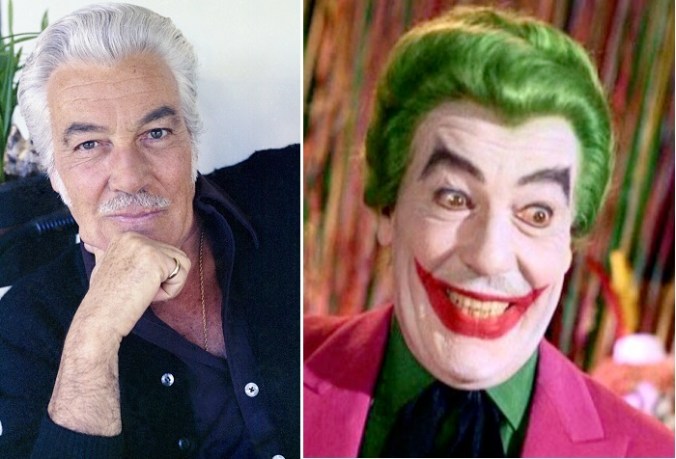
No, the really interesting ethics debate the new movie has revived is another old one: Was it ethical for actor Cesar Romero to keep his moustache when he played the Joker?
Cesar Romero (February 15, 1907 – January 1, 1994) is now largely forgotten, but he was a familiar presence in films, radio, and television for almost 60 years. Sort of a Grade B Riccardo Montalban, Romero had a rather narrow range, with his portrayal of dashing Latin lovers, historical figures in costume dramas, and characters in light comedies all looking and behaving similarly. Romero’s trademark was his moustache, especially in the post-Errol Flynn era when leading men seldom wore them.
When the 1966 camp TV show Batman became a brief sensation in 1966, the casting of Romero as the Joker was a shock. He had never played any role remotely like it, nor was broad, silly comedy his typical milieu. Most shocking of all, when the Joker finally made his appearance on the show it was obvious that Romero hadn’t shaved his upper lip. Reportedly the actor refused to eliminate his moustache for the role, and so the supervillain’s white face makeup was thickly smeared over it throughout the series’ three-year run and for Romero’s co-starring appearance in the 1966 film. Continue reading →
I don’t care: Whenever I get up on Saturday, it’s morning to me.
1. Those fake recordings...I have almost gotten used to the fake versions of famous songs an by iconic artists that show up as background in TV shows and movies, but I still resent them. They are lies, in essence, designed to fool less discriminating and knowledgeable audience members. Many people aren’t even aware of the practice, which is virtually routine, of long-standing, and considered standard practice. A friend of mine , a musician/ actor with a gift for mimicry, once explained the whole industry supported by these frauds, which exist because it is cheaper to record a faux version of a famous recording than to pay to use the real thing in a movie.
For some reason, however, the last 24 hours forced me to hear some unusually obnoxious examples. I just heard fake Roy Orbison, for instance. Nobody sounds like Roy Orbison. I heard fake versions of The Platters’ immortal and inimitable Tony Williams twice, and that really ticks me off. Williams, whose rendition of “Only You” may be my favorite male vocal ever, had a freak voice, and younger listeners who hear inferior versions of his “Twilight Time,” “The Great Pretender,” and “Smoke Gets in Your Eyes” are tragically misled. It is an insult to Williams’ memory and legacy to represent through deceptive imitations that he wasn’t as great as he really was.
Anytime you hear a song playing behind a scene, listen closely. I just heard Fake Any Williams, a really bad imitation. Interestingly, I have noticed that there are some departed artists that nobody dares to imitate. Bing Crosby, for example, is always the real Bing (although I have heard several fake Frank Sinatras). They don’t try to fool anyone with fake Judy Garlands, either; I haven’t heard a fake Freddie Mercury, and hope I never do. But it’s unethical to fake anyone without being transparent about it..
Especially Tony Williams.
2. Still looking for some partners…in the Ethics Alarms Impeachment Project. I have now heard from three volunteers, and I’m grateful…a few more would be ideal. Of course, when and if the website gets published, I expect it will be easier to interest active participants.
The idea is to provide an easily accessible way for “low-information voters” and others to follow this dangerous and depressing drama while having access to the essential materials, facts, context and legitimate analysis without being confused by spin, selective reporting, misinformation and partisan agendas. Here’s an example of information that is relevant to the Democratic impeachment efforts that has hardly been reported at all, because the news media overwhelmingly wants to see the President of The United States impeached, and has made that objective clear to most objective observers for more than three years.
Six months ago, the NY Daily News revealed that Congressman Jerrold Nadler (D-NY)received at least $65,000 in campaign donations “from the music industry and other intellectual property businesses that he oversees as chairman of the House Judiciary Committee.” That was the end of the story; even the Daily News never followed up. Nadler also spent about $30K to host a Grammy Awards gala in LA in February during the Grammy Awards, giving him access to music executives for more campaign donations. Those execs, meanwhile, had their companies pony up $5,000 a ticket to attend the party. This is influence peddling, of course. It’s legal, because Congress won’t criminalize sleazy politics. TechDirt called it soft corruption:
“These are the kinds of practices that are most likely legal, and possibly even common among the political class, but which absolutely stink of corruption to the average American. And that’s a huge problem, not just because of the general ethical questions raised by such soft corruption, but because it creates a cynical American public that does not trust politicians to adequately represent their interests.”
Nadler’s conduct is relevant to the impeachment efforts because it reveals the hypocrisy behind Democratic efforts to impeach President Trump for political practices that are neither illegal nor unusual while making pious pronouncements that belie their own behavior. The purely political assault on the 2016 Presidential election results is obscured by the media’s efforts to hide the true character and motives of the President’s foes, including the journalists and editors themselves.
3. Here’s another example...My New York Times this morning is dominated by yellow-highlighted text messages between the Ukraine’s ambassador with U.S. Ambassador Volker, and a two-column width headline, “Another Official Considers Filing a Report On Ukraine.” When have you ever seen front page news about an anonymous figure “considering” something? That’s not fact, that’s not news, it is entirely prejudicial spin intended to create distrust and suspicion.
Meanwhile, the Times could have made legitimately made the front page stories about last week’s Congressional testimony from Ambassador Kurt Volker, who served for two years as the top U.S. diplomatic envoy to Ukraine, which directly contradicts the pro-impeachment narrative . He testified, under oath, that he was never aware of and never took part in any effort to push the Ukrainian government to investigate former Vice President Joe Biden or his son Hunter, and stressed that the interactions between Giuliani and Ukrainian officials were facilitated not to find “dirt” on Biden, but to address concerns that the incoming Ukrainian government would not be able to get a handle on corruption within the country. The Federalist obtained the full transcript of the testimony, which certainly could have been revealed by the Times as well, if it wanted to.
More later-––I have a terrible headache that has lingered for two days, and I can’t tell if it’s this crap or a brain tumor. Coffee, Tylenol, and the Twins beating the Yankees should help.

 Ethics Alarms