Journalism Ethics/Legal Ethics/Government Ethics Rot: The Democrats And Journalists Tried To Convict Donald Trump With Fake News

U.S. Capitol Police officer Brian D. Sicknick lies in honor, in Washington

Gee, does this bother anyone out there who hates Donald Trump or who voted for Joe Biden?

If your answer is no, I’m disgusted with you. You’re beyond help, hope, or rehabilitation.

The farce of a Senate trial the nation just endured was predicated on emotion rather than law, logic, fact, language or evidence. Prime among the emotions weaponized was hatred of former President Trump (in the trial: hatred of then-President Trump was all the Democratic House needed for its evidence-free, investigation-free “snap impeachment” (credit: Prof Turley.) At the trial, House managers alluded to Capitol Police officer Brian Sicknick being “killed’ in the riot, the intended implication being that President Trump was responsible for his death. Nancy Pelosi made certain that Sicknick’s body lay in the Capitol Rotunda, one of only five civilians so honored. All the better to show the nation that the President had blood on his hands. right, Nancy? The AP wrote on February 2,

Slain U.S. Capitol Police Officer Brian Sicknick lay in honor in the building he died defending, allowing colleagues and the lawmakers he protected to pay their respects and to remember the violent attack on Congress that took his life.

That’s false on its face, but it is the mythology the public and the Senators were fed in the weeks and days following the House impeachment. Here’s CBS: “‘Hero’: Lawmakers honor officer killed in US Capitol riot.”

Continue reading →

Comment Of The Day: “Ethical Quote Of The Month: Bret Stephens’ Critical Column About New York Times Cowardice And Hypocrisy That The Times Tried To Censor”

what-is-strict-liability

Comment of the Day auteur Glenn Logan (one of many at EA) has helpful thoughts about the intertwined issue of speech control/ racial epithets/ intent and political correctness. I’m behind on COTDs again, but jumped Glenn’s ahead in line because the blog has been active on related topics today.

Here is Glenn Logan’s Comment of the Day on Bret Stephens’ discarded op-ed and the post, “Ethical Quote Of The Month: Bret Stephens’ Critical Column About New York Times Cowardice And Hypocrisy That The Times Tried To Censor’:

This is an excellent inquiry into the current state of political culture. The left has discovered one of the things it has historically eschewed — the concept of strict liability, and the power it brings them to redefine the English language in America, and by extension, the political environment. For years, liberals have found crimes which didn’t consider intent offensive, and for good reason. Alas, it seems that is no longer the case.

At the risk of being pedantic, strict liability — for those who may not be aware — is a type of crime or regulatory violation where intent does not matter. The quintessential strict liability crime example is statutory rape, where violation of the statute requires no general or specific intent. Regardless of whether the violator knew, had reason to know, or intended to have sexual relations with a minor person, the fact he/she/xe/them did is all that matters.The word “nigger” has now become, in the world of the Left, a strict liability offense when uttered in any form and for any reason. More and more, this is also becoming true of descriptive constructions like “n-word, ” “n*****,” “n—–,” or “n_____.”

The recent incident with the Times shows just how successful this effort has become, and is sure to become a model for other words considered to be offensive at some fundamental level. There is no reason to believe the proponents of this new morality will be circumspect in this expansion, either.Using the power of the mob, the Left has found that they can circumvent the First Amendment by ginning up social outrage and placing pressure on companies to do what the law cannot — punish speech.

Continue reading →

“Intent” Ethics: The “Grape Soda” Caper

Grape Soda

Little noticed when it was reported a month ago, but of special interest now that the New York Times is on record that the use of a racist slur is to be regarded as a racist act regardless of the intent of the speaker, is the decision by The New York Racing commission to ban a prominent trainer from competition for giving a horse a name that isn’t racist but apparently intending it to be a racist slur. Yes, it’s a reverse Donald McNeil! What do you say, Bret Stephens?

As Alice said in Wonderland, “Curiouser and curiouser!” The banned trainer is Eric Guillot, whose horses have earned more than $13 million in purses and have won 259 races. “Racism is completely unacceptable in all forms,” David O’Rourke, the association’s president and chief executive, said in a statement. “NYRA rejects Eric Guillot’s toxic words and divisive behavior in the strongest terms. Our racing community is diverse, and we stand for inclusion.” What were the “toxic words”?

“Grape soda.”

Yes, grape soda. I confess, I’ve used the words “grape soda.” I like grape soda; always have. But Guillot, see, named a horse “Grape Soda” after tweeting on New Year’s Day that he was giving a 3-year-old colt a “unique name in honor of a TVG analyst.” The tweet had a Black fist emoji. Apparently “grape soda,” in addition to meaning, you know, grape soda, has been used somewhere I’ve never been as a racial epithet. So bad an epithet is it that the New York Times wouldn’t dare print it in its headline: “NYRA Bars Horse Trainer For Using Racist Name.” I couldn’t find out what the “racist name” was until six paragraphs into the article. The Times didn’t even call it the “GS-word,” though it says it “can” be a racist term, presumably based on context and intent. But now, as a Times columnist discussed in a banned op-ed, the Times says intent and context doesn’t matter. If that’s true, then “Grape Soda” must be presumed to have the same meaning in the case of the horse as it is presumed to mean anywhere else, like when I say to my wife, “Hey, while you’re at 7-11, pick me up a grape soda please!” But that does not seem to be the case in this story, and the Times itself doesn’t challenge the logic that “Grape Soda” as a name for a horse is racist simply because it was dedicated to the only black horse-racing analyst. They think. Or someone thinks.

Confused? Me too, and I have some questions:

Continue reading →

Ethical Quote Of The Month: Bret Stephens’ Critical Column About New York Times Cowardice And Hypocrisy That The Times Tried To Censor

Stephens

Ethics Alarms is temporarily parting with its usual practice by publishing Times columnist Bret Stephens’ suppressed column in full. Normally, I regard doing this as unethical: the publication that pays for an essay deserves to have the benefit of the links and the views. But this was published not by Stephen’s employer, whom he serves as house conservative with varying effectiveness, but by a competitor, the New York Post, to which the piece was leaked. As a leaked document, it is fair for Ethics Alarms to publish, and as an important piece of evidence further proving the corruption of American journalism, I believe that Stephens’ spiked op-ed needs to be widely read. I doubt that the mainstream media can be trusted to give it the circulation it needs.

Stephens wrote his column in response to this incident, where his paper fired a respected journalist after its investigation of his reportedly using the word “nigger” in a discussion with students indicated that none of his remarks had been, I wrote, “sexist or racist, but that he had used words employed by sexists or racists to talk about sexism or racism, rather than using the approved poopy/ pee-pee/woo-woo baby talk codes (n-word, b-word, c-word) demanded by language censors.” “Initially, the Times’ editor, Dean Baquet, tried to be fair and to uphold what the Times is supposed to respect—the Bill of Rights,” I continued,”but eventually capitulated to his woke and anti-free speech staff, as he has before.”

Stephens told colleagues the column was killed by Times publisher A.G. Sulzberger. The piece the Times didn’t want the public to see circulated among Times staffers and others until someone sent it to the New York Post.

I will say at the outset that Stephens should quit, just as Glenn Greenwald quit his own organization when it blocked publication of his piece about the Hunter Biden story embargo .I don’t know if there are enough journalists of integrity and honesty who are concerned about the ruinous abdication of their profession from its crucial obligations to democracy to prevent the death spiral into totalitarianism. But the few there are need to step up.

Here is Bret Stephens’ column:

Continue reading →

Why Freedom Of Speech In America Is Threatened: Too Many Cowards

Coward

Oh no, not this issue again so soon.

Another prominent professional has been fired for breaching political correctness rules and annoying the totalitarian Left’s censors. His crime: speaking the taboo word “nigger” while referencing it in a discussion of racial slurs. Then, as we have seen over and over again, the exiled victim of this assault on free speech apologized. “Thank you sir, may I have another?” And, as we have also seen, it did no good.

The New York Times fired its #1 science and health reporter Donald McNeil Jr., after The Daily Beast reported that he had used racist language while on a 2019 trip with students to Peru. He did not use “racist language,” however, and there is no evidence at all that he displayed racist attitudes or opinions. What he did is to speak a word that speech censors have decided is itself forbidden, even if it is necessary in order to discuss the issue of racism, censorship or linguistics. This is, I note again, punishing or even criticizing such conduct is unethical, idiotic, juvenile, and sinister. Nonetheless, it is rapidly becoming the norm, and it is becoming the norm because so many individuals of power and influence lack the integrity and fortitude to oppose an indefensible position loudly and unequivocally.

(See the previous post. It is very relevant here.)

McNeil, formerly the Times’ top reporter on COVID-19,was fired because six students or their parents claimed he had made racist and sexist remarks throughout the trip. An investigation inicated that none of his remarks were sexist or racist, but that he had used words employed by sexists or racists to talk about sexism or racism, rather than using the approved poopy/ pee-pee/woo-woo baby talk codes (n-word, b-word, c-word) demanded by language censors. Initially, the Times’ editor tried to be fair and to uphold what the Times is supposed to respect—the Bill of Rights—but eventually capitulated to his woke and anti-free speech staff, as he has before.

So here are the cowards in this nauseating drama:

Coward: Dean Baquet. The Times Executive Editor initially said McNeil should be “given another chance” (Chance to do what? Conform his speech to oppressive conformity with progressive dictates?).”I authorized an investigation and concluded his remarks were offensive and that he showed extremely poor judgment, but it did not appear to me that his intentions were hateful or malicious,” he said. But anti-white racist and liar (but Pulitzer Prize-winning racist and liar!) Pulitzer Prize-winner Nikole Hannah-Jones threatened to call the parents and students on the trip to determine what McNeil had said and in what context (all of which would be hearsay, and thus unreliable except to an ideological hack like Hannah-Jones). Then a group of over a hundred staffers, mostly “of color” or female, signed a letter demanding serious sanctions.

“Our community is outraged and in pain,” the signees wrote. “Despite The Times’s seeming commitment to diversity and inclusion, we have given a prominent platform—a critical beat covering a pandemic disproportionately affecting people of color—to someone who chose to use language that is offensive and unacceptable by any newsroom’s standards. He did so while acting as a representative for The Times, in front of high school students.”

Baquet, publisher A.G. Sulzberger, and Chief Executive Meredith Kopit Levien responded that they welcomed the letter, saying, “We appreciate the spirit in which it was offered and we largely agree with the message,” they wrote in masterpeice of weasel-wording. Then Baquet reversed himself and fired McNeil, saying, “We do not tolerate racist language regardless of intent.” Really? So if a news story involves a racist or sexist statement, the Times can’t write about it and use the langauge that makes the episode a story? If the Supreme Court holds that “nigger” or other words are constitutionally protected (as indeed they are), the nation’s ‘paper of record’ won’t be able to quote the opinion?

Baquet had an opportunity to take a crucial stand for freedom of expression and against the criminalizing of language and the retreat to the primitive logic of taboos. He proved himself to be more interested in Leftist agendas and his job than the principles of democracy.

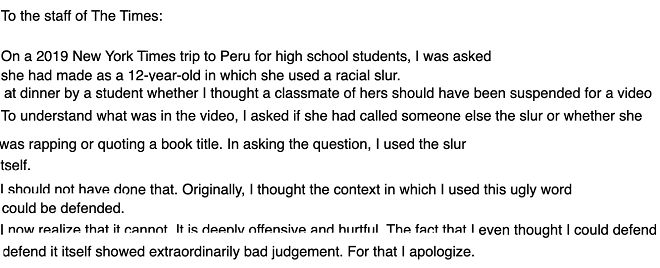
Coward: Donald McNeil Jr. He could have articulately objected to the warped logic of the Times mob, and explained, as he was equipped to do, why we must never cripple expression by banning words, legally or culturally, and why this episode is a perfect example why. Instead, he wimpered an illogical and craven apology, telling the staff in part,
McNeil grovel

Well hello Galileo! He went on to say, “I am sorry. I let you all down.” He let a newspaper down by using a word in a discussion with students in Peru to examine the use of the word. He let a newspaper down by being clear and describing the matter under discussion… because at the New York Times, progressive agendas trump the truth.

Well, I guess we knew that.

Since he was going to sacked anyway, was obligated as an American to go down fighting for free speech and against the censorship of expression. Nah. That might interfere with getting his next job with an ideological indoctrinating institution or publication.

Coward: Ann Althouse. This is disappointing. She says the right things in her post on this fiasco:

In the old days, a big deal was made of the “use/mention” distinction. It doesn’t seem to matter anymore. Even McNeil, defendinghimself, asserts that he “used” the word.
I understand wanting to say that “intent” shouldn’t be decisive, because it presents evidentiary problems. What went on in a person’s head? Did he somehow mean well? But the “use/mention” distinction doesn’t require a trip into someone’s mind. If you have the outward statement, you can know whether the speaker/writer used the word as his own word or was referring to the word as a word. 
You don’t need to know whether I think Dean Baquet is a coward to distinguish the statement “Dean Baquet is a coward” from “I can imagine someone saying ‘Dean Baquet is a coward.'”

But there’s something oddly missing from her post. As one commenter coyly asks (and to her credit, Ann allowed it to be posted): “What word are you talking about?”

In this case, Althouse is a hypocrite as well as a coward. I can expect her to be on the sidelines with the mob when they haul me off to in the tumbrils because I write the word “nigger” when the topic is using the word “nigger.” Such reticence—I guess she’s worried her University of Wisconsin law school pals will shun her–does not help the cause of freedom of expression, which Ann knows damn well is under attack

The 1776 Report: Addendum

Declaration

I noted the rapid memory-holing of the Trump Administration’s 1776 Commission’s report yesterday. Then I read this article about the report by the New York Times’ “culture reporter’ whose beat is intellectual life and “the world of ideas.” It is a useful barometer of the biases the Times’ staff has against core American values as well as the Left’s thinly-veiled contempt for much of what our culture is built upon. It also reveals the paper’s assumption about its readership’s biases.

Right at the start, the article thinks it is smearing the report and its authors by asserting “its claims derive from arguments that have long circulated on the right.” Ooooh, “the right.” THOSE demons and troglodytes. In truth, most of the “ideas” have represented majority historical and philosophical thought in the U.S. until the ascent of race conflict as the defining feature of the nation became the cant of the increasingly anti-American educational establishment.

Here are some of the report’s conclusions that the Times mocks:

Continue reading →

Comment Of The Day: “Bizarro World Ethics: A Vicious Young Jerk’s Unethical Act Is Celebrated …..Part II: The Times And Its Readers

new yorktimes

Arthur in Maine earned the second Comment of the Day to end the year with his observations on the New York times aiding and abetting the savaging of Mimi Groves. Here is his COTD on the post, “Bizarro World Ethics: A Vicious Young Jerk’s Unethical Act Is Celebrated And His Victim Vilified In A Cautionary Tale Of What Happens When Society Allows Its Values To Be Turned Inside Out. Part II: The Times And Its Readers”:

Let me go further into my comment to Part 1, which boiled down to “the NYT acted most unethically of all.”

I chose not to expound then, anticipating this post, but I will now.It’s likely – indeed, even essential – to this story that the pitchfork-and-torches mobs on social media have a larger footprint than the New York Times. But THIS Facebook group, THAT Instagram “Influencer”, THOSE Twitter feeds – tend to be narrow channels of like-minded myrmidons (this is what social media has done to society, more effectively than any propagandist ever could: separated culture into armed camps).

Continue reading →

Bizarro World Ethics: A Vicious Young Jerk’s Unethical Act Is Celebrated And His Victim Vilified In A Cautionary Tale Of What Happens When Society Allows Its Values To Be Turned Inside Out. Part II: The Times And Its Readers

Mimi

In Part I, describing the horrific personal destruction of 18-year-old Mimi Groves (above)–the antiseptic term “unethical” does not adequately convey the pure viciousness and wrongfulness of the act—I attempted to clarify what the entire scenario represents, a near complete distortion of values and ethical norms with ominous implications. I mostly left out the enthusiastic participation of the New York Times in this destructive process, first, because it was not directly involved in Jimmy Galligan’s hateful and pernicious conduct, and second, because of space considerations. Thus we have Part II.

The Times signaled its sentiments and objectives in the headline of its feature, written by reporter Dan Levin: “A Racial Slur, a Viral Video, and a Reckoning.” “Reckoning” means, in this context, a settling of accounts, a judgment, or earned punishment. In the view of the Times writer and the editors who allowed it to be published, Mimi Groves was justly punished by her black classmate, who plotted–plotted is a fair description—to derail her education and future prospects, and did so. What was the conduct that earned the “reckoning”? Groves used a word, in a general context, that the social justice establishment has ruled, on its own authority, can never be uttered for any reason, or published in print—unless the individual responsible is black, in which case it may be rude or less than desirable, but otherwise it’s OK.

At the time the word “nigger” was used by Groves in a three second video on social media, and today, popular songs embraced by her age group and peer group used the same word repeatedly, and made millions of dollars as a result. At the time the word “nigger” was used by Groves in a three second video on social media, popular movies showed black characters calling other black characters that same word in jest, or affectionately, or for shock value.The actors playing those characters, notably Samuel L. Jackson, who has earned a bundle as the spokesperson for a major credit card,while using teh word “nigger” more times on screen that any actor in film history, have not faced any “reckoning.” The screenwriters who put those words in his mouth faced no “reckoning”; the directors who permitted the dialogue to be read and the studios that sent the wave of “niggers” into theaters and streaming services faced no “reckoning.”

Just this month, Netflix premiered an adaptation of August Wilson’s play “Ma Rainey’s Black Bottom,” directed by acclaimed social justice warrior director George C. Wolfe, an African American. When a stream of “niggers” was unleashed about ten minutes into the fim, never to stop, I was genuinely confused. How could this be, when I have a file of professors and teachers who faced sanctions, protests, suspensions, and professional destruction, not by referring to any black individual as a nigger, but by using the word in the context of discussing legal, ethical and cultural implications of language.

Yes, I was confused, and I am a lawyer, a writer, an ethicist and a teacher with more than four times as much experience in life as Mimi Groves when, as a child, she mistakenly thought a casual use of the word in a social media message wouldn’t upset anyone, much less put a dedicated life assassin on her trail.The the New York Times holds that Mimi deserved her “reckoning,” and made sure that if anyone inclined to tar her as a racist unfit for human association on this woke culture we are breeding didn’t know that she had to be punished and why, a major feature in the nation’s most read, circulated and quoted newspaper would spread word of her disgrace. The paper’s verdict is clear: Jimmy Galligan struck a blow against “systemic societal racism.” He’s a hero, even though literally nothing he did was ethical, fair, or just:

Continue reading →

Bizarro World Ethics: A Vicious Young Jerk’s Unethical Act Is Celebrated And His Victim Vilified In A Cautionary Tale Of What Happens When Society Allows Its Values To Be Turned Inside Out. Part I: Jimmy Galligan, Ethics Villain

The New York Times published a long and detailed account of what can and will happen if society allows its values and ethical norms to become distorted. It enters the world of Bizarro Ethics, where, like the fictional and allegedly comic planet of Bizarro World in old Superman comics, everything is backwards and inside out. In such a culture, I have explained here many times, being unethical is ethical, and being ethical is wrong. A black student set out to use an old social media post to destroy the reputation of a white classmate after she had been admitted to the college of her dreams. And he succeeded. The Times story is a cautionary tale of what is happening in our culture, but that’s not its objective. Its objective is to rationalize and justify what the black student did.

In 2016, when she was a freshman and 15-years old, Mimi Groves sent a three second video SnapChat message to some friends that said, “I can drive, nigger!” She has explained that she used the dreaded “N-word” because it was common in the music she and her friends had been listening to. It was not intended to be seen by or to upset anyone; it was just a one-off social media message like millions of others that are sent every day, by an immature child lacking common sense, experience and a fully formed brain. As such, it should have been ignored, especially by her peers, who suffered from the same maladies.

But because of the scourge of social media and a culture which increasingly encourages cruelty, vengeance, personal destruction, and the elevation of doing harm to those who “deserve it” to a societal norm, the message became a ticking time bomb in the hands of those who felt they had a right to destroy her.

Somebody send a copy of the message to Jimmy Galligan’s phone last school year. Galligan is black, and Mimi was a fellow classmate whom he knew and had spoken with earlier in their high school days.

Ethics Point 1: Whoever saved the message and set out to make sure that someone would see it who would find it upsetting is the first and the catalytic ethics villain in this story. There was no justifiable reason to send the message to Galligan except to upset and trigger him, which someone who knew him obviously believed it would. A fair, rational and ethical person would know that a years-old message on SnapChat is meaningless, and the Golden Rule would have taught him or her that circulating such a message is something he or she would never want anyone to do with an ill-considered video of their creation.

Here the Times attempts to prejudice the reader in Jimmy’s favor with a trail of irrelevancies:

Continue reading →

Tree Day Ethics Warm-Up, December 22, 2020

Tree needles

I’ll be writing this between bouts with the lights. The Marshall Tree was supposed to go up a week ago, then it rained, so the thing had to dry out. Then last week was consumed with an expert witness report, and now this weird tree with long needles and soft branches is standing in my living room, and none of my usual decoration techniques, and probably only 30% of our ornaments, will work with the damn thing. Yesterday I was supposed to hang the lights, and I was so stressed out I couldn’t do it. But today is the day…

1. Anyone surprised at this? A December survey by the international organization More in Common seemed to show that citizens on the far left are the most likely to report negative feelings about the United States.. Only 34% of the group More in Common calls “progressive activists” agreed with the statement “I feel proud to be American.” It was the only ideological group in the survey that agreed with that statement at a rate below 60%

All other respondent groups, including minorities and Americans identifying as politically conservative, strongly agreed with the statement, including 70% of black Americans and 76% of Hispanic Americans. Whites registered a 75% proportion asserting patriotic pride.

100% of the group categorized as “devoted conservatives” said that they take pride in being Americans. 80% of all respondents surveyed said they were thankful to be American, with more than two-thirds reporting a connection to their local communities and fellow Americans. The weakest sense of belonging to the culture and community came from progressive activists and younger respondents.

2. On priority for vaccines...I have read a lot of unethical nonsense being framed as ethics about the question of who should get the vaccine first. I expect to read a lot more. A Times article on the topic says, “Ultimately, the choice comes down to whether preventing death or curbing the spread of the virus and returning to some semblance of normalcy is the highest priority.” Is that really a difficult choice? Obviously the top priority for society in both the long and the short run is to get back to normal as quickly as possible, not to prioritize trying to delay the mortality of citizens who don’t have that long to live anyway. I haven’t heard the “if it saves just one life” rationalization yet, but I’m sure it is coming.

Then there is this: “To me the issue of ethics is very significant, very important for this country,” Dr. Peter Szilagyi, a committee member and a pediatrics professor at the University of California, Los Angeles, said at the time, “and clearly favors the essential worker group because of the high proportion of minority, low-income and low-education workers among essential workers.”

There it is: let’s prioritize by race, because not prioritizing by race is racist.

Continue reading →