Six Ethics Problems With This Picture….And You Should Be Able To Find More

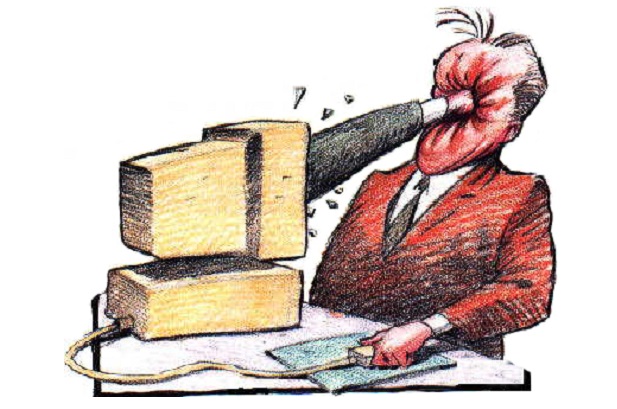
“Scratch” is a New York Times cartoon feature  in the Sunday Business section. This was the most recent installment. I’ll save my (disgusted) comments for the end…

  • The breathtaking leap of logic in the introduction represents such flawed logic that the Times Business Section destroys its credibility, such as it is, by permitting such an illogical statement on its pages. ‘Since companies have been foolishly pandering to hyper-woke complaints about, for example, the picture on a box of rice and the artwork on a package of butter, and statues of important and influential historical figures who were honored in their times are being vandalized and toppled by people who barely know who they are, it’s a ‘perfect time’ time to consider dishonoring the Founders and others without whom we would have no nation at all.’

Continue reading

News Flash: Derek Chauvin Is Not A Racist, And George Floyd’s Death Had Nothing To Do With Race. Let’s Think About That….

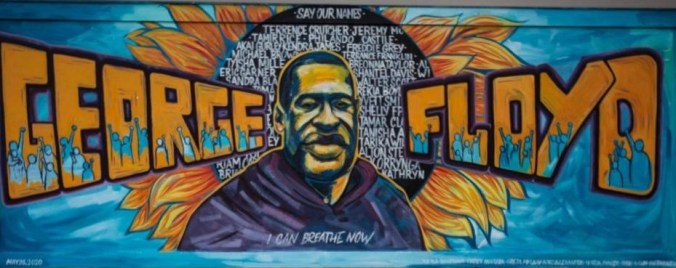
On May 25, 2020, Minneapolis Police Department officer Derek Chauvin ignited national protests, riots, burnings and vandalism by keeling on counterfeiting suspect George Floyd’s neck until  he died. The reaction to the African-American’s death, all captured by a cell phone video, was almost immediately co-opted and exploited by the black anti-police, anti-white activist group Black Lives Matter, which emphatically added Floyd’s death to others it cites to prove the intrinsic racism of  U.S. law enforcement and the United States of America itself. The incident has transformed BLM into a national force in the midst of a crucial Presidential campaign, with one party endorsing it (despite the organization’s indisputable anti-US and anti-white, not to mention Marxist,  rhetoric, and almost all corporations feeling forced to publicly signal their support in pandering statements. The death of George Floyd even turned professional sports into a  massive race-obsessed propaganda machine for Black Lives Matter and its foundational assertion that the United States is built on racism, with the police enforcing white supremacy.

I think the forgoing is a fair, if perhaps unsympathetic summary.

Through all of this, one critical element has been prominent by its absence. Ethics Alarms flagged it on June 9, in a post titled, “The Question That Must Be Asked In Any Fair And Responsible Analysis Of The George Floyd Tragedy…” That question was, “How do we know George Floyd is dead because he was black?”

I wrote in part,

There is absolutely no evidence  that George Floyd is dead because he was black, and no evidence that former officer Chauvin had his knee on his neck until Floyd died because Floyd was black. This has been presumed, and no politicians or national leaders, and certainly no mainstream media reporters,  have had the integrity or courage to require more than that mandated presumption before accepting the narrative. No evidence of racism among the officers involved has been found, and you know people have been looking.  The proposition that any time a black citizen is abused by the police it is per se racism, that is, presumed racism, is logically and ethically absurd, and people should have the courage to say so. …

Of course, virtually nobody on the left wants to consider the possibility that Floyd is dead because he had a contentious confrontation with a bad cop who was a human ticking time bomb. If Floyd had been white, there would have been no protests or riots, although the injustice and the misconduct would have been exactly the same. Especially convenient for activists, and too hard to resist,  was the symbolic nature of a white cop having his knee on the neck of a black man: the perfect metaphor for white supremacy.

But if [Floyd’s] death is going to be exploited as the rallying point to justify protests, riots, and unhinged policy recommendations like abolishing police departments, if it is going to be the catalyst for compelled virtue-signaling speech from elected officials, celebrities, sports figures and corporate executives, isn’t it reasonable, indeed essential, to be certain that George Floyd’s death actually was what it is being represented as—a racist police killing?

Apparently that crack investigative journalism organization, the New York Times, realized that it was essential to show this, so it put a team of reporters on it—when, it’s hard to determine. However, tucked away in the lower right-hand corner of its front page on the typically slow news day-reporting Sunday Times, dwarfed by a giant feature on the death of Rep. John Lewis, and under the mandatory above-the-fold story about how the Trump Administration is responsible for the “raging” Wuhan virus, was the report on the results of the Times investigation, headlined, “In Minneapolis, A Rigid Officer Many Disliked.”

Guess what the report doesn’t mention. Go ahead, guess.

Race. Racism. We learn that Chauvin was often over-aggressive in his law-enforcement methods. We are told he was unpopular with other officers, most of whom  didn’t want to work with him. We learn he was rigid, and a workaholic. The piece begins with an account about Chauvin pulling his gun on four teenagers who shot a Nerf dart out a car window. All four of the teenagers were white.

The article contains not a single piece of evidence that Derek Chauvin is a racist. The reporters couldn’t find a single individual who recalled Chauvin using a racial epithet, —you know, the evidence that proved that Mark Furmin was a racist and thus O.J. Simpson had to be innocent—or anyone, even from Chauvin’s school days, who could recount an incident in his professional or private life suggesting racism. Chauvin’s wife wasn’t white, she was Asian. The entire article, which took up all of page A-17, runs 2,067 words. Not one of them is “race,” “racist,” or “racism.”

Yet we know, don’t we, that proof of racism is what the Times was looking for. The fact that Derek Chauvin was not a racist (except in the sense that Black Lives Matter tells us, which is that all whites are racists) was the news—rather crucial news, I’d say—to come out of the investigation, but not only did the Times “bury the lede,” it censored it.

I also believe, but cannot prove, that the Times knew there was no evidence that Chuavin was a racist long before it published the results of its investigation on July 19, after nearly two full months of fury over a “racist cop” killing a black man. Racism was the evil we were told had to be expiated by fire, toppled statues, violence and, apparently, revolution. If the metaphorical match that lit the fuse was based on a false assumption, the Times, indeed all of the news media, had an urgent obligation to reveal this as quickly as possible. I believe it did the opposite, intentionally, to avoid publishing anything that might stem the burgeoning insurrection’s momentum.  I assume that the investigation into Chauvin began shortly after the incident, and when the expected evidence that the officer was a virulent racist who killed Floyd because of the color of his skin didn’t materialize, the Times first extended the inquiry, and then held off publishing the results.

Sometimes democracy literally dies in darkness.

I asked “How do we know George Floyd is dead because he was black?” on June 9, and the news media took a month and ten days to supply the information that provides the answer, which they still haven’t had the integrity or courage to publish outright.

The news media hid the fact to allow a false presumption of racism crush America’s throat.
Today’s Featured Media Anti-Trump Smear [Corrected]

During a violent storm here in Alexandra, with the internet going in and out, my wife and I gave up and watched “Spotlight” again, an ethics movie, and a genuinely heroic story about journalists doing their jobs, informing the public, exposing popular institutions. Those were the days. The ending speech, where the Boston Globe’s editor talks in high-minded terms about the reason journalism is worth the effort, made me physically nauseous. The profession he described is virtually unrecognizable from what I see on CNN, Fox News, NPR, the Washington Post and the New York Times.

Almost immediately after, I read a column in the Times from two days ago, in the Arts section. It’s a periodic feature by John Williams where he interviews an author, “5 Things About Your Book.” This time he was talking to Larry Tye, whose biography of Joe McCarthy has just been published. The cut line read that Larry Tye “discusses his biography of that American bully, and an eerie echo.”

Having read the Times for the last four years and watched with admiration how it can toss gratuitous insults and sinister innuendoes about President Trump in any context no matter how remote, from book reviews to cooking columns to fashion essays.  I was certain what the “eerie echo” would be. Joe McCarthy was a bad guy, so the article would show how much Donald Trump is like Joe McCarthy.

For the nonce, I will ignore that salient fact that it is “the resistance,” the Democrats and the anti-Trump media, which is to say, the media, that have been using relentless McCarthyite tactics against the President from before he was elected.

So where was this eerie echo of Trump in the life of “Tail-gunner Joe”? Here’s Tye’s  shocking illumination of that question:

I knew there was a general link between Senator McCarthy and President Trump, but I didn’t realize how eerily echoing it was.

Huh? What “general connection”? The Senator died in 1957, when Trump was 10. How can you have a “general connection” with someone who isn’t in your family, you never met, and whom you didn’t know anything about at all until well after he died?

That’s smear #1. Here’s smear #2: Continue reading

Ethics Hero: New York Times Editor Bari Weiss

I supposed that should have read “former New York Times editor Bari Weiss.” Until her resignation today,  from 2017 to 2020, Weiss was the staff editor for the opinion section of the The New York Times.

Her letter of resignation to the Times publisher is here.  It is beyond excellent, beyond brave, beyond important.  It is breathtaking.

She writes in part,

I joined the paper with gratitude and optimism three years ago. I was hired with the goal of bringing in voices that would not otherwise appear in your pages: first-time writers, centrists, conservatives and others who would not naturally think of The Times as their home. The reason for this effort was clear: The paper’s failure to anticipate the outcome of the 2016 election meant that it didn’t have a firm grasp of the country it covers…

But the lessons that ought to have followed the election—lessons about the importance of understanding other Americans, the necessity of resisting tribalism, and the centrality of the free exchange of ideas to a democratic society—have not been learned. Instead, a new consensus has emerged in the press, but perhaps especially at this paper: that truth isn’t a process of collective discovery, but an orthodoxy already known to an enlightened few whose job is to inform everyone else…

Stories are chosen and told in a way to satisfy the narrowest of audiences, rather than to allow a curious public to read about the world and then draw their own conclusions. I was always taught that journalists were charged with writing the first rough draft of history. Now, history itself is one more ephemeral thing molded to fit the needs of a predetermined narrative. Continue reading

Morning Ethics Warm-Up, 7/11/2020: Still Crazy After All These Posts

1. Atticus, Aaron and Alexander. Today, July 11, was a crucial date in history for two great Americans, now in danger of being canceled by the ignorant woke. One cancellee was a real man, Founder Alexander Hamilton; the other is fictional, Atticus Finch. Both have been pronounced wanting in character of late because they did not manage to discern in their eras the full extent of the necessary racial equities Americans have largely come to understand today, with the benefit of decades more of debate and experience than Finch, and with a 250 years advantage over Hamilton.

In Finch’s case, this is his “birthday”:  on July 11, 1960,  34-year-old novelist  Harper Lee published her first, and except for a rejected “sequel” to  “Mockingbird” published later under ethically dubious circumstances, her only, novel.  Fortunately for Atticus, the version of the Depression Era small town Alabama lawyer that most Americans know is the film’s, where he is played by Gregory Peck as a pure idealist without any of the alleged flaws—like saying that it is wrong to assume that racists can’t still be good people—that the novel’s Atticus is condemned for today. (The multiple Atticus problem is discussed here.)

While Atticus Finch was “born” on this date, Alexander Hamilton died, perhaps by bravely but naively exhibiting ethical character while at the mercy of a man whose ethics were elusive at best, Aaron Burr, who fatally shot the nation’s first Secretary of the Treasury in a duel this day in 1804.

The adversaries met at 7 a.m. at the dueling grounds near Weehawken, New Jersey on the same spot where Hamilton’s son had died defending his father’s honor in 1801. (The concept of karma was apparently unknown in 1804.)  According to Hamilton’s “second,” Hamilton deliberately fired his weapon into the air rather than at Burr (Burr’s second claimed that Hamilton fired at Burr and missed) , whereupon Burr, who had the second shot,  killed  Hamilton by sending a bullet through his stomach into his spine. Hamilton died the next day.

If you think politics are crazy now, consider: Hamilton’s death was the direct result of his publicly attacking and demeaning Burr for years (“I feel it is a religious duty to oppose his career,” he once wrote). Hamilton also was instrumental in blocking Burr from becoming President in the ridiculous election of 1800, when a quirk in the election rules threatened to allow the sociopathic Vice-Presidential candidate  to defeat his running mate, Thomas Jefferson. Continue reading

The “I’d Say ‘Thank God It’s Friday,’ But In A Home Office During A Pandemic Friday’s Just A Name” Ethics Grab Bag, 7/10/2020

1. Re: Privilege and bit more on the Harper’s letter fiasco. At the Volokh Conspiracy, David Bernstein flags this tweet by New York Times reporter Farnaz Fassihi:

A few thoughts:

  • Why do I subscribe to a paper that would employ someone like this? I forget.
  • She’s a bigot. I just wrote a bit on the “privileged smear” on another thread:

I have to say again that I do not comprehend the “privilege” line of thought at all. In the hands of most who wield it, I find the tactic the equivalent of Butch Cassidy kicking huge Harvey Logan in the balls to start their knife fight….

Continue reading

Tuesday Ethics Tidbits, 7/7/2020: Goodbye To “Social Q’s,” Faithless Electors And A Weenie Judge

1. I’m cancelling Philip Gallanes. The advice columnist in the Times’ Sunday Styles section has provided some interesting topic for discussion here, but there have to be some consequences for irresponsibly spreading propaganda and falsehoods, even if they are sanctioned by his employers. In response to a “Social Q’s” query from someone who was annoyed that a neighbor had posted a “Defund the Police” sign and asked if it would be ethical to eschew calling the cops if she saw her neighbor’s house vandalized (Answer: Of course not.), Gallanes had to give readers the whole set of George Floyd Freakouts talking points:

“Many of the reports I’ve read about defunding the police focus on limiting the deployment of armed police officers to situations where they may be necessary and helpful — such as violent crimes. Many activists point to the large share of state and local budgets dedicated to police services when many calls to police (about persistent homelessness or family conflicts, for instance) would be better handled by social workers. Why not redirect some police funds to affordable housing and mental health services, they ask?”

Then why not say what you mean, I ask? Defund means defund. I resent this dodge.

“Still others would like to dismantle the current model of policing, as Minneapolis has pledged to do, and reimagine community safety given the frequency with which officers kill unarmed Black men and women.

And how’s that working out so far for Minneapolis, Phil? The frequency in which officers kill unarmed Black men and women is called “infrequently,” and the frequency is decreasing. Continue reading

Independence Day With Ethics Alarms 1… Ethics Quote Of The Month: President Donald Trump

“It is time for our politicians to summon the bravery and determination of our American ancestors. It is time. It is time to plant our flag and to protect the greatest of this nation for citizens of every race in every city in every part of this glorious land. For the sake of our honor, for the sake of our children, for the sake of our union, we must protect and preserve our history, our heritage, and our great heroes. Here tonight before the eyes of our forefathers, Americans declare again, as we did 244 years ago, that we will not be tyrannized, we will not be demeaned, and we will not be intimidated by bad, evil people. It will not happen.”

President Donald J Trump, speaking at Mt. Rushmore last night, and aggressively defending the United States of America, its Founders, its history and culture.

Bravo.

Last night’s speech, a ringing assertion of American greatness and a defiant condemnation of those who would topple it, despite the inevitable Trump flourishes of exaggeration, hyperbole, and deliberate provocation, was exactly what was needed, called for, and had to be said. It was inspiring, or should have been: I wonder about anyone who could read the transcript and not be stirred. I would ask, “What happened to you?” We also now know why it was appropriate to give that speech by Mt. Rushmore. The President extolled and defended our heroes, and devoted a section of the speech to each of the Presidents on the mountain, including, as CNN said last night to its damnation, “two slaveholders.”

There are about ten passages in the speech that I could have highlighted. I picked that one because it reminded me of this speech by a fictional President in a movie I detest, “Independence Day.” I would not be surprised to learn the speechwriter had that model in mind:

“President Whitmore” is talking about space aliens trying to destroys us. The mobs of America-haters who are attacking our core values and culture remind me of the aliens in “Invasion of the Body-Snatchers,” taking over the minds and bodies of one rational citizens, and terrorizing those who won’t submit to their “conversion.” Continue reading

Morning Ethics Warm-Up, 7/2/2020, Part 2: It’s “Know Your American History Day”!, The Usual Ethics Mess

The theme from “Rocky” topped the charts on July 2, 1977. Remember that Apollo Creed won the fight, so maybe “Rocky” won’t be banned as racist.

1. Stop making me defend Alyssa Milano! Not that I don’t enjoy watching the obnoxiously woke being hoisted by their own petards, but the has-been actress turned Twitter scold is being accused of appearing in blackface because of this:

Alyssa is irate, tweeting at the “gotcha!” critics, “Hey, assholes! The picture is me parodying Jersey Shore and Snookie’s (cq) tan. Snookie’s tan (she is a sweetheart by the way) is worthy of parodying as is Trump’s ‘tan.'”

“Snookie,” in case you have a life and never watched “Jersey Shore,” is Italian, not black.

Milano’s defense is solid, except that her woke allies seem to regard dark make-up as blackface when it suits their needs. Wasn’t the dark make-up that prompted the Washington Post to get a D.C. woman fired for her 2018 Halloween Party costume satirizing Megyn Kelly? What are the rules here?

2. What will it take for CNN to finally admit that Chris Cuomo is an idiot and an embarrassment to the network, his profession, and homo sapiens, and fire him? In the latest episode of “I Love Fredo,” the CNN anchor accused St. Louis attorney Mark McCloskey, who used his guns to confront a mob of George Floyd protesters who had broken through an iron gate to access his private property, the “face of white resistance”  to the Black Lives Matter movement. McCloskey responded,

First of all, that’s a completely ridiculous statement. I am not the face of anything opposing the Black Lives Matters movement. I was a person scared for my life, who was protecting my wife, my home, my hearth, my livelihood. I was a victim of a mob that came through the gate. I didn’t care what color they were. I didn’t care what their motivation was. I was frightened. I was assaulted and I was in imminent fear that they would run me over, kill me, burn my house.

Why wouldn’t he think that, based on what we have seen in the last couple of week?

Then Cuomo argued—he’s also a lawyer you know—that  the McCloskeys committed wrongdoing by “pointing a loaded weapon at a group of people who were walking past. They did not go up your steps. They didn’t go to your house. They didn’t touch you, they didn’t try to enter your home or do anything to your kids, but you say you were assaulted.” But it was a mob. A mob advancing on one’s home is inherently a threat.

Prof. Turley has an extensive analysis of that issue here. In one of his equivocating moods, Turley concludes, to the extent I can decypher his overly careful discussion,  that a conviction on the facts of the case would be a long-shot at best. Continue reading

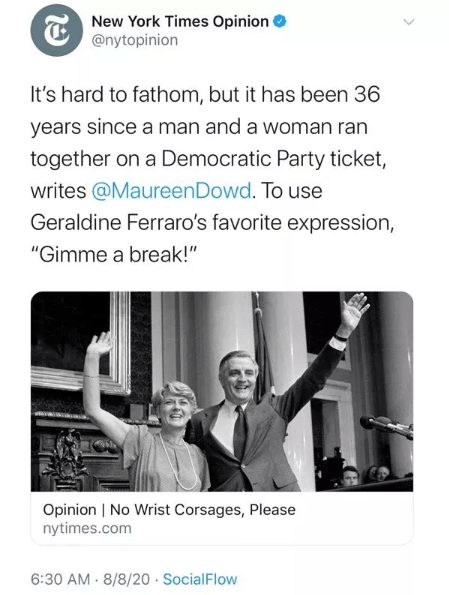
Unethical Tweet Of The Month: The New York Times…And A Close Runner-Up, Both Libeling America

This isn’t news, it isn’t history, it isn’t fair, and it is anti-American. Does anyone objective need more evidence that the New York Times has abandoned any sense of its role in informing the public? This is pure, indefensible race-baiting and Black Lives Matter propaganda.

1. Native American Tribes “owned” almost all of the territory everything in the U.S. was built on, including the New York Times building. They don’t any more.

2. The Mount Rushmore sculpture is art, and the political and social views of the artist, Gutzon Borglum, is a matter of record. The George Floyd mobs want to justify erasing as much American art and culture as possible by any means necessary. If the artwork itself won’t justify the destruction (as with the Emancipation Memorial, the second version of which was just marked for removal in Boston), then the subject will ( Columbus); if the subjects are defensible, than the artist must have something in his history to support the erasure of his work. It’s a disingenuous bootstrapping exercise, for the objective is really to destroy the symbols of our republic and re-write the history of the United States. An artist’s work and the artist are separate and distinct. In the case of Mount Rushmore, the work has taken on far more importance and symbolism, all positive, inspiring and uplifting. An American who cannot find pride in Mount Rushmore is an ignorant American, one whose understanding of his or her own nation has been poisoned, or one with a sinister agenda. Continue reading