Sunday Ethics Warm-Up, 5/12/2019: The Tricky Edition

Well, the news from Harvard has me half-headed and depressed, so I think I need to hear Winston Churchill’s favorite hymn…and my Dad’s, too.

1. I think this is known as “a drop in the bucket.”James Bennet, the editorial page editor of The New York Times, announced that he would recuse himself from any involvement in opinion coverage of the 2020 presidential election, after his brother, Senator Michael Bennet of Colorado, announced his candidacy for the Democratic nomination. I suppose this is admirable, as it is a standard conflicts of interest move, but I’m sorely tempted to call it grandstanding, and maybe even a diversion. Bennet’s brother candidacy is hardly the only blatant conflict of interest on the times staff that makes its news coverage and punditry suspect. Virtually all of them are Democrats, for example, and progressives. What’s so special about an editor’s brother making a completely futile run for the Presidency? (Quick: if you’re not in Colorado, can you picture his face? Name anything he has accomplished?)

This note from 2017 (in RealClearPolitics) puts the Times editor’s decision in proper perspective:

There is a pretty substantial symbiotic relationship between the political left in Washington and the media. While a few people went from the media to the Bush Administration, it was never like it was with Obama.

Jay Carney went from Time to the White House press secretary’s office. Shailagh Murray went from the Washington Post to the Veep’s office while married to Neil King at the Wall Street Journal. Neil King has left the Wall Street Journal to work for Fusion GPS. Linda Douglass went from ABC News to the White House and then the Atlantic. Jill Zuckman went from the Chicago Tribune to the Obama Administration’s Transportation Department. Douglas Frantz went from the Washington Post to the State Department and Stephen Barr went from the Post to the Labor Department.

Ruth Marcus, who heads the Washington Post Editorial Board, is married to the Obama Administration’s former Federal Trade Commission Chairman. Jonathan Allen had been at the Politico before going to work for Debbie Wasserman Schultz, then back to Politico before going to the left leaning Vox. Now he is at NBC News. Andy Barr worked for the Politico before leaving for Democrat politics. Michael Scherer was at both Salon and Mother Jones before going to Time. Laura Rozen was at Mother Jones and the American Prospect before Foreign Policy magazine. Even Nate Silver had started out at Daily Kos. Then, of course, there is Matthew Dowd, who worked for scores of Democrats before working for George Bush. That, though he later washed his hands of Bush, bought him street credibility with ABC News to become its senior politically analyst alongside George Stephanopoulos, formerly of the Clinton Administration.

It goes on and on in a feedback loop of incestuous politics and worldview shaping. In the Obama Era, it was all about protecting their precious. Now it is about undermining the President.

2.  Puerto Rico Ethics. OK, explain to me, if you can,  why this isn’t incredibly unethical:

From the Times:

The government oversight board leading Puerto Rico through its $123 billion debt crisis sued dozens of banks and financial firms on Thursday, saying that they had helped the island issue $9 billion of debt illegally, and that the people of Puerto Rico should not have to repay it.

The board said the debt should be voided because it exceeded the territory’s constitutional debt limit, and it added that Puerto Rico would try to recover hundreds of millions of dollars in interest and principal payments that it has already made.

The board was joined in the litigation by the official committee representing Puerto Rico’s unsecured creditors in the territory’s bankruptcy-like legal proceedings. Both plaintiffs said they understood they were making an unusual request, but asserted that no other approach would be legal or fair.

“The laws of Puerto Rico limit government borrowing authority for a reason: to prevent the government and its financiers from hitching the Commonwealth and its instrumentalities, as well as taxpayers and legitimate creditors, to a level of debt that cannot be repaid without sacrificing services necessary to maintain the health, safety and welfare of Puerto Rico and its people,” the plaintiffs said in one of several complaints…

What a great theory! The government of Puerto Rico has managed its finances irresponsibly and needs more money. “Hey!” says a brilliant staffer. “There’s a law that limits how much debt we can run up. Let’s borrow billions from banks illegally, then later sue them saying that the debt is invalid because they abetted our illegal act!”

3.  Candidate for the Rationalization #22 Hall of Fame. Rationalization #22 is one of the most cited entries on the Rationalization List, and in my opinion, the worst of them all:

22. The Comparative Virtue Excuse: “There are worse things.”

If “Everybody does it” is the Golden Rationalization, this is the bottom of the barrel. Yet amazingly, this excuse is popular in high places: witness the “Abu Ghraib was bad, but our soldiers would never cut off Nick Berg’s head” argument that was common during the height of the Iraq prisoner abuse scandal. It is true that for most ethical misconduct, there are indeed “worse things.” Lying to your boss in order to goof off at the golf course isn’t as bad as stealing a ham, and stealing a ham is nothing compared selling military secrets to North Korea. So what? We judge human conduct against ideals of good behavior that we aspire to, not by the bad behavior of others. One’s objective is to be the best human being that we can be, not to just avoid being the worst rotter anyone has ever met.

Behavior has to be assessed on its own terms, not according to some imaginary comparative scale. The fact that someone’s act is more or less ethical than yours has no effect on the ethical nature of your conduct. “There are worse things” is not an argument; it’s the desperate cry of someone who has run out of rationalizations.

Now outgoing Mayor of Chicago Rahm Emanuel has boasted in the  New York Times about his success at  introducing  police reform and reducing crime.Emanuel  makes his case in part by comparing Chicago’s crime numbers over the last two years with those of  Baltimore, one of America’s most dangerous, murder-prone, mismanaged cities. He omitted mentioning New York orLos Angeles, perhaps because his city had more murders in 2018 than New York and L.A. combined, though Chicago is smaller then either.

I wonder if the Chamber of Commerce is considering “Less dangerous than Baltimore!” as a promotional slogan. [Pointer: City-journal]

Morning Ethics Warm-Up, 5/9/2019: Incompetence Parade!

Good Morning!

1. Here, as if objective observers needed any more, is the definitive proof of what a dishonest, untrustworthy, biased partisan hack New York Times columnist Paul krugman is. Do present this to any of your Krugman-worshiping Facebook friends. I’m dying to hear their best spin attempts. It should be hilarious.

Yesterday, Krugman tweeted  a photo of the President awarding Tiger Woods the Presidential Medal of Freedom , and wrote,

I’m old enough to remember when Presidential Medals of Freedom were given for showing courage and making sacrifices on behalf of the nation and the world. Tiger Woods … hits golf balls for money.

Washington Free Beacon editor Andrew Stiles quickly compiled this partial list of recipients of the honor during Obama’s Presidency:

  • Michael Jordan
  • Kareem Abdul-Jabbar
  • Meryl Streep
  • Steven Spielberg
  • Robert Redford
  • Robert De Niro
  • Tom Hanks
  • Yo-Yo Ma
  • Bob Dylan
  • Stevie Wonder
  • Gloria Estefan
  • Barbara Streisand
  • James Taylor
  • Diana Ross
  • Bruce Springsteen
  • Warren Buffett
  • Tom Brokaw
  • Lorne Michaels

What does this teach us about Krugman? Well, let’s see…

—He doesn’t check his facts before shooting off his metaphorical yap.

—He is so biased against the President that his judgment is untrustworthy and useless except to anti-Trump fanatics.

—He flagrantly endorses double standards, condemning one President he hates for the exact conduct that he found unobjectionable from a President he supported.

—He’s an idiot. Any pundit with multiple brain cells firing would hesitate to set himself up for ridicule like this, and would automatically make sure his complaint was supported by reality.

—This is the quality of columnists the New York Times employs. Continue reading

More Ethics Notes On The New York Times Anti-Semitic Cartoon

  • The main lesson of this episode (which was discussed here in the fourth item) is that the New York Times culture is so ideologically and politically biased and one-sided that even an obvious breach of taste, decency and ethics like this cartoon can slip by the deadened ethics alarms.

The American Jewish Committee said in response to The Times’s editors’ note after pulling the drawing,. “What does this say about your processes or your decision makers? How are you fixing it?”

The Times can’t fix it.

  • One Times columnist, the politically schizophrenic Bret Stephens, wrote that “in another age, might have been published in the pages of Der Stürmer,” the infamous anti-Semitic tabloid published during Germany’s Nazi regime. “The problem with the cartoon isn’t that its publication was a willful act of anti-Semitism. It wasn’t.” Stephens continued.

“The problem is that its publication was an astonishing act of ignorance of anti-Semitism …. at a publication that is otherwise hyper-alert to nearly every conceivable expression of prejudice, from mansplaining to racial microaggressions to transphobia.” Continue reading

Comment Of The Day: “Greek Easter Ethics Warm-Up: Authority, Causation, Credibility And Dead Ethics Alarms” [#4]

Long-time commenter E2 scores her first Comment of the Day with some perspective on why Western civilization, and the United States particularly, owes Israel a permanent debt.

I have no problem with critics having honest, reasonable differences with Israel’s policies and the U.S.’s support of them, as long as such critics have a sufficient knowledge of the history of the Jewish people, their existential plight in the Thirties through World War II, the initial contrived ignorance of the U.S. government and President Roosevelt of that plight, and how the State of Israel came into existence. (Two new biographies of playwright and screenwriter Ben Hecht, who played a large but largely forgotten role in that remarkable event, were just published this month. There is a reason one of the ships that brought Jewish ex-patriots to Israel was named, “The Ben Hecht.”)

As E2 points out, the public ignorance of all of this is staggering, and it fertilizes the dirt from which anti-Semitism grows, of late, in abundance. One of the many jaw-dropping statements of stupidity or dishonesty—it’s often so hard to tell which with him— that Joe Biden uttered after his announcement of his candidacy was that America needed to return to being loyal to its allies. Biden was the #2 official in an administration that displayed the most outright hostility to Israel of any since the nation’s founding, our ally that most needs our support and that common decency demands should always be able to count on it.

Here is E2’s Comment of the Day on the item #4 in the post, “Greek Easter Ethics Warm-Up: Authority, Causation, Credibility And Dead Ethics Alarms.”

Does no one know any history at all? That, for example, the English Jews funded the Crusades, and when the King of England couldn’t pay back his debt, he simply exiled all Jews from the country to Europe? Hence, an early forced diaspora of Jews.

Do others really believe that anti-Semitism was grown by Hitler and ended in the Holocaust? Do so many not  know that FDR’s anti-Semitic State Department refused political asylum for desperate Jews from Hitler’s Germany…or the story of the ship “St. Louis” – full of fleeing Jews, that went from port to port in the US and were never allowed entry? Continue reading

Greek Easter Ethics Warm-Up: Authority, Causation, Credibility And Dead Ethics Alarms

Christos Anesti!

…as my Greek-American mother used to greet us every Greek Easter morn. You were supposed to respond in kind, but my father’s Greek pronunciation was always so  hilarious that I don’t recall that he ever did.

1. Anthony Napolitano and the appeal to authority. Fox analyst “Judge” Napolitano (you’re not supposed to call yourself “judge” after you stop being a judge, but never mind) is suddenly being hailed as a definitive legal authority because he has “broken ranks” (as the liberal websites put it) to argue that President Trump obstructed justice based on the Mueller report. Virtually nothing Napolitano said or opined on prior to this was ever treated by these same sudden fans as anything but the meanderings of a crank, but “the enemy of my enemy is my friend,” as someone once said in Sanskrit.

I would never appeal to Napolitano’s authority, though he is far from a crank. He was indeed a lower court judge in New Jersey, he has taught at a law school, and he has written many books. He is not a conservative or a Republican but a libertarian. Like Ron Paul and his son Senator Rand, Napolitano’s ideology is such that he arrives at positions that make it impossible for me to trust his reasoning processes. Notably, he doesn’t think Abraham Lincoln should have fought the Civil War or abolished slavery, saying that it would have been better to allow slavery to peter out peacefully without government intervention. I wonder how the slaves would have felt about that?

He also believes that human life should have full legal rights at conception, and that abortion ought to be outlawed completely. Well, both of those positions—he has others equally extreme—mean to me that as smart as he may be, I don’t know what kind of extremist bats are flying around in the man’s belfry, so while I believe his arguments  on obstruction should be judged on their objective merits, that fact that he’s the one making them do not and should not enhance their persuasiveness.

2. Trump Tweets segue...in a tweet, the President claimed that Napolitano asked him to appoint the “Judge” to the Supreme Court, and that his much-publicized obstruction claim is Napolitano’s revenge for the President refusing. Continue reading

Propaganda And Fake History: How Are We Supposed To Trust A Newspaper With Editors That Allow This?

New York Times journalist Eric Copage decided to resurrect the “Jesus was black” controversy from the Seventies for Easter in a column called, “As a Black Child in Los Angeles, I Couldn’t Understand Why Jesus Had Blue Eyes.”

That’s funny: as a white child growing up in the Boston area, I couldn’t understand how anyone knew what Jesus looked like, since there were no photographs then and he never had his portrait painted. I had the same question about Moses, and Adam and Eve.

But I digress. Copage seems to think it matters that Jesus wasn’t blue-eyed; I have a harder time imagining him shorter than a typical jockey, which he quite possibly was. The writer then says, Continue reading

WTF? The New York Times Again Violates Its Own Standards Because Bringing Down The President Is More Important

The “The New York Times Manual of Style and Usage,” pompously sub-titled, “The Official Style Guide Used by the Writers and Editors of the World’s Most Authoritative Newspaper,” has always inveighed against the paper publishing vulgar or obscene words. In particular, it has never allowed the printing of the word “fuck” or any version of it anywhere in the paper. On one occasion, the Times stage reviewer had to review a play with “fuck” in the title without ever revealing what the title was.

Ethics Alarms has consistently held that 1) if a vulgar word is a substantive part of the news story, then a newspaper should print the word. Codes like “the f-word,” “F-bomb,” and “f—” convey the word fuck, so why not just print it? The practice is juvenile (remember the camp song  “Shaving cream”, in which a line that was set up by a previousl line rhyming with “shit” and suggesting “shit” would substitute “having cream! Hilarious! Well, if you were 11…) and yes, the position here is the same regarding so- called taboo words like “nigger.” In 2015, there was a huge uproar after Kentucky guard Andrew Harrison muttered “Fuck that nigger” behind his handinto a live microphone after answering a post-Final Four game news conference question about Wisconsin player Frank Kaminsky. Yet despite the  fact that the words he used were the issue, no newspapers, and certainly no TV news outlet, actually reported the words.  I wrote,

It took me 15 minutes and visits to six web sites before I could find out exactly what it was that Harrison said.  Most sources vaguely reported that he had uttered “an expletive and a slur,” or plunged readers into a game of “Hangman” with the statement being reported as “_ _ _ _ that _ _ _ _ _ _.” The Washington Post settled on “[Expletive] that [N-word].” Which expletive??? This is ridiculous, and as inexcusably bad journalism as refusing to show the Charlie Hebdo cartoons that caused the Paris massacre.  The story is about what Harrison said, and it is impossible to inform readers about the incident without saying exactly what was said.

Continue reading

Ethics Observations On Reactions To The Mueller Report, Continued: Quotes

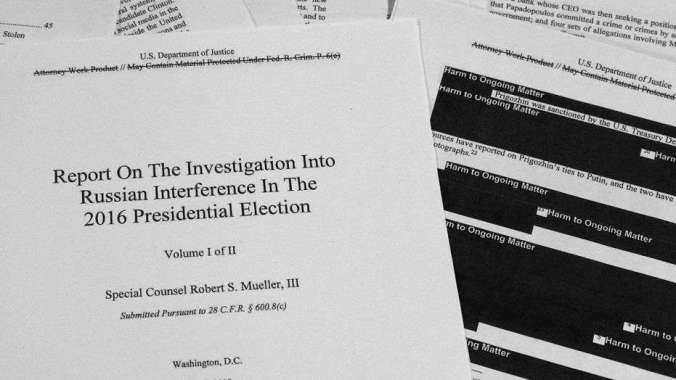
1. The most revealing quote is the New York Times headline I’m looking at, approximately the same size as the one announcing that the Titanic had sunk: “Mueller Report Lays Out Russian Contacts And Trump’s Frantic Effort To Foil Inquiry.” What it reveals is that the New York Times has no interest in objective reporting on this matter, and is still in the mode it announced during the campaign: it sees its job as not to report the news, but to take down Donald Trump. The headline, as well as the cherry-picked excerpts from the 400 page report, are calculated to mislead the public and impede the President’s ability to govern. “Contacts” are not collusion or conspiracy, as the report itself showed. Meeting with Russians is neither illegal nor unusual. “Frantic” is a subjective characterization that does not belong in a headline, and “foil” is misleading. The President wanted the investigation to end, as it made doing his job difficult (as it was intended to do), and he wanted to “foil” its illicit (and obvious) objective of carrying out the Democratic Party’s and the mainstream media’s attempted coup.

The Times, the Post and the rest know that most citizens won’t read the report and couldn’t understand it if they tried, so they are pushing the same false and misleading narrative, an abuse of the news media’s critical role, to see if, somehow, they can still take “get” Donald Trump.

2. Andrew McCarthy, who has been an invaluable analyst throughout this fiasco, clarified the “obstruction of justice” controversy yesterday, and William Barr’s comments on them. McCarthy’s quote:

The attorney general stated that the special counsel evaluated ten incidents with an eye toward whether they amounted to an obstruction offense. Barr elaborated that he and Deputy Attorney General Rod Rosenstein disagreed with Mueller on whether these incidents even could have amounted to obstruction as a matter of law…. Barr was not saying that Mueller found one or more of these incidents to constitute obstruction; Mueller was saying that the incidents involved actions that could theoretically have amounted to obstruction.

A concrete example may make this easier to grasp: the firing of FBI director James Comey. Before a prosecutor considered evidence regarding that incident, there would be a preliminary question: Could the president’s dismissal of an FBI director amount to an obstruction offense as a matter of law? If prosecutors were to decide that, even if the evidence showed corrupt intent on the part of the president, a president’s firing of the FBI director cannot constitutionally amount to an obstruction crime, then the prosecutors would not bother to investigate and make an assessment of the evidence.

What Barr is saying is that he and Mueller did not agree, with respect to all ten incidents, on whether the incident could legally amount to obstruction. What the attorney general therefore did was assume, for argument’s sake, that Mueller was correct on the law (i.e., that the incident could theoretically amount to obstruction), and then move on to the second phase of the analysis: Assuming this could be an obstruction offense as a matter of law, could we prove obstruction as a matter of fact? This requires an assessment of whether the evidence of each element of an obstruction offense – most significantly, corrupt intent – could be proved beyond a reasonable doubt. That is why Barr laid out the facts that the president could have shut down the investigation but did not; that he could have asserted executive privilege to withhold information from the investigation, but instead made numerous witnesses and well over a million documents available to the special counsel; and that – reportedly according to Mueller – the president sincerely felt frustrated that the investigation was unfairly undermining his presidency. The point is that these facts so cut against the idea of corruptly impeding an investigation that it is inconceivable the prosecutor could prove an obstruction case beyond a reasonable doubt.

What you keep reading and hearing the bitter-enders say is that Trump wanted to obstruct the investigation,  but his staff stopped him. Well, wanting to do something isn’t a crime or even unethical, and staffs and advisors saying “no” is what good staffs and advisors do. Continue reading

Ethics Dunce, Cultural Dunce, Journalist Dunce—Yes, These Are Our Elite Journalists, Folks!—Times Reporter Maggie Haberman

This would have a KABOOM! tag, but my head is all exploded out today.

But think about it as you read: Haberman has been the primary reporter for the New  York Times on “Russiagate,” and she is obviously Trump Deranged, infected by crippling confirmation bias, and to be crude because sometimes crudity is called for, a total dumb ass.

New York Post reporter Nikki Schwab tweeted today, “Edelweiss” was being played as we walked into the @WhiteHouse”

The woke and culturally literate Haberman responded in horror, “Does…anyone at that White House understand the significance of that song?” Yes, Haberman, who has been crippled by the “resistance” narrative that the President is a Nazi, thinks “Edelweiss” is a Nazi anthem, because, well, see the descriptors above.

No, you lazy, biased, musical theater-challenged moron, “Edelweiss” is the anti-Nazi anthem sung by Baron Von Trapp at the climax of “The Sound of Music,” the artistic creation of two Jews, Richard Rodgers and Oscar Hammerstein, Jr. The  paternal head of the singing family defiantly sings the song as a sentimental salute to Austria before the Nazi’s took over, as the Austrians sing and the Nazis scowl. It’s a scene much like the famous Marseillaise scene in “Casablanca.” Maybe Maggie also thinks the French national anthem is pro-Nazi. Why not? It’s no more ridiculous than her misunderstanding of “Edelweiss.” Continue reading

Fascinating: The New York Times Thinks The Public Has A Right To Know That It And Its MSM Buddies Obscured What It Had A Right To Know

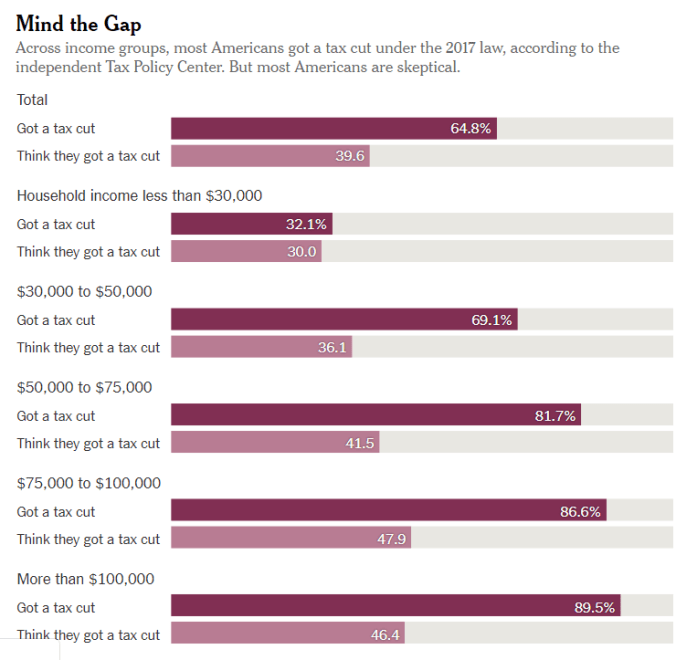
The chart above comes from the New York Times, which apparently decided that it’s safe to spill the beans now: the Trump tax cut really is a tax cut for most Americans. The ironic thing about the Times article, “Face It: You (Probably) Got a Tax Cut”

is that it reveals one of the more effective anti-Trump, anti-Republican Big Lies, this one being that the 2017 tax cut was really a sham, benefiting the rich while soaking the poor. The Times, in many ways, large and small, helped sustain that lie, with the results above. What is this? Is it like the amateur magician who has to reveal how his trick was pulled off? Is it the practical jokester who has to shout “It was all a gag!” so he can see your shock? You can almost feel the Times’s metaphorical chest swell with pride as it writes,

If you’re an American taxpayer, you probably got a tax cut last year. And there’s a good chance you don’t believe it. Ever since President Trump signed the Republican-sponsored tax bill in December 2017, independent analyses have consistently found that a large majority of Americans would owe less because of the law. Preliminary data based on tax filings has shown the same. Yet as the first tax filing season under the new law wraps up on Monday, taxpayers are skeptical. A survey conducted in early April for The New York Times by the online research platform SurveyMonkey found that just 40 percent of Americans believed they had received a tax cut under the law. Just 20 percent were certain they had done so. That’s consistent with previous polls finding that most Americans felt they hadn’t gotten a tax cut, and that a large minority thought their taxes had risen — though not even one in 10 households actually got a tax increase.

The Times goes on, infuriatingly, Continue reading