Unethical Quote Of The Week: NYT Columnist David Brooks [UPDATED}

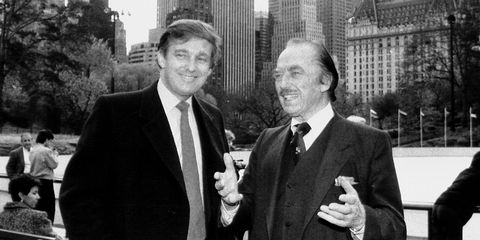
“Biographies describe a man intent on making his fortune and not afraid of skating near the edge to do so. At one point, according to Politico, federal investigators found that Frederick used various accounting measures to collect an extra $15 million in rent (in today’s dollars) from a government housing program, on top of paying himself a large “architect’s fee.” He was hauled before investigating committees on at least two occasions, apparently was arrested at a K.K.K. rally in Queens (though it’s not clear he was a member), got involved in a slush fund scandal with Robert Wagner and faced discrimination allegations.”

—New York Times columnist David Brooks arguing that Donald Trump, Jr.’s conduct in holding the controversial meeting  with some Russians and Russian-Americans to acquire useful negative information about Hillary Clinton for his father’s campaign came about because his family is just no damn good, as shown by the conduct of Fred Trump, the President’s storied father.

Unlike some commentators, I have no ethical problem with Brooks’ basic thesis. Culture molds ethics, children are influenced by the conduct and values modeled by their parents, and I have pointed out too many times to  count that Donald Trump doesn’t know ethics from a merry-go-round, and appears to have no  conventionally functioning ethics alarms at all. It makes perfect sense that Donald Jr. would grow up similarly handicapped.

However, Brooks’ evidence that Trump family patriarch Fred Trump was corrupt and without scruples is all innuendo and supposition, and thus dishonest, incompetent, and unfair. Let’s examine the components of Brooks’ attack:

  • “federal investigators found that Frederick used various accounting measures to collect an extra $15 million in rent (in today’s dollars) from a government housing program, “

Were the accounting measures illegal? Apparently not. Was the  “architect’s fee”? I guess not: Fred wasn’t indicted or prosecuted. Being investigated by the feds does not prove or indicate wrongdoing. Maybe Fred was cheating; I wouldn’t be surprised. But Brooks has no facts to support that assumption, just a pejorative characterizations.

  • “He was hauled before investigating committees on at least two occasions…”

I love the “hauled.” Being asked to testify isn’t evidence of wrongdoing either. Continue reading

Morning Ethics Warm-Up: 7/11/17…”Alan Brady” Shows His Ignorance, And The New York Times Shows Its Bias.

Good Morning!

[By the time I finished #1 on today’s list, there was no room for the rest, except for the shortest item. Oops. But it’s Carl Reiner’s fault: he ticked me off.]

1. Carl Reiner, comedy legend and still kicking in his 90s, wrote an op-ed for the New York Times urging Supreme Court Justice Kennedy not to retire, as some believe he is preparing to do. Kennedy is a relative  whippersnapper at 8o. That Reiner’s argument is unethical in multiple ways should be obvious, but then expecting the editors of the New York Times to spot an ethics problem is naive.

Reiner tells Kennedy that he shouldn’t retire because ” the best part of your career has just begun. As a nonagenarian who has just completed the most prolific, productive five years of my life, I feel it incumbent upon me to urge a hearty octogenarian such as yourself not to put your feet up on the ottoman just yet. You have important and fulfilling work ahead of you.” The problem is that the decision shouldn’t be based on what Kennedy wants or will enjoy. He’s supposed to act in the best interests of the nation, not to maximize the rewards of his golden years. Reiner uses a comparison to his own career—he still acts periodically, but even Reiner can’t possible think that his last five years were objectively more productive than when he was writing and performing in “Your Show of Shows,” or playing Rob Petrie’s hilariously nasty boss on “The Dick Van Dyke Show”—which shows a narrow perspective. If Carl can’t perform the way he used to but movie-goers still like watching him, there’s no harm done. A SCOTUS justice who no longer is in top mental fettle, however, can do substantial harm.

How many screenplays has Reiner had produced since he turned 80? How many studios have hired him to direct? The last movie he wrote was in 1989, when Carl was 67.  His last directing assignment was 20 years ago. So Carl has retired from those jobs that are too demanding for him, just not acting. His argument to Kennedy is disingenuous. Gee, maybe the Justice should try acting, like Carl.

Reiner’s entire piece is a sham: it isn’t about retirement, it’s about liberal politics. He writes,

“The country needs justices like you who decide each case with fairness and humanity, and whose allegiance is to the Constitution of the United States of America, not to a party line. You have always voted your conscience, and defended the rights and liberties of all our citizens.”

Is  Reiner seriously arguing that there are no younger qualified judges “whose allegiance is to the Constitution of the United States of America, not to a party line” ? That’s what all SCOTUS justices are pledged to do.  Does anyone think that Reiner would like Justice Ginsberg, also in her 80’s, to step down because she reliably hews to Democratic Party positions in virtual lockstep? No, of course not. What he is really saying is that when Republican-appointed justices consider cases, they violate their duty to be objective, but when Democrat-appointed justices decide in favor of progressive positions, they are just being wise and fair. This also the position of the New York Times, which is using an old man as its mouthpiece. Nice. Continue reading

The New York Times’ Smoking Gun Op-Ed

Robert Leonard is the news director for the radio stations KNIA/KRLS. He wrote a jaw-dropping op-ed yesterday, one that only could be written and voluntarily made public by someone completely committed to the idea that the news media should decide what the public thinks, and who should run the government. That the New York Times would publish this unethical, biased and anti-democratic screed is signature significance. If the Times editors had any respect for the nation’s democratic processes or the proper boundaries of journalism, it would have regarded the column as risible and an embarrassment to its profession. Instead, the Times published Leonard’s piece in the prime left-hand column of its op-ed page.

Let’s begin with the creepy headline: “Want to Get Rid of Trump? Only Fox News Can Do It.”

No, you arrogant jerk, only democratic elections can “do it.” The entire premise of Leonard’s essay, and it is the premise that the mainstream media now believes, though won’t admit, is that journalists have the power and the obligation to take down a government they don’t approve of. That is what it is trying to do, and that is what the Times is trying to do in concert with the rest. If this was not the case, the Times would not allow such an incendiary headline in its paper.

The op-ed begins with a lie, at least a lie by the kinds of standards applied by the Times in assessing what constitutes “lying” by the President:

“President Trump’s administration is in crisis, consumed by fears of what Robert Mueller, the special counsel investigating Russia’s meddling in the election, might find. Everyone’s lawyering up — even the lawyers have lawyers.”

The Trump Administration isn’t in a crisis according to any facts in evidence. It’s a crisis because the news media wants it to be in crisis, and keeps publishing whispers from leakers  trying to undermine the administration as it says so. Everyone is “lawyering up” is a pejorative phrase intended to imply guilt: in a government investigation, anyone likely to be questioned or come under scrutiny gets legal representation, and this partisan hack knows it. Nevertheless, he is making an innuendo suggesting guilt. Nor does he have any justification that the Trump administration is “consumed by fears of what Robert Mueller might find.” That assumes there is something incriminating to find,  a false assumption, and thus a false statement.

Normally, I would stop reading at that point. This is an incompetently cooked stew of partisan, anti-Trump propaganda, not worth my time, written to appeal to the Times’ “resistance” subscribers. I continued however, because I sensed a vivid illustration of how estranged from objectivity, moderation and responsible writing the Times has become.

The op-ed continues… Continue reading

Morning Ethics Warm-Up: 6/26/17

1. I am puzzled that no respected journalism source—assuming arguendo that there is one—hasn’t taken on the New York Times’ alleged list of President Trump’s “lies,” which was in my Sunday Times and released on-line earlier. I will do it today, but it shouldn’t fall to me, or other similarly obscure analysts. Why, for example, hasn’t the Washington Post taken this golden opportunity to prove how biased, dishonest and incompetent its rival is? Because, you see, the list is disgraceful, and smoking gun evidence of the Times’ abdication of its duty to its readers, except its own perceived duty to give them around the clock Trump-bashing.

The other thing I’m puzzled about is why I continue to subscribe to the New York Times.

2. One possible reason: The Sunday Times is now a weekly collage of the various derangements, false narratives and  obsessions of the Left, and worth reading just to witness how 1) bias makes you stupid and 2) how unmoored to reality one can be and still be judged worthy of op-ed space. Here, for example, is “Black Deaths, American Lies” (the print title), a screed by Ibram X. Kendi, a professor of history at American University in Washington, D.C. (Disclosure: I was also a professor at American University. But I was an honest and apolitical one.)

The first line is, “Why are police officers rarely charged for taking black lives, and when they are, why do juries rarely convict?” This is deceit: an honest scholar wouldn’t have written it, and an ethical editor wouldn’t have allowed it to get into print. The sentence implies that officers are less rarely charged and convicted when they take white lives, and this is not true. In the print version, the article is headed by a touching photo of a street memorial to Mike Brown, whom we now know got himself shot. The Black Lives Matter narrative that Brown was murdered is still carried on by racist activists, ignorant members of the public, cynical politicians  and unethical figures like Kendi, who lend their authority to divisive falsehoods.  Kendi then focuses on the Philandro Castile shooting, as if its facts support his thesis. They don’t. First, the officer was charged, though he shouldn’t have been. Second, we have now seen the video, which clearly shows that after telling the officer that he had a gun, Castile reached into his pocket and began pulling out his wallet as the obviously panicked officer shouted at him not to pull out his gun. Just as the video proves that the officer was unfit to be a cop, it shows that he was in fear of his life and why. He could not be convicted of murder on that evidence. Never mind: The professor writes, Continue reading

Morning Ethics Warm-Up: 6/17/2017

1. If you haven’t yet read them, Steve-O-in NJ’s Comment of the Day on Chris’s brilliant Comment of the Day regarding ideological and partisan hate—plus Chris Bentley’s Comment of the Day on the same post, are all especially worth reading, not that all Comments of the Day by Ethics Alarms readers are not. I apologize for an unusually long intro to Steve’s post, but I had been holding on to a lot of related material from the day past on the topic, and it was either use them there or be redundant later. This meant putting Steve-O’s COTD after the jump, which is why I’m giving an extra plug to it now.

2. There were two significant criminal trial verdicts yesterday: the guilty verdict in the trial of  Michelle Carter, a Massachusetts woman charged with murder for using text messages to persuade her teenaged boyfriend to kill himself, and the acquittal of the Minnesota police officers who shot and killed black motorist Philandro Castile during a traffic stop. I’ll cover the Carter case later.

There were the obligatory riots after the verdict acquitting Jeronimo Yanez, the officer who fatally shot Castile in his car after he told the officer that he was carrying a legally registered firearm and then reached for his wallet to show the officer his license. This is just the latest cattle-car in the Ferguson Ethics Train Wreck, the familiar pattern of a badly-trained cop, a dubious police stop, poor judgment by a victim, and a needless death. I would compare it to the Tamir Rice shooting in Cleveland, where the officers involved weren’t even indicted.

Why in the world would a motorist tell a cop in that situation—Castile had been officially stopped for a broken tail light, but in reality because he was black, and the officers thought he resembled a suspect in a crime who was also black—that he had a gun? This could be interpreted as a threat, and obviously Yanez saw it as one. The verdict looks wrong at a gut level, but it is easy to see how the jurors were thinking: they placed themselves in the officer’s position. They would have been in fear of their lives, so they couldn’t find a way to pronounce Yanez a murderer for doing what they could see themselves doing under similar circumstances. This was a legitimate case for reasonable doubt under the law. Police officers, however, are supposed to be less likely to panic than a typical juror. Castile is dead because of incompetent police work, but the criminal laws don’t allow different standards to be applied  for different occupations, not should they. Continue reading

Morning Ethics Warm-Up: 6/15/17 [UPDATED]

1. Topic for a longer post when I can think hard about it: five officials in Michigan, including the head of the state’s health department, were charged with involuntary manslaughter yesterday in connection with the Flint water fiasco. The use of criminal sanctions based on gross incompetence by public servants is such a slippery slope that I instinctively recoil from it. Unless an official can be shown to have deliberately harmed people, trying officials for crimes when the real “crime” is that they were  stupid, negligent, incompetent or lazy has the whiff of scapegoating about it, will discourage more citizens from entering government service, and is so likely to become a political weapon—especially these days–that abuse of process is almost inevitable. The Flint catastrophe involved culpability at three levels of government, all the way to the EPA. These five officials are criminals, and the rest are—what? Acceptably incompetent?

2. The polarization in the news media and society is such that I find myself hesitating to use material that appears on an openly conservative website,  papers like the Washington Times or New York Post, or Fox News. This, despite the fact that I use the New York Times and the Washington Post more than any other sources, despite the undeniable evidence that their coverage is often partisan and biased. In the current environment where the Left and its allies appear to be circling the wagons, I encounter articles like the one by Megan Fox discussed in the next item and wonder why similar  analysis isn’t  appearing in the Times, the Post, or Vox? It is obviously valid and fair. But it is also critical of the left-biased news media, and so far, that entity is refusing to acknowledge how much harm its abandonment of objectivity is inflicting on the nation. So the analysis appears on a right-biased site, giving half the country an excuse to ignore it, and those who read my related post an excuse to dismiss it, and Ethics Alarms.

Good system. Continue reading

Morning Ethics Warm-Up: 6/11/17

1.  Mainstream media bias has been such a frequent topic on Ethics Alarms that I hesitate to focus on it even when, against all odds, what passes for American journalism has another rotting chunk fall off.  The reaction of most of the media to the Comey testimony was a huge chunk, once again shocking me when I didn’t think my regard for this unprofessional profession could sink lower. Some commentators yesterday (they were conservative, but there is no reason a fair and objective liberal wouldn’t and shouldn’t come to the same conclusion) said that we are witnessing the birth of a mainstream media-progressive fusion political party. This is not a hysterical analysis. The New York Times coverage of the Comey hearing, for example, was so misleading and dishonest as to eliminate that paper from ever being regarded as a reliable political analyst again, at least until it cleans house and issues an abject apology to the nation. Ethics Alarms reader Greg did an excellent job detailing the Times’ disgraceful anti-Trump/pro-resistance spin in the thread on the Comey testimony post, as did journalist commenter Tippy Scales.

The Times knows its first take was untenable; you can tell by its editorial today, in which it already is changing the subject. If Comey had laid a glove on Trump (and he didn’t) regarding  impeachable conduct and a route to removing him—which was the Left’s fervent hope and the resistance’s confirmation bias-driven fantasy—the Times would have been  shaking its fist and demanding action in it Sunday pronouncement. Instead, it offered an extended whine about how Paul Ryan excused Trump’s clumsy handling of his communications with Comey by citing Trump’s inexperience, but that he had condemned President Obama for his inexperience, as if the two positions are inconsistent. First, they are not: Ryan did not support Trump’s nomination, though political inexperience was the least of his disqualifications. Second, the President’s cluelessness is directly relevant to the weaker than weak argument that he was obstructing justice by having the kinds of conversations with a subordinate that is commonplace in a business setting. The Times, as it has been doing a lot lately, simply assumes away an insuperable obstruction to its “resistance” position, , saying that “The president obviously knows that it’s wrong to interfere in an investigation.”

Like Hillary Clinton, apparent cyber-dolt,  “obviously” knew that using a private server for State Department business violated classified communications law?

The same logic that Comey himself used to give Clinton a Stay Out Of Jail pass applies to Trump’s statements to Comey, but far more reasonably. Not only was he not, as Ryan said, “steeped in the long-running protocols that establish the relationships between D.O.J., F.B.I. and White Houses,” the President  wasn’t interfering in the Flynn  investigation by telling Comey he hoped it would end, and he couldn’t interfere in the Russian investigation by firing the FBI director. The Times editorial reveals the real impetus behind the paper’s determination to bring down the President who dared to be elected by “deplorables” who don’t march to the Times’ ideological lock-step: Trump “[struts] about at the head of the party, insulting everyone and everything in sight: staff members, allies, laws, diplomatic decorum and common sense.”

Yes, for once the Times is reporting accurately, but that’s not grounds for removing an elected President, and it does not justify misrepresenting facts to create a public groundswell based on bias, hate, fear and ignorance.

2. And when it is clear that the news media and the Democrats are coordinating in an “Anti-Trump” party, what is a responsible stance for the Trump Administration regarding news organizations who wave the anti-Trump banner at the expense of fair reporting? Continue reading

Morning Ethics Warm-Up: 6/9/17

1. News Item: “More than 130 imams and Muslim religious leaders in the United Kingdom have said they will refuse to perform funeral prayers for the Manchester and London terrorists as a rebuke to the “dastardly cowardice” of the “vile murderers.” Notes Ethics Alarms issue scout Fred, “This time it’s religious institutions refusing [to provide a service based on religious/political beliefs and conduct], and it’s based on the actions of the people they’re refusing to pray for or bury. On the other hand, anyone born in Scotland is entitled to the government’s services even if he’s No True Scotsman. By analogy, is it right for them to deny funerals to Muslims, even the most egregiously sinful?

I’d have to do more research on Islam than I have time for right now to address that question, but it’s an interesting one.

2.  As a follow-up to New Orleans’ lamentable decision to remove statues honoring Confederate figures (discussed on Ethics Alarms here), The Atlantic published an exhaustive brief against the “myth” that Robert E. Lee was worthy of his reputation as a noble human being who fought for Virginia out of loyalty to his “country,” but who deplored slavery. I have criticized the hero-worship of Lee as well, but much of what is in Adam Serwer’s article was completely unknown to me. If accurate, it is horrifying. Just one example:

“Lee’s cruelty as a slavemaster was not confined to physical punishment. In Reading the Man, the historian Elizabeth Brown Pryor’s portrait of Lee through his writings, Pryor writes that “Lee ruptured the Washington and Custis tradition of respecting slave families,” by hiring them off to other plantations, and that “by 1860 he had broken up every family but one on the estate, some of whom had been together since Mount Vernon days.” The separation of slave families was one of the most unfathomably devastating aspects of slavery, and Pryor wrote that Lee’s slaves regarded him as “the worst man I ever see.”

3. I’ll discuss the Comey testimony in detail later, but I came close to writing about the unseemly and self-indicting display of gleeful anticipation by much of the news media (and “the resistance,” of course) over what they were just certain would be the smoking gun to get President Trump impeached. CNN had a countdown, second by second, on-screen the whole previous day, like Christmas was coming. Ann Althouse nicely summed up how foolish and ugly this was: Continue reading

The Ethics Of Responding To Inconvenient Truths: Colleges Aren’t Working…Now What?

From the Wall Street Journal:

Freshmen and seniors at about 200 colleges across the U.S. take a little-known test every year to measure how much better they get at learning to think. The results are discouraging.

At more than half of schools, at least a third of seniors were unable to make a cohesive argument, assess the quality of evidence in a document or interpret data in a table, The Wall Street Journal found after reviewing the latest results from dozens of public colleges and universities that gave the exam between 2013 and 2016. …At some of the most prestigious flagship universities, test results indicate the average graduate shows little or no improvement in critical thinking over four years. . . .

Some academic experts, education researchers and employers say the Journal’s findings are a sign of the failure of America’s higher-education system to arm graduates with analytical reasoning and problem-solving skills needed to thrive in a fast-changing, increasingly global job market. In addition, rising tuition, student debt and loan defaults are putting colleges and universities under pressure to prove their value.

Some?

What’s the other side saying, that the results are cooked? That critical thinking is over-rated or a sexist, racist, xenophobic construct? How can any objective individual who has followed the news, listened to activists babble incoherently on  campuses like Dartmouth, Yale, Columbia, University of Missouri and hundreds of others, been aware of higher ed apocalypse stories like this one , or notice that the overwhelming majority of college students enthusiastically supported the fact-, math-, economics-, foreign policy-, history-and Constitution- challenged candidacy of Bernie Sanders  be surprised at these findings? They aren’t even new.

The scam that is U.S. higher education poisons the American dream in too many ways to count.  50% of employers say that college graduates they hire aren’t ready for the workplace because of inadequate critical-reasoning skills.  Yet virtually every institution cites this as the prime benefit of paying it a king’s ransom for four years, with brochure proclamations like…

“The university seeks to foster in all its students lifelong habits of careful observation, critical thinking, creativity, moral reflection and articulate expression.”

and

“… University fosters intellectual inquiry and critical thinking, preparing graduates who will serve as effective, ethical leaders and engaged citizens.”

and

“The college provides students with the knowledge, critical-thinking skills and creative experience they need to navigate in a complex global environment.”

“At most schools in this country, students basically spend four years in college, and they don’t necessarily become better thinkers and problem solvers,” said Josipa Roksa, a University of Virginia sociology professor who co-wrote a book in 2011 about the CLA+ test, that littel-known test the Wall street Journal referred to. . “Employers are going to hire the best they can get, and if we don’t have that, then what is at stake in the long run is our ability to compete.”

Even the arguments used to defend college lack evidence of critical thinking. Today’s New York Times special Higher Ed section highlights this quote: Continue reading

Unethical Quote Of The Week: New York Times Publisher Arthur Sulzberger Jr. [UPDATED and CORRECTED]

“Our followers on social media and our readers across the internet have come together to collectively serve as a modern watchdog, more vigilant and forceful than one person could ever be. Our responsibility is to empower all of those watchdogs, and to listen to them, rather than to channel their voice through a single office.”

—-New York Times publisher Arthur Sulzberger Jr, announcing that the Times was eliminating its “public editor” and its public editor position.

The decision was bad enough, the disingenuous excuse was almost worse. Yes, by all means, the Times doesn’t need an independent, internal expert on journalism ethics to blow the whistle when the Times ignores its duties of competence, independence and objectivity and breaches its own ethics code: the overwhelmingly left-wing readers the Times panders too daily will keep it on the straight and narrow! Besides. why does the Times need an ethics cop now? After all, the public’s trust in the news media, of which the Times is supposed to be the role model, has never been higher!

Well, no, actually, the public’s trust in journalism has never been lower, and the New York Time’s blatant bias during the 2016 campaign and in the wake of Donald Trump’s election is one of the main reasons. Tell me: if an organization finds its public trust diminishing drastically, which act shows a sincere interest in addressing that distrust and reversing it…

A. Hiring an independent journalism ombudsperson who investigates instances of dubious journalism ethics and reports to the public in the paper, no matter what the results, entering criticism and recommending changes as needed, or

B. Eliminating the above position entirely?

The New York Times chose B. What this indicates is that the Times doesn’t care about the public trust, just its readers’ trust. It knows most of its current readership wants an aggressive progressive advocacy rag, not bold, objective and independent journalism. When a new less-progressive-than-usual op ed writer dared to suggest that critics of climate change orthodoxy be listened to respectfully, Times readers tried to get him fired. Continue reading