Comment of the Day: “Roshomon, Good Citizenship And Ethics: The Case Of The Concerned Stranger And The Indignant Father”

Poster - RashomonJeff Gates, the father, photographer and writer whose essay in the Washington Post prompted my post here and a lively discussion thereafter, has been kind enough to contribute additional thoughts and clarifications in response. This is one of the really good things about the internet, and his willingness to enhance the discussion with additional perspective reveals good things about Jeff as well. His original article is here.

At the outset, I want to clarify something about my post that I kept intending to do but obviously did not, at least not well. The fact that the man who was suspicious of his photo-session with his daughter said later that he worked for Homeland Security didn’t figure into my analysis at all, and still doesn’t. I am concerned with the original encounter, and the question of whether this was excessive Big Brotherism clouds the issue, which I see, and saw as this: we should applaud and encourage proactive fellow citizens who have the courage and the concern to step into developing situation that they believe might involve one individual harming another.  As the man needed no special authority to do that, I don’t care whether he was a federal agent or not; I thought it was pretty clear that this was not official action. Indeed, I think as official action, the man’s intervention was ham-handed and unprofessional.

Here is Jeff Gates’ Comment of the Day, on the post, “Roshomon, Good Citizenship And Ethics: The Case Of The Concerned Stranger And The Indignant Father.” Continue reading

Roshomon, Good Citizenship And Ethics: The Case Of The Concerned Stranger And The Indignant Father

“O wad some Power the giftie gie us To see oursels as ithers see us!”

—Robert Burns bystander-effectJeff Gates, a writer and adoptive father, contributed a thought-provoking column in the Washington Post’s Outlook section this weekend, describing what seemed to him to be a traumatic experience at Cape May. It begins…

“After my family arrives on the Cape May ferry for our annual vacation to the Jersey Shore, I take pictures of our two daughters on the ferry’s deck as we leave the harbor. I’ve been doing this since they were 3 and 4 years old. They are now 16 and 17. Each photo chronicles one year in the life of our family and our daughters’ growth into the beautiful young women they have become….On that first day of vacation, the sea was calm and the sky a brilliant blue. As I focused on the image in my camera’s viewfinder, the girls stood in their usual spot against the railing at the back of the boat. I was looking for just the right pose…Totally engaged with the scene in front of me, I jumped when a man came up beside me and said to my daughters: “I would be remiss if I didn’t ask if you were okay.”

He goes on:

“It took me a moment to figure out what he meant, but then it hit me: He thought I might be exploiting the girls, taking questionable photos for one of those “Exotic Beauties Want to Meet You!” Web sites or something just as unseemly. When I explained to my daughters what he was talking about, they were understandably confused. I told the man I was their father. He quickly apologized and turned away. But that perfect moment was ruined, and our annual photo shoot was over.”

Many of us might laugh off the experience as a funny anecdote, but not Gates, and not his daughters. He is Caucasian and they are both of Chinese heritage, having been adopted as infants in China by Gates and his wife. He obsessed about the incident for a while, and worked up sufficient indignation to track down the man and confront him, saying “Excuse me, sir, but you just embarrassed me in front of my children and strangers. And what you said was racist.” Continue reading

Twelve Post-Veto Ethics Observations On The Arizona “Religious Freedom” Bill

veto2

1. As we now know, Governor Brewer vetoed AZ SB1062, the so-called “religious freedom” bill that was widely (and accurately) interpreted as support for discrimination against gays. In the previous post, I suggested that her delay in doing so sent a message that was as hostile to gays as the law itself: if she felt the law was ethically wrong, then she should have and would have announced that she would not sign the bill long ago. Instead, she waited to see how much economic damage the law would do to the state, and then vetoed it, not because this was the right ting to do, but because it was the pragmatic thing to do. (As the satiric Borowitz Report put it, “The state of Arizona found itself in the middle of a conundrum today as it awoke to the awkward realization that gay people have money and buy stuff.”) USA Today noted that, to the contrary,”Some political insiders believe Brewer has allowed furor over the legislation to build to thwart social conservatives’ attempts to push a similar bill later.” I doubt it, but if so, Brewer allowed her state and her fellow Republicans to be represented nationally as homophobic for as long as possible to spare herself the inconvenience of vetoing a second bill.

2. Despite the extravagant debate over the bill, almost no commentators actually published the bill’s text in the commentary. The reason appears to be that since the bill is really an amendment of an existing law, it takes a modicum of intelligence to figure out what’s going on. Here it is (the original law is in black; the new text is in blue; what has been removed in the amended version is struck through): Continue reading

The Fifth Annual Ethics Alarms Awards: The Worst of Ethics 2013 (Part Three)

Jill-Greenberg

Unethical Artist Of The Year

Photographer Jill Greenberg, whose art requires parents to make their children cry. Runner-up: Peeping Tom photographer/artist Arne Svenson

Kaitlyn Hunt

False Allegation Of Anti-Gay Bigotry Of The Year

Kaitlyn Hunt’s parents, who spun a false tale of anti-gay prejudice to portray their sexual predator daughter as a victim after she was accused of statutory rape by the parents of her under-age target. Hunt’s parents even managed to suck the ACLU into their web and the liberal-leaning press portrayed her as a martyr to anti-gay bias. But Hunt’s lies ultimately caused her cover-story to unravel.

 Unethical Hoax Of The Year

Oberlin students Dylan Bleier and Matt Alden, aided and abetted by  Oberlin College and its president, Marvin Krislov. The two students, self-proclaimed progressives, posted a series of racist and anti-Semitic posters, graffiti and anonymous emails as “an experiment.” Krislov and Oberlin, after cancelling classes and engaging in campus-wide navel-gazing, continued to allow the media and the public believe that this was the work of racists on campus well after it had learned who the real miscreants wereRunner-up: The horrible Meg Lanker-Simons, former University of Wyoming student (now admitted to law school—I don’t want to talk about it) who threatened herself with rape and used the bogus threat to show that her campus was violent and sexist.

Most Unethical Use of Social Media Continue reading

Note To Matt Drudge: He’s The President. Show Some Damn Respect

This will be short.

This week a fly was buzzing around the President’s head at a White House event this week, and  photographers got multiple shots of the insect as it lighted briefly on various parts of the President’s face. One comic use of such a photo is, I suppose, to be expected; we all know a fly on President Bush would have been all over the media. But Drudge has used the photos for two days now. (No, I’m not showing it, and I’m not sending Drudge links for being a sophomoric jerk.) It’s not funny. It’s unfair, mean-spirited, rude and disrespectful, and would be for any President.

Cut it out.

Unethical Quote of the Week: Rep. Nancy Pelosi (D-Cal.)

“It’s an accurate historical record of who the Democratic women of Congress are. It also is an accurate record that it was freezing cold and our members had been waiting a long time for everyone to arrive and that they had to get back into the building to greet constituents, family members, to get ready to go to the floor.”

—- House Minority Leader Nancy Pelosi, lamely and absurdly defending  her posting of a digitally altered photograph of female Democrats in the House, which added several members who were unable to attend to shoot to the members actually in attendance.

Except for the fact that a digitally-altered photo is not an accurate historical record and she knows it, Pelosi’s statement is completely reasonable and honest. The Washington Post published the unaltered photo.

A digitally altered photograph that misrepresents an event by inserting individuals who were not present is ethically indistinguishable from the old Soviet Union practice of excising the images of purged officials from official photographs. It is a lie. It represents an effort to alter history, and mislead viewers of the historical record. Which is more disturbing: that a high-ranking U.S. government official blandly endorses this deceptive practice with connections to totalitarian propaganda, or that Nancy Pelosi calls a doctored photo an accurate historical record?

She is and has ever been an ethically-deficient disgrace to her district, her state and Congress.

[And as an aside, I believe that a gender-segregated photo of female legislators is sexist, prejudicial and hypocritical. Every one of these women would scream if, for example, Republican House members posed for a photo excluding the women in their number.]

_______________________________

Facts: Washington Post

The Ryan Soup Kitchen Photo: Everybody Does It, But It’s Still Unethical

In the early 1960s, as the Great Leap Forward led China into political, social and economic disasters, the opposition to Mao Zedong’s leadership grew; Chairman Mao’s reaction was to purge the party leadership of intellectuals and officials in what is now termed, “the Great Proletarian Cultural Revolution.”

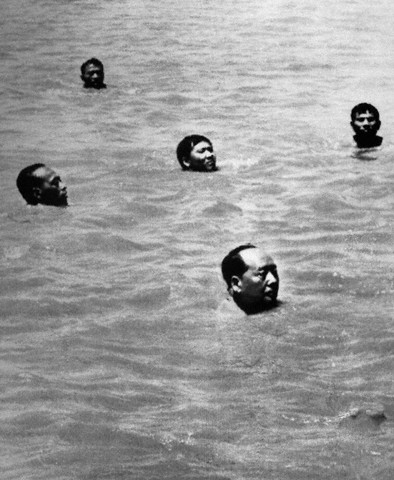
Mao Zedong’s hold on the leadership of China was shaky as he passed 70; even slaughtering more of his enemies and rivals wasn’t working. On July 16th 1966, Mao sought to debunk rumors that he was frail and ill by staging photographs of him vigorously swimming in the Yangtze River.  It was called, “The Swim Seen Round the World.” The Chinese press did its job, describing Mao’s cheeks as “glowing” and “ruddy,” his stroke steady and strong. “Our respected and beloved leader Chairman Mao is in such wonderful health!” one press report enthused.

In the West, however, there was more skepticism. Time reported that Mao swam “nearly 15 km in 65 minutes that day–a world-record pace, if true.” The photos of the swim, which showed an oddly solemn group of floating heads, were widely believed to have been doctored. As it turned out, the photos were real; Mao really did take a swim, though the event was staged, and nobody knows how long the swim lasted or how far Mao paddled. What are such photo ops? Are they deceptive? Are they ethical? Continue reading

The Times Square Kiss, and Feminist Blogs’ Fanatic Crime Against Joy

The blog posts at issue make me angry. Usually it is silly to be angry about mere opinions, I know. However, the opinion registered by “Lori” on the blog Feministing, taking her cue from another feminist blogger, is a symptom, a symptom of the scourge of pernicious, political-correctness zealots, who refuse to recognize the important distinctions between malice and human beings being human, and seek to wipe out that distinction by distortion, sophistry, historical revisionism and bullying.

The bloggers’ target is an iconic photograph from the heart of American history: LIFE photographer Alfred Eisenstaedt’s shot of an American sailor kissing a nurse on August 14, 1945, in a moment of jubilation on Victory over Japan Day in the heart of New York City. Ah, but all is not as innocent and blissful as it would appear. Some historians think they have finally confirmed the identities of the mysterious couple (the photographer never identified his subjects) as Greta Zimmer Friedman, a dental nurse at the time, and George Mendonsa, a sailor. [Despite the assertions of the bloggers and the historians, we can never know for sure. There were apparently many similar pairings that day, and several couples have credibly claimed to be those kissing through the decades.] Greta was recently interviewed, and noted that that she was just grabbed by a sailor she didn’t know and kissed. “That man was very strong. I wasn’t kissing him. He was kissing me,” Greta told interviewers.

Ah HA! declare the feminist bloggers. Don’t you see, you addled, male-culture dominated, female-subjugating fools? This wasn’t a pure expression of joy in the long-awaited  end of a world conflict that had killed millions and laid waste to much of the planet! Oh, no! The famous photo was something dark and sinister: Continue reading

Photography Ethics on Trial

Two photography technology ethics cases erupted this week.

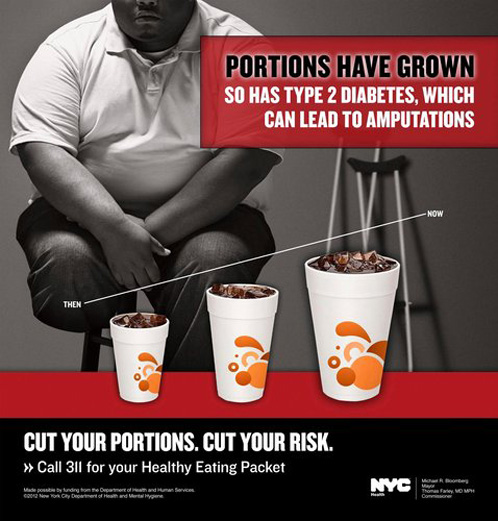
The Case of the Fake Amputee: A recently unveiled New York public health campaign warning against Type 2 diabetes uses a photo of an overweight man who is missing his leg.  The man, however, had both legs when the photo was taken. One was digitally removed to make it appear that his right leg had been amputated. The American Beverage Association, fighting the city’s efforts to reduce consumption of sweetened soft drinks and fast food, seized on the photo to press its case. “Clearly, the straight facts don’t support their singular attacks on our products, so they keep falling back on distortions and scare tactics that are over the top,” association spokesman Chris Gindlesperger said in a statement. “That’s disappointing.”  Well, diabetes does increase the risks of amputations, and a fake amputee is no more scary than a real amputee. Real amputees do exist; having a graphically-created one doesn’t change the accuracy of the ad’s message one bit. What does the association’s argument have to do with the photo-manipulation? Nothing. Continue reading

Ethics Hero: Jennifer McKendrick

My hero.

Jennifer McKendrick is my favorite Ethics Hero of 2011.

An Indiana County freelance photographer of sensitivity, courage and principle, McKendrick engaged in classic ethical behavior—seeing wrongful conduct that harms others, and taking affirmative action to address it. Her conduct is a template for all of us, and not merely regarding the specific problem she decided to confront: online bullying.

McKendrick had been hired to shoot the senior photos of several high school girls, then discovered that they had viciously denigrated other students on Facebook. She sent the girls’ parents this letter:
Continue reading