Self-Serving Twitter Plagiarism From Shia LaBeouf

"How To Be A Jerk"

“How To Be A Jerk”

Actor Shia LaBeouf has two impressive achievements, neither anything to be proud of, but impressive nonetheless. In a showdown with World Champion Hollywood creep Alec Baldwin, LaBeouf, against all odds. managed to come off as the bigger jerk. In the process, he created, or at least gave unprecedented publicity to a new ethical transgression: Twitter plagiarism.

You will recall LaBeouf, if you recall him at all, as the former Disney Channel child star who had movie hits with “Disturbia” and the “Transformers” franchise, as well as gaining a form of lasting notoriety as Indiana Jones’ son in the fourth and lamest installment of that classic series. He also has established a reputation for being trouble, and this week it was revealed that he had been fired (the old “artistic differences” excuse) from what was supposed to be his Broadway debut in the new play “Orphans,” starring Baldwin. The exact reasons are unclear, but incompatibility with Baldwin was part of it.

How do I know that LaBeouf, rather than the famously volatile Baldwin was at fault? Simple, really. Baldwin is the show’s star; he has theater credentials; he’s an established pro. It is part of LaBeouf’s job to get along with him, not the other way around. He could also learn something from Baldwin, who, though it seems hard to imagine, was once an even bigger jerk than he is now—so big, that at one point his career had gone from losing the Jack Ryan franchise (to Harrison Ford) to playing the conductor in the sad and awful movie version of “Thomas the Tank Engine.” Baldwin knows where Shia is headed, and could help stop him from going there.

In the wake of his canning, LaBeouf took to his Twitter feed and posted various e-mails leading up to his fate. One of them was erudite and almost poetic:

“A man can tell you he was wrong. That he did wrong. That he planned to. He can tell you when he is lost. He can apologize, even if sometimes it’s just to put an end to the bickering.”

Hey! Jerk or not, this guy can write! He has a brain!

Well, no, not really: he has a computer, and can cut and paste. His words were lifted from Tom Chiarella’s essay in Esquire, “How To Be A Man.” Continue reading
Ethics Hero: Cartoonist Ted Rall

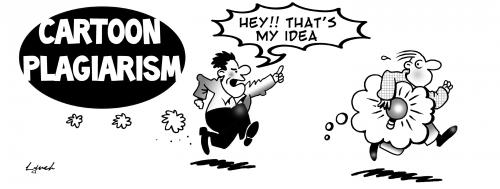
cartoon_plagiarism_444045

It is always courageous and exemplary when someone calls out his own profession for deficient ethical standards, and this is what political cartoonist Ted Rall has done on his blog. The topic: plagiarism in editorial cartoons, which is bad enough. Rall, however, makes strong case that the unethical practice flourishes because syndicates, editors, publications, honors committees and the professional associations tolerate it, and journalists don’t seem to care. He also blows the whistle on the practice known as self-plagiarism, where a cartoonist recycles his previous work as new. Rall writes, Continue reading

Of Fareed Zakaria, Scraping, Plagiarism and Hypocrisy

Is it “Oops!”, “Damn!” or “Better luck next time”?

I once had a dear friend in the DC theater community who committed an industry taboo when he mounted a play before, rather than after, obtaining the performing rights. His company was in the red, and his intent was to get some advance sales to pay the licensing fees that he otherwise couldn’t afford. It was a desperate, foolish scheme and an unethical one, as he readily admitted, and my friend paid dearly for it, as he was fired as the head of the theater company he had founded, and rendered a pariah in the community. What always infuriated him, however, was the instant condemnation and pious pronouncements he received from his peers in the theater world. “I know for a fact that everyone of them either would have done the same thing or had done the same thing, or worse, to keep their theaters running,” he told me.  “I was wrong and I know I was wrong, but for them to act as if I am some kind of a monster when I know they are really thinking, ‘Yikes! I better be more careful, that could have been me!’ is driving me crazy.”

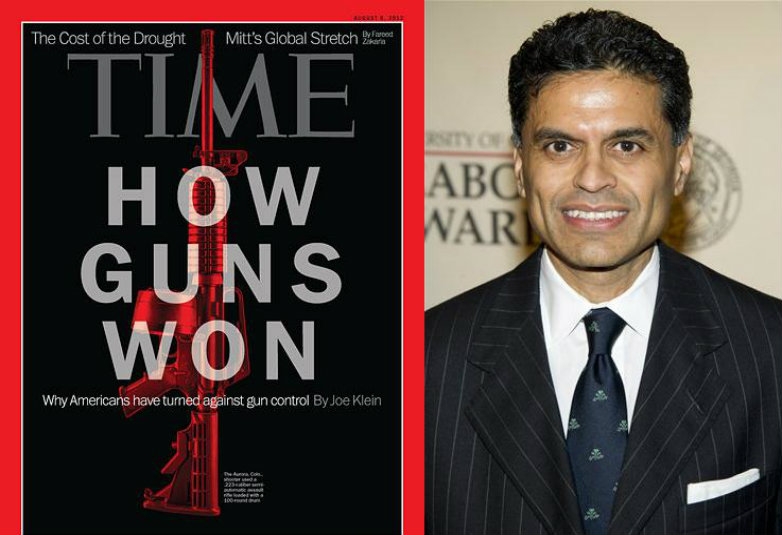
I wonder if disgraced CNN host and Time writer Fareed Zakaria is thinking the same thing as his colleagues in the news media and assorted web commentators are describing him as a plagiarist and an untrustworthy fraud in the wake of his suspension for lifting a paragraph from another writer’s work  and putting it in his own Time essay without attribution. After the parallel passages were flagged on the conservative website Newsbusters (you didn’t think he would have been outed by a liberal site, did you—or that Newsbusters would have been looking for plagiarism from a rightward  journalist?) both Time and CNN suspended Zakaria indefinitely.

This was the appropriate response. Zakaria is an opinion journalist, or a pundit: the idea that he is surreptitiously cribbing from others undermines his credibility substantially and perhaps fatally. That is not an entirely fair description of what Zakaria did, however.  What he engaged in was “scraping,”  the web-age technique where an author cuts and pastes a passage or more from another work and uses it as the foundation for a portion of a supposedly original article. When the passage in question is substantive, contains the ideas and conclusions of the author  whose work is being scraped, or is the product of another writer’s research, that is indeed plagiarism. When the passage being scraped is something the borrowing author could have written himself, however, it is more accurately described as lazy. It is still wrong, but it does not necessarily rise to the level of intellectual theft that can reasonably justify calling the author untrustworthy. Continue reading

Comment of the Day: “The Ice Child” and Staging Theft Ethics”

Arts blogger Jeremy Barker contributes a provocative counter-argument to my stance in the controversy over a D.C. based theater company that borrowed/adapted/stole an original production concept from a New York company without attribution or permission.  My position was (and is) that no rule, principle or law designed to discourage such conduct could avoid suffocating legitimate adaptations, mutations and new uses of  ideas devised by others, with devastating effects on creative expression. This is one of the great ethics controversies in the world of art, and I am glad to see it back in the ring.

Here is Jeremy’s Comment of the Day on my post, “The Ice Child” and Staging Theft Ethics.

“Jack–I just came across this piece and wanted to respond because I think, in quoting me, you ignore part of my argument, and I’m curious if you can clarify your perspective.

“Specifically, I feel like your caveated argument in favor of Factory 449 is based on the sense that it’s common practice to borrow such design or staging elements in text-based theater. I agree, it is. But if we were speaking of a specific author’s text, I think most commenters would have swung the other way. We tend to protect the playwright’s text in a different fashion than we do a design concept. A writer could be accused on plagiarism for either (a) imitating a distinctive plot, or (b) appropriating the same words. Yes, we can argue about what is an acceptable form of “referencing” (no one thinks Arthur Laurents wrote Romeo & Juliet, for instance) and what crosses the line. Often, this applies to how the text is used. But we understand and appreciate a playtext as a protected, distinctive thing.

“Indeed, I’d argue that this logic, which privileges the text, is the basis on which people in this thread are defending Factory 449′s appropriation. Since it wasn’t the same “play,” by which they mean “play text,” it’s not really the same thing, ergo, it’s not ripping someone off wholesale. Continue reading

Ethics Dunces: Massachussetts Democrats

Then again, the values of Massachusetts Democrats in choosing Senate candidates has a certain consistency…

95.7 percent of the 3,500 delegates attending the Massachusetts state Democratic convention in Springfield, Mass. endorsed faux-Cherokee Harvard professor Elizabeth Warren for U.S. Senator.  Since Warren’s support exceeded 85%, Marisa DeFranco, the only declared opposition to Warren’s nomination to oppose Republican Senator Scott Brown’s bid for re-election, will not have the chance to test Warren in a primary.

Since no Democratic candidate had ever won more than 86 percent of the vote in the 30 years of the state party’s endorsement process, the party’s doubling down on the thoroughly disgraced Warren is a stunning rejection of ethical principles.

Warren, just this week, admitted that she had told Harvard that she was a Cherokee after she had been hired, prompting the University to list the blue-eyed, blonde-haired scholar as “a woman of color” in its diversity statistics. She had explicitly denied this for months. She has shown to be a plagiarist, a liar, a fake, and a hypocrite, and an inept politician as well. Her party’s response to all of this was to make it impossible for its members to reject her at the polls, and to nominate a candidate of integrity to oppose Brown.

What does the conduct of Massachusetts Democrats demonstrate? Continue reading

Recipe Rationalizations

Go ahead: tell him that recipes are trivial.

The Elizabeth Warren recipe plagiarism is turning into a fascinating study of whether objectivity and fairness can survive partisanship. So far, the results are depressing.

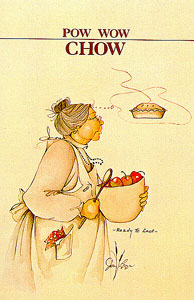
There is increasingly persuasive evidence that the recipes contributed by “Elizabeth Warren, Cherokee” to the cookbook “Pow Wow Chow” were not Native American recipes passed down over generations as Warren represented them, and that she 1) knew this and 2) intentionally misrepresented and disguised their origins while lifting them, barely altered, from other published sources. Faced with this, Warren supporters are falling back on classic rationalizations rather than accepting, reluctantly, the obvious import of the data: their candidate is an untrustworthy faker.

Howie Carr, the Boston radio talk-show host who initially uncovered the plagiarism in “Pow Wow Chow,” reveals more details of one of Warren’s apparent thefts in today’s Boston Herald. For her version of the recipe for “Herbed Tomatoes” that she lifted from the September 1959 edition of Better Homes and Gardens, Warren made a few strategic changes, Carr reports.  She cut one the “one-half teaspoon monosodium glutamate” from the ingredients ( “Apparently MSG was not available at the Muskogee Stop & Shop in 1856,” writes Carr) and also eliminated the option of using margarine rather than butter, since “I Can’t Believe It’s Not Buffalo Grease” was not on the shelves of her elusive Cherokee ancestors. This indicates an intent to deceive by Warren, in addition to her plagiarism.

Central to the defenses offered for Warren by Democrats are the following classic rationalizations: Continue reading

“Pow Wow Chow” Follow-Up: My Breitbart Interview On Harvard and Professor Plagiarism

Michael Patrick Healy, an author and conservative activist, interviewed me today regarding what Harvard Law School’s response ought to be if indeed Elizabeth Warren engaged in plagiarism with her contributions, as “Elizabeth Warren, Cherokee”, to the cookbook “Pow Wow Chow.”

His article, including the interview, are on the Breitbart Big Government site, here.

The Significance of “Pow Wow Chow”

Great title, by the way….

There is mostly bad ethics news for Elizabeth Warren fans from the re-discovery of the 1984 cookbook she contributed to called “Pow Wow Chow,” but some good news too. The good news is that the 28 year-old cook book, edited by her cousin and listing the current Harvard professor and Democratic Senate contender as a contributor named “Elizabeth Warren, Cherokee,” shows that Warren didn’t just concoct her claims of Cherokee heritage to achieve minority status to help her get faculty jobs through university diversity hiring policies. Oh, she intentionally employed her dubious heritage credentials to get that edge, no doubt about it. But the cookbook shows that though she was only 1/32 Native American by the most generous calculations and was assuming that lineage on the basis of hearsay alone, Elizabeth Warren really had convinced herself that she is a Cherokee, and probably believes it to this day. Hence her obsession with being able to call herself a Native American appears less opportunistic and more, well, nuts. [ Note: for a thorough though excessively sympathetic review of Warren’s claims, read this, in The Atlantic.]

In fact, it looks like a severe case of Sixties Liberal Delusion Syndrome, also known as Billy Jack Disease. Warren talks and writes like a stereotype campus liberal, and like her Sixties campus forbears, she must have figured out in early adulthood that kinship with oppressed minorities is the antidote to white guilt and the ticket to a perpetual state of self-righteousness and victimization. If my diagnosis is correct,  Warren’s lockstep liberal mindset seized upon her family lore about American Indian heritage, and installed it as a cornerstone of her self-image as a foe of the capitalist, white-dominated American power structure. I am sorry I doubted her; I now think it is likely that she has long thought of herself as a true Cherokee. True, I think that is ridiculous; I think extending that attenuated minority identification into a resume enhancement, allowing her to displace more deserving candidates, is indefensible; and I think her obsession calls her judgement and stability into question. But at least she wasn’t lying. About that.

Yes, this is the good news.

The bad news is that Warren’s contributions to the cookbook appear to be misrepresented and stolen. Continue reading

Editor, Plagiarist and Ethics Dunce Extraordinaire Robert Ripley Meets His Worst Nightmare…

….and that nightmare is Duane Lester, a hard-working, honest, courageous, organized and determined blogger who wasn’t going to let a newspaper rip him off and get away with it. Lester researched and posted an original local news story, a true scoop, and days letter was shocked to find that a local paper, the Oregon Times Observer, had lifted his entire post and put it on the paper’s front page, without credit, permission, or attribution. Shocked and unprepared for such flagrant and shameless appropriation of his labors, he researched the issue, wrote a letter, and then visited the paper to demand payment. Brilliantly, he also brought along a friend with a video camera.

The whole story, as well as the enlightening and satisfying confrontation between the Blogger and the Word Thief, is on the resulting video. There is a lot to see here.

Continue reading

Credit Ethics: New Ethics Alarms Policy

The sound of my palm belatedly smacking my expansive forehead

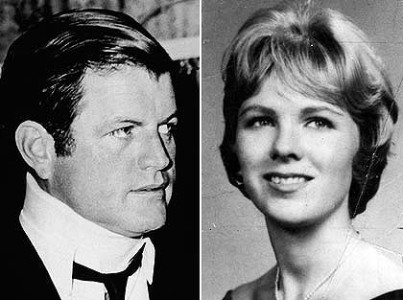
What will heretofore be referred to as “The Mary Frances Prevost Affair” has its silver lining. Watching another blogger incorporate the main body of my blog post into her own by-lined essay without credit or attribution has caused me to do a lot of thinking about the inadequacy of credit and attribution in the blogosphere  generally, with a relatively  few exceptions. Most of these are blogs written by academics who hold to the standards of their profession rather than the much looser practices of the internet. It also caused me to wake up to the inadequacy of my own attribution practices on Ethics Alarms. I have never taken an entire post from another source and represented it as my own, but I have frequently taken a factual account of a story from another website that itself was essentially  republishing, for example, an AP story, put the facts in my own words, sometimes with a stray phrase remaining, and not credited either source. I have often derived information in a post from multiple news sources but only linked to the one that I felt related the event the most thoroughly and clearly. Another writer’s work has sometimes sparked an idea for a post that was substantially different, and I have not credited the source of that spark.

All of this is common practice in blogging, but it is still wrong, and sloppiness is always a slippery slope. In the wake of “The Mary Frances Prevost Affair,” a colleague alerted me that I had included one complete sentence and part of another in an Ethics Alarms post that were identical to the post of another writer on the same subject. I didn’t even recall using the source, but upon going over my notes, I found that the earlier post had supplied me with the bulk of the facts I relied upon, though not the analysis of them. . I immediately contacted the author to apologize, and he was gracious and understanding. Nonetheless, this should never happen, especially on an ethics blog.

Therefore, as of today, Ethics Alarms will maintain a strict policy of crediting all sources that go into the inspiration, research and writing of the posts here. Links in the body of the text will be either be for informational purposes only, such as when I make a gratuitous cultural reference that nobody under the age of 50 is likely to recognize, or to back up direct quotes. At the end of each post, there will be credits and/or links listed, when appropriate, in some or all of the following categories: Continue reading