Let me make the ultimate conclusion of this post immediate and prominent:
The dog rescuer,Michael Hammons, is admirable and ethical in every way. Elantra Cunningham, the irresponsible and ungrateful woman who placed the dog in peril and had Hammons arrested for rescuing it is unethical and shockingly lacking in civilized values.
Let us all henceforth regard them and treat them appropriately according to their conduct in this matter.
There.
Now the details.
Over the weekend, Desert Storm veteran Michael Hammons saw a small dog locked in a parked car, with its windows closed, on a sweltering day in Athens, Georgia. The dog, an Australian terrier mix, I think, was panting, and Harmon correctly concluded that it was minutes away from death. He smashed in the windows of the car with the footrest of his wife’s wheelchair.
22-year-old Elantra Cunningham, owner of both the dog and the car, insisted that a police officer arrest Hammons for trespass and destroying private property. “It was not an arrest made by the deputy’s own volition,” Chief Deputy Lee Weems explained. “The woman pressed charges for breaking out the window of the car, and the deputy did what he had to do.”
Animal control cited Elantra for leaving her dog in a hot vehicle. Hammons spent the night in jail.
The African-American community needs to get its objectives and messages straight…quickly. That is, it needs to do this if it really knows what its objectives and intended messages are. This story should make everyone, including them wonder.
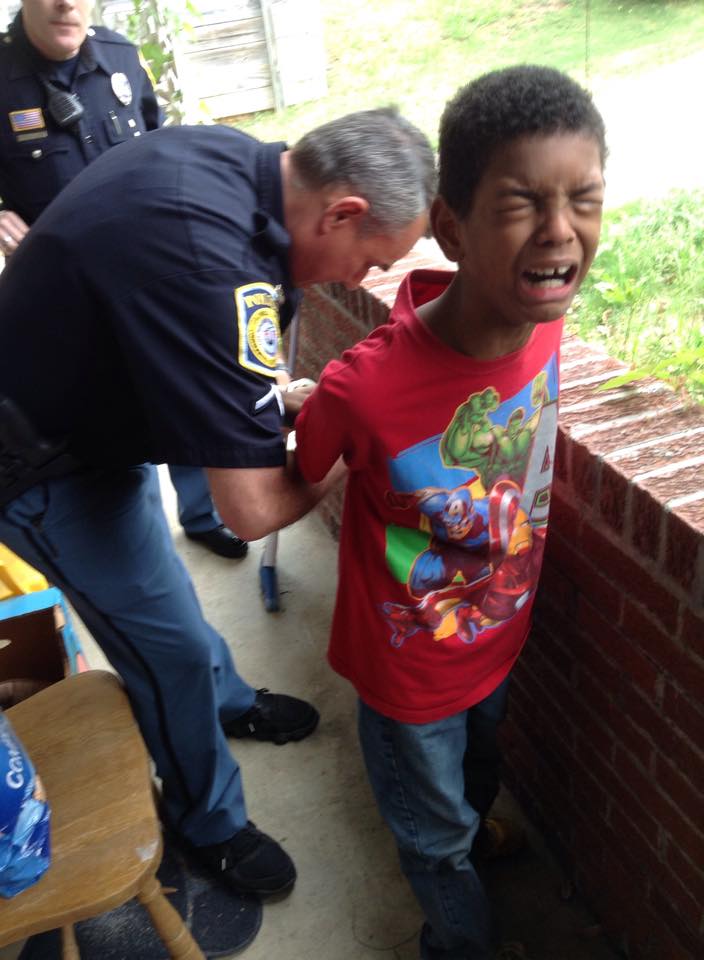
In Columbus, Georgia, Chiquita Hill’s 10-year-old son, Sean, was disrespectful to his teacher and repeatedly defiant in class. Sean’s mother was beside herself, and as I just heard her explain on HLN, was worried about what the child might be like when he reached puberty. Thus she devised the brilliant idea (yes, many people—cretins, but still—are saying that on social media) of “scaring her son straight” by calling 911 and having a police officer pretend to arrest him and take him to jail. Let me repeat that: there are people on social media saying this was a good idea.Many of these people have children themselves. Think about it.
Hill said her son didn’t believe she had called the cops on him—for the crime of talking back to his teacher— until Columbus police officers showed up at the door and put him in handcuffs, put him in the patrol car and pretended to take him to jail. “It happened so quick he didn’t know what to do,” she told the media. “I don’t know what they said to him but he came running down the hill, gave me a big hug said, ‘I’m sorry, I’m sorry!”
Then Chiquita posted the pictures of her son in handcuffs on Facebook, where it has gone viral and will last forever.
There is nothing ethical, civilized, justifiable, reasonable, rational or right about either the conduct of the mother, or the conduct of the police officers. In the context of speeches and protesters in Baltimore and elsewhere proclaiming angrily that the police forces of the United States are racist and determined to exterminate black males, the episode is also hypocritical on the part of both the police and the mother, while intentionally seeding the racial distrust both police and African Americans are supposed to be working together to defuse, not working together to create.
I assume that readers here have functioning ethics alarms so let’s do this as a game, shall we? Before you read further—no cheating now, this is an ethics blog–vote on how many ways this episode involved wrongful conduct. Then see how close you came by finishing the post.
State’s Attorney Marilyn Mosby announced today that the six Baltimore police officers involved in the arrest and subsequent death of Freddie Gray have been charged with criminal charges second-degree murder, manslaughter, second-degree assault, vehicular manslaughter , and misconduct in office. I have no comment on that: I haven’t seen the evidence. I will assume the charges are justified base on what evidence there is.
Nonetheless, Mosby’s announcement and related statements from the steps of Baltimore’s War Memorial Building were unethical, and indeed constituted a professional ethics breach:
Mosby said she told Gray’s family that “no one is above the law and I would pursue justice upon their behalf.” Unethical. Her client isn’t the family. Her client is the state. If the evidence appears too weak to get a conviction based on any new revelations, her duty to her client, which only requires justice, not justice for any party, would be to drop the case. Telling the family that she is working “on their behalf” is either a lie, or, if true, unethical. She is not their lawyer or the victim’s lawyer.
“I heard your call for ‘no justice, no peace,'” she said. “Your peace is sincerely needed as I work to deliver justice on behalf of this young man.”
Ugh. Again the “on behalf of” misstatement. Worse, though, is “I heard your call for ‘no justice, no peace.” What are we to take from this statement, other than the disgraceful admission that the indictment is in response to mob violence and threats of more? She may not say that. By saying it, she has undermined the rule of law. Prosecutors must not”hear” demands that a citizen be prosecuted, or not prosecuted. They are ethically obligated to ignore them, and do what the evidence dictates.
The demonstrators obviously got her meaning. Desmond Taylor, 29, shouted to the crowd, “This day means that your actions bring consequences in Baltimore City.”
Long-time Ethics Alarms commenter Michael R. delivers another of his provocative and informative Comments of the Day, this time on the festering scandal that is prosecutor misconduct and abuses of due process in our criminal justice system. This kind of commentary justifies the existence of Ethics Alarms, in my view, regardless of what I may write here. It is a virtual template for what makes a Comment of the Day.
Q. “Oh, ICK! Why would you take money for THAT?” A. Because it’s valuable, they want it, and I own it, you idiot.
Slate Magazine’s Josh Voorhees seems to think there is something unseemly about Feidin Santana, the bystander who recorded the film on his smartphone showing North Charleston police officer Michael T. Slager shooting and killing Walter Scott on April 4, seeking payment from news outlets who use his video.
In an article revealing that Santana’s lawyers are making the case that he is entitled to compensation, Voorhees writes, “While it may seem opportunistic to try to make money off a video of someone’s death…” and later,
“Regardless of how you feel about Santana trying to cash in, if nothing else it provides another incentive—albeit a less noble one—for bystanders to whip out their phones and start filming when they see a police confrontation.”
Let me be uncharacteristically blunt: anyone who sees anything unethical, unseemly, ignoble or opportunistic about Santana seeking fair payment for his property when it is being used by news outlets all over the country as if the video was shot by their own employees is either… Continue reading →
Just months after suburban Maryland parents Danielle and Alexander Meitiv were cited by Montgomery County’s Child Protective Services for “unsubstantiated neglect” for allowing their children Rafi, 10, and Dvora, 6, to walk home from a park close to home, the defiant parents let their kids to do it again. Again, someone called 911 (anonymously), and again the children were picked up by police.
This time, the police took the Meitiv children to Child Protective Services headquarters and for some reason didn’t tell the parents, who, naturally enough, freaked out. Five and a half hours later the agitated children and frantic parents were reunited. You can read about the initial incident from the mother’s perspective here; and obviously Lenore Skanazy is in full battle array on her “Free Range Kids Blog.” Columnists everywhere are rushing to their keyboards to write columns like this one, by the Washington Post’s Petula Devorak, titled “Why Are We Criminalizing Childhood Independence?”
The ethics of this issue are more complicated than simplistic “We used to walk around freely all the time when we were kids and it was more dangerous then than now” reminiscences are equipped to explore.
Analyzing this ethics conflict (“when two or more ethical principles are in opposition”) screams out for the useful starting point for ethics analysis:
What’s going on here?
Before I answer, let’s get a couple of ethics verdicts out of the way: Continue reading →
UPDATE (MAY 3): I have been convinced that the original post that generated this Comment of the Day went too far. Asking for support for Slager’s defense cannot be unethical: Slager has a right to a defense, and the best one available. My thoughts on that issue, in relation to the Freddie Gray cops, are here. I still think it is obvious that the individual who posted the appeal is doing so for unethical reasons, and is likely a racist, an apologist for a bad cop, and an idiot. But the appeal itself is not unethical, hence the website was not unethical to post it.
________________________________________________
How can a website dedicated to paying for the defense of fired police officer Michael T. Slager be unethical, when every citizen is guaranteed the right to a defense before a jury of his peers? I thought I made my ethical objections to the site clear when I wrote:
Slager deserves a fair trial and will get one, but anyone whose immediate reaction to seeing the horrific video is sympathy for this killer cop needs psychiatric treatment, and quickly.
I also made it clear—I thought–that the text of the appeal betrayed a strange and ugly urge to shield Slager from the consequences of his conduct, which was per se, on its face, undeniably illegal under the laws of every state in the land, including South Carolina. He shot a fleeing man in the back; he cannot claim self-defense. Deadly force is forbidden in such situations. Unless Slager noticed that victim Walter Scott had death-ray shooting eyes in the back of his head, Scott’s death is a homicide, and it’s an open and shut case. The only remaining question is what level of homicide.
The appeal said that the poster supported Slager. Wrong. We should not support police officers who shoot citizens in the back. It attempted to minimize Slager’s offense by calling it a “mis-step.” Intentionally shooting someone illegally is not a mis-step. It’s murder. Then the appeal reminded us that Slager has a family, and didn’t do anything bad before he shot a man to death. Well, “first offense” is not a big mitigating factor when it comes to executing people.
However, I appreciate Ethics Alarms newcomer Gustav Bjornstrand‘s comment, though I don’t think this is the best context for it. Here is his Comment of the Day on the post “Unethical Website Of The Month: Michael T. Slager Support Fund.” I’ll be back at the end.
I venture to say that to offer support to Slager is certainly ethical, in and of itself. That is, if one believed that he or anyone deserves monetary support in order to raise a defence. It is conceivable that even someone who was certain he had committed a crime would choose still to aid him in getting good representation. It is unethical, I suggest, for anyone to assume that Slager is guilty of murder before a court decides the issue. It is possible, even if improbable, that there were circumstances prior to Slager firing that may shed light on his decision to fire. Additionally, there are a few other factors that need to be taken into consideration:Continue reading →
For those who think that our ethical sensitivities don’t evolve for the better over time, I prescribe a careful viewing of that family classic, “It’s A Wonderful Life.”
At the film’s climax, George Bailey, the self-sacrificing hero who has been granted his inadvertent wish to see what the world would be like if he had never been born, finds the love of his life and (in the life he has given up for this dystopian hell) the mother of his children now unmarried, alone and working as a librarian despite the fact that she looks like Donna Reed. He embraces her, and since she’s never met him in this alternate reality, she screams, believing she is being sexually assaulted by a madman. Kind, jovial police officer Bert is summoned to quell the ruckus, and George, who is a bit upset, punches him in the face to avoid arrest, and runs away. Bert then takes out his pistol and fires it at George repeatedly.
He’s a lousy shot.
In 1946, when audiences first saw this film, nobody thought there was anything unusual about Bert’s professional conduct. Many, many films right through the 1960s show police officers, “good guys,” even ones not trapped in a strangely mean alternate reality like Ward Bond’s Bert, shooting at fleeing suspects or criminals. That was considered appropriate police procedure then, and the public, society and U.S. culture saw nothing amiss. You were expected, as a good citizen, to submit to a police officer’s lawful authority. If you resisted arrest and ran, then it was fair and reasonable for the officer to shoot you, ideally after a “Stop or I’ll shoot!” warning. Indeed, many people were shot, and killed, this way. If it was news, it wasn’t on the front page, and it wasn’t considered any kind of an outrage.
Now consider the public and media reaction to Michael T. Slager’s shooting of Walter Scott. We now know that Scott was resisting arrest: he had a bench warrant out on him for non-payment of over $18,000 in child support, and Slager was trying to bring him into custody. Instead of doing as the officer demanded, Scott resisted and ran. Burt would have shot at his back too; the difference is that Slager is a better shot, and George was faster. Slager, however, is completely reviled across the country; even his own lawyer found him so repugnant that he refused to represent him.
That represents a massive shift in cultural values in a little over half a century. Continue reading →
“In North Charleston the officer executed a fleeing man, while in Ferguson an officer used appropriate force to defend himself, but CNN represented the story as an officer executing a fleeing man anyway.”
I literally just saw this minutes ago, so I can’t provide a link, and because smug, biased, despicable-beyond-words CNN morning anchor Carol Costello caused my head to explode with her commentary, the accuracy of my quotes may be a little off.
My brains hit the ceiling the second Costello said, “Unlike the shooting of Mike Brown by a Ferguson, Missouri police officer, the shooting of Walter Scott in North Charleston was captured on video. Witnesses in the Ferguson case disagreed about key facts in the shooting, and about whether Brown’s hands were up or not.”
Disgusting journalism, and close to pure evil. How long did Carol labor over that deceitful phrasing? Though Mike Brown’s shooting has been decisively shown by the credible eye-witness testimony and forensic evidence to have been consistent with the police officer’s account, and though the witnesses claiming that Brown was surrendering have been shown to be following the lead of CNN guest Dorian Johnson, who lied about what happened and set off the nationwide “Hands Up! Don’t Shoot!” protest theme, Costello and CNN are deliberately linked the two incidents, suggesting in tone and context that had there been a video, Darren Wilson might have been shown to be an executioner too. Continue reading →
UPDATE (MAY 3): I have been convinced that this post went too far. Asking for support for Slager’s defense cannot be unethical: Slager has a right to a defense, and the best one available. My thoughts on that issue, in relation to the Freddie Gray cops, are here. I still think it is obvious that the individual who posted the appeal is doing so for unethical reasons, and is likely a racist, an apologist for a bad cop, and an idiot. But the appeal itself is not unethical, hence the website was not unethical to post it.
______________________________________________
On Indiegogo, a competitor of GoFundMe, some deranged individuals have actually—can I be really writing this?—put up a website seeking funds to defend Michael T. Slager, who is, on the video above, shooting Walter Scott in the back as he fled, apparently executing him with multiple shots, handcuffing his motionless body, and then planting a stun gun beside him. Slager deserves a fair trial and will get one, but anyone whose immediate reaction to seeing the horrific video is sympathy for this killer cop needs psychiatric treatment, and quickly.
The text of the appeal is similarly jaw-dropping:
We’re campaigning to show our Support for Officer Michael T. Slager!
Why in the world would anyone want to support a man who has committed a murder and fanned the flames of distrust and racial discord in the process?
We believe in all of our LEOs and want to publicly support them!
Do you believe in video technology? Do you even support murderous law enforcement officers?Apparently so.
Although he may have made mis-steps in judgement he was protecting the community.
Calling shooting an unarmed fleeing man a misstep in judgement is like calling Jeffrey Daumer a bad chef. A white officer hooting a defenseless and fleeing black man endangers the community, by straining the bonds of trust that hold it together.
Michael is a former Coast Guardsman with two stepchildren and a wife who is expecting a child, served for more than five years with the department without being disciplined.
So what? Does this any of this earn him special immunity from the requirements of decency, justice, and respect for human life?
Please help in any way you can.
Why? Why should anyone want anything other than for this disgrace of a cop to be tried, convicted, and locked up for the rest of his life?
He has served five years with the department without being disciplined.
Oh. Well, that changes everything! He should be able to shoot anyone he decides to shoot, then.
Eight people have contributed to this nauseating appeal.





 Ethics Alarms