Casting Ethics: A Black Joan Of Arc?

Sure, why not?

From Playbill:

Manhattan Theatre Club has announced a Broadway revival of “Saint Joan” by Nobel Prize and Oscar winner George Bernard Shaw with direction by Tony winner Daniel Sullivan. Heading the cast as the famous heroine will be Condola Rashad, fresh off her Tony-nominated performance in “A Doll’s House, Part 2.”

Superficially, at least, the casting of Rashad, an African American actress, as the famous “Maid of Orléans,” the French teenager who gained political and military power as a self-proclaimed messenger of God and who was burned at the stake, would seem like precisely the kind of stunt non-traditional casting that I have condemned by subjugating the intent and art of a playwright to affirmative action and virtue-signaling. However, this is not a legitimate objection to this casting choice, and in fact the upcoming Broadway production is as close to a perfect example of how creative casting can enliven a production and deepen its ability to make an audience think.

Joan of Arc, of course, was not black. Nor was she Swedish, though Ingrid Bergman played her memorably enough in the most famous Hollywood version of  Shaw’s play, She also didn’t speak English, and certainly not Shavian English. She spoke French. Ethnicity, race and color are not part of Shaw’s drama, however, nor are they relevant to what Joan of Arc did in life, and what she meant to her nation, its history and our shared Western culture.

How many public schools teach anything about Joan of Arc? How many U.S. students graduate completely ignorant of the historical Joan, not to mention Shaw’s version? Yet hers is one of the most remarkable stories in recorded history.

Joan of Arc was born around 1412, the daughter of a tenant farmer, Jacques d’Arc, from the village of Domrémy, in northeastern France. She was illiterate, as were most  of her class and gender, but also was indoctrinated into the teachings of the Catholic Church by her mother.  France was engaged in what we now call the Hundred Years’ War with England, and England had France by the throat.  A forced  treaty in 1420 disinherited  Charles, French crown prince, and England’s King Henry V—there’s a famous play about him, too– was made ruler of both England and France. Upon his father’s death, Henry VI succeeded him as king in 1422. At this point England occupied much of northern France, and many in Joan’s village, Domrémy, were forced to abandon their homes under threat of invasion.

Thirteen year-old  Joan began to hear voices in her head. Today we think the cause was tinnitus, but she was certain God was assigning her the mission of  saving France by defeating the English, and installing Charles as its the rightful king. Joan took a vow of chastity, as part of her bargain with God; this allowed her to reject a marriage her father arranged for her when she was 16.

Around this time, Joan traveled by herself to  Vaucouleurs, a nearby stronghold of those loyal to Charles. With her faith and her persuasive claim of being a holy messenger, she attracted a small band of followers who were convinced her sudden appearance was the the result of a popular prophecy coming true, and that she was destined to save France. Joan cut her hair short and dressed in men’s clothes to make an 11-day journey across enemy territory to Chinon, where the crown prince’s palace stood. She met with the young man, and convinced him that she was the Real McCoy (they didn’t use that phrase in France, of course)  by allegedly telling him things only God would know. She also  promised Charles that she would see him crowned king at Reims, the traditional site of French royal investiture, and asked him to give her an army to lead to Orléans, then under siege from the English.

Charles granted her request. Think about this for a bit. A strange teenage girl, dressed like a boy and claiming to hear voices, meets with the leader of a nation at war and convinces him to put her in charge of an army.

Amazing. Continue reading

The Supreme Court Rules Against Government-Enforced Political Correctness

The Supreme Court affirmed today that a Trademark law’s restriction on registration of disparaging marks violates the free speech guarantees of the US Constitution. In the case of Matal v. Tam, the Court (as Ethics Alarms predicted over a year ago) ruled that the government cannot legally  deny a trademark to companies or other applicants solely on the basis of the name being regarded as “offensive.”

Good.

The case concerned  an Asian-American band called The Slants, but the decision effectively settles the Washington Redskins’ fight to retain the trademark on its nickname. Harry Reid, also engaging in unconstitutional infringement of free speech, had his Democrats in the Senate send a threatening letter to team owner Dan Snyder, while the U.S. Patent and Trademark Office (PTO), taking its cues from the Obama Administration theme that race and victim-mongering  trumps basic rights, ruled that the Washington NFL team’s name was “disparaging to Native Americans,” and cancelled six of its federal trademark registrations. The team appealed that verdict, and team owner Dan Snyder has vowed not to cave to illegal bullying from the government.

Thanks to the ruling—did I mention that it was unanimous?—the PTO will begin allowing registration of disparaging marks and will not cancel Registered marks because they are disparaging.

The last time I addressed this issue, in December of 2015, I wrote,

“I would like to see Snyder fight off the unethical government speech bullies, foil the political correctness hordes, and then, after he hasn’t heard a peep about team for a couple of years quietly change the anachronistic team name on his own volition. It’s time. The message sent by capitulating to the activists trying to force him to change, however, would be the same dangerous message sent by today’s college administrators, which is that a claim of offense doesn’t have to be reasonable to effectively muzzle speech, just persistent.”

I also wrote, somewhat more passionately ,in an earlier post, Continue reading

Social Media Ethics Conundrum: What Is The Fair, Objective, Rational Response To This?

double-standard

A libertarian website, curious as to how objectively Twitter enforces its standards, registered a complaint about the tweet on the left, and receiving the circled response, sent the tweet on the right, with Twitter responding to a complaint by banning the account.

How should fair, ethical people respond to this?

I do not see the website’s investigation, or this post, for that matter, as partisan or ideologically slanted in any way. A major social media platform used by government agencies, the President Elect, journalists, pundits, and news organizations as well as celebrities, scholars and average members of the public, has a duty commensurate with its power and influence. It can be politically biased and manipulative of public opinion, it can tilt its content to reflect particular interests, policies, cultural attitudes and agendas, but it is unethical for it to do so, particularly when it claims it does not do so.

This is smoking gun proof that Twitter is biased, censoring what it doesn’t like from people and groups it doesn’t like while allowing identical tweets from people and groups it feels an alliance to. It is a double standard. Now what?

Should fair, ethical people continue to use an organization that abuses its influence and trust like that? I use twitter, though only to send out links to Ethics Alarms posts. Am I ethically obligated to stop doing that? Should a non-left biased counterpart to Twitter take away half its business? Well, as we have learned from Fox News vs. the left-leaning mainstream media, competing media entities with off-setting biases still won’t supply what is needed, which is fair, trustworthy and reliable reporting. Continue reading

Comment of the Day: “Ethics Quiz: The Harvard Soccer Team’s ‘Locker Room Talk'”

Men are pigs, and how dare they stereotype us?

Men are pigs, and how dare they stereotype us?

Alizia Tyler, the provocative arch-conservative Ethics Alarms iconoclast whose comments here are frequently far longer than the posts she comments on, delivers the Comment of the Day.  It involves the controversy regarding the Harvard soccer team’s cruel “scouting report” on the sexual attributes of their female counterparts, and the college’s punishment it brought down on the team’s members.

Alizia’s particular focus is the response by the members of the women’s team, which was not the primary focus of the Quiz. Indeed, Alizia’s post is what first brought all of it to my attention. My reaction was, simply, that it is pure, indefensible bigotry. This isn’t about “men,” this is about jerks, and the letter tells us that these women think the two are one and the same. They are not. This is the same as blacks asserting that all whites are racists. It is a bigotry double standard. When women posture in public forums about their innate superiority, the reaction should be exactly as indignant and condemning as when a man says that women should be kept barefoot and pregnant in the kitchen. It never is, however. Misogyny is disgusting. Misandry is cool.

If Harvard president Drew Faust had integrity and was not a biased, feminist social justice warrior, she would end the women’s soccer season too. It is, however, a useful microcosm of what men can look forward to under President Hillary.

Alizia has more to say. Here is her analysis of the letter, a Comment of the Day on the post, Ethics Quiz: The Harvard Soccer Team’s “Locker Room Talk”:


From the Harvard Crimson and the letter published by the women’s soccer team representative:

“In all, we do not pity ourselves, nor do we ache most because of the personal nature of this attack. More than anything, we are frustrated that this is a reality that all women have faced in the past and will continue to face throughout their lives. We feel hopeless because men who are supposed to be our brothers degrade us like this. We are appalled that female athletes who are told to feel empowered and proud of their abilities are so regularly reduced to a physical appearance. We are distraught that mothers having daughters almost a half century after getting equal rights have to worry about men’s entitlement to bodies that aren’t theirs. We are concerned for the future, because we know that the only way we can truly move past this culture is for the very men who perpetrate it to stop it in its tracks.

“Having considered members of this team our close friends for the past four years, we are beyond hurt to realize these individuals could encourage, silently observe, or participate in this kind of behavior, and for more than four years have neglected to apologize until this week.

“We have seen the “scouting report” in its entirety. We know the fullest extent of its contents: the descriptions of our bodies, the numbers we were each assigned, and the comparison to each other and recruits in classes before us. This document attempts to pit us against one another, as if the judgment of a few men is sufficient to determine our worth. But, men, we know better than that. Eighteen years of soccer taught us that. Eighteen years—as successful, powerful, and undeniably brilliant female athletes – taught us that.

“We know what it’s like to get knocked down. To lose a few battles. To sweat, to cry, to bleed. To fight so hard, yet no matter what we do, the game is still out of our hands. And, even still, we keep fighting; for ourselves, yes, but above all for our teammates. This document might have stung any other group of women you chose to target, but not us. We know as teammates that we rise to the occasion, that we are stronger together, and that we will not tolerate anything less than respect for women that we care for more than ourselves.”
_____________________

There is something so creepy in this that has to be located and exposed.

Continue reading

The Redskins Native American Poll: Integrity Check For Progressives And Race-Baiters

Washington-Redskins

My Washington Post is filled with articles and columns reacting to the “surprising” poll results released yesterday—a poll taken by the Post itself— that appears to settle a manufactured controversy of long-standing. If it doesn’t, that will tell us more about those who resist than it does about the merits of the controversy itself.

The Washington Post-commissioned poll shows that 9 in 10 Native Americans are not offended by the Washington Redskins name, despite a steady tom-tom beat of complaints and insults from activists, pandering politicians, cultural bullies and politically correct journalists insisting otherwise. The poll, which was analyzed by age, income, education, political party or proximity to reservation, shows that the minds of Native Americans have remained unchanged since a 2004 poll by the Annenberg Public Policy Center found the same result. (Actually,  Native Americans are somewhat less offended by the name than twelve years ago.)

The immediate question that the poll raises is one that Ethics Alarms has raised repeatedly as a rhetorical one. As the Post wrote today, speaking specifically of the segment of the sports media that had been so doctrinaire in attacking the name, even to the point of censoring it:

“Can they be offended on behalf of a group that they’re not part of, especially a group that appears, overwhelmingly, not to be offended by the word media figures object to?”

To ask the question is to answer it.  If the name in fact isn’t offensive to the group it is claimed to offend, then it is ridiculous for non-Native American to continue to be offended on their behalf.

Thus the poll results pose an excellent test of integrity and honesty for all of the liberals, politicians, political correctness junkies, pundits, social justice warriors and fringe Native American activists who have been so insulting and shrill to supporters of the name. Do they have the courage and fairness to admit they were wrong? Can the ideologically programmed ever do this: do facts matter, or is it essential for them to interpret the world according to cant rather than bend, adapt and compromise to inconvenient, messy reality?

Well, we shall see. The Post’s early results do not speak well for the anti-Redskins zealots. Continue reading

Encore! Presidents Day Ethics: The Presidents of the United States on Ethics and Leadership

It’s President’s Day, and I see that it has been five years since the most popular Ethics Alarms President’s Day post was published. That one, from 2011, reminds us of the ethics wisdom and leadership acumen of the remarkable men who have served their country in the most challenging, difficult, and ethically complicated of all jobs, the U.S. Presidency.

In the middle of a campaign season littered with some disturbingly unethical candidates, it seems especially appropriate to re-post that entry now….with some updates. In 2011, I left out three Presidents, including the current one. Now all are represented, most of them well.

So…

Ladies and Gentlemen, the Presidents of the United States of America:


George Washington: “I hope I shall possess firmness and virtue enough to maintain what I consider the most enviable of all titles, the character of an honest man.”

John Adams: “Because power corrupts, society’s demands for moral authority and character increase as the importance of the position increases.” 

Thomas Jefferson: “On great occasions every good officer must be ready to risk himself in going beyond the strict line of law, when the public preservation requires it; his motives will be a justification…”

James Madison: “No government any more than any individual will long be respected without being truly respectable.”

James Monroe: “The best form of government is that which is most likely to prevent the greatest sum of evil.”

John Quincy Adams: “Always vote for principle, though you may vote alone, and you may cherish the sweetest reflection that your vote is never lost.”

Andrew Jackson: “One man with courage makes a majority.”   (Attributed)

Martin Van Buren: “No evil can result from its inhibition more pernicious than its toleration.”

William Henry Harrison: “There is nothing more corrupting, nothing more destructive of the noblest and finest feelings of our nature, than the exercise of unlimited power.” Continue reading

The Unethical Web-Shaming Destruction Of Holly Jones

kilroysFB.0

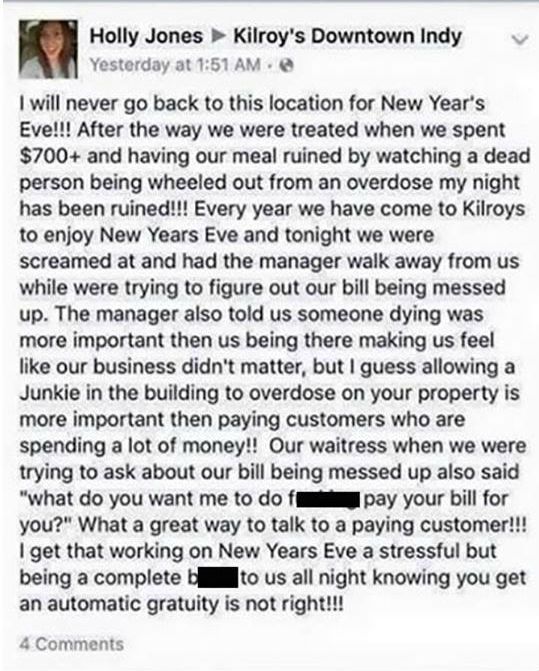
“I will never go back to this location for New Year’s Eve!!!” young Holly Jones ranted on an Indianapolis bar and restaurant’s Facebook page. “After the way we were treated when we spent $700+ and having our meal ruined by watching a dead person being wheeled out from an overdose my night has been ruined!” The angry post accused the evening’s restaurant manager of rudeness, the party’s waitress of profanity and the establishment itself of inattention.

After a sharp on-line rebuttal by the restaurant, the Web Furies were unleashed. Jones’ post became the latest web-shaming catalyst and an invitation to join a cyber-mob where fun could be had by all turning an ordinary jerk into a national villain. Lots of people signed up. The mob tracked down Jones and bombarded her own Facebook page with hate—she took the page down—then moved on to the salon where she worked as a hairdresser, threatening a boycott unless it fired Jones.

So it did.

These exercises in vicious web shaming can be ranked along an ethics spectrum. At the most unethical end is the destruction of Justine Sacco, who had her legitimate marketing career destroyed by social media’s  hysterical over-reaction to a self-deprecating, politically incorrect tweet. Now she works promoting a fantasy sports gambling website, a sleazy enterprise that entices chumps into losing serious cash with a business model derived from internet poker—she not only had her life derailed, she was corrupted too.

At the other end is Adam Smith, the one-time executive who wrecked his own career, with the help of another cyber-mob, by proudly posting a video of himself abusing an innocent Chic-fil-A  employee because Smith didn’t like her boss’s objections to gay marriage.  Somewhere between the two is Lindsay Stone, who lost her job by posting a photo showing her pretending–she later said— to scream at the Tomb of the Unknown Soldier while flipping the bird at the “Silence and Respect” sign.

The distance between Smith and Jones is the difference between words and conduct. Smith’s video showed him abusing a young woman, and his posting of the video indicated that he saw nothing wrong with it. Jones, in contrast, did nothing, other than prove herself to be, at least at the moment she posted her rant, an utter jerk. Everyone along the spectrum, however, including Jones, were excessively and unjustly harmed by the web-shaming  campaign against them. Last I checked, Smith was unemployed and destitute three years after his episode of atrocious judgment.

In the current case, the cyber-mob forcing Holly’s employer to fire her is ethically worse, by far, than anything she can reasonably be accused of doing by posting her criticism of the restaurant. Continue reading

A Merry Christmas For The Washington Redskins, “The Slants,” And The First Amendment

Yes, The Slants were apparently, disparaging. themselves.

Yes, The Slants were apparently disparaging. themselves.

The political-correctness obsessed Democratic component of our government has decided that forcing Dan Snyder to change the name of his football team due to its alleged offensiveness to people who don’t care about football is a legitimate government function, or so they would have us believe. Actually, they believe it is a legitimate political function to lick the moccasins of progressive activist groups who thrive on opportunities to tell others what they can safely say.

After Senate Democrats signed an unethical  missive threatening the Washington Redskins if the team wasn’t renamed something that an enterprising race-baiter wouldn’t find offensive—not as easy as it may seem— the Patent and Trademark Office canceled the registration of “Redskins” using the excuse that Federal trademark law excludes the registration of “scandalous, immoral, or disparaging marks” as well as trademarks that a “substantial composite of the referenced group” perceives as disparaging to a religion, nation, ethnic group, or  belief system. [ You can read my opinion on this ruling here. I’d quote from it, but it’s Christmas Eve.]

The ruling was upheld in the Fourth Circuit, despite the fact that it seem to be fairly blatant viewpoint-based restriction of speech, or in other words, unconstitutional. To his credit, Snyder is not allowing the Democrats to bully him or illegally try to control his speech either, and has the resources to fight. The betting is that the Supreme Court will tell the Trademark Office to stop playing politics.

The Patent and Trademark Office also barred the registration of “The Slants,” the trademarked name of Simon Tam’s Asian-American band. Now the U.S. Court of Appeals for the Federal Circuit just held, in the case of In re Tam, by a 9-to-3 vote, that this exclusion of “disparaging” trademarks, and, by extension, the Redskins ban as well, violates the First Amendment.  This means that the Redskins case is likely to go to the Supreme Court if the government doesn’t agree to let people trademark whatever the want to, regardless of who or what it might “disparage.” Continue reading

Unethical Quote Of The Month: Christiane Amanpour

amanpour

“There are some situations one simply cannot be neutral about, because when you are neutral you are an accomplice. Objectivity doesn’t mean treating all sides equally. It means giving each side a hearing.”

——Christiane Amanpour in 1996, responding to critics who called her reporting on the Bosnian War biased.

Now THIS is an unethical quote, in contrast to the earlier one from Christiane, which I posted yesterday as an “Ethics Quote of the Week.”

I’m posting this one 20 years after it was uttered because…

1. It explains the previous quote from yesterday.

2. It tells us everything we need to know about Christiane, which is to say, she cannot be trusted as a reporter.

3. For some reason I was unaware of it.

4. It appears to have become the motto of all reporters.

5. It is unethical to the core, and

6. A lot of people, including most journalists, don’t know why. Continue reading

A Presidents Day Celebration (PART 4 and Final): The Wild, Wild Ride From FDR to W.

smiling-presidents

All of the Presidents (except FDR) in this last section were alive and kicking while I was, and so to me they are both more real and less fascinating to some extent. Familiarity breeds, if not contempt, a tendency not to idealize. These leaders are no more flawed than their predecessors, they just seem that way thanks to mass media.

Franklin D. Roosevelt

Franklin Roosevelt

Three terms plus, a World War, a Depression, a transformative Presidency and an epic life spent in public service: FDR is another President who can’t be summed up in an anecdote, one book, or a hundred. He accomplished enough great things to be a deserving icon; he committed enough wrongs to be judged a villain. (He was pretty clearly a sociopath, but a lot of great leaders are, including a fair proportion of ours, including some of the best.) The only completely unfair verdict on this Roosevelt is not to acknowledge the importance and complexity of his life. Here are some of my favorite items about him:

  • FDR wrote down a plan when he was still in school outlining the best way for him to become President. The plan was essentially to follow his distant cousin Theodore’s career steps: Harvard, Assistant Secretary of the Navy, Governor of New York, Vice-Presidential candidate, and President. (He skipped “Rough Rider.”) Amazingly, he followed it, and it worked.
  • Conventional wisdom holds that FDR’s polio transformed his character, and that without that crisis and challenge he would have been content to be a rich dilettante. I doubt it, but there is no question that he fits the Presidential survivor template, and that his ordeal made him stronger, more formidable and more determined.
  • Many Presidents had strong mothers, especially, for some reason, many of our Chief Executives from Roosevelt to Obama. Franklin’s mom, however, wins the prize. It’s amazing Eleanor didn’t murder her. But Mrs. Roosevelt is why Eleanor was there in the first place: all of our Presidents raised by strong mothers married very strong wives.
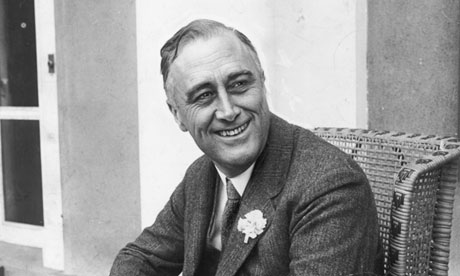
  • If a computer program were designed to create the perfect American leader, it would give us FDR. He was the complete package; his charisma, charm and power radiate from recordings and films that are 90 years old. That smile! That chin! That head! That voice! He is one of the very few Presidents who would be just as  popular and effective today as the era in which he lived.
  • And just as dangerous. FDR is also a template for an American dictator, which, I believe, he would have been perfectly willing to be. It’s no coincidence that Franklin was the only President to break Washington’s wise tradition of leaving office after two terms.
  • Political and philosophical arguments aside, at least four of Roosevelt actions as President were horrific, and would sink the reputation of most leaders: 1) Imprisoning Japanese-Americans (and German-Americans, too); 2) Ignoring the plight of European Jews as long as he did, when it should have been clear what was going on; 3) Handing over Eastern Europe to Stalin, and 4) Knowing how sick he was, giving little thought or care to who his running mate was in 1944.
  • Balancing all that, indeed outweighing it, is the fact that the United States of America and quite possibly the free world might not exist today if this unique and gifted leader were not on the scene. Three times in our history, the nation’s existence depended on not just good leadership, but extraordinary leadership, and all three times, the leader we needed emerged: Washington, Lincoln, and Franklin. I wouldn’t count on us being that lucky again.

I left the bulk of reflection about the character and leadership style of Theodore Roosevelt to one of Teddy’s own speeches to embody, and I’ll do the same for his protege.

On September 23, 1932, New York Governor Franklin D. Roosevelt gave a speech at Manhattan’s Commonwealth Club. (Everyone, conservative, liberal or moderate, should read it….here.) It was a defining statement of progressive principles and modern liberalism, redefining core American values according to the perceived needs of a changing nation and culture.  It is a radical speech, and would be regarded as radical by many today, even after much of what Roosevelt argued was reflected in the policies of the New Deal.

After sketching the origins and progress of the nation to the present, he flatly stated that the Founders’ assumptions no longer applied:

A glance at the situation today only too clearly indicates that equality of opportunity as we have know it no longer exists. Our industrial plant is built; the problem just now is whether under existing conditions it is not overbuilt. Our last frontier has long since been reached, and there is practically no more free land. More than half of our people do not live on the farms or on lands and cannot derive a living by cultivating their own property. There is no safety valve in the form of a Western prairie to which those thrown out of work by the Eastern economic machines can go for a new start. We are not able to invite the immigration from Europe to share our endless plenty. We are now providing a drab living for our own people….

Just as freedom to farm has ceased, so also the opportunity in business has narrowed. It still is true that men can start small enterprises, trusting to native shrewdness and ability to keep abreast of competitors; but area after area has been preempted altogether by the great corporations, and even in the fields which still have no great concerns, the small man starts with a handicap. The unfeeling statistics of the past three decades show that the independent business man is running a losing race. Perhaps he is forced to the wall; perhaps he cannot command credit; perhaps he is “squeezed out,” in Mr. Wilson’s words, by highly organized corporate competitors, as your corner grocery man can tell you.

Recently a careful study was made of the concentration of business in the United States. It showed that our economic life was dominated by some six hundred odd corporations who controlled two-thirds of American industry. Ten million small business men divided the other third. More striking still, it appeared that if the process of concentration goes on at the same rate, at the end of another century we shall have all American industry controlled by a dozen corporations, and run by perhaps a hundred men. Put plainly, we are steering a steady course toward economic oligarchy, if we are not there already.

Clearly, all this calls for a re-appraisal of values.

So Franklin Roosevelt re-appraised them: Continue reading