Web Hoaxes: Not Funny, Always Unethical

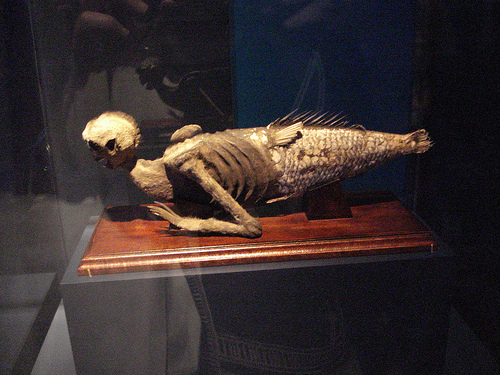
P.T. Barnum’s “Fiji Mermaid:. At least in 1842,. it wasn’t on the web.

Ethics Alarms is swearing off “angry ex-boyfriend/girlfriend takes cruel outrageous revenge” stories, no matter how juicy the ethics lesson may be. First it was the tattoo artist who defaced his ex’s back with a huge and ugly drawing of steaming dog excrement that was fantasy masquerading as news, and now it’s the Polish dentist scorned…remember? The one who pulled out her cheating boyfriend’s teeth? Yes, it seems that horror story was a hoax too.

A lot of people who should know better think that web hoaxes are funny and hoaxers are clever. I regard them as the ethical equivalent of  chefs and waiters who spit in restaurant customers’ food. The web creates—a web!—of information and communication across nations and cultures, and poisoning that web with bogus stories creates a chain of unpredictable harm. At very least, hoaxes make every trusting source that passes along the lie an unwitting accomplice in a despicable act. It harms long-nurtured relationships of mutual trust between those who post on blogs and websites and those who read them. Continue reading
When Routine Deadens Ethics

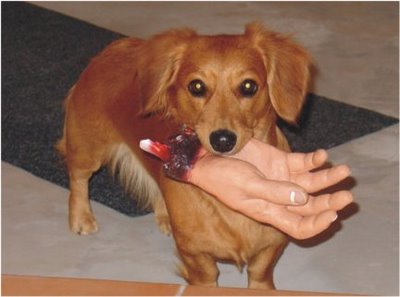
"Good boy!!!"

A Niagara County, New York coroner just resigned as he faces possible imprisonment after taking a fresh body part from the carnage of a local plane wreck and using it to train his personal cadaver-sniffing dog.

How, you may ask, could anyone, particularly a public coroner, be so callous and ethically numb? “Hey! Here’s a leg! What luck! Now I can train Rex!” How can a professional—or a human being— treat some grieving family’s loved one like a piece of meat?

I think it’s natural, really. Coroners, morticians, medical examiners, rescue workers, military commanders and doctors all have to detach themselves from the human beings whose deaths are a routine part of their daily work, or they risk being unable to do their work at all. Objectivity and independent judgment are crucial elements of professional conduct, and emotion, including sorrow, sympathy, and revulsion, is the enemy of objectivity. The danger is that in order to deaden one’s emotions through repetition and routine, one risks unplugging an ethics alarm. For these emotions are also part of the ethical value of caring.

The coroner might have been excellent at his job, but he lost all human connection to his work. The mangled body part that had once been a living, breathing, loving person seemed like a piece of meat, because to the coroner, like his dog, it was just a piece of meat.

When feeling gets in the way of a professional’s  duties, it is only normal for the professional to try to eliminate them, and even prudent, except that the absence of feelings can cause a deficit in ethics. Building those callouses over normal human emotions are matter of survival in some professions, but doing so creates what I call a “pre-unethical condition” requiring awareness and vigilance.

The Niagara coroner wasn’t sufficiently vigilant, and he fell into a career ending trap.

______________________________

Facts: WGRG New York

Graphic: Greenwich Roundup

Ethics Alarms attempts to give proper attribution and credit to all sources of  facts, analysis and other assistance that go into its blog posts. If you are aware of one I missed, or believe your own work was used in any way without proper attribution, please contact me, Jack Marshall, at  jamproethics@verizon.net.

Now THIS Is Unprofessional Conduct: The Lesson of the Jilted Dentist

No! It's NOT safe! It's not safe at ALL!

The hallmark of professionals is trust. We should be able to trust professionals to do their duty on our behalf despite their personal feelings. Lawyers often dislike or even fear their clients, for example: a defendant charged with murder who has stabbed his previous three attorneys with pencils is now back in court with a fourth, though certain precautions have been taken. When a professional finds that his or her personal feelings are so intense that they jeopardize the professional’s ability to fulfill their duties objectively, fairly and well, then that’s a conflict of interest, and it must be dealt with, usually by stepping aside.

A professional who doesn’t step aside despite an evident conflict has determined that he or she has the detachment and self-control to overcome it. A recent news story from Poland, however, suggests that it is not a good idea to risk too much trust on a professional’s determination that she can remain objective. Continue reading

Do Nicer People Earn Less Money? Of Course They Do. And That’s the Way it Should be.

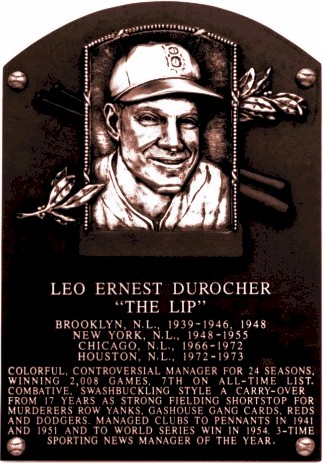
Leo Durocher figured out that "nice guys finish last" 60 years ago, and he never went to college. Now three academics, after extensive research, have "discovered" the same thing. Ah, scholarship!

A study by Cornell professor Beth A. Livingston,  Timothy A. Judge of the University of Notre Dame and Charlice Hurst of the University of Western Ontario study used survey data to examine “agreeableness” and found that disagreeable men made 18%, or $9,772 annually, more in salary than those who are more accommodating. The salary disparity was  less among women, with disagreeable females making 5% or $1,828, more than those who are easier to get along with. Does this shock you? It shouldn’t.

As is depressingly often the case, the academics who come up with such crack-brain studies—I read this one, and will want that wasted hour back when I’m on my death-bed so I can watch one last re-run of “Magnum, P.I.”—have so little experience with the working world and the reality of non-academic cultures that they don’t even comprehend their own research and draw absurd conclusions from it.

“The problem is, many managers often don’t realize they reward disagreeableness,” Livingston told the Wall Street Journal. “You can say this is what you value as a company, but your compensation system may not really reflect that, especially if you leave compensation decisions to individual managers.”

Oh brother. Continue reading

Herman Cain Flunks The Presidential Candidate Competency Test

Herman Cain's Consitution

The legal ethics standards do not require that a lawyer be fully knowledgeable and competent to handle a particular representation when he or she accepts the assignment, but does require that the lawyer be sufficiently up-to-speed in the legal area at issue when the work commences. That standard is reasonable for the law,  but the American public should expect more when an individual has the audacity to pronounce himself fit to be President of the United States. One area I would hope a candidate wouldn’t need to bone up on after the fact: the nation’s founding documents.

Former pizza CEO and conservative radio host Herman Cain officially entered the contest for the GOP nomination over the weekend with this statement, following his exhortation to America’s public to read the Constitution:

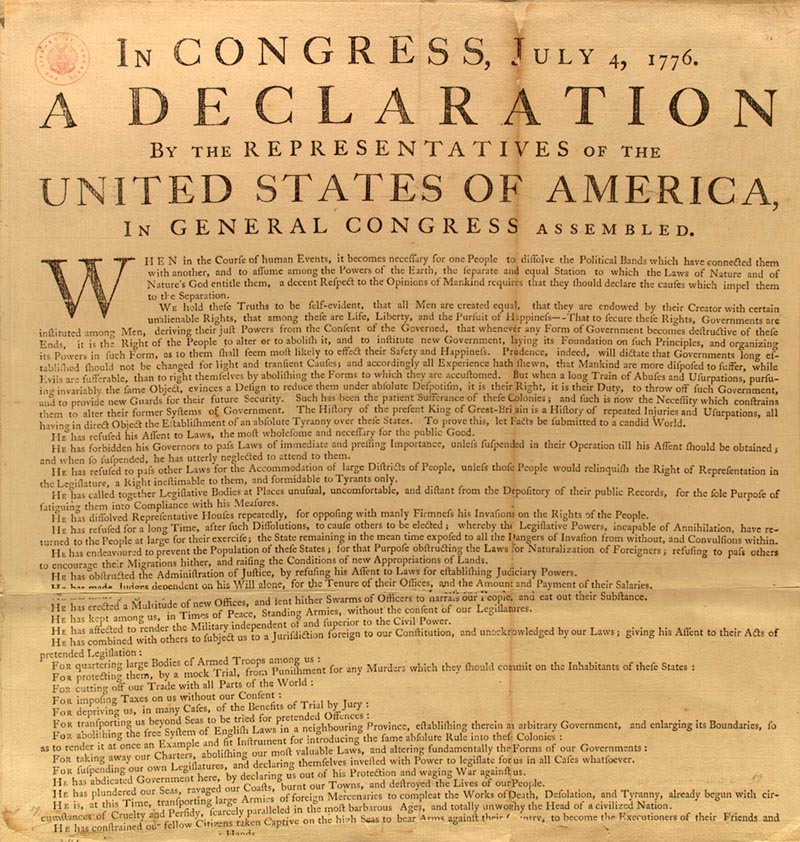
“Keep reading! Don’t stop at life, liberty and pursuit of happiness.”

Meet me at the bridge; I’ll be jumping at noon. Continue reading

Botching Big News: CNN and Fox Show How Far Their Profession Has Fallen

It was nearly 11 PM, E.S.T., and the sudden announcement that President Obama was about to make an important announcement “related to national security” had been hanging in the air for almost a half hour, as TV reporters, hosts and anchors speculated and waited. I was jumping back and forth between two networks when the news began leaking out about what the announcement would be: Osama bin Laden had been killed in a U.S. operation. The professional ethics on both networks promptly evaporated, as Walter Cronkite, David Brinkley and Howard K. Smith looked down from news anchor heaven and retched. Continue reading

The Professions Most Likely to Cheat on Their Taxes?

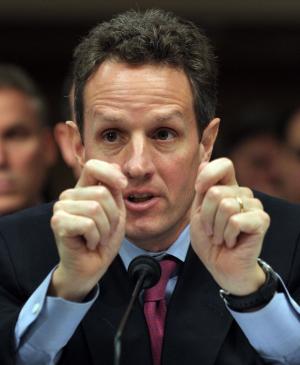
Gee, where do "Treasury Secretaries" fall on the list?

A study of I.R.S. data by a University of Chicago graduate student, now Doctor, Oscar Vela,  produced the following list of the professions most likely to file fraudulent tax returns, at least according to his analysis. Make of it what you will. The Time Magazine website blog post about the list is worth reading, first for the blogger’s highly questionable theories explaining, for example, why lawyers aren’t on it, but mostly to see conclusive proof that Time is hiring English-as-a-second-language night students, relatives of Ko-Ko the talking gorilla, or stroke victims to write their blogs. Sample sentence: “His conclusion was that as much as we would like to think so we pay taxes out of  the goodness of our hearts, or even because we are fearful of fines or worse.” Henry Luce just did a back-flip in his grave.

Dr. Vela’s theory is that the professions that are required to maintain a perception of integrity are less likely to cheat. Let us say that I am dubious. Why then are scientists so high on the list?

Here it is: Continue reading

Becoming a Society Without Empathy

Attorney, blogger and legal ethicist Franco Tarulli has a thoughtful post on The Ethical Lawyer about the results of a recent study I had missed, and now that I know about it, I almost wish I was still missing it. The findings are ominous. Continue reading

Halloween Ethics! Facebook Ethics! Political Ethics! Blackface Ethics! It’s Tennessee’s Aunt Jemima Affair, the Ethics Controversy That Has Everything!

It’s just after Halloween, and followers of the ethics wars know what that means: somewhere, somebody is in trouble for their choice of costume.

Actually, in this case it’s someone in trouble for her choice of someone in costume to pose with: Tennessee Republican state Rep. Terri Lynn Weaver posted a picture on the Internet of her standing with her pastor, who had dressed up as Aunt Jemima—of syrup fame and black stereotype infamy— for some Halloween festivities. Her caption to the photo:

“Aunt Jemima, you is so sweet.”

Weaver has apologized, swearing that when she posed for the picture with her pastor, she did not know the photo would upset anybody. “It was fun, done in innocence. My friend is dressed up as syrup. He wife was going to be a pancake,” said Weaver. “I never intended to offend anyone. I took the picture off my Facebook. I apologize if it ever meant to offend anyone.”  Weaver,who apparently has lived in a cave since 1957,  also said she was not aware that Aunt Jemima represented black stereotypes to many people, and was unaware that wearing blackface was also considered offensive to the vast majority of Americans. Yes, she really did. (Note: I know Aunt Jemima as a brand of pancake mix; I did not think the logo  gracee any syrup containers. I assumed Weaver confused confused the good Aunt with her white rival. Mrs. Butterworth, who is a syrup brand. Aunt Jemima obviously hangs out with pancakes, so the pastor’s wife was on firm ground, no matter what. But thanks to a syrup-minded reader, I have been set straight: there is Aunt Jemima syrup, too)

State Sen. Thelma Harper, an African-American, said she and members of the Black Caucus want to put Harper before the House Ethics Committee.“This is what we have had to live with, making a mockery of being black and copying the language that Aunt Jemima used,” said Harper.

This controversy has everything! Halloween ethics! Blackface ethics! Facebook ethics! Political ethics! Syrup ethics!

Let’s go through them, shall we? Continue reading

Steven Slater And The Rest of the Story: No Surprises

Occasionally, there is cosmic justice. The astounding number of bloggers, media commentators and  ordinary working folks who have expressed admiration for Steven Slater, the irresponsible and unprofessional flight attendant who threw a tantrum of Adam Sandler proportions at the end of a recent Jet Blue flight, appears to have been itching for a confrontation throughout the flight, and had behaved is a rude and provocative manner to more than one passenger.

Well, of course. Continue reading