From Acculturated, A Perfect Rationalization #22

The post by Mike Judge on the pop culture site Acculturated is such a perfect example of The Worst of All Rationalizations, #22 The Comparative Virtue Excuse, that I might add a permanent link to it in the Rationalizations List.

In case you have been out of the Ethics Alarms loop, here is #22:

22. The Comparative Virtue Excuse: “There are worse things.”

If “Everybody does it” is the Golden Rationalization, this is the bottom of the barrel. Yet amazingly, this excuse is popular in high places: witness the “Abu Ghraib was bad, but our soldiers would never cut off Nick Berg’s head” argument that was common during the height of the Iraq prisoner abuse scandal. It is true that for most ethical misconduct, there are indeed “worse things.” Lying to your boss in order to goof off at the golf course isn’t as bad as stealing a ham, and stealing a ham is nothing compared selling military secrets to North Korea. So what? We judge human conduct against ideals of good behavior that we aspire to, not by the bad behavior of others. One’s objective is to be the best human being that we can be, not to just avoid being the worst rotter anyone has ever met.

Behavior has to be assessed on its own terms, not according to some imaginary comparative scale. The fact that someone’s act is more or less ethical than yours has no effect on the ethical nature of your conduct. “There are worse things” is not an argument; it’s the desperate cry of someone who has run out of rationalizations.

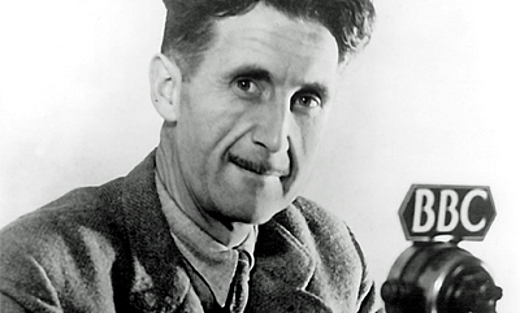
Judge spends his post, titled “Why Are Some Journalists Acting Like Snowflakes?,’ mocking journalists who complain when the President punches down at them, which is unethical conduct on his part, or when the public is openly hostile to reporters, which is wrong, but it is the escalating bias and trustworthiness of the news media that arouses the public’s ire. In contrast, he reminds us that George Orwell (above) was shot in the neck when he was on assignment as a reporter, that young reporter Ernest Hemingway was hit with a mortar in World War I, and that Woodward and Bernstein thought their lives were at risk. Continue reading

Morning Ethics Warm-Up, 9/16/17: Amazon Purges Reviews For Hillary, Equifax Must Die, Making Literature More Diverse, And The Red Sox Get Away With It…

GOOD MORNING!

1 “It would be wonderful, wouldn’t it?”

This is the response that the widow of writer Roald Dahl to a reporter’s suggestion that Charlie, the hero of Dahl’s “Charlie and the Chocolate Factory” (aka “Willy Wonka and the Chocolate Factory:) should be made black in a future “reworking” of the book. Recently Mrs. Dahl has claimed that Charlie was originally supposed to be black, but that her husband changed the character before the book was published. She blames his agent, who was, she says (none of this is more than hearsay) afraid that the book wouldn’t sell as well in American with a black hero. She blames “American sensibility.”

No, it wouldn’t be wonderful to start changing the races (and inevitably, genders and sexual orientations) in “reworkings” of literary classics. It would be unethical and irresponsible, as well as a defilement of the author’s visions and creations. Whatever the reason was, and we cannot know it regardless of what Mrs. Dahl now claims, Charlie was white in Dahl’s book. If he had wanted his book to be about a black child, or a little girl, or a Muslim transsexual, the author would have made it so. If someone obsessed with tribal identity politics wants to write a new adaptation under their own name so we can jeer and mock him or her, swell. But it isn’t any more “wonderful” to “rework” Dahl’s own story this way than it is to make Bob Cratchit black, or Captain Ahab black, or Bigger Thomas in “Native Son” Asian-American.

Of course, a stage or film adaptation of the book can cast it any way it chooses.

2 The major business ethics story this past week has been that data security breach by credit giant Equifax. An estimated 143 million Americans now face identity theft for the rest of their lives because the company wasn’t competent to be in the business it was in. It’s that simple. The ways in which Equifax blundered into allowing all this data to be hacked are legion, with more revelations almost daily. My personal favorite is that it neglected to install a patch that would have made its files more secure, delaying for months for no good reason.

Business analysts point out that despite this massive demonstration of ineptitude, the company is not likely to suffer more than the cost and inconvenience of a class action lawsuit or five. The companies that pay Equifax weren’t harmed by the breach, just the lives of the credit-seekers who they use Equifax to check. Nobody seems to think that even this massive misconduct will put Equifax out of business.

The company has dumped some executives, and will probably dump some more, reorganize, and padlock that barn door securely now that the horse has fled. TooLate. The company is untrustworthy, and more than that, companies like Equifax that gather personal information about innocent citizens need to be scared sick about what will happen to them if they can’t keep the information from falling into malign hands. Equifax needs to be put out of business. Its leaders and management need to be imprisoned, fined so severely that they are reduced to eating cat food, or blacklisted so their future employment is limited to bait shops and traveling carnivals. Continue reading

The Lesson Of The Harvard-Chelsea Manning Fiasco

I often point out to my ethics classes that when the ethics alarms don’t sound, one can make decisions that result in ethics zugswang, which is the hopeless bind where there are no ethical solutions, only unethical ones. Then the only practical objective left is damage control: determine which course  is the least unethical. An ethical result is no longer possible. It was precluded forever by the original ethics failure.

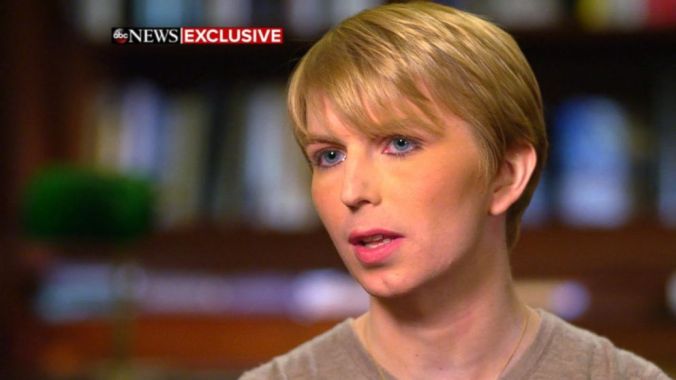
I can’t think of a better example of this process than the Kennedy School’s botched appointment of Chelsea Manning as a ” visiting fellow.” It was an incompetent, foolish, reckless decision that a half-wit should have known would cause an ugly and unnecessary controversy. What was the school thinking?

I can only speculate. Either the school was looking for “buzz’—it got that all right— , or was trying particularly odious progressive virtue-signaling to the anti-war crowd that still hangs out around Harvard Square clutching their love beads, or most indefensible of all, was giving a gratuitous nod to the current transgender fad. Whichever it was of these, it should have been obvious that the choice was a terrible idea, and it says a lot about the school’s leadership and procedures that nobody in a position of influence shouted, “Wait, are you kidding? Chelsea Manning?  She’s a convict and a felon who leaked secret information to enemies of the United States!” Manning, as I noted in the Morning Warm-Up covering the story, isn’t a scholar, a deep thinker, or a stable or a trustworthy individual. Selecting her was bound to upset other more qualified teachers at the school as well as any American not partial to traitors, and it did. It also devalued every previous fellow at the Kennedy School, by demonstrating that being a Kennedy School fellow wasn’t a credential signifying special talent or admirable qualities. Not if Chelsea Manning qualified, it wasn’t.

The fury over the appointment erupted so vigorously in public, and, I suspect, even more vigorously behind the ivy-covered doors in Cambridge (my mother spent most of her working life at the University, and ended it as Asst. Dean of Housing: the Marshalls know how Harvard works), that the reversal wasn’t as big a surprise to me as it seems to be to some. Nonetheless, the criticism levied by many has justification. Wrote Jonathan Turley, for example,

“The only thing worse than Harvard’s Kennedy School of Government appointing Chelsea Manning as fellow was the school’s withdraw of the fellowship…My concerns are not really focused on Manning but the danger of universities tailoring its academic programs to public opinion. I have written extensively about the hostile environment for conservative speakers on campus. Invitations have been withdrawn due to opposition groups and protests. This case is even more concerning because it was a formal invitation to join the program as a fellow. The invitation and then the withdrawal leave total confusion as to the purpose and academic content of these fellowship positions. Harvard appears to have carefully avoided any principled ground in both the appointment and the withdrawal.”

Continue reading

Morning Ethics Warm-Up, 9/15/17: Lafayette, Harvard, Manning, And “Shut Up And Give Us The Score!” [Updated]

Good Morning!

1 Commenter Other Bill had to ruin my evening by posting this defense of Jamele Hill from a Sports Illustrated writer, which would be enough for me to cancel my subscription if I had one.

“I was going to give this a pass. Truly, I was. Jamele Hill, the gifted young woman who co-hosts ESPN’s The Six every night with my old Morrissey Boulevard running buddy Michael Smith, got on her electric Twitter machine and tweeted out her unremarkable—and damned near irrefutable—opinion that the current president of the United States is a racist and a white supremacist. This drew the usual screams from the political flying monkeys of the American Right. ESPN responded with a craven corporate response that I’ll get to in a minute, but let me just say right now that you will not believe that the response was written by anyone who ever came within a light-year of any newsgathering operation. OK, so I thought that was pretty much it. I agreed with everything Hill tweeted. I thought what she said should be obvious to everyone in America at this point. She delivered her opinion. There was the customary cyber-bullying pushback, and we all move on.”

This is a perfect example of why sports writers should be seen and not read or listened to on non-sports topics. Let’s see:

a) The fact that she is “gifted”—a matter of opinion: a smart ESPN broadcaster wouldn’t do something this stupid—is irrelevant to the controversy. So a bad sports journalist  would be less justified in attacking the President like this?

b) A journalist calling the President of the United States a racist is in fact quite remarkable, and if an ESPN employee had called Barack Obama equivalent things, he or she would have been fired so fast her hair would have combusted.

c) OK, asshole, give me your closing argument about how President Trump is irrefutably a white supremacist. You can’t use the fact that he believes in enforcing immigration laws, or the fact that white supremacists tend to support him, when his political opponents are addicted to saying and writing things like “the whole white race is a virus.” You can’t use the fact that he doesn’t believe that tearing down statues of Civil War heroes is smart or valid, because I agree with him, and I am not a white supremacist. The fact that he implicitly defended the right of white nationalists to exercise their First Amendment rights makes him a supporter of the Constitution, as his oath of office requires, and not a nascent totalitarian like the hate-speech banning politicians you probably support.

So what have you got? I’d say nothing. It’s “irrefutable” to you because your left-wing friends say it is….

d) …not that whether Hill was right or not is the least bit relevant to whether ESPN is sending the message that gratuitous public anti-Trump, race-baiting grandstanding from employees is acceptable, but anti-Democrat/Muslim/Trans statements are not. It is sending that message, and that’s a double standard and obvious bias.

e) ESPN’s response was craven all right, but for the opposite reason that this guy says.

f) The fact that mostly conservatives correctly condemn Hill and ESPN only proves that the Left has lost its ethics alarms and professional compass, or broken them while stomping and screaming during their post 2016 election tantrum. It’s not a partisan or political verdict, except that “the resistance” would defend the Zodiac killer if he attacked the President. That’s their flaw, not ours.

2. Today’s “I was going to post on it but the story is so stupid that I don’t want to give it the prominence” note is this one.  Continue reading

Portrait Of An Ethics Train Wreck:The Race-Baiting ESPN Commentator

The recent still-rolling ethics train wreck launched by ESPN “SportsCenter” co-host Jemele Hill is a perfect example of how such cultural fiascos occur.

Hill, a young African American woman, went on a Twitter rant against President Trump  this week.

“Trump is the most ignorant, offensive president of my lifetime,” Hill tweeted Monday night. “His rise is a direct result of white supremacy. Period. He is unqualified and unfit to be president. He is not a leader. And if he were not white, he never would have been elected.”

Factors, Stage I:  The Instigator

A. An ethics alarms doesn’t  ring.

Why in the world would Hill think that the face of a national broadcast network could publicly call the President of the United States a white supremacist without causing a problem for her employer? The key ethics values being breached  are trust and responsibility. She has a responsibility to ESPN, which should be able to trust her not to harm it or upset viewers.

B. An instigator has an inflated view of his or her own importance, indispensability, wisdom, expertise or authority.

We are living in an age where narcissism is epidemic, but even so, a sports anchor has to be able to comprehend that once he or she is outside the realm of sports, her opinion on the President or anyone else cannot possibly have a positive effect on public discourse unless it is carefully crafted, thought out, and expressed.

The key ethics values being breached are competence and  humility.

C. Social media.

Any public figure, including TV personalities, should not use social media until they recognize that a flamboyant post is the equivalent of a press release. Attacking the President, especially in personal terms, is stupid, even when the attack itself isn’t as stupid as Hill’s. (Uh,  Jemele ?  President Obama would never have gotten to within a baseball throw (remember, we saw him throw a baseball) of the White House, or even the nomination, if he were not black. Before him, no candidate, successful or not, for President would have been elected if wasn’t white, or male for that matter. Or Jewish. The accusation if Trump were  “not white, he never would have been elected” is really, really stupid.

The key ethics value being breached is competence.

D. Corrupting cultural influences.

Too many of Hill’s likely peer groups and those around her have, since last November 8, engaged in nearly continuous disrespect of the President’s person, his office, and the process that elected him. This continues to be divisive, destructive, and dangerous for the nation. It is wrong. The culture is giving her terrible role models, like Maxine Waters, celebrities on Hollywood award shows, and Stephen Colbert, who, for example, thought that it was a appropriate and hilarious to repeatedly give the “Heil!” salute on his show as an insult to the President. CBS (unethically) lets him get away with this kind of thing, because it embraces the Star Syndrome, or the King’s Pass, rather than ethical principles.

The key ethics value being breached is citizenship.  Hill has been misled into thinking that amplified hateful conduct and rhetoric toward a President is appropriate conduct for any U.S. citizen. it isn’t. It is even more inappropriate for prominent Americans in the media.

Stage Two: Failed Containment

ESPN’s response was this: “The comments on Twitter from Jemele Hill regarding the President do not represent the position of ESPN. We have addressed this with Jemele and she recognizes her actions were inappropriate.”

This made the problem worse. Why? Because ESPN had, more than once, suspended or fired prominent personnel for far less “inappropriate” public comments than what Hill said. Thus it appeared to shrug off a personal attack on the President, including accusations of racism.

Factors, Stage Two

A. Inept Ethics Chess

How could ESPN, already under fire for politicizing its sports reporting (and losing viewers as a result) not realize that an ethics train wreck was starting to roll, and that it could either stop it, or accelerate it? Hill had made sure that no matter what it did, it would be attacked, but no valid attacks would land if it said, “As we have in the past when on-air personnel have made inflammatory statements about public figures and issues unrelated to sports, ESPN has suspended Jamele Hill for her comments about President Trump.”

The key ethics values being breached are  competence and fairness.

B. Bias makes you stupid.

ESPN and its parent company Disney is largely run and populated by Democrats, progressives and liberals who detest President Trump, and thus have their values paralyzed by bias in everything related to him. Echo chamber or no, they should recognize this by now, and adjust accordingly. Everyone has to recognize the biases that lead to bad decision-making. In addition, one is in immediate peril of unethical conduct when one refused to respect the choices and views of fellow citizens, especially when you purport to provide services and products to all

The key ethics values being breached are trust, competence and fairness.

C. Unethical messaging

As a business, employer and a prominent presence in the culture, ESPN has an obligation to send clear, positive, responsible messages to its employees, audience and the public at large. Ugh. Here are some of the messages a reasonable person could derive from the networks bland reaction to Hill’s rant:

If you are female and black, you can pretty much get away with saying controversial stuff that a white man can’t. (See: Curt Schilling)

ESPN thinks the President and half the population and probably more than half its audience is racist, but would prefer employees not broadcast that fact, because it is inappropriate.

ESPN hires self-righteous political grandstanders rather than competent sports commentators.

ESPN has double standards.

ESPN has no standards.

ESPN is run by a confederacy of gerbils.

Here is the message that ESPN, if it were responsible, trustworthy, fair and competent while respecting its viewers, should have sent with whatever action it chose to take regarding Hill: Continue reading

Ethics Alarms Baseball Ethics Special Report: The Boston Red Sox, Sign Stealing, Technology, And Cheating [UPDATED]

[I got the news about Major League Baseball’s announcement that the Boston Red Sox had admitted that some of the team’s employers and players had engaged in illegal sign-stealing about an hour before the Sox-Blue Jays game was scheduled. My intent was to write the post about it last night after the game. The game, however, went 19 innings and lasted 6 hours. (The Sox won, and absent this scandal, it would have been a big news story itself, one of the most important victories of the year and one that set several team records.) So the post didn’t get written, and believe it or not, I have occasional priorities and commitments that take precedent over my profit and income free ethics blog. Thus I consider the multiple e-mails and Facebook messages I have received accusing me of ducking the issue less than amusing, an unwarranted attack on my integrity. To all of those individuals, most of whom barely read the news reports, I say, “Bite me.”]

Yesterday afternoon the New York Times broke the following story, which reads in part:

Investigators for Major League Baseball have determined that the Red Sox, who are in first place in the American League East and very likely headed to the playoffs, executed a scheme to illicitly steal hand signals from opponents’ catchers in games against the second-place Yankees and other teams, according to several people briefed on the matter.

The baseball inquiry began about two weeks ago, after the Yankees’ general manager, Brian Cashman, filed a detailed complaint with the commissioner’s office that included video the Yankees shot of the Red Sox dugout during a three-game series between the two teams in Boston last month.

The Yankees, who had long been suspicious of the Red Sox’ stealing catchers’ signs in Fenway Park, contended the video showed a member of the Red Sox training staff looking at his Apple Watch in the dugout. The trainer then relayed a message to other players in the dugout, who, in turn, would signal teammates on the field about the type of pitch that was about to be thrown, according to the people familiar with the case.

Baseball investigators corroborated the Yankees’ claims based on video the commissioner’s office uses for instant replay and broadcasts, the people said. The commissioner’s office then confronted the Red Sox, who admitted that their trainers had received signals from video replay personnel and then relayed that information to Red Sox players — an operation that had been in place for at least several weeks.

As reported by ESPN, Baseball Commissioner Rob Manfred said in a statement,

“We actually do not have a rule against sign-stealing. It has been a part of the game for a very, very long time. To the extent that there was a violation of the rule here, it was a violation by one or the other [team] that involved the use of electronic equipment. It’s the electronic equipment that creates the violation. I think the rule against electronic equipment has a number of policy reasons behind it, but one of them is we don’t want to escalate attempts to figure out what a pitcher is going to throw by introducing electronics into that mix.To the extent there was a violation on either side, we are 100 percent comfortable that it’s not an ongoing issue, that if it happened, it is no longer. I think that’s important from an integrity perspective going forward.”

This is a complicated story, and part of not one complicated ethics category, but several: technology ethics, baseball ethics, cheating, and general ethics. In the interests of clarity, I’m going to cover the story in a series of short observations, each with a heading. At the end of this post, I have posted a long published essay I authored about baseball ethics within the culture of the game. Those who are not familiar with these issues, which are fascinating, might want to read that first. it is helpful background information.

Points and Observations:

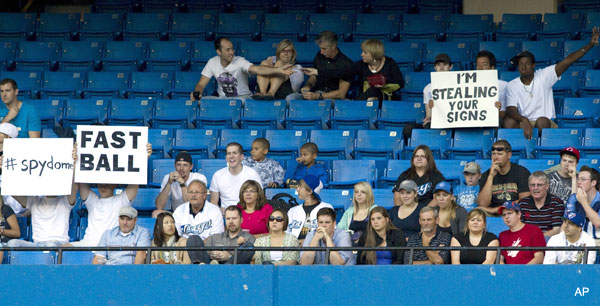
  • Traditional sign-stealing in baseball is not regarded as cheating. This seems counter intuitive because of the word “stealing.” Sign-stealing refers to teams decoding the signals given by the catcher to the pitcher (regarding what kind of pitches to throw and where ), and the coach or the dugout to a batter or baserunner (in bunt and hit-and run plays). Theoretically, knowing the other team’s signals provides an advantage, as to a batter who knows that the next pitch will be a curve rather than a fastball. Usually, signs from the catcher to the pitcher are in jeopardy when there is a runner on second base. He can see the catcher’s signs as well as the pitcher can. Catchers use finger-signs in various combinations to ask for various pitches, and position their gloves to indicate where they want the balls thrown. If the runner at second can signal to the batter what the catcher has told the pitcher to throw, the batter may have an advantage.

This is why catchers often go to the pitching mound when a runner is on second base. They change the signs. The second baseman will often join them, because it is his job to know what pitch is being thrown so he can signal (usually behind his back, using his hand) to his team’s outfielders. An outside fastball makes it unlikely that the batter will pull the ball, for example.

Sign-stealing on the field, using just eyesight and hands, is what players call “the game within the game.” Joe Girardi, the Yankee manager, said in an interview yesterday that he just assumes every team is trying to steal signs, whether they are or not. Continue reading

Another Harvey Ethics Quiz On Looting….

The comments on the Ethics Quiz on shooting looters was edifying. Now let’s examine the question of “legal looting,” according to a Yale Law School professor.

In a post for Bloomberg, Stephen L. Carter argues that “Peacefully taking what you need from a supermarket isn’t the same as looting.” he writes in part,

Should we conclude that people taking food from an empty store during an emergency are not committing a crime? That’s exactly what we should conclude — they are not lawbreakers — but it’s important that we understand exactly why.

Let’s start by considering our own instincts. If I were trapped and my family was starving, I would grab the food; I suspect most readers would too. Already our instincts tell us, then, that the moral situation in which we find ourselves is different when a disaster has struck. I believe, very deeply, in the importance of strong property rules. In an emergency, however, we should interpret the rules differently…. A well-known example in the Model Penal Code posits a hiker who, trapped by a blizzard, breaks into a cabin and eats the food to survive. The hiker has taken both food and shelter without the permission of the owner. By choosing to violate a property rule rather than starve to death or die of exposure, the hiker has selected the lesser of two evils. This is one form of the defense known as “necessity,” and is generally considered to mean that there is no crime.

(You need to read the whole post to fairly consider Carter’s argument.)

Your Ethics Alarms Hurricane Harvey Ethics Quiz of the Day is…

Is looting an abandoned supermarket for food still a crime?

Continue reading

Professor Volokh’s Ethics Dissent On The Vicious, Pazuzu-Blaming Professor’s Firing

‘Yes, I know he’s an idiot, but we should support idiots as highly paid teachers of our children, for the protection of the non-idiots…

Eugene Volokh is one of the best and most objective legal minds in the country. If he finds himself on the Supreme Court when Kennedy retires or Ginsberg shuffles off this mortal coil, we will not have suffered through the ugliness of the Trump years in vain. When he opines, I listen, as we all should, and he has now opined regarding the now fired idiot that I wrote about this morning, ex-University of Tampa visiting sociology professor Ken Storey.

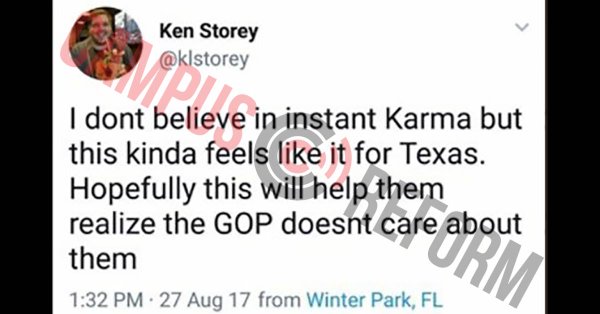
Storey used Twitter, in the middle of the still-unfolding human disaster in Houston and soon New Orleans, to announce that flooding victims who were Trump supporters or Republicans deserved to die. He did this twice, so his later claim that his words did not intentionally convey what his words were obviously intended to convey was a desperate and obvious lie.

I wrote:

The university or college that fires an employee like Storey is protecting its reputation as a responsible institution, by stating in clear terms that people with terrible judgment and cruel and unethical instincts who are motivated by hate and intolerance are not qualified to teach….because they aren’t. That professors increasingly have no ethics alarms beeping when the prepare to publish sentiments like Storey’s (or worse) shows how thoroughly the leftist echo chambers of most campus faculties turn academics into Pat Robertson, which is to say, rigid, mean, and dumb. Once upon a time, liberals giggled themselves silly over the evangelical huckster’s periodic pronouncement about how a disaster was God’s way of punishing the U.S. for not abusing gays sufficiently, or similar bile, Now they do the same thing, and expect their colleagues and students to applaud.

Today, in the Washington Post, Professor Volokh advocates a different position:

Storey’s comments were nasty and mean-spirited; and I should note that the University of Tampa is a private university, in a state that doesn’t limit private employers’ ability to fire employees for their speech. The university’s actions thus seem legal (assuming they didn’t breach any contract). And Storey’s comments also weren’t academic or likely to be part of a serious political debate.

But the university’s action strikes me as further undermining the freedom of expression and debate at American universities, including the freedom to say things that are much more thoughtful. If you were an untenured faculty member at the University of Tampa, would you feel free to express your views on controversial subjects, when you saw how the university reacted to this tweet? Even if your views were very different politically, what do you think the University would do if people started pressuring for your dismissal, pointing to the Storey incident as precedent?

I’ve talked before about “censorship envy,” one mechanism through which these sorts of speech restrictions can grow: “If my neighbor — and especially my political adversary — gets to ban speech he reviles,” the thinking goes, “why shouldn’t I get to do the same?”

If a university has a strong policy of protecting speech, including offensive speech, administrators can point to that policy as a means of resisting calls for firing a controversial faculty member, and they can appeal to people’s desire to see speakers on their own side protected, and use that desire to help protect speakers on all sides. But once the university starts firing some people for speech “that do[es] not reflect [the university’s] community views or values,” that makes it much harder to resist calls for more suppression. Indeed, at that point tolerating speech starts implicitly conveying the message that the speech does reflect the university’s community views or values — and to avoid that implication, the university would have to fire any speaker who offended some sufficiently influential constituency.

I am very confident that in this rare case, Prof. Volokh is dead wrong. Continue reading

Morning Ethics Warm-Up, 8/30/17: A Vicious Professor, Pazuzu, And Kathy Griffin Revokes Her Apology

[ Just to remind you how good Debbie, Gene and Donald were. Note that these dancers skipped the staircase..]

GOOD Morning…

I’m changing the Warm-Up headlines to reflect the topics covered. I may even go back and revise the old headlines. It took a while, but I realized that having dozens of essentially identical post titles with only a date as the distinction made archive research harder than it had to be.

1.I would have headlined the story of now fired visiting University of Tampa professor Ken Storey “Vicious, bigoted and possessed by the Demon Pazuzu is no way to go through academia, son,” but so many professors have used social media to make outrageous and offensive statements that the ethics issue is getting repetitious. (I think Jonathan Turley has done a post on each one of them, and will continue to on his blog.)

The question is whether a college or university is breaching its commitment to free expression and academic freedom when it fires a professor who says that all men are rapists, or that whites should be exterminated, or, in Storey’s case,

When asked later if this theory also applied to Florida,  and Trump supporters there deserved a similar fate.the Florida college professor replied,

“Yep, those who voted for him here deserve it as well.”

The answer is no. The university or college that fires an employee like Storey is protecting its reputation as a responsible institution, by stating in clear terms that people with terrible judgment and cruel and unethical instincts who are motivated by hate and intolerance are not qualified to teach….because they aren’t. That professors increasingly have no ethics alarms beeping when the prepare to publish sentiments like Storey’s (or worse) shows how thoroughly the leftist echo chambers of most campus faculties turn academics into Pat Robertson, which is to say, rigid, mean, and dumb. Once upon a time, liberals giggled themselves silly over the evangelical huckster’s periodic pronouncement about how a disaster was God’s way of punishing the U.S. for not abusing gays sufficiently, or similar bile, Now they do the same thing, and expect their colleagues and students to applaud.

Ken compounded his ethical offense by the standards of Ethics Alarms by issuing a terrible apology that evoked the Pazuzu excuse. Realizing that he had gone too far, he tweeted,

“I deeply regret a statement I posted yesterday. I never meant to wish ill will upon any group. I hope all affected by Harvey recover quickly.”

Translation: “Oops. My hateful expression of glee over the tragedy afflicting Texans seems to have put my job in jeopardy. I regret that, so I have pulled down my tweet and am pretending to be sorry. I never meant to wish ill will upon any group, even though somehow my tweet wished ill on a group in the clearest terms, and I doubled down on it. Someone or something else must have been responsible. I hope all affected by Harvey recover quickly. (Saying that will let me keep my job, right?)”

This is a #10 apology on the Ethics Alarms Apology Scale, the worst there is:

An insincere and dishonest apology designed to allow the wrongdoer to escape accountability cheaply, and to deceive his or her victims into forgiveness and trust, so they are vulnerable to future wrongdoing.

Storey was fired.

Good.

2. Speaking of phony apologies, Kathy Griffin, she of the Bloody Head, went all the way to Australia to reveal that she really isn’t sorry about representing that the beheading of a U.S. President is hilarious: Continue reading

When “Ick!” Strikes Out Ethics: The Intensifying Robo-Umpire Controversy

[I see that I last wrote about this issue in April, and before that, in June of 2016, and in 2012 before that.Well, it’s worth writing about again, and again, until ethics and common sense prevails.]

This weekend Major League Umpires held a silent protest, wearing armbands in support of colleague Angel Hernandez, whose competence was publicly questioned by Detroit Tiger player Ian Kinsler. In fact, Angel Hernandez is a terrible umpire, and terrible, indeed, even mildly fallible umpires have a problem now that they never had to worry about in the good old days: their mistakes are obvious and recorded for all to see.

Yesterday Red Sox color man and former player Jerry Remy was reminiscing during the Red Sox -Yankee game broadcast about one of his few home runs. He said he had struck out, missing with his third swing by almost a foot, and was walking back to the dugout when the umpire called him back, saying he had foul-tipped the ball. “I know that was wrong, but I’m not going to argue I’m out when the ump says I’m not.” Remy said. He went back to the plate, and on the next pitch hit a home run. “Of course, they didn’t have replay them,” Jerry added.

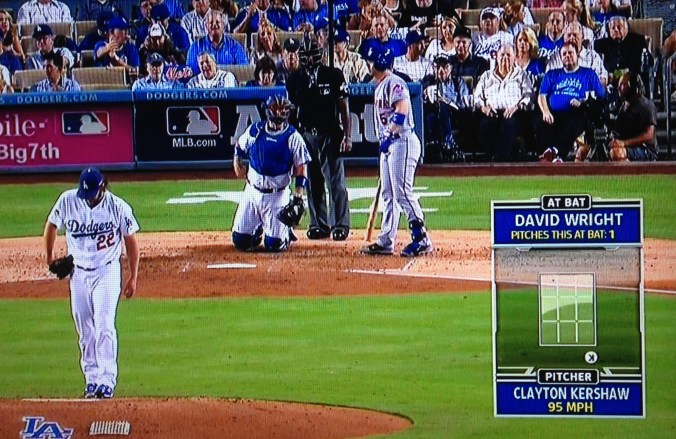
Before every game was televised and before technology could show wear each pitch crossed the plate, balls and strikes were called definitively by umpires, many of whom proudly had their own strike zones. “As long as they are consistent with it ” was the rationalization you heard from players and managers. It was, however, a travesty. The strike zone isn’t a judgment call; it is defined, very specifically, in the rules. A pitch is either within the legal zone or it is not. A strike that is called a ball when it is not, or vice-versa, is simply a wrong call, and any time it happens can affect the outcome of the at-bat and the game. If you watch a lot of baseball, you know that we are not just talking about strikeouts and walks.  The on-base average when a batter is facing a 2 balls, one strike count as opposed to a 1-2 count is significantly higher. The wrongly called third pitch can change the result of the at bat dramatically.

Since the technology is available to call strikes correctly 100% of the time, why isn’t the technology being used? Actually it is being used, in TV broadcasts. The fan can see exactly when the umpire misses a call, and the broadcasters talk about it all the time. “Where was that?” “That was a gift!”  “Wow, the pitcher was squeezed on that one.” Once, a missed call in a game was virtually undetectable, because one could assume that the umpire had a better and closer view than any fan or broadcaster could have. Now, there is no doubt.

Yet the players, sportswriters and broadcasters still overwhelmingly argue against the use of computer technology to call balls and strikes. It’s amazing. They know, and admit, that  mistaken  ball and strike calls warp game results; they complain about it when it happens, point it out, run the graphics repeatedly to show how badly a crucial call was botched, and yet argue that a completely fixable problem with massive implications to the players, the games and the seasons, should be allowed to persist.

These are the rationalizations and desperate  arguments they advance: Continue reading