The Facile Fad Rationalization “We Are Better Than This,” The Democratic Candidates, And The DHS Deportations

illigals

I am trying to decide whether “We are better than this,” the suddenly resurgent short-cut around actual reason and analysis, deserves to be added to the Ethics Alarms Rationalizations List.  What do you think?

All of the other sixty have broad, everyday applications, while this one is usually restricted to matters of public policy, which is why I hesitate to include it. On the other hand, it is a particularly insidious rationalization, and cynical too. It attempts to win policy debates by implicitly accusing any opposition of being beneath the advocate on the moral and ethical scales, while never actually offering a reason why the advocate’s position is superior and wiser.

The statement is also especially objectionable when it issues from partisans who normally deny the fact of American exceptionalism. They can’t have it both ways: either the United States is unique in its values, aspirations and accomplishments, and thus is “too good” to engage in certain policies that others nations don’t shrink from at all, or it isn’t. Choose your construct, hypocrites! When the acolytes of Howard Zinn, Noam Chomsky and other habitual villifiers of our history, motives and culture—such acolytes encompassing a large chuck of the progressive community—say “We are better than this,” they should be laughed at, in the face, hard. Better than the genocide-mongering, racist, sexist, greedy, exploitative, arrogant colonial power that has impoverished the world? HA! Cannibalism isn’t better than the country you think we are. According to you, we’re not better than anyone or any thing.

There are policies that there is every reason to say the United States is better than. Prime among them is engaging in torture, which not only violates international treaties that we led the way to establishing, but also because it violates our founding principles. There are, in short, tangible and substantive reasons why the United States is “better” than the nations who torture our soldiers, and they can be articulated without resorting to bumper stickers.

When “We are better than this” is followed by “because..’ and more substantive points, I have no objection to it, although “we should be better than this” is fairer. It can begin an analysis, but is not an analysis itself. However, when it is used as a substitute for analysis, it is pure rationalization.

Hillary Clinton, Bernie Sanders and Martin O’Malley started spouting versions of the Facile Fad Rationalization upon the release of  new report that the US Department of Homeland Security plans to raid and deport hundreds of families who illegally entered the U.S. through the southern border.  Note, please, that what is being proposed is called “enforcing the law.” Democrats and progressives have somehow managed to get away with arguing that while the United States “of course” should control its own borders, it is somehow inhuman, cruel and wrong to take action against foreign citizens who intentionally violate those laws that are intended to exact such control.

This is irresponsible, I dare say insane, but with the assistance of the news media and the collusion of business interests that love having fearful, low-wage workers they can exploit to keep costs down, the insanity is routinely extolled as compassion.  Adults who continued their illegal status in the U.S. long after discovering it and having ample opportunity to abide by the law (and leave) have been anointed with the lovely euphemism, “Dreamers.” (The definition of “Dreamers” is “illegal immigrants from childhood who have continued to defy the law, lie and pose as citizens due to a self-serving belief that they have a right to be here, when they don’t.”) Beautiful Dreamers! Continue reading

On The Matter Of Fake Buglers: Beyoncé Revisited

I don’t know how I missed the fact that the armed services increasingly use fake buglers at military funerals, but I just learned about it the hard way.

Our neighbor, a navy veteran who died unexpectedly leaving his wife and small daughter, received a military burial in Quantico, Virginia. The uniformed bugler raised his instrument to his lips (out of my sight, but I saw him with his bugle on the way to the site), and the mournful sound of TAPS began, only to end abruptly halfway through the melody. There was an awful, awkward silence as the mourners wondered what happened and if the tune would be completed, and then the sailor put away his bugle into a case, and walked over to fold the flag on the coffin.

Because of budget cuts (which, of course, could have been applied elsewhere, for this is a choice) and a shortage of buglers, most military funerals employ non-musicians who hold a fake bugle with a chip and a speaker installed to give the illusion that TAPS is being performed.

In other words, it is a subterfuge and a lie.

I discussed what was wrong with such fake live performances in 2009, and again in 2013, when I beat this topic to death, even going on Bill O’Reilly’s show to talk about Beyoncé lip-synching at the Inauguration as the newscasters lied about it being a live performance. The key quote from both posts is this..,

“The performance was part of the swearing-in ceremony of President Barack Obama, and that meant that it could not, should not, must not be phony, faked, or a lie.”

Whether you think that similar fakery is more or less excusable when the nation says good-bye and thanks to a deceased veteran is a matter of priorities. Both are unethical, both represent creeping corruption and a betrayal of values. This was a Navy service; here’s the relevant provision of the Navy Ethics Compass: Continue reading

Heroes, Villains And Fools In The Latest “Donald Trump Candidacy Ethics Train Wreck” Disaster

Circus Train wreck

In a single post I can’t possibly cover all of the heroes, villains and fools who have emerged in the aftermath of the explosion of Trump’s latest hand-grenade tossed into the Presidential campaign. I have to start somewhere, though.

At the outset, I want to officially designate Trump’s campaign as an ethics train wreck, neatly paired with the Hillary Clinton Campaign Ethics Train Wreck (more from that later.) Do you sense that the number of Ethics Train Wrecks are proliferating? You are correct, and it is both a direct result and an indirect result of the Obama Administration Ethics Train Wreck. When leadership is feckless, weak, dishonest, unethical and ineffective, a society’s ethical standards start to unravel.

Now on to the initial designations regarding Trump’s declaration that Muslims should be banned from entering the country.

Hero, Villain, AND Fool: Donald Trump. Trump is a hero in his own mind; in ethics terms, the status is accidental, an example of doing a good and courageous thing for all the wrong reasons. In his typical, bully-in-a china-shop  way, Trump has forced the national debate to focus on nasty realities rather than operate from President Obama’s fantasy world, where radical Islamic terrorists somehow are not Islamic, and Hillary Clinton’s delusion/lie that terrorism has “nothing to do with Muslims, whatsoever” even after two Muslims, because they were Muslims, killed 14 citizens in a terrorist attack. Muslims who have been radicalized or who have ties to terror groups are a real and existential problem that requires a coherent policy addressed at the problem. Chanted nostrums like “This isn’t who we are” don’t get the job done. A frank debate is mandatory, and sometimes only a boor, a maniac or a boob with less than acute intellectual skills will have the guts to force such a debate. Clarence Darrow regarded nut-case John Brown as such a hero, arguing that some problems require someone whose disregard for conventional societal standards to “cut the Gordian Knot.” By Darrow’s definition, then, Trump is a hero. Continue reading

Ethics Musings Sparked By The Passing Of Ken Beatrice, D.C. Sports Talk Legend

kbeatrice2

If you did not live in the D.C. area in the Eighties, you probably never heard of Ken Beatrice, who just died in a hospice at the age of 72. There was a time when Beatrice was the radio sports authority in pro football crazy Washington D.C., and star of the most popular and talked about call-in show of any kind on the local radio. He deserved his popularity, for Beatrice was smart, hard-working, knowledgeable, professional, and nice. His career, its rise and fall, was also a hard ethics lesson, for anyone paying attention, on why it is that good people do unethical things that hurt themselves more than anyone else.

Beatrice’s acclaim arose out of his astounding knowledge of football at all levels, from the pros to high school. I’ve never cared about football, but I listened to Ken’s show just because he was amazing. From his Washington Post obituary:

“His knowledge of pro football players, current and potential, was nonpareil. Call in to ask about the third-string quarterback at a second-tier college, and Mr. Beatrice could tell you the player’s height, weight and 40-yard dash time.He was so attentive to the game, a sportscaster once told The Washington Post, that he was able to recite a team’s depth chart off the top of his head, naming both the starters and the second- and third-stringers who would eventually replace them.”

This doesn’t even do Beatrice justice: you had to hear him. It was like a Las Vegas magic act. A caller would say, “I graduated from Madison High in Rexburg, Idaho, and I hear they have a running back on the football team that may have pro potential…I can’t think of his name..” Continue reading

And Here’s Yet Another Unethical Use For Facebook…

shaming

Senga Services, a Canadian cable company, recently web-shamed some of its  customers who were behind in their cable fees by listing their names and amount owed on Facebook. Of course, “it wasn’t the worst thing”—the company could have put up wanted posters

Naturally, the company had an excuse: Rationalization 2A, Sicilian Ethics.* “We always got excuses from everybody,” a rep for Senga told the CBC about the decision to publicly humiliate customers. “Promissory notes and everything, and it never arrives. So we found the most effective way is to publicly post the names.”

Effective, maybe. Ethical, never. Employing the threat of using humiliation to extract funds is indistinguishable from extortion. Yes, lawyers do it all the time, and mostly get away with it. It’s still wrong. It is particularly wrong when consumers have reason to believe that they are dealing with a business entity that respects their privacy and understands that their dealings, amicable or not, are not to be shared with the public. This is a dirty tactic, and in the U.S., an illegal one.  Section 551(c) of the Cable Communications Policy Act specifically prohibits cable companies from disclosing “personally identifiable information concerning any subscriber without the prior written or electronic consent of the subscriber concerned.” The Office of the Privacy Commissioner of Canada maintains that Canadian law only “allows organizations to use or disclose people’s personal information only for the purpose for which they gave consent,” meaning that there ” is also an over-arching clause that personal information may only be collected, used and disclosed for purposes that a reasonable person would consider appropriate under the circumstances.” Senga, not knowing ethics from a tree frog, feels that public shaming for amounts as small as a hundred dollars is appropriate. Nonetheless, Senga agreed to pull the shaming posts.

Ban them from cable service, take them to court, work out a payment plan, charge interest…all of that is fair and reasonable. Using private information as a reputation-wrecking weapon, however, isn’t.

I think the debts of every Senga customer who the company treated this way should be cancelled.


*Note of Rationalization List change: Rationalization #2 was always two rationalizations in one. I finally split out the two, with the main rationalization re-named “Ethics Estoppel,” for the theory that Party A’s unethical conduct makes him unworthy of ethical conduct from Party B. The sub-rationalization, “Sicilian Ethics,” is just an excuse for revenge.

___________________

Pointer: Alexander Cheezem

Facts: Consumerist

Wow! Trump Tries a JUMBO!

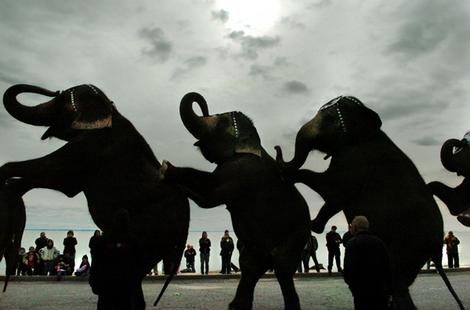
Elephants from the Ringling Bro. and Barnum and Bailey Circus perform a nine-trunk salute.

Donald Trump is apparently testing yet another piece of political conventional wisdom. Having already conquered such long standings assumptions as “A Presidential candidate shouldn’t talk and act like a sixth grader” and  “A candidate shouldn’t embarrass his party every time he opens his mouth,” Trump is now setting his sights on the classic, “It’s not the crime, it’s the cover-up,” but with an impressive extra challenge.

He is now trying to cover up the fact that he grotesquely mocked the disability of a New York Times reporter in a public appearance that was videotaped.

Trump actually is denying that he did what he was obviously doing. Very bold, very intrepid. It will be fascinating to see if he can pull it off.

Here’s Trump, after the Times excoriated him for ridiculing reporter Serge Kovaleski, who has arthrogryposis, a malady that  limits flexibility in his arms:

“Serge Kovaleski must think a lot of himself if he thinks I remember him from decades ago – if I ever met him at all, which I doubt I did. He should stop using his disability to grandstand and get back to reporting for a paper that is rapidly going down the tubes.”

Odd that Trump didn’t remember him, since before doing his “man with weird arm movements” bit he said quite clearly, “Now, the poor guy — you’ve got to see this guy…” One doesn’t normally call a reporter “a poor guy” for no reason, nor does one say, “You’ve got to see this guy” if you aren’t going to show the crowd what it is they have to see.”

Never mind, Trump is going for it: the full “Who are you going to believe, me or your own eyes?”, or as Jimmy Durante put it, in the show that gave the Ethics Alarms category it’s name, “Elephant? What elephant?” Continue reading

And Speaking Of Turkeys, Here Are Random Observations On Donald Trump’s Handicapped Times Reporter Impression

1. Stay classy, Donald.

2. Yes, I agree, it is refreshing to have a politician on the scene who does not hide his true self, does not calibrate his words and opinions to what people want to hear or what journalists and pundits will approve, does not suddenly speak in a Southern accent in front of crowds south of the Mason-Dixon line or pose as a lifetime Yankee fan in the Big Apple. Okay, it’s a novelty to have an asshole who has the integrity to openly behave like the asshole he is.

BUT HE’S STILL AN ASSHOLE.

How are people missing this?

3. One theory is that Trump has chosen this week to go all out to see if there is anything he can say or do so beneath the dignity of the office he is seeking and so repugnant to core American values that the idiots supporting him will finally wake up and say, “What was I thinking?”

If so, his experiment is working well.

And yes, it is fair to identify anyone who supports Donald Trump at this point as an idiot.

4. Please ask the Donald Trump fans at  your Thanksgiving dinner whether this is really how they want to see their President behaving in public. If #2 above is correct, I assume that he’ll eventually don a Hillary mask, glue a herring to his forehead, and recite dirty limericks while riding on the Spinning Teacups ride in Disneyland nude.  Hell, why not?

5. Imagine:Democrats decided that they didn’t want Howard Dean to be President based on this…

Donald Trump makes Howard Dean look like Henry Higgins. Continue reading

The Cost Of Rationalizations

Employee Theft

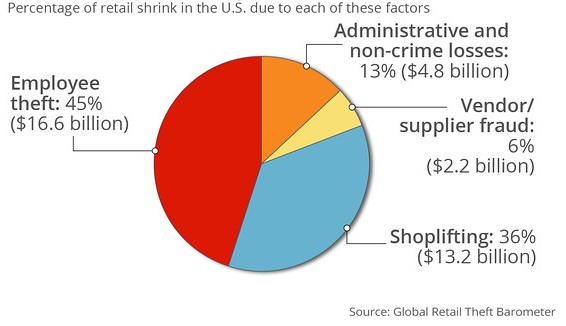
According to The Global Retail Theft Barometer released this month by Checkpoint Systems,  employees in the U.S. steal from their employers at significantly higher rates than workers in other countries. The direct cost to businesses, as you can see in the diagram above: a staggering 16.6 billion dollars.

Most of this is taken in incremental amounts, by people who would be shocked if you questioned their character. Why is this number is so high? As far as comparing to other countries are concerned, it’s the same factor that anti-gun zealots refuse to acknowledge, and that Bernie Sanders can’t seem to grasp. Our country is not like other countries; we guarantee our citizens more freedom, for one thing, and freedom unavoidably means more freedom to do bad things as well as good.  Our national character is not like other countries. Americans are not like other people.

Good. Continue reading

Comment of the Day: “World Series Ethics: Another Pine Tar Sighting, As Baseball Ethics Rot Gets A Thumbs Up From Legal Ethics Rot”

Volquez, unaware...

Volquez, unaware…

I think I made a poor call deciding not to write about the interesting ethics question that arose during Game #1 of the just completed World Series.

We learned during the broadcast of Game 2 on Fox that Daniel Volquez, the father of Kansas city Royals Game #1 starting pitcher Edinson Volquez, had died of heart trouble during the day in the Dominican Republic. But Volquez’s family had asked the team not to inform Volquez until after the game, and the team, on behalf of the family, asked the same of the broadcasters, directing them to withhold the news from the TV audience. I decided to pass on the story because I couldn’t confirm that Volquez didn’t know about his father’s passing, though it now appears he did not. That was foolish: the ethics issues are the same regardless of whether he knew.

Fortunately Ethics Alarms reader Noah D. insisted that the issue was attention worthy, and wrote his own commentary. I’ll have some comment at the end. Here is his Comment of the Day on the post, World Series Ethics: Another Pine Tar Sighting, As Baseball Ethics Rot Gets A Thumbs Up From Legal Ethics Rot: Continue reading

World Series Ethics: Another Pine Tar Sighting, As Baseball Ethics Rot Gets A Thumbs Up From Legal Ethics Rot

Sal Perez

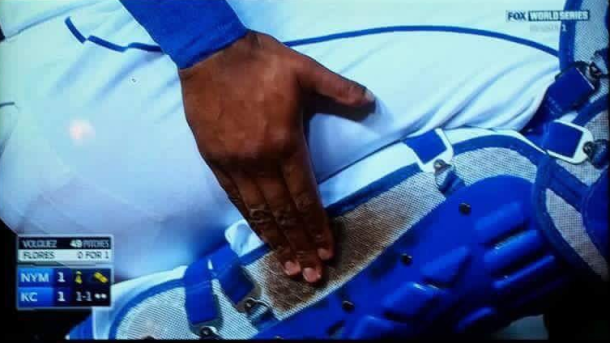
Cameras during Game #2 of the 2015 World Series revealed that Kansas City Royals catcher Sal Perez had what appeared to be pine tar on his shin guard during the game. This would presumably be there for the purpose of surreptitiously smearing some of the gunk on the ball, then throwing it back to the pitcher so he could “get a better grip on the ball,” a.k.a “tamper with the baseball so it can do loop-de-loops.” This is illegal. It is cheating. According to Rule 8.02(a)(2), (4) and (5), the pitcher shall not expectorate on the ball, on either hand or his glove; apply a foreign substance of any kind to the ball; [or]  deface the ball in any manner. The rule is unambiguous, and if a pitcher or a catcher is caught violating the rule, they are thrown out of the game with a suspension and fine to follow.

None of this happened to Perez or his pitcher that night. According to NBC Sports blogger Craig Calcaterra, a former practicing lawyer who I am officially disgusted with, the reason was that “Nobody cares,” including Calcaterra.

I wrote extensively about Major League Baseball’s unethical attitude toward violations of this particular rule last year, after an absurd sequence in which Yankee pitcher Michael Pineda was caught by TV cameras apparently using pine tar on his pitches without compliant from the opposing Red Sox, followed by Sox manager John Farrell saying that he hoped he would be “more discreet” about his cheating “next time,” and then when Pineda was more obvious about it next time, Farrell complained to the umpires, who threw Pineda out of the game (he was also suspended). I wrote, Continue reading