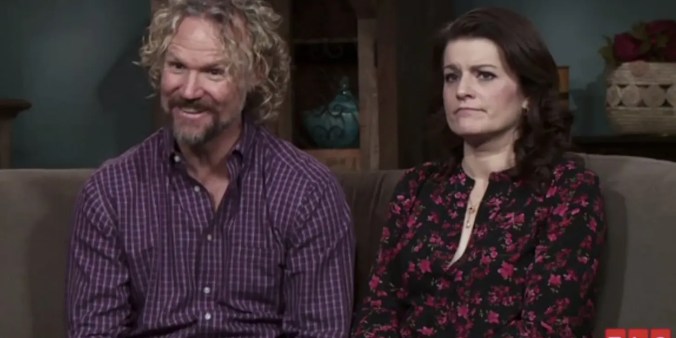
The substacker “Holly Mathnerd,” not for the first time, has a well-written and interesting post about her reaction to a book by the “star” of a reality show I had never heard of and definitely never watched. Christine Brown Woolley’s memoir “Sister Wife: A Memoir of Faith, Family, and Finding Freedom,” released today, is about one of the “stars” of “Sister Wives,” a reality show that has been running for 15 years, including 20 seasons. The show centers on Kody Brown, a fundamentalist Mormon man with twelve children from three wives. His “family” dwells in what Holly calls a “polygamist house”with three apartments branching off a shared common space. That’s Kody above with one of his other wives.
Yikes.
I really don’t care about the details. Polygamy and polyamory (the same thing but without bothering with the marriages) are unethical; never mind the morality issues. Like adultery and prostitution, these are practices that undermine families, real marriages, subjugate women and harm children. Libertarians see nothing wrong with polygamy, or at least think it should be legal, which adequately tells you what’s wrong with libertarians.
I can’t imagine buying a book by a woman who voluntarily submitted to a polyamorous relationship and now wants to make money by writing about what a mistake it was. Gee, ya think? I put Woolley’s memoir in the same category as I would a book by someone who used to shoot nails into his head but who now realizes it was probably a mistake.
From Holly Mathnerd’s account, it seems like the better part of the book is its account of just how phony “reality” shows are, not that this should be a shock to anyone who is familiar with the genre. Holly writes in part,
“…The memoir also peels back the curtain on how fake “reality” really is. Watching the show, you’d think you were seeing the Browns’ daily life: family dinners, arguments, weddings, tears. But Christine makes clear that what you’re really seeing is a carefully curated product — sometimes scripted, sometimes manipulated, always edited with an eye toward what would get people talking on Twitter.
Kody, in particular, seemed to understand this instinctively. He weaponized the cameras. He would drop painful revelations on air — things Christine was hearing for the first time along with millions of strangers — and then claim that the wives couldn’t “control the narrative” because they weren’t “being honest enough.” Meanwhile, what they were really up against was the power of editing: hours of footage boiled down into forty-two minutes that could make anyone look like a saint, a villain, or an afterthought depending on what the producers wanted.
It reminded me of the gaslighting built into the whole setup. The audience was constantly asked to question its own eyes: “No, you didn’t see favoritism; you saw family unity. No, you didn’t see cruelty; you saw tough love. No, you didn’t see neglect; you saw the noble sacrifice of plural marriage.” Christine’s memoir blows a hole in that façade by admitting what fans always suspected: our eyes weren’t lying, the edit was….
Another benefit of the post was that the blogger introduced the term “parasocial relationship,” which I had never encountered before. She didn’t define it, but I looked it up: Google’s bot says that “a parasocial relationship is a one-sided, one-way connection in which an individual develops a strong sense of intimacy, familiarity, and emotional investment with a public figure or fictional character they don’t know personally. These relationships are common and often occur through media, such as television, social media, or podcasts, where an individual feels like they have a personal connection with the person or character on screen or in their feed. While these relationships can be a natural part of human behavior and even provide positive influences, they become unhealthy if they interfere with real-life interactions or daily functioning.”
Good to know! You can read Holly’s post here….




 Ethics Alarms