The Biden White House Trying Its Big Brother Thing To Avoid Being Held Responsible For A Recession Might Be Not Be So Suspicious If We Forgot About The Last 18 Months…Or Five Years [Corrected!]

As Ronald Reagan might say, “There they go again!” This White House and Democrats in general are addicted to the Orwellian technique of avoiding reality and gaslighting the public using the technique represented by Ethics Alarms Rationalization #64, Yoo’s Rationalization, or “It Isn’t What It Is.”

Orwell’s Big Brother reveled in mottos like “War is Peace,” “Freedom is Slavery” and “Ignorance is Strength.” The Democratic way for some time now, and it is natural that the Biden Administration would employ it, is to deal with facts it doesn’t care for by denying them, altering unpleasant reality by offering an alternate one to the gullible public, or, as in the current case, just changing the meanings of words so things are too muddled and confusing for anyone to be sure what’s happening.

Democracy dies in befuddlement.

All my adult life, I have read that economists view two consecutive quarters in which the economy has contracted as signifying a recession. Well, you know…economists. Nonetheless, I have lived through a lot of them, and never before have I seen the unfortunate wretches caught “holding the bag” when this damning diagnosis attaches have the chutzpah to do what the Bidenites have. The Bureau of Economic Analysis is set to release the second-quarter gross domestic product (GDP) numbers this week, and they are widely expected to show those two consecutive quarters of economic decline. So what have the Democrats cooked up? A definition of “recession” that will allow them—they hope—to avoid the “R” word.
Continue reading

The Bo Deplaning Background: A Picture Not Quite Worth 1000 Words

I reluctantly replaced the background photo of Justin Carter (who is still, by the way, awaiting trial for the crime of making a sarcastic comment on Facebook that post-Sandy Hook hysterics decided to treat as a terrorist threat) and put up the iconic photo of Bo, the Presidential dog, being solemnly escorted out of an Osprey to join the First Family in another spectacularly ill-timed vacation in Martha’s Vineyard, together with a photo of the National Debt clock. I hoped the background picture would save me the proverbial thousand words, because I think it speaks eloquently to several issues. But I have already received some squeals of protest, so I’m going to have to use up some of those words after all.

I generally have no problem with any President taking vacations, since the job is impossible and it travels with him, no matter how much he might wish otherwise. I have a problem with Presidents spending excessive amounts of the nation’s time in partisan fundraising, but that’s another issue. As one of the President’s supervisors, I have serious concerns about this President taking so many vacations, because, frankly, I don’t know what he does all day. He appears to have no foreign policy, other than making speeches, waffling, and dithering. He says he is making the economy his full time priority, but I see little indication of that. We know he doesn’t dirty his hands with engaging in politics and forging compromises with the opposition, and based on his statements and stunned surprise when incompetence or misconduct appears, he seems not to know what is going on in his own departments. We know he doesn’t trouble himself with oversight or management—even #1 fan Chris Matthews admits that.

Obama said on The Tonight Show (he has time to appear on The Tonight Show) that the U.S. has no domestic spying program. Today we learn that the NSA has habitually violated privacy restrictions on its spying, meaning that we don’t have a domestic spying program, just a spying program that repeatedly engages in domestic spying. Call me a stickler, but I think a few of those down days on vacation should have been spent instead actually learning what was the real situation before he told the nation things that weren’t true. Or was he lying? If you prefer that explanation, fine. That is another ethical issue. Continue reading

The Difference Between Unemployed Scientists and Unemployed Lawyers

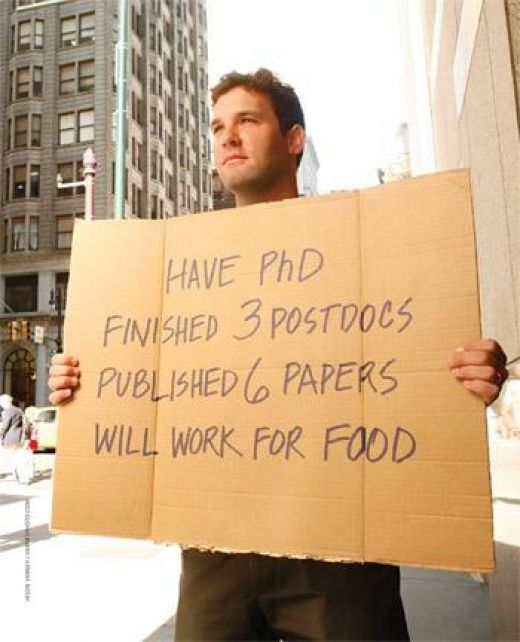
A front page story in today’s Washington Post casts interesting perspective on an Ethics Alarms rumble that broke out here a couple of weeks ago. One of the many websites where underemployed, over-indebted law grads hang out to commiserate—sites with pathetic names like “butidideverythingrightorsoithought”—discovered a post from the days when people were taking Occupy Wall Street seriously, in which I chided a protester whose sign blamed his law school  for his failure to  find a job, without giving due weight to the fact that sitting in a park whining about his plight wasn’t doing him any good either. Suddenly Ethics Alarms experienced an avalanche of indignant and often personally insulting comments introducing me to the strange world of the JD conspiracy theorists, who maintain that law schools engaged in an intentional conspiracy or “scam” to gull naive college grads into believing that a law degree was a sure-thing ticket to Easy Street and six-figure starting salaries.

In the Post’s report, we learn that other advanced degree-holders, namely PhDs in scientific fields, are also unable to find work or toiling in fields unrelated to their degrees. The Post says:

“Traditional academic jobs are scarcer than ever. Once a primary career path, only 14 percent of those with a PhD in biology and the life sciences now land a coveted academic position within five years, according to a 2009 NSF survey. That figure has been steadily declining since the 1970s, said Paula Stephan, an economist at Georgia State University who studies the scientific workforce. The reason: The supply of scientists has grown far faster than the number of academic positions.”

Sounds a lot like the legal market to me! Continue reading

Extending Job Benefits: Irresponsible, Unfair and Unethical

Last week, Republicans blocked yet another extension of unemployment benefits, and we can only hope they have the integrity and courage to do it again, in the face of predictable cries that they are cruel and heartless. The correct term is “fair and responsible.”

Well over a decade ago, President Clinton and a Republican Congress instituted welfare reform over similar accusations that it would spark tragedy and starvation. What it did was help end cycles of poverty and dependency. Hardly anyone except die-hard socialists argues that limiting welfare was a mistake today.

The serial extensions of unemployment benefits we have seen for two years, however, have become indistinguishable from welfare, and are now blatant political pandering to a large unemployed voter bloc in distress. The government is broke and in debt, and in no position to add an open-ended entitlement that pays Americans not to get jobs. Continue reading

Rahm Emanuel, History and Hyperbole Ethics

There are times when obvious exaggeration is nothing worse than politeness, nothing more than an expression of admiration and affection. “You’re the best boss anyone ever had,” is in this category, especially when the boss is retiring or dying. But when one is speaking in public about controversial and historical matters involving well-known public figures, the margin between excusable hyperbole and unethical dishonesty or worse is much smaller. Al Gore learned this when he played loyal Vice-President on the day his President was impeached by vote of the House of Representatives. Gore’s statement that Bill Clinton was “a man I believe will be regarded in the history books as one of our greatest Presidents” was intended as supportive, but interpreted as a toadying endorsement of Clinton’s unsavory and dishonest conduct, impeachable or not. It probably cost Gore the Presidency.

Worse yet was Trent Lott’s clumsy effort to praise the ancient, infirm and mentally failing Sen. Strom Thurmond at his 100th birthday party. Lott said, “I want to say this about my state: When Strom Thurmond ran for president we voted for him. We’re proud of it. And if the rest of the country had followed our lead, we wouldn’t have all these problems over all these years, either.” Thurmond, running on the Dixiecrat ticket, had opposed segregation, and Lott’s comment, less fact than flattery, made him sound like he longed for the days of Jim Crow and “white only”rest rooms. The lessons of these hyperbolic gaffes are similar: if the well-intentioned compliment concerns a public figure in historical context, historical exaggerations either appear to be unjust to history or its important figures, seem to make inappropriate value judgments, or come off as a blatant effort to mislead the public.

Rahm Emanuel hit the Trifecta with his fawning farewell to President Obama, as he left the White House to run for Mayor of Chicago. Obama, he said, is “the toughest leader any country could ask for, in the toughest times any president has ever faced.”

Wow. Continue reading

Unethical Quote of the Week: White House Economic Adviser Austan Goolsbee

“The vice president was talking about the summer of recovery in reference to the Recovery Act, that you would see the creation of a series of infrastructure and other projects ramping up over the summer. And you did see that.”

White House Economic Advisor Austan Goolsby, when asked on “Fox New Sunday” about Vice President Biden’s proclamation in June that this would be “the summer of recovery”—a predication that has fallen embarrassingly flat, and that sounded rash and even silly at the time.

Of course, nobody but nobody really believes that Biden wasn’t talking about jobs when called this the “summer of recovery.” Continue reading

Obama’s Damaging Ethical Blind Spot

For several years, I have been using a hypothetical in my business ethics courses involving the head of a non-profit who brings in a fundraising whiz to help the organization survive. While he is settling in and before he has had time to rescue the organization with his fundraising wizardry, she has asked the staff to accept a freeze on raises and hiring, and has cut other expenses, and even some staff. She asks the new fundraiser to live with his dilapidated office, though she had promised him a redecoration while recruiting him. But he objects: Continue reading