Ethics Dunces: The Senate and House Leadership

The names are in.

As part of the pathetic, cynical and inadequate budget deal to raise the nation’s debt ceiling, Republicans and Democrats were called upon to assemble a bi-partisan “super committee” of twelve House members and Senators, chosen by the respective leaders from both parties, to come up with a way to close the deficit. Now that the S&P ratings downgrade has embarrassed the nation, destabilized foreign markets and sent an unambiguous message that the United States has to get serious about balancing the books and fast, have our political leaders responded to the challenge by choosing elected representatives of states and districts who have track records of collaboration, political courage, truthtelling and placing the best interests of the nation over narrow electoral fundraising and ideological objectives?

Naaa.

What, are you surprised? The leaders of the House and Senate have met our lowest expectations, and have chosen a hyper-partisan group to make up the super committee, guaranteeing that it will be super-contentious and super-ineffective. The degree to which this represents an abdication of their duties of leadership and responsible government is impossible to exaggerate. Continue reading


Another Sexting Pol: Drawing the Lines

"ARRGH! I didn't consent to THAT!"

From today’s  New York Daily News:

“Garden State Democrat Louis Magazzu announced his resignation Tuesday after nude pictures he sent to a woman he had been corresponding with were posted on a Republican activist’s website. At least two of the photos showed the Cumberland County freeholder’s crotch, two showed him dressed to the nines in a suit, and a fifth showed him waist up without a shirt.

Comments and observations:

  • Magazzu didn’t have to resign, but it was right for him to do so. Sexting is a problem among high school students, and it doesn’t help to have elected representatives indulging in it. He was humiliated by publication of the photos, and because the humiliation extended to his constituents and his party, resigning quickly was an appropriate, honorable, courageous thing to do—as it would have been for Bill Clinton, Sen. David Vitter, ex-Sen. Ensign, ex-South Carolina Governor Sanford, and others. He didn’t have to resign, however. Continue reading

Ethics Dunce: Central Bucks East High School

"Hello class! I'm your teacher, Miss Munroe, and as you know, you all disgust me. Now, I expect your full trust and respect this year. I am a professional, and my superiors and I agree that the fact that I hate you with all my soul won't change how I treat you, because hate doesn't affect how people treat each other in life. Wait...why are you all looking at me like that?"

Administrators at Central Bucks East High School in Doylestown, Pennsylvania, have decided to reinstate suspended teacher Natalie Munroe, who had made it very clear in several blog posts discovered by the school and her students last February that she detested her job and a great many of her students and their parents, spewing  diatribes that ridiculed specific students for their appearance, habits, speech and character.

There is no conceivable  justification for this. Munroe both deserved to be fired, and had to be fired, because she cannot be trusted to be fair, unbiased or diligent in educating students when she is so disgusted, annoyed and infuriated by them. I hate your kid,” she wrote to the generic parents of her charges on her now discontinued blog.

“I hate your kid.” This is a smoking gun, but the school has chosen to ignore it.

How responsible is it for a school to entrust schoolchildren to the instruction of a teacher who admits that she hates them?  It is as responsible as letting a caregiver at a nursing home continue employment after writing, “I dislike old people.” As responsible as hiring a nurse who tells the hospital that  she is  nauseated by sick people. As responsible as entrusting an orphaned  child with an adoptive couple who announces that they can’t stand him.

Amazingly, Munroe has never denied that she meant what she wrote. Instead, her defense was this: Continue reading

Did Amy Winehouse Cheat the World?


A mark of failure, or betrayal?

I appreciated Amy Winehouse’s talent rather than enjoyed it. Nevertheless, her death-–many have said her completely predictable death—of a drug overdose at 27 once again causes me to ponder the recklessness with which gifted artists who can give so much to the world throw their lives away.

As an ethicist who never hesitates to hold individuals ethically responsible for conduct that harms others, I have not completely worked out in my own mind how to characterize the many artists and performers whose self-engineered destruction have robbed the world of laughter, enlightenment, and joy. Every time I watch John Belushi in “Animal House” or an old Saturday Night Live clip, I get angry at him—I admit it. I know Belushi didn’t want to die young any more than I wanted him to die young, but he treated his life as if it was disposable and without value, when it really was of extraordinary value. When Belushi sacrificed it in a stupid drug binge, it was more than a tragedy for his friends, lovers, colleagues and family; it was a tragedy for the art and history of comedy. Much the same can be said of Amy Winehouse—and James Dean, Jimi Hendrix, Billy Holiday, Heath Ledger, Michael Jackson, River Phoenix, Marilyn Monroe, and Elvis. Continue reading

The Ethics of Stopping the Condemned From Accepting Death

In Oregon, a judge has granted death row inmate Gary Haugen’s motion to dismiss his lawyers after they persisted in taking measures to block his execution. They had declared he was not mentally competent to waive his appeals and allow his own state-decreed death to proceed.

Leave it to lawyers to be convinced that they know what’s best, even when it involves someone else’s wishes about his own life and death.

Is the condemend prisoner who approves of his own excecution insane, or courageous?

In an attorney-client relationship, the lawyer is ethically bound to do what the client wants as long as it is legal and within the bounds of the ethical constraints on the lawyer. A lawyer can render advice and should; a lawyer can explain the legal consequences of a course of action. But substituting the attorney’s judgment for that of the client is taboo…except, all too often, in cases like this one, in which a death row inmate decides that letting justice take its course and accepting the state’s death decree is preferable to rotting in prison.  Continue reading

Conservatives, Rotting Children’s Brains On Principle

Why can't today's TV pass on good taste like this to our children?

Perhaps I am over-reacting, but I was recently horrified. Sometimes conservatives allow their ideology to lead them into places that make it impossible to take them seriously, or  to view them as rational and responsible. This is especially true when it comes to the arts.

Yesterday, radio talk show host Laura Ingraham was bemoaning the coarsening of the culture, and the way she feels that television is poisoning the minds of children. She spoke nostalgically about how entertainment in the golden past was family-friendly, and reliably conveyed the values of humor and wit that enriched children’s minds, their taste, and their understanding of “good entertainment.” Those days are no more, Ingraham said. Television is vast slime-pool, and concerned parents can only look to past gems of the comic arts to teach their children “humor and wit.”

So what show did Laura Ingraham, accomplished writer, former Supreme Court law clerk, and author of political satire extol as epitomizing these lost values? What classic TV show’s complete set of DVDs did she reveal that she had given to a colleague so he could save the minds and souls of his children?

“Gilligan’s Island.”

“GILLIGAN’S ISLAND!” Continue reading

A Tale of Two Heathers

All right, cooking your child doesn't mean you're a bad person.

Heather #1: Ethics Hero Heather Elliott, who saw two small boys locked in a car parked outside a Kroger store in Indianapolis. The temperature was in the 90s and climbing, and the boys looked red-faced and hot. One was screaming and crying, and banging at the closed window. Elliott decided to take action, and began to try to find a way to open the car doors.

Heather #2: Ethics Dunce Heather Query, 21-year-old mother of the two cooking boys, who arrived on the scene just as Heather #1 was trying to rescue her children. “How long were you in that store?’ Heather #1 asked #2.  “It’s 100 degrees outside.” ‘What do you care?” said Ethics Dunce Heather. “Mind your own business” When Ethics Hero Heather responded, “I’m just concerned about your kids. I’m just thinking about the safety of your kids,” Heather #2 attacked her, punching her in the face.

There’s gratitude for you. Continue reading

Barn Doors + Anger + Ignorance + Irresponsible Legislators = “Caylee’s Law”

When someone first mentioned the wave of support for “Caylee’s Law,” proposed legislation so far pending in four states making it a felony for a parent not to report a child’s death within an hour or a missing child within 24 hours, I responded that it “sounded like a good idea.”  Lots of dumb things sound good to me before I think about them. “Caylee’s Law,” is in fact a terrible idea, and about 10 minutes of quality thought illuminates why.

The law is the result of multiple factors more related to human nature than sound law enforcement. When something unpopular and frustrating happens, like the death of Caylee Anthony and her mother’s subsequent acquittal of murder charges, the response is often to try to fix the problem with a law. Such laws are often formulated in the heat of emotion and sentiment rather than careful reasoning and consideration, and the result is  bad laws that cause more problems that they solve.

These laws also embody the Barn Door Fallacy. Society passes broad-based measures to stop an unusual occurrence that has already done its damage, and that may be extremely unlikely to occur again. Nevertheless, society and the public saddle themselves with expensive, inconvenient, often inefficient measures designed to respond to the rare event. One shoe bomber, and millions of passengers have to remove their shoes to go through airport security. One adulterated bottle of Tylenol, and every over-the-counter drug bottle requires a razor blade and the manual dexterity of a piano virtuoso to open. Two sick boys shoot up Columbine, so third graders get suspended for bringing squirt–guns to school. Continue reading

The Shannon Stone Tragedy Ethics Quiz, Part II

Don't try this if you're not a firefighter

 Many commenters were upset with me for characterizing the tragic death of Shannon Stone, who fell to his death while trying to catch a ball during a Texas Rangers game, as the result of his own bad judgment, suggesting that I was impugning the character of a dead man. (I wasn’t.) That reaction sparks the second Ethics Alarms quiz question relating to the incident.

NBC baseball blogger (and lawyer) Craig Calcaterra put up a post this morning headlined “Idiot nearly falls from the stands chasing a ball at the Home Run Derby”:

“Just days after Shannon Stone died from a fall while reaching for a baseball at a Texas Rangers game, a fan at last night’s Home Run Derby nearly fell out of the outfield stands while lunging for a home run ball hit by Prince Fielder.  He was spared serious injury or death only because his friends grabbed him by his feet, held him and then pulled him back as he dangled over the railing above a concrete deck 20 feet below…His name is Keith Carmickle, and common sense is not his forte. His fall came after he stepped up onto the narrow metal table which abutted the railing — the kind you stand in front of and set your drink on while watching the game — and then, while still standing on it, reached down low to catch the ball as it came in…He missed the ball, but his momentum carried him forward and he fell headfirst over the rail. If it wasn’t for his brother’s and his friends’ quick action, down he would have gone. Despite his idiocy, he (a) escaped this dangerous situation of his own making unscathed; and (b) was allowed to stay at the Derby by security. Both of these factors have been added to the “evidence that there is no God and/or that He is not just and fair” side of the big ledger I keep on my desk and in which I tally the wonder and folly of Humanity as I encounter it…”

Your questions to answer, if you dare: 1) Is it fair for Calcaterra to call Carmickle an idiot, and Stone just a random victim of circumstance? 2) Why or why not? Continue reading

Wanted, Desperately Needed, and Lacking: Professionals, Adults and Values in the Media

What? Is there something wrong?

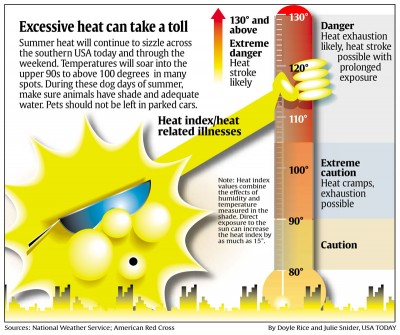
There is not a lot to say about the graphic above, other than:

  1. It is crude.
  2. It is funny.
  3. It is intentional.
  4. It is inappropriate for a general audience newspaper
  5. A competent editor should have caught it, and
  6. The graphic artist needs a warning and a reprimand.

The media, its staff, celebrities and assorted vulgarians and boors seem to be determined to make public square America as uncivil as a locker room, as crude as a peep show, and as juvenile as a junior high school farting contest. Professionals, including USA Today editors and publishers, can either do their duty and discourage this intentional rudeness in their products and services, or shrug it away. Similarly, our culture needs to decide if we are going to just define our deviancy down some more, and accept gratuitous sexual innuendo that will gradually make the whole population into a bunch of snickering Beavises. Continue reading