
Ethics Observations On The Scaramucci Attack Interview Aftermath

1. We are told that President Trump was thrilled with Anthony Scaramucci’s vile, obscene, threatening, vainglorious interview attacking his own colleagues and making Samuel L. Jackson’s movie rhetoric sound relatively refined. Incredible. An individual who represents the White House expresses himself in a published interview like a preening teenage gang member, breaches all existing standards of management and professionalism, throws red meat to the stalking news media writing the narrative that the President’s office is a den of narcissists, assassins, jerks and nut-jobs, and the President is applauding.

This is a level of irresponsible leadership not just unprecedented in U.S. history, but seldom equaled in the history of national leadership world wide. Incompetent and irresponsible don’t begin to describe it.

2. We are also told that the President was disgusted with Reince Priebus’s failure to “return fire” at the White House’s thuggish communications director. Wait, what? What kind of leader wants his staff to have public pissing matches? That’s a rhetorical question; the answer is obvious: a bad leader.

Yes, Priebus is a weenie: Ethics Alarms marked him so in 2015. Trump knows he is a weenie: if Priebus hadn’t been a weenie, he would have stopped Trump from getting the Republican nomination. He sold out instead.

Priebus is  a professional however, who knows, as Scaramucci and Trump do not, that a warring staff at the highest levels of government makes the public nervous and that government look like a Three Stooges short. As I wrote in the post about the Mooch’s outburst, Priebus and Steve Bannon should have presented their letters of resignation unless Scaramucci was disciplined. If Priebus was a weenie, so was Bannon. “Returning fire,” however, would have been disruptive and destructive. The President is angry with Priebus for  for being prudent, exercising restraint, being responsible, and being professional—in short, for conducting himself ethically. Continue reading
Unethical Quote Of The Week: San Diego State University Political Science Professor Jonathan Graubart

I find myself annoyed at the groundswell of good wishes for John McCain after his diagnosis of glioblastoma…McCain is a war criminal and, more to the point. someone who as a politician has championed horrifying actions and been lousy on state commitment to public health…But ultimately what troubles me is the urge to send such well wishes to an utter stranger as it reinforces the notion that some lives are more important than others. There are lots of people with glioblastoma and who have died from it (including my mother twenty years ago)….

San Diego State University Political Science Professor Jonathan Graubart on Facebook, prompting some calls for him to be fired, and others on campus to second his opinion.

Is this an Ethics Quote or an Unethical Quote? I could call it  an Ethics Quote because it raises many ethical issues, and mere statements of opinions, even stupid and vicious ones, are not usually unethical in themselves. This quote strongly suggests that the speaker is unethical in  than one respect; it is also, at very least, irresponsible in its context, which is that he is a teacher, and represents the institution.

Jonathan Turley flagged this episode, as he reliably does any time a professor comes under fire for controversial speech. As always, he supports his fellow academic:

“Graubart’s comments are hurtful and hateful. It is a reflection of the incivility that has taken hold of our social and political dialogue. It is always sad to see a fellow academic rush to the bottom of our national discourse. However, we have free speech and academic freedom to protect unpopular, not popular, speech. Popular speech does not need protection. Graubart is expressing his deep political and social viewpoint on social media. He should be able to do that just as his critics have a right to denounce his views.”

San Diego State University is a government institution, and thus subject to the First Amendment, in addition to the principles of academic freedom. However, even a state institution  has a right to protect itself from harm. This isn’t just political speech; it is bona fide asshole speech, signaling that the speaker is not a trustworthy teacher, and that any school that would have someone this intolerant, doctrinaire, vile and contemptuous of kindness and compassion educating, aka indoctrinating students isn’t trustworthy either. Universities, public or not, should be able to insist on a minimal level of professionalism from faculty in their public behavior and pronouncements so the institution isn’t permanently discredited, embarrassed, and harmed.

Here is Graubart’s whole Facebook rant: Continue reading

Pro Football Finally Gets An Ethics Call Right!


So, naturally, it is being attacked.

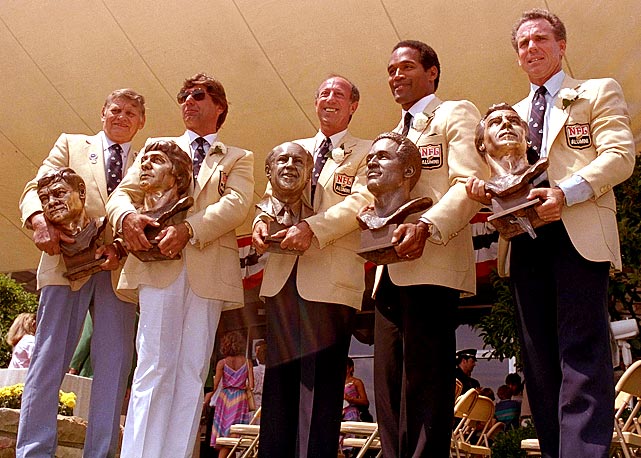
The Pro Football Hall of Fame invites every Hall of Famer to its annual enshrinement ceremony  When asked whether O.J. Simpson, the acquitted double-killer and the newly paroled convicted burglar/kidnapper who was enshrined in 1985, will be invited to the next ceremony, the Hall of Fame told ESPN, “All Hall of Famers are invited to attend the annual enshrinement.”

This is the Bill Cosby bust story in reverse. Like Cosby, O.J.’s honor was earned before his character issues were known, and in Simpson’s case, before he embarked on an avocation as as a knife murderer. The honor was based entirely on what Simpson did on the football field, and nothing he can do subsequently can change that record, which was and is deserving of recognition. It would be a different question (though, I believe, demanding the same result) if Simpson were a member of baseball’s Hall of Fame, which has a character requirement. Not pro football. O.J. is the only murderer, but felons abound. One of the greatest running backs ever, Jim Brown, repeatedly beta up his girl friends, and that was before he was enshrined.

Has Simpson embarrassed his league, his sport and the Hall? Sure he has. Is he a pariah in the NFL? Boy, I hope so. But no Hall of Fame should try to constantly re-qualify its members once they are admitted. What standards would justify de-busting? Universities like Princeton and Yale are doing too much of this kind of thing already. O.J. Simpson was a great football player. As the song says, they can’t take that away from him. Nor should they.

However, Simpson, being treated ethically by the Hall, should show his gratitude and respect it  by never darkening its door again.


Morning Ethics Warm-Up: 7/21/17

Good Morning!

1. There was one of those moments in a Major League Baseball game yesterday that teaches life lessons in character, and ethics for anyone who is paying attention.

The Boston Red Sox were playing the Toronto Blue Jays in an afternoon game at Fenway Park. Boston led 3-1 in the second inning, but the Red Sox pitcher,  veteran Doug Fister, was struggling with an uncharacteristic control lapse: he walked his third batter in the inning, and also had given up a couple of hard-hit balls that suggested that a gaggle of runs and a blown lead were inevitable. Then, mirabile dictu, Fister caught a break. The next Toronto batter swung mightily and lofted an easy, lazy pop-up to the infield. If there had been one out rather than two, it would have been called an automatic out under the Infield Fly Rule. Everyone, including Fister, who is fighting to preserve his spot on the Sox roster as well as his flagging career, breathed a sigh of relief. The Toronto batter slammed his bat to the ground. Settling under a pop-up not any more difficult than those he had successfully caught as a Little Leaguer was Red Sox utility man Brock Holt, a second baseman this day. He is much admired for his versatility, energy and reliability. Holt is also trying to revive his career after a frightening, season-long battle with vertigo, as well as to show the team that he can fill a yawning void at third base.

Holt dropped the ball. It bounced off his glove, as the Toronto baserunners were charging around the bases at the crack of the bat, since there were already two outs. Two of them scored, and later two more after Fister surrendered hits in te lengthened inning, making the bounty bestowed by Holt’s muff four runs. Fister was soon out of the game, and was charged with his team’s eventual two-run loss by an 8-6 score. (Today’s headline in Boston: “Doug Fister’s Future As Starter Uncertain After Loss To Jays”).

Yet Fister never shot an angry glance at Holt. He’s played the game; he knows how mistakes and random bad luck can turn everything around in an instant. He probably has dropped a similar ball in a crucial situation: I know I’ve done it, at second base, losing a company soft-ball game. Holt trotted to the dugout, got supportive pats on the back and fanny from his team mates, and played the rest of the game with his head high and his skills on display. There is no doubt that he felt terribly about the play, but Holt  didn’t hide under a rock, rend his garments, or make a big display of anger and frustration to signal to the hometown crowd—which didn’t boo or jeer him at any point in the game.

That’s life, as my father used to say, and this is how ethical people handle life. Disaster strikes out of a confluence of factors (a very bright sun undoubtedly helped Holt miss the ball, but professional ballplayers learn to cope with the sun) and all we can do, if we are competent at life as well as fair, responsible and brave, is to accept responsibility, not make excuses, and not allow such events to diminish or destroy us. Both Fister and Holt displayed the character necessary to do that. Neither blamed the other, and no one blamed them. Tomorrow is another day.

Play Ball!

2. Professional troll Ann Coulter is having a public spat with Delta Airlines that reflects badly on both of them. Continue reading

This Is Why It’s Time For Political Cartoons To Go


Here (and above) is a sample of the bumper crop of political cartoons inspired by the Donald Trump, Jr. aborted meeting to acquire damaging information on Hillary that never materialized.

They are all, to various degrees, unfair, misleading, or simply untrue. Why is this acceptable? If presenting a false representation of the truth is required to make a joke, and the intended audience accepts what is false as fact, how is that justifiable?

The cartoon above, one of the most unethical, is typical of the work of Tom Toles, the Washington Post’s relentlessly biased cartoonist.

The others are presented below, in approximate order of unfairness and dishonesty.

They collectively state that there has been treason, a crime, corruption, collusion and conspiracy, and that there is actual, as opposed to speculated, “news” that the Trump campaign worked with Russia to interfere with the election. This is old fashioned yellow journalism-style political cartooning, throwing red meat to members of the public who want to believe that the President of the United States is a traitor so they can undo the election. That isn’t funny. That’s disgusting.

As I wrote in 2012, focusing on another dishonest and partisan Toles cartoon:

” Political cartooning peaked as a form of commentary about half a century ago, and has been declining ever since. Now it is dominated by hateful, unfunny and witless culture warriors who have as much in common with Jules Feiffer and Bill Mauldin as Mario Mendoza had in common with Hank Aaron. Are there exceptions? There are always exceptions. Pat Oliphant, Exhibit A, is brilliant, nuanced and clever; he’s also 77 years old, the last of the greats. If there are Oliphants out there, legitimate commentators who can make fair and honest observations with humor and a pen, great: what a wonderful alternative to the typical pundit rants. Put them on the editorial pages. The standard, however, should be content, not form. Political cartoons were once an efficient means of aiming a thousand words at non-readers and members of the public without the skills or education to grasp complex issues. They have become a vehicle for the unqualified and trivial-minded to acquire a platform they don’t deserve, to the detriment of the public and journalism.”

Now the evidence: Continue reading

Ethics Quiz: The Neglectful Mom

An upstate New York mother allowed her 10-year-old child to shop alone at the LEGO store as she shopped at a different store in the same mall. It appears that the LEGO store’s personnel called the mall’s security, and the child’s mother was arrested and charged with endangering the welfare of a child. The store does have a sign that states that children under the age of 12 must be accompanied by an adult.

Arresting the mother is obviously absurd over-kill. Obviously also, the LEGO store has a right to have whatever policy it chooses regarding unaccompanied children. However the question remains, and is the Ethics Alarms Ethics Quiz of the Day

Is it irresponsible for a mother to allow her 10-year-old to shop alone if the mother is shopping in the same mall?

Related questions as you ponder: Continue reading

The Tangled Ethics Of Men, Women, Sexual Harassment,Sexual Discrimination, Romance, Common Sense, And “Vive La différence!”

Mike Pence would not have a business dinner with Debrahlee Lorenzana. What’s wrong with him?

Many years ago I did a sexual harassment seminar for a New York law firm. Afterwards, the partner responsible for handling the firm’s EEOC and workplace matters told me that my ethics-based approach to the topic wasn’t sufficiently rigorous, since he believed that innocent contact between employees in the firm could spawn lawsuits. “I refuse to travel with female associates,” he told me. “I can’t be sure what they will think is harassment.”

“Wait,” I asked. “So because you’re afraid of being accused unjustly of sexual harassment, you engage in sexual discrimination?”

He sputtered something and left to arrange his sock drawer.

I think of this conversation often. I thought of it when Vice-President Mike Pence was reported as saying in 2002  that he never had a meal with a woman who was not his wife, and was promptly savaged for it by feminists and the news media. Because the new rules and practices of the workplace have developed amid contradictions and rigid doctrine rather than with attention to whether they were workable or not, Pence and that hypocritical lawyer years ago are both victims and victimizers. It is often impossible to know what ethical workplace conduct is.

The New York Times was happy to bash Pence for his candor as part of a requirement of membership in “the resistance,” but then, as is often the case for the schizoid paper, later competently and objectively examined the issue away from politics. A Morning Consult poll conducted for the paper  found that there is widespread fear of one-on-one situations, male-female interactions in the workplace.  About 25% think private work meetings with colleagues of the opposite sex are inappropriate. Almost 2/3  say it is prudent to be especially wary and sensitive around members of the opposite sex at work. A majority of women, and nearly half of men, say it’s unacceptable to have dinner or drinks alone with someone of the opposite sex other than their spouse. Continue reading

A Life Ethics Lesson: The Washington Nationals And The Duty To Improve

Tex Ritter’s much-covered recording about the soldier whose deck of cards reminded him of the Bible has a parallel for me in the relationship of baseball to ethics. Like cards, baseball is a pastime, a game, but if you pay attention, there are profound lessons in ethics to be gleaned from the history, characters, and events of the game. In my official bio that I use for speaking engagements, I suggest that intensely following the travails of the Boston Red Sox since I was 12 was a major factor in sparking my lifelong interest and fascination with ethics. And it is true.

I live in the Washington, D.C. area now (unfortunately), and the local team is the Montreal Expos in exile, the Washington Nationals. The Nats’ mission is to bring Washington its first MLB World Championship since Walter Johnson was pitching and Coolidge was President. So far this goal has been elusive. That 1924 World Series-winning team, with the best names any team has had ever (Muddy Ruel, Ossie Bluege, Goose Goslin, Joe Judge, Nemo Liebold, Firpo Marberry, Mule Shirley, Pinky Hargrave, Curly Ogden, and more) has faded into forgetfulness while two Washington Senators franchises fled (to become the Minnesota Twins and the Texas Rangers, respectively) after decades of failure. The Washington Nationals, not nick-named Senators on the theory that the name was cursed, have proven cursed themselves. Despite having won more games over the last five seasons than any National League team, and having won the National League Eastern Division three times, the team has never sniffed the World Series, having lost repeatedly in the first round of the play-offs.

This season the Nats were loaded from the start, and even after terrible injuries to two of their best players, they have the best offense in the league, the best hitter (Bryce Harper) and arguably the best starting pitcher (Max Scherzer).  They are also in a lousy division where they don’t need to be great to win it without breaking a sweat.

But like the gorgeous woman with a wart on her nose, there is an obvious imperfection. The Nationals have no closer, that pitching specialist whose job is to get the last three outs (and sometimes more) to lock down victory in a close game.  This is not a new development, by any means. After the team decided to let last season’s (excellent) closer to leave via free agency, fans and sportswriters wondered how and when the team would replace him. One by one all of the established closers available by trade and free agency were snapped up, and it became clear that the Nationals ownership’s position was, “Never mind. The team is good enough. Maybe we’ll get lucky and some pitcher will surprse us, but even if we don’t, this team is good enough to win anyway. And we can save ourselves a bunch of money.Continue reading

California “Ethics”

California is not only rapidly exiting mainstream U.S. culture, it is forging its own distorted and unethical version of right and wrong.

Three alarming examples:

1. Forging ahead with single payer, and reality be damned.

The Sacramento Bee  pointed out that by replacing current state-run health programs with a single-payer system, the state would still need to come up with an additional $200 billion annually.This year’s state budget in California is about $180 billion. Yes, implementing a single-payer health care system would require doubling California’s current tax burden.

Oh, never mind! The state Senate voted 23 to 14 this month in favor of SB 562, a single-payer proposal that would guarantee universal health care to all Californians. “What we did today was really approve the concept of a single-payer system in California,” declared state Senator Ricardo Lara following the vote.

No, what they did was reaffirm the fact that progressive cant refuses to yield in the face of cold, hard facts, math, reason and common sense. The cheerleading from the Left is mind-numbing. Writes the Nation: If health care is a right—and it is—the only honest response to the current crisis is the single-payer “Medicare for All” reform that would bring the United States in line with humane and responsible countries worldwide.”

Well, let’s see: health care is NOT a right except in Left-Wing Fantasyland, and all of those “humane and responsible countries” have crushing tax burdens, reduced liberty, economic instability, crushing debt and completely different values, priorities and responsibilities than those of the United States.

Ethics is only ethical when it is practical and practicable in the real world. The ethical response to the fact that single-payer doubles the state budget is to say, “Oh. Well, obviously we can’t do that, then. On to plan B.”

2. That minimum wage increase that Gov. Brown said was based on principle rather than economics? Yeah, about that…

Continue reading

Morning Ethics Warm-Up: 6/20/17

1. It isn’t just the President’s boorish role modelling and the misbehavior and incivility of his opposition that makes me fear for the ethics alarms of our rising generation. The long-term results of people being able to isolate themselves from social contact—and the social skills and sensitivities that direct, face to face contact nurture—by constant attention to electronic devices is a matter for concern. Yesterday, I became aware of another danger.

I heard, on the new Sirius-XM Beatles channel, a recording of Paul McCartney singing my favorite song from “Guys and Dolls,” a sweet ballad sung in the musical by an elderly father to his grown daughter during her romantic crisis.

McCartney has a foot in two cultures and always has. As much as a rock and pop innovator as he was, Paul was also steeped in the traditional love songs of his parent’s generation, including Broadway. Today both of McCartney’s feet are planted where nobody under the age of 30 is likely to tread, and that is natural. Yet it seems that popular music is increasingly devoid of tenderness, empathy and compassion. Hip-Hop, particularly, seems immune from being able to express a sentiment like that in Frank Loesser’s nearly  70-year-old song that Paul McCartney obviously understands. I wonder, and worry. how many of today’s young Americans understand it, or will grow up with the capacity to do so.

Here’s Bing crooning the same song…

You know I love ya, Bing, but the Moptop wins this round.

2. There was some discussion on a thread here yesterday about the ethics of interests outside the state putting so much money into Georgia’s 6th congressional district’s special election. The House was designed to give communities a say in the national government, so to the extent that a local election is warped by interests outside the community—the Democrat, Jon Ossoff, is a carpetbagger who doesn’t live in the district—it’s a violation of the spirit of the Constitution and the ideal of American democracy. Some have even made an analogy to foreign governments interfering in U.S. elections. On the other hand, all this outside “interference” consists of are words, ads, and marketing. The district’s residents still are the ones who vote. If they are so easily swayed by slick ads and robocalls, that’s their responsibility. (There may even be a backlash.) Continue reading