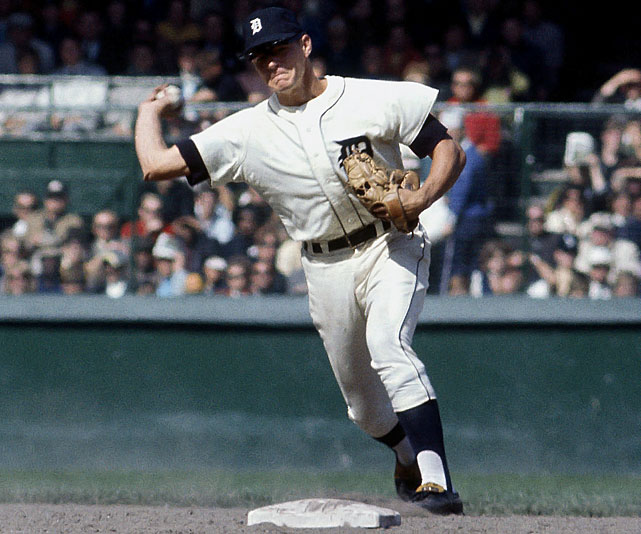
Case Study In How Sports Encourages Consequentialism: The 1968 Detroit Tigers

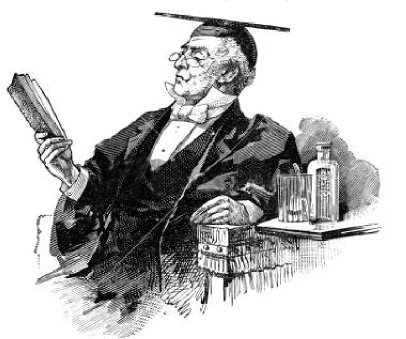
Mickey Stanley in 1968: learning a new position in the World Series, making us dumber...

Mickey Stanley in 1968: learning a new position in the World Series, making us dumber…

Frequent readers here know that I often inveigh against consequentialism in its various forms, from labeling sound decisions “mistakes” when they don’t pan out due to uncontrollable factors, to pronouncing unethical conduct as ethical because it chanced to have some beneficent results. This particular hydra seems to be a tough one to kill, and one of the reasons is, I realize, the pervasiveness of sports in our culture.

Reflecting on sporting contests, particularly those involving teams, routinely generates hindsight bias on the part of fans and sports commentators….for one thing, it’s fun to second guess managers and coaches from the safety of an armschair or from behind a computer screen. Unfortunately, the practice endorses consequentialism. Decisions that result in a win are seldom criticized, no matter how moronic or misguided they may have been; tactics that ended in defeat are always called “mistakes,” or worse.

The baseball post-season began yesterday. We won’t see a World Series game until October is almost over, but there was a time, children, long ago, before divisions and the designated hitter, before steroids and ESPN, when in major league baseball, the World Series was the post season. This was the case 45 years ago, in 1968, when the Detroit Tigers, who had clobbered the American League competition on the way to a 103-59 record, including the last 30 game-winning season by any pitcher, turned in by Denny McLain. They were about to face the reigning baseball champions from 1967, the NL’s St. Louis Cardinals, led by future Hall of Famers Lou Brock, Orlando Cepeda, and Bob Gibson. Both were veteran teams and well-balanced; there was every reason to believe that each had a good chance at victory. Certainly, neither was in need of any last-minute overhaul.

Nonetheless, Tigers manager Mayo Smith decided to take a gamble. Continue reading

Now THAT’s Unprofessional!

"911...what is your emergency?"

“911…what is your emergency?”

There are many professions where a whimsical, even a black sense of humor is useful, perhaps essential. If M*A*S*H taught us anything, it taught us that. 911 operator, however, is not one of them.

I say this knowing that I would be dreadful at the job, as I find it hard not to see humor in disasters that befall others, or even myself—-too many Warner Brothers cartoons, perhaps. 911 operators must maintain a cool, calming, respectful demeanor, even when they are being told by a panicked mom that her kid super-glued a rat to his sister, that her home has been invaded by thugs dressed as Muppets, or the house has been engulfed by a flood of molasses. I couldn’t do it.

But then, it’s not my job.

It was the job of the operator on this call, though: Continue reading

The Right Thing In Spite Of Themselves: CNN And NBC Abandon Their Hillary Projects

Hillary Clinton, in her dreams...and Bill's...

Hillary Clinton, in her dreams…and Bill’s…

If CNN and NBC had any sense of responsibility, fairness and respect for the American political system, neither would have planned Hillary Clinton projects—CNN, a documentary, NBC, a “docudrama” mini-series—for the coming year, in which the controversial Ms. Clinton is expected to begin running for President of the United States. Neither deserves any credit for cancelling them now, after pundits and especially the Republican Party screamed foul, and foul it was.

There is no way either product could avoid making difficult content choices that would be inevitably influenced by such non-ethical considerations as entertainment value, ratings, political pressure, and artist bias. The documentary and the mini-series would necessarily distort fact and history, because so much of any contemporary figure’s life and career has yet to be objectively examined, and no more so than Hillary Clinton, as polarizing and mysterious figure as U.S. politics has ever produced, rivaling Richard Nixon and Aaron Burr. Continue reading

The Truth Behind School Anti-Gun Madness: In The Battle of the Razors, Occam’s Beats Hanlon’s

"GUN!!!!!!!!!!!!!!!"

“GUN!!!!!!!!!!!!!!!”

My parents once gave me a tie clip with a tiny derringer on it, which I wore to school frequently. Occasionally, I loaded it…you see, the gun took a miniscule cap, and when you pulled the trigger, the report was shockingly loud. Had this been the kind of itsy-bitsy gun that 12-year-old Joseph Lyssikatos had on his key chain (his gun was slightly larger than a quarter; mine was slightly smaller than a nickel), then his school might have had a valid reason to object. But it wasn’t. His gun was a decoration only, but it didn’t stop the school from suspending him for three days.

I’ve been pretty dense about these cases, I must admit. I used to think it was just no-tolerance idiocy, merged with post-Sandy Hook paranoia, that was behind all of the silly news stories. It finally dawned on me that it is far more sinister than that: this is a deliberate and relentless process of state indoctrination. The schools, teachers and administrators are determined to make  future generations of Americans just as fearful and negatively disposed toward guns, and thus toward self-sufficiency and the Second Amendment, while pushing them to embrace complete dependence on a government that cannot be depended upon, and trust in a government that has proven progressively more untrustworthy. Continue reading

Are Universities Ethically Obligated To Tolerate Professors Who Embarrass Them By Saying Idiotic And Offensive Things?

Apparently the answer to the above is “Yes.”

"Duh!"

“Duh!”

If the university is a state school, then for it to fire a professor who makes ridiculous, foolish or hateful statements that make people wonder why they should ever entrust the minds of their tender charges into an institution that would knowingly hire cretins and jackasses to pollute student RNA, then this is probably a First Amendment violation, since it amounts to the government punishing speech and chilling free expression. If, on the other hand, the university involved is not a state school, then to send a professor packing because he or she has rammed his or her foot down his or her throat up to the knee is a violation of the crucial principle of academic freedom, which is, in brief, that to encourage the free discussion of ideas on a college campus, education being the purpose of the institution, literally no idea, point of view or position should be blocked or chilled by substantive negative action.

Three cases of recent vintage illustrate the university’s plight: Continue reading

Ethics Quote Of The Week: Washington Post Columnist Michael Gerson

casino_large

“Most theorists of self-government have maintained that certain modest virtues are necessary to democracy and free markets: deferred gratification, diligence, a prudent concern for the future. There is an ongoing American debate about the degree to which government can or should promote such virtues. But here is an extraordinary case of government actively undermining the moral underpinnings of market capitalism for its own benefit. It holds out the promise of sudden wealth without work or productive investment, engaging in a purposeful and profitable deception. A corrupting fantasy becomes a revenue stream, dependent on persuading new generations to embrace it. Perhaps we have given up on government as a source of moral improvement. Does this mean we must accept a government that profits by undermining public virtues? Nearly 20 years ago, William Galston and David Wasserman wrote, “While history indicates that gambling is too ubiquitous to suppress, moral considerations suggest that it is too harmful to encourage. The most appropriate state stance toward gambling is not encouragement, but rather containment.”’

——- Washington Post op-ed columnist Michael Gerson, on the implications of a new report by the Institute For American Values titled, “Why Casinos Matter.” Continue reading

Ethics Hero: Minneapolis Dairy Queen Manager Joey Prusak

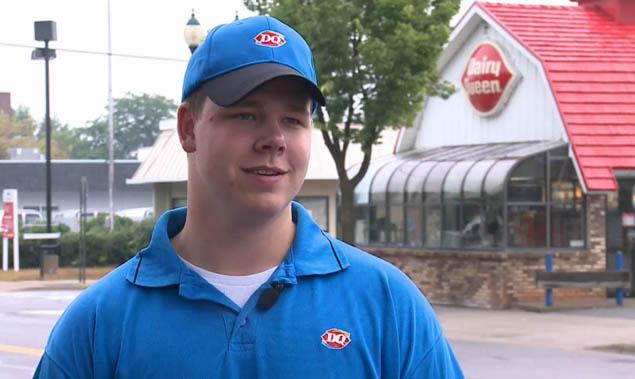
"Good job, Joey!You made Dairy Queen proud and brought honor to the store, Here's 40 dollars."

“Good job, Joey!You made Dairy Queen proud and brought honor to the store, Here’s 40 dollars.”

It’s a simple story, trivial in a way, but with an important ethics lesson.

Joey Prusak, the 19-year-old store manager at a suburban Minneapolis Dairy Queen, watched as a female customer with a heart of ice saw a vision-impaired man drop a $20 bill, picked it up, and instead of returning the money to the unaware customer, slipped it into her own purse. When the certifiably awful woman got up to the counter to order, Prusak told her what he had seen and demanded that she return the bill as a condition of service. The woman, as one might expect from someone who would take money under such circumstances, refused, so Prusek reimbursed the visually impaired customer with $20 of his own.

A customer who saw the incident e-mailed Dairy Queen in praise, and now Prusak has become something of a folk hero.

The important ethics lesson is “Fix the problem.” If you are in a position to right a wrong or prevent one, it has become your obligation to do it. Don’t adopt  any of many rationalizations available to persuade you to do nothing— “It’s not my job,” “Mind your own business,” “Who am I to judge?”, “It’s not my fault”, “What if I’m wrong?”—or, in a case like this one, manufacture excuses for the vile miscreant who took the money—–“Maybe she’s desperate,” “Finders keepers”-–and just act. Fix the problem. Continue reading

Unethical Tweet Of The Week: Prof. David Guth

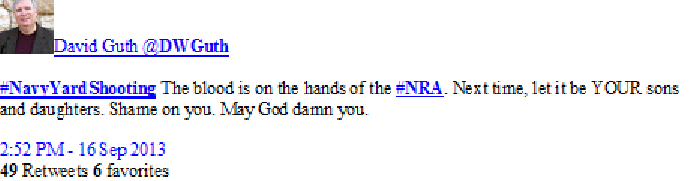
Guth Tweet

With this brain-jarring twitter offal from University of Kansas journalism professor David Guth—and if you marvel at the abysmal quality of today’s journalists, there’s a big clue right there—Ethics Alarms launches a new category, the Unethical Tweet of the Week. Clearly, Twitter has a magic ability to make even reasonable public figures and professionals engage in irresponsible, hateful and idiotic discourse, though I seriously doubt that this particular tweet’s author needed much of a shove.

What’s the matter with the tweet? Well, how long have you got? Let’s see: Continue reading

Your Introduction To “Private Re-Homing”

Puppy, child, what's the difference? The point is make it someone else's problem, right?

Puppy, child, what’s the difference? The point is t0 make it someone else’s problem, right?

Every time you see a national newscast take up valuable time telling us about Miley Cyrus, the Kardashians, Chelsea Clinton or the White House waterdogs, think about Inga, or Quita, victims of the increasingly common practice of underground adoption known as “private re-homing,” in which adopted children are traded around like dogs or kittens, and abused dogs and kittens at that.

I don’t have a lot of commentary about this horrible practice. My life was a little bit happier before it was brought to my attention. In the history of Ethics Alarms, perhaps the most upsetting story I have had to write about was the horrific conduct of Torry Hansen, a Tennessee mother who adopted a Russian child and then, finding that she couldn’t cope with his problems, put him, alone, on a plane bound for Russia with a note pinned to his jacket. I wrote that post with tears in my eyes; it upsets me to write about it now. Yet something very like what Hansen did to her son is being done via the internet, frequently and with little interference from the government or anyone else. I wish I didn’t know about this—no, that’s not quite right. I wish this wasn’t a feature of our society, so I wouldn’t have to know about it, much less write about it. Continue reading

Ethics Hero: Glen James

Glen James, role model.

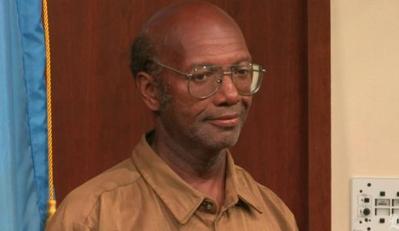
Glen James, role model.

This is straightforward: Glen James, a Boston man who lives in shelters and has no money, found a backpack over the weekend that contained $2,400 in cash, $39,500 in traveler’s checks, passports, and other personal items. James flagged down a passing Boston police officer and gave him the backpack.  As is often the case with stories like this, he doesn’t think what he did was a big deal: after all, isn’t this what anyone would do?

We all know the answer to that question. Continue reading