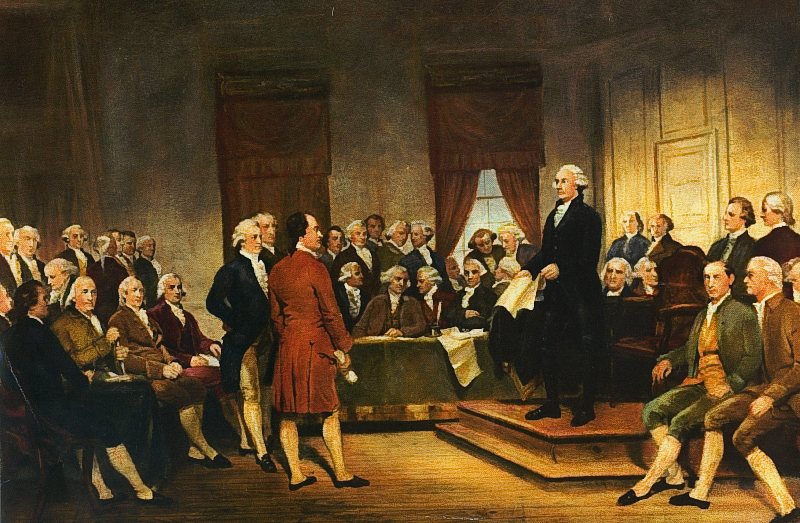
Barack Obama may not be the Worst President Ever, but I am slowly reaching the conclusion that he is the Worst Former President Ever, though Bill Clinton and John Tyler are tough competition.
Incredibly, Obama said, during the opening of his library, “The founders fell terribly short of the Declaration’s promise.” His case, which requires ignoring history and documentation, is the old leftist lie that they should have banned slavery and foreseen the women’s movement. So days before the United States marks its 250th anniversary, an ex-President, whose contribution to the United States, its politics and culture, were overwhelmingly negative, has the hindsight chutzpah to insult men who were wiser, smarter, and braver than he.
Does Obama know how wrong that Unethical Quote of the Month is? I’m guessing that he does. Obama thinks the public and especially the Democratic Part’s base are stupid and frames his rhetoric accordingly. Everyone who has studied the issue knows that insisting on banning slavery would have meant no Constitution at all, just as Jefferson had to strike an anti-slavery section from the Declaration for there to be a revolution. Most of the people O was addressing probably still think the Founders’ three-fifths compromise was an expression of racism, when it was designed to set the stage for slavery’s eventual elimination. As the late Gordon Wood explained here, the Founders had reason to believe that slavery was on the way out, and that it was not the metaphorical hill let democracy die on.
But enough of one of the three most over-rated U.S. Presidents and the only one who is still yapping (JFK and Woodrow Wilson are playing Trivial Pursuit in Hell).


Try this here this time:
https://x.com/RealBrittHughes/status/2066996315104710761?s=20
Quick ethics observations:
1) Simple conversations can bypass a lot of societal rules established to govern interactions between strangers.
2) It’s well understood that parents of opposite gendered (there’s only two) children have to make an arbitrary choice what bathroom they’ll accompany their younger children to.
3) It’s obligated that parent to make sure the bathroom is clear of anyone else before entering, otherwise wait.
4) It’s obligated that parent to try to ensure no one else enters the bathroom while it’s “awkwardly” occupied.
5) It’s also obligated that the parent try to minimize the duration of the awkward arrangement.
6) It’s almost obligated that anyone who seeks to enter such an atypical situation, to wait patiently for the bathroom to return to a “normal” status.
7) In this video: are the girls old enough to handle themselves in a bathroom alone…? Maybe…I’m not convinced it’s a closed case that they are, even while some kids may be.
8) In this video, lacking context before it began: we don’t know what kind of basic conversation (see point 1) occurred before the episode began.
9) Assuming the dad did the basics (see points, 1, 2, 3, and 4) it would seem the “angry man” ignored point 6 and is in error here.
10) That being said: it also seems pretty clear that the dad slowed down his efforts, letting pride get in the way of resolving the awkward accommodation, see note 5.
11) The dad should have also just left the locale as soon as he and his daughters were done, there was no reason to continue interacting with the “angry man”.
12) The dad was, at this point in societal disfunction, probably OK recording the event to make sure anything going south could be proven.
13) The dad was, probably not OK publishing this event outside of any court-room needs – because now, “angry man”, who could have been acting inappropriately after experiencing an exceptionally bad day, is now *permanently* associated with an event that would have ordinarily been forgotten by tomorrow. “Angry man” has been fired.
I read an article about this and have a couple of comments to make, not so much at what you have said, but about the whole situation.
One of my favorite books has a quote that I love and find appropriate with so many problems in today’s society, “…this may well have been a case where chilly logic should have been replaced by the common sense of, perhaps, the average chicken.” This bathroom instance is one of those situations.
I live in Wyoming, and one of the unusual things about this state is that decent sized towns are about 100 miles apart. This also has the effect of making bathrooms a little harder than average to find. Therefore, it is extremely common to see a dad taking girls into the girls bathroom or a mom taking boys into a boys bathroom. I encounter this many times in a year.
The basic understanding is that kids should go into the appropriate bathrooms until they are old enough to go alone. Now, when you are in the middle of nowhere rest stop in a place you are unfamiliar (or even a familiar one known for drug trafficking, but the only place to pee indoors for forty miles in a blizzard), no police within those forty miles, no cell service, and many strangers lined up for the john, that age might be an awful lot higher than in a well populated Walmart with a security force at most five minutes away.
It is actually quite a bit ickier for a ten or twelve year old boy in the girl’s bathroom with his mom than it is for a dad with his twelve and ten year old girls in that same bathroom, again depending on circumstance. Note, that if your kids are about four or younger, no one cares, but starting at six, they should be in their restroom. Of course, part of the reasoning is that mom will take the ten year old boy in with her and expect me to be ok with my naked twelve year old changing her clothes in the area that is understood to be available for changing, which has no stalls. The dad will call out and ask if I’m in there and wait until I’m ok with him entering, usually after I leave. Now depending on the bathroom set up, and how conversations with the dad take place, I might be willing to use it myself, or will just wait until the situation is handled.
There is another option, depending on the circumstances and geography. I have been approached by a man before when I was there with my girls. He asked me if I could help his daughter and he stood outside the open restroom door until I led her back out, which I did as fast as appropriate. We did not know each other, but we could see the advantages, and it wasn’t like she couldn’t call to him, and if I had done anything untoward, he probably would have burst in and beaten me senseless. This does not work for two exit bathrooms or stall-less bathrooms, of course, but single exits with private stalls are fine. Often men will even step out to the door way while I and my kids do our business while they are waiting for theirs to finish, depending on the maturity of the children involved. As you say, a polite conversation fixes a LOT of potential problems.
Wyoming is a place with very little patience for men in girl’s restrooms or the trans movement. This is never a problem or a discussion point when you have children trying to use the bathroom. Another thing is that many restrooms are single holer’s (often literally a hole in an outhouse). People really don’t care at that point, children or not, who is using what as long as you follow basic line rules with some politeness and common sense (someone with a vomiting four year old gets to skip the line and go in whatever door is unlocked). Again, the common sense of an average chicken turns this whole mess into a non-issue.
Frankly, there was no reason for the second man to have gotten involved and was an ethical failure right out. Once he did, this escalated. The dad should have stood his ground, kept his mouth shut, and not done anything, though perhaps recording in this day and age is necessary. Posting the recording, unless circumstances dictate otherwise (charges filed or a second recording, for example) is absolutely an ethical failure.
By the time they were out of the bathroom, he was informed that the police had been called, and probably thought he had to wait and resolve the issue.
So often the news is filled with reports of sexual assaults on children, these days I would accompany my daughters into a gas station or rest stop bathroom. With a son who is 10 or 12 I might stand near the door and say something loudly, like “I’ll be right here.” The fellow who made the ruckus should have understood that this wasn’t a suspicious situation, but, who knows, he may have thought the dad was a predator and the girls were at risk. Memories are short – I’m sure he’ll recover. The dad might have been a jerk to make this public, or he may have been worried about legal problems. Sounds like the police officers acted responsibly. Unfortunate all the way around.
Can we talk about the reflecting pool on the National Mall?
My social media is full of memes and pictures of the recent algae problem that has resurfaced, apparently due to some residual stuff in the pipes. By all accounts, the problem has been fixed, but the level of mockery involved is becoming grating.
When Republicans, Conservatives and Normal, Decent Americans complain about Trump Derangement, this is exactly the type of situation we mean. There was nothing wrong with fixing the plumbing in the pool, painting it and cleaning it.
“When Republicans, Conservatives and Normal, Decent Americans complain about Trump Derangement, this is exactly the type of situation we mean. There was nothing wrong with fixing the plumbing in the pool, painting it and cleaning it.”
This is the ultimate poison on good faith discussions. I do my best to criticize Trump’s decisions when and where they should be criticized. But the progressive mental illness leading them to not only criticize him about *everything* but also to use the most irrational angles from which to criticize the things worthy of criticism makes it hard to occasionally align with those loathsome creatures across the aisle.
Just leave it alone for a minute Democrats and make us think that maybe you are not completely insane and you might find some people on the right offering concerns with Trump’s actions.
The reflecting pool kerfuffle is interesting. There was no complaint about its condition before Trump decided to clean it. Now that it is clean, the algae problem is Trump’s fault because, Trump is evil and everything he touches is evil. So, the algae is evil and will always be evil. It is a silly issue but hey . . .
More important issue, though is the Iran deal. Those who hated military action in Iran are now saying that the deal is not enough, doesn’t go far enough to deal with the threat, and leaves the Iran government in place. Yet, those same people were complaining about military action in Iran, that the mullahs are just fine and not an existential threat to anyone, and Iran won. What’s a body to do?
jvb
Yeah, the Iran ‘ceasefire’ (which is what the MOU is), is another one of those things where the anti-Trump crowd just can’t be sane. However, in this instance, they have one slight kernel of traditional American attitude on their side:
we’d rather not start a war if we don’t want to and we’ll be pretty annoyed if we start one that we don’t want to, but if we’re in one (even if we didn’t want it) we’d better win and we’ll be pretty annoyed if we don’t.
But even then they can’t be sane on even that point of view.
where the anti-Trump crowd just can’t be sane.
Please then, demonstrate the “sanity” you have at your disposal. Describe what happened in realistic terms and forget the TDS people. Defend the Iran fiasco to MAGA-type people, such as myself was, who are not happy about what happened and the DEFEAT of the US in this stupid expedition. Defeat Michael. No win 🏆 of any sort.
You will not be able to but I am sure I’ll be amused with mealy-mouthery!
Make it good!
You should have a glass of water and go outside.
As I predicted you can make no defense. You are dishonest.
“Craft a discussion on a 14 point memorandum establishing a ceasefire regarding the most extensive military operation against Iran in the context of an increasingly hazardous geopolitical situation within the history of the 47 year Iran-US war in 5 minutes or else you’re dishonest!”
Alizia you are comically unreal.
You sure you aren’t an AI bot?
Historical note: the self-exiled esteemed commenter “Still Spartan” was convinced that Alizia was in fact a bot.
To be clear also- I began crafting a comment on the Memorandum of Understanding (whatever that means) about 10 this morning, but alas, and to Alizia’s dismay, I have a job and I probably won’t be done with my comment until late this evening.
Alas it will have to wait until tomorrow.
Spartan should return.
I’ve tried, I swear I’ve tried.
No she wasn’t. She knew beyond doubt that I was not a bot. That was her way of being insulting.
And you bringing it up is for the same purpose 😎 And I don’t even slightly mind! It is all a way of avoiding the facts. And the truth.
The war was a disaster. A stupid waste. And for that the man must ve condemned. Simple.
Bringing this down to be easier read:
“Historical note: the self-exiled esteemed commenter ‘Still Spartan’ was convinced that Alizia was in fact a bot.”
If memory serves, SS was…um…convinced of more than just that.
PWS
What’s a body to do?
Stop thinking through those established binaries (Trump hatred/Trump love) and take an independent, rational stance: Only harm was done, no aims were achieved, and the régime that was to fall is still there, stronger, and an empowered regional player that chased the US out of the region.
”The founders fell terribly short of the Declaration’s promise.”
that’s right. They did not promise a society exactly as it existed at the time; the status quo requires no promise at all.
they promised a different kind of nation and that promise took decades to fulfill.
and, even with the abolition of slavery, there was more work to do.
thankfully, they aimed at high targets, instead of easy ones.
-Jut
The Founders said they created America for people of their race and heritage and that is the sole fact that pertains to them. But since the mission of America has been reengineered to multi-ethnicism and multiculturalism, well, no one can defend the Founders in real, honest terms.
As long as you cannot say what they had in mind was good in itself, you are stuck in hypocrisy.
Which Founders said that?
And where?
I know Justice Taney thought that.
Many Founders thought slavery was inconsistent with the stated ideals of the country.
But, the elimination of slavery had been a persistent feature in the legal system.
I think what they had in mind was good.
-Jut
It was early established as a guiding concept, of that there is no doubt of any sort or whatever.
“The Naturalization Act of 1790 (1 Stat. 103). The act provided: that any alien, being a free white person, who shall have resided within the limits and under the jurisdiction of the United States for the term of two years, may be admitted to become a citizen thereof.”
This idea, or rule, or concept, was the operative concept of the definition of American, and it remained that way until the conceptual and legal re-engineering processes began (in the early part of the 20th century and under the influence, mostly, of radicals, many from Eastern Europe. My understanding is that the social and political agitations of the 1920s and 1930s, often socialistic, communistic and Marxian in influence, established a new ‘vision’ of Americanism, and this new vision, over time, morphed into the Multi-cultural and necessarily Multi-ethnic cultural, legal and business model that defines the United States today.
But factually these are new definitions presented and empowered by PR and overt Propaganda and sponsored by America’s business class who do not, in fact, give a rat’s ass about the country in any original sense. And have perverted original Republicanism by way of developing the US into a neo-imperialism. There are now two major aspects to the US today: One, a domestic concept or entity based essentially on the New Model of Americanism, and 2) America as a giant military-business entity with world holdings and interests.
These are the irrefutable and obvious facts, Mr Jut, and we can make of them what we will. But they are the facts and should be understood by all. Even by the most subservient intellects (no names will be mentioned).
Any other questions?
that’s right. They did not promise a society exactly as it existed at the time; the status quo requires no promise at all.
they promised a different kind of nation and that promise took decades to fulfill.
and, even with the abolition of slavery, there was more work to do.
thankfully, they aimed at high targets, instead of easy ones.
Good Lord, this is pure projection and political romanticism. Under this emotionalism you can now easily understand how DEI has developed as an operative ideology. What I try to point out, and always to fierce resistance, is that everyone writing on this blog, especially Jack, are themselves progressive American radicals of the new variety. It is such a simple, truthful and accurate assessment and it cannot be refuted. You are, in this sense, “birds of a feather” with those Dread Democrats who are simply more empowered engines and agents of New Americanism.
Essentially, it is a business model and a business ideology, and it spreads by way of ideological polemics and a perverse sense if American righteousness. And that is a whole other conversation: the perversion of American Exceptionalism.
Is this all new to you, Jut?
Suite au prochain … 😎
Last month, I talked about a duty to confront situation that hit me. There’s a property that I occasionally walk my dog past, owners using a shock collar fence. The dog breached the “barrier” and attacked mine. No observed broken skin, but a good amount of non-shedding hair pulled out. Nobody heard my dog’s yelping, my yelling, or witnessed kicking of the animal to get it to leave us alone, and after it retreated to the front porch furniture, took a picture. Reported to the authorities, because a sudden change in behavior might mean rabies.
Two weeks later, see the same dog (illegally) restrained, but this time didn’t approach us. Took another picture.
Another period later, dog owner is driving his son home from little league. Asks me from his car if it was me that photographed the dog. He then goes on a tirade about his dog being inside the house at the time of attack. Unknown to him, I’ve started video recording this part of the walk. (Because, attack!)
As soon as I realize he’s the owner, camera comes up and he retreats to his driveway continually yelling over anything I try to say. He pulls a backpack out of the trunk with two aluminum baseball bats on it, so I decide to continue on my walk, and he’s still berating me and yelling at me.
So what do you do when someone won’t let you talk? I wrote a letter. Enclosed was three pages of the city code relating to tether requirements where there is no physical fence and the penalties for a loose animal. I told him I’d continue recording every time I see the law not being followed and would send all the recordings to the authorities if a second breach were to occur. I suggest he wear the collar to ensure functional operation before relying upon it.
Another period later, I walk past and flip off their security camera. This results in them calling for police to investigate. From that they obtain my address and I’m served a harassment protection order. The truth doesn’t justify such a thing, so all kinds of creative license is made in the petition to get it issued ex-parte.
I hired a lawyer and requested a hearing for dismissal, which happens by default.
So…Current state, they’re out $250 for a unrestrained dog ticket and I’m out ten times that in legal fees. Since they didn’t show to the hearing I couldn’t request recompense.
Can we talk about…
President Trump’s total, 100%, absolute, no argument possible, thorough and total LOSS in the recent (almost not ended) Iran war? There is no upside, no positive aspect, it was a stupid, belligerent exercise in political stupidity at the worst possible time. A great deal of harm was done (to the world, not to speak of America).
OK, you go first …
I see someone is more than hyperbolically not following the basic rule of Trump and Geopolitics: wait 2 weeks before beginning to think about preparing to consider an initial review of evaluating whether it is time to start determining the positives and negatives of any event.
What nonsense. That war, that stupidity, will stain his presidency. Because it was totally stupid, badly thought out, and in the end (if this is an end) it strengthened that régime that the loud-mouthed idiot said would fall.
The entire thing was and is absurd. Why you resort to mealy mouthed defense I cannot guess. Surely you see EXACTLY what happened?
I voted for the man for what he said he would do (and not do).
It could be exactly as you hyperventilatingly assert.
We’ll see.
But by all means, rant on.
You are merely insulting and avoiding the issue. I am not hyperventilating, I am talking realistically, honestly and accurately about what happened. Again you are dishonest.
It doesn’t sound like it.
It could be exactly as you hyperventilatingly assert.
No, Michael, it is just like I say. And why you will not assent to what I assume you see as well, is incomprehensible to me.
This blog CALLS OUT unethical lying and misrepresentation.
Do your duty! 😆
Maybe later. At the barbershop right now enjoying the spectacle.
Is it just me or am I right to think the Obama Center’s design is simply awful? I am not, by any stretch of the imagination, an expert in modern architecture, but I find it clunky and unappealing. I heard that the design was to reimagine four hands meeting in friendship (or something). What am I missing?
I watched Sean Hannity for about 6 minutes last night (before I had to claw my eyes out or watch Mexico play against South Korea in the World Cup (I chose the latter and watched the Mexican goalkeeper block to unblockable goals to my utter amazement!!!). Hannity was mocking the building because either he has Obama Derangement Sydrome or he is simply not too bright or both. I don’t want to jump on the Obama Center design hate but, compared to other presidential libraries, I simply do not understand what I am supposed to see. I heard someone call it Mecca in the Midwest. I also read that the thing is $500 million over budget and contractors haven’t been paid for the work. Seems unlikely but who I am to question what the media tells me?
Any assistance would be greatly appreciated.
jvb
“an expert in modern architecture”
So?
The measure of art is whether or not it effectively captures or communicates a message about the true, the good and the beautiful. You don’t need to be an expert to see that the building is ugly.
In fact, our society could do a lot better with fewer appeals to “experts”. They have their role in society, but they aren’t determinative or decisive.
The Obama Center reminds me of Squidward’s house in Spongebob Squarepants cartoons.
The left seems to have an anti-aesthetic mantra now. Obama’s library looks like something from a video game where you go inside to fight the final boss in his fortress.
They are also apparently not paying the contractors.
FOLLOW UP
Yogi Berra: It Ain’t Over ‘Til It’s Over; to wit:
Conservative Group Sues DPI, Alleging OPEN MEETINGS VIOLATION
PWS
I’ve been on vacation for a week and only able to keep scant contact with anything “computer”. My wife’s back has been really bad (dealing with osteoporosis, rheumatoid arthritic, several vertebral fractures, and a bone spur between two ribs), but recent shots gave her just enough relief for us to put our feet on one-half mile of the Appalachian Trail near Waynesboro, VA. What an absolute thrill!!
Anyways, I just finished reading Rod Dreher’s “Live Not By Lies” after it was recommended by a good friend. Written as the Wuhan virus was raging, it deals with living in – and fighting back against – a society increasingly driven by left-wing, socialist/communist ideologies. While it is subtitled “a Manual for Christian Dissidents”, the content is not solely Christian, but rather has much application for anyone (of faith or no faith) wanting to push back against increasing totalitarianism tendencies. At just over 200 pages, it’s a quick read and features lots of interviews with survivors of Cold-War era communist regimes.
I plan to buy a copy for a grandson…and probably one for myself. I recommend just as my friend did to me.
Hello Joel. I remembered I had this title on my Kindle and started reading it again. “Do not live by lies” is an extremely challenging provocation. My present view is that it is relatively easy to notice the ‘totalitarian’ trend in DEI and much of the controlled speech and ideologically motivated social and political ideas of this very weird “Left” movement the author talks about, but harder to develop a critical position (that is fair and coherent) of America’s ‘business regime’ and the control mechanisms they use to protect their enterprises and interests. Is it possible to have a Right-tending political position that, similar to the (traditional) Left is critical — can even be critical — of the manipulations of our own ruling class? (I do not know how else to this).
One book that had a strong influence on me (I likely mention it in the past) was The Marketing of Evil by David Kupelian:
”Within the space of our lifetime, much of what Americans once almost universally abhorred has been packaged, perfumed, gift-wrapped, and sold to us as though it had great value. By skillfully playing on our deeply felt national values of fairness, generosity, and tolerance, these marketers have persuaded us to embrace as enlightened and noble that which every other generation has regarded as grossly self-destructive? In a word, evil.”
If “not telling (ourselves) lies” is the objective, it is hard to know how far one can go with a critical perspective since, indeed, we are dealing with (excuse the term!) issues that are “systemic” and have become integrated with a strange “Americanism” with obviously perverse elements. How can we address “mechanisms” that (following Kupelian) present us and sell us what is ‘evil’?
It was not leftists that gutted American industries, shipped the factories to Asia, and reduced American workers and families to penury, but America’s business-class (starting in the Reagan era is my understanding). The division into strict binary categories (the Left is corrupt, the Right is restorative and ‘decent’) simply cannot function as a framework for sober, careful analysis.
So, what is the right perspective for “telling the truth”? If only to oneself?
The Obama comment isn’t shocking. If you recall, it was only when they moved into the White House that the Obamas were proud to be Americans. The bits I’ve heard from their speeches, interviews and podcasts don’t endear them to me at all. Weasels.
On another topic, the DOJ bringing the MLB to task is a welcome development. I really wish every sport would get the hell out of politics and social engineering and just play ball!
Michael West, true patriot and ultra-sane, wrote:
”However, in this instance, they have one slight kernel of traditional American attitude on their side:
“We’d rather not start a war if we don’t want to and we’ll be pretty annoyed if we start one that we don’t want to, but if we’re in one (even if we didn’t want it) we’d better win and we’ll be pretty annoyed if we don’t.”
This is a stunning statement! It is not factual and it is extremely ideological. It is based in an hallucinated, or dreamed sense of irreal Americanism. It is, obviously, a lie, a lie to the self. This has NO RELATIONSHIP with what was brought about in Iran, and for this reason it is purely obscuration to any intellectually honest conversation.
A war was started by way of provocation, bluster, absolutely stupid and embarrassing loud-mouther statements and promises by a president who violated his campaign promises at the worst possible time, under the appearance if being Netanyahu and Israel’s L’il Bitch. Very wealthy and apparently very powerful American Zionist Jews literally have bought American media companies so that Zionist policies can be sold to the American population.
IS THIS NOT WORTHY OF CONVERSATION? Are you allowed even to see this and to state that it is happening? What about the last 30 years of war-making by American business interests and geo-political remodelers in the Middle East?
Michael West, the truest of American patriots, it would be wise to get your facts straight. This is false-conservatism, American jingoism, and it functions against the interests of America.
Great post about Obama.
Double points for the fitting use of “chutzpah.”
My sister and I were having a discussion on some of the significant things our grandmother was alive to see — she would have been a teenager when the Wright brothers first flew at Kitty Hawk, and she also was alive to see a man walking on the Moon.
One of the things that came up was women suffrage — when my grandmother came of age she was not permitted to vote herself (knowing her strength of character, I dare say she had a word or two for her husband on who to vote for).
Well, that got me thinking. I knew that Wyoming was the first state to permit women to vote (although I didn’t recall just when) and that Western states were more prone to allow women to vote. So my grandmother grew up in Nebraska and, as a young woman, she and her mother homesteaded in South Dakota, so maybe she could vote.
But no, it turns out Nebraska was one of the last states west of the Mississippi to join the bandwagon, defeating women suffrage more than one at the ballot box.
What did surprise me was learning why Western states were passing woman suffrage laws. By the way, it turns out that Wyoming started this as a territory in 1869, and was the first state in 1890 to have full woman suffrage.
So, one of the reasons Western states in particular advanced woman suffrage was to attract settlers. These territories needed more people to help them become states. There was also a marked gender imbalance with a lot more men than women in the early days of the western frontier. As well, the passage of the Fourteenth Amendment sparked a debate about universal (well, maybe not Chinese) suffrage. Suffrage leaders came to the Western United States to speak and to found suffrage organizations.
Ultimately four states in the 1890s (Wyoming, Colorado, Utah, and Idaho) passed woman suffrage. But most of a generation passed before Washington followed suit in 1910. Eleven states passed full woman suffrage in the 1910s before the Nineteenth amendment passed, and another dozen allowed women to vote in some elections.
==================
Interesting. I looked up women’s suffrage in the UK — Parliament passed a limited suffrage in 1918, with universal suffrage not coming until 1928. What also struck my eye was that prior to the 1918 act, men had to be resident in the country for 12 months prior to an election. Therefore, troops serving overseas in France would lose their eligibility to vote. I would bet that did not go over well.
There is one rule that should govern how we evaluate geopolitics in general — and Trumpian geopolitics in particular.
Wait at least two weeks before pronouncing judgment.
In fact, by the time you slog through to the discussion on the Memorandum of Understanding, some of the provisions may already be moot. Such is the nature of modern geopolitical crises, and particularly so in the case of Iran, a regime whose conduct repeatedly demonstrates that agreements, negotiations, and diplomatic gestures often function less as sincere attempts at peace than as instruments of delay, deception, and strategic maneuvering.
This reality matters as we begin evaluating the recently discussed Memorandum of Understanding — whatever, in practical terms, that phrase ultimately proves to mean.
Responses to the MoU and the current battle in the Iran-America war seem to have a tone as if this situation was born out of a history that began with the JPCOA. These discussions surrounding American policy toward Iran begin in the wrong place. Hyperbolically responding to the latest diplomatic proposal, military strike, speech by a president, or partisan dispute ignores or devalues the far older, broader and deeper context. Before evaluating the MoU, we must answer several more fundamental questions.
We need to ask ourselves some more fundamental questions first. Two of the most basic questions simple yes/no questions that often, depending on how answered, set two sides of an discussion arguing past each other.
First: Should the Islamic Revolutionary Guard Corps be allowed to develop nuclear weapons?
Second: Is the IRGC presently attempting to develop nuclear weapons?
Despite the endless complexity of Middle Eastern politics, diplomatic history, constitutional debate, military strategy, and partisan disagreement, virtually every position regarding modern American policy toward Iran ultimately flows from how one answers these two questions.
If the answer to the first question is yes, then a radically different personal interest in the IRGC question follows. If the answer to the second question is no, then many of the actions currently undertaken by the United States, Israel, and allied governments become unnecessary.
But if the answer to the first question is no — and the answer to the second question is yes — then the entire strategic conversation changes dramatically and serious people should pay attention as the character of the IRGC’s role in the Middle East ratchets up exponentially.
But, before we touch the answers to those questions, there’s a larger context that we need to review
This question requires immediate clarification. I try to distinguish between Iran and the IRGC. Iran is an ancient civilization whose historical continuity stretches back thousands of years and whose people possess a deep cultural identity rooted in one of history’s oldest continuous centers of civilization.
The IRGC, by contrast, is a revolutionary political institution created in 1979 and built around a highly ideological interpretation of Islamic governance that now functions as the principal guardian of the Islamic Republic.
But when discussing geopolitical conflict, we must distinguish between civilizations and regimes. The Iranian people and the revolutionary apparatus that governs them are not synonymous.
The answer to the question as it pertains to Iran, inconvenient though it may be for some modern observers, is yes.
Iran is not merely another modern Middle Eastern state – which are typically Sunni and typically formerly subjected to rule from other power centers, such as the Ottoman Empire seated in Turkey or the variety of Caliphates centered on Saudi Arabia.
Iran is one of history’s great civilizational powers. Its historical memory extends backward not decades, not centuries, but millennia – uniquely reaching back before its own domination by Islam. Unlike many modern states whose political identity was largely imposed by colonial powers or arbitrarily drawn borders, Iran possesses an unusually deep sense of historical continuity — a continuity profoundly tied to its long experience as a regional imperial center.
The Iranian Plateau has served as a fortress from which a succession of powerful states for over two thousand years were able to project power over a larger region.
Among these were the great imperial dynasties that shaped the ancient and medieval Near East:
The Achaemenid Empire (550-330 BC), often remembered in the West simply as the Persian Empire, stretching from the eastern Mediterranean deep into Central Asia.
The Parthian Empire (247 BC – 224 AD), which successfully resisted Roman expansion for centuries.
The Sasanian Empire (224-651 AD), the last great Persian imperial state before the Arab conquests.
The Samanid Empire (819-999 AD).
The Buyid Dynasty (934-1062 AD).
The Seljuk Empire (1037-1194), a conquering Turkic people that essentially became “Iranian” in its rule.
The Timurid Empire (1370-c1500 AD), another external conqueror that rapidly adopted Persian political and cultural identity.
And finally the Safavid Empire (1501-1736 AD), whose legacy remains central to modern Iranian religious identity.
For over two thousand years, Iran existed not as a peripheral civilization but as a recurring center of regional power. Frequently, Iran’s control or direct hegemony extended westward toward the Levant, eastward toward modern Pakistan, north into Central Asia, and more often than not “owned” territories corresponding to modern Iraq and Afghanistan.
Iran remembers all of this: not primarily as a vulnerable modern state on a shaky arbitrarily defined foundation but as a civilization that historically occupied a central role in regional affairs. This memory remains deeply embedded in Iranian political consciousness.
Following the decline of the Safavid state, Iranian history entered a long and painful period of strategic decline. Rather than projecting power outward, Iran increasingly found itself struggling merely to preserve its own sovereignty as a succession of weaker dynasties — including the Afsharids, Zands, and Qajars — inherited a state increasingly unable to defend itself against stronger external powers.
Gradually, Iran became the object rather than the subject of geopolitical competition.
To the north was the expanding Russian Empire; to the west, the weakening but still formidable Ottoman Empire; to the east, the Mughal Empire, itself another foreign imperial force competing for influence; and eventually, dominating maritime access from the south, the global reach of United Kingdom.
Not to extend an already wordy context, by the early twentieth century, this process had culminated in effective domination by outside powers, particularly Russia and Britain. To its credit, during the flux of the early 1900s Iran attempted political reform – becoming a kind of constitutional monarchy — a political experiment intended to balance monarchical authority with parliamentary governance and greater domestic autonomy.
Unfortunately for Iran, this coincided with the discovery of oil. Britain recognized the immense strategic potential of Iranian petroleum reserves and moved aggressively to develop them creating the Anglo-Persian Oil Company.
Modern discussions frequently portray this relationship in simplistic colonial terms, but reality was somewhat more complicated: Britain invested capital, infrastructure, expertise, and industrial capability that Iran itself neither possessed nor had meaningfully attempted to develop. In exchange, Iranian governments received a share of the profits.
Yes, this arrangement was undeniably unequal, strongly favoring Britain. But it did reflect the kind of contractual arrangement one expects when a dominant imperial power negotiates with a comparatively weak state. But fairness requires acknowledging that Iran did receive compensation for resources it had neither independently developed nor possessed the infrastructure to exploit. Nevertheless, from the Iranian perspective, the larger picture was that of a foreign power profiting disproportionately from resources located beneath Iranian soil.
Nationalist sentiment began rising across the region. Populations throughout the region began demanding greater control over their own national destiny. Eventually, the Iranian parliament moved to challenge Britain’s control over Iranian oil production – eventually nationalizing its oil industry entirely. Unable to reverse nationalization independently, Britain turned to the United States for assistance.
And here we arrive at one of the most consequential moments in modern Iranian history.
In 1953, the United States and Britain cooperated in undermining Iran’s parliamentary government in what became known as 1953 Iranian coup d’état. The goal was to diminish the power of the nationalist parliament and increase the power of the western friendly Shah and preserve Western strategic influence over Iran.
Iran’s constitutional monarchy, which had represented at least the possibility of indigenous parliamentary self-governance, was effectively transformed into authoritarian monarchy centered around the rule of Mohammad Reza Pahlavi where parliamentary institutions remained formally intact.
From Washington’s perspective, this decision appeared strategically rational: the emerging Cold War was rapidly dividing the world into hostile ideological blocs and a stable pro-Western Iran seemed vastly preferable to political instability potentially exploitable by the Soviet Union.
But strategic rationality and moral legitimacy are not always identical. Among ordinary Iranians, the coup planted a seed of lasting resentment. Many increasingly viewed the Shah not as an Iranian ruler serving Iranian interests, but as a regime sustained by foreign powers — particularly by the United States.
It should also be noted that anti-Western resentment in Iran did not begin in 1953 nor did resentment toward foreign interference begin with the United States. Iranian political consciousness had already accumulated centuries of grievance toward external powers.
The United States simply inherited the role of latest outsider interfering in Iranian self-determination yet, any honest assessment of modern American conflict with Iran must acknowledge this uncomfortable truth.
The Iranian people possessed legitimate grievances.
Historical grievance does not automatically confer moral legitimacy upon the political movements that arise in response to that grievance.
Does the existence of legitimate Iranian grievances automatically justify the ideology of the regime that later emerged in 1979? The revolutionary institution that ultimately seized power in 1979 did not simply seek national sovereignty, but rather a over-arching societal revolution centered on an ideology repudiating all things western and then taking a step further, seeking to battle all western influences minimally in areas it historically once dominated and maximally as part of a larger apocalyptic vision of Islamic world domination.
This distinction is essential because one of the most common errors in modern discussions surrounding Iran is the tendency to treat modern hostility between Iran and the United States as though it were simply a continuation of understandable anti-colonial resentment.
We are discussing confrontation with a specific revolutionary regime that has repeatedly declared itself committed to ideological objectives fundamentally incompatible with peaceful coexistence.
Following decades of increasingly authoritarian rule under the Shah whose authority had become deeply associated with foreign influence, particularly that of the most recent player the United States, resentment had steadily grown inside Iran. Compounding this resentment was the growing contradiction: the Shah aggressively pursued modernization along Western lines, liberalize the economy, suppressed Sharia in favor of western ways while a substantial portion of the people quietly wanted a more Islamic country.
The long-suppressed nationalist desire for self-determination and freedom from outside influence merged with the quietly growing religious backlash, creating the eventual turmoil into which the IRGC, led by Khomeini stepped.
Remarkably, unlike many of the 60’s and 70’s political upheavals in the middle east, the Iranian Revolution wasn’t an offshoot of the larger American-Soviet rivalry. It would be easy to claim the fall of the Shah was a partially Soviet endeavor, but the IRGC, unusually to its credit did not like Communism just as much as it did not like the United States. It was a uniquely religious revolution, rejecting outsiders altogether.
The IRGC was built on a tradition within Shiite Islam commonly referred to as Twelver Shiism. Centered around belief in a succession of legitimate leaders, or Imams, descending from the Prophet Muhammad, “Twelvers” distinguish themselves by believing the 12th and last Imam (his name was Mahdi), disappeared but would return during the final phase of the Islamic view of history.
Traditionally, during Mahdi’s absence, clerics avoided political rule as that was the Imam’s role, and absent him, clerics should stick to teaching religion while awaiting the return. Khomeini changed this tradition, asserting that clerics *must* rule politically while awaiting the return. To top it all off, the IRGC’s goal then, was not inherently to defend *Iran* but rather to defend the *Islamic Revolution* and all the implications associated with its world-wide aim.
The IRGC perennially reminds everyone that the first two key obstacles to the Revolution are: Israel and the United States. The IRGC equally reminds everyone that the solution to these obstacles are their destruction. The IRGC’s opening actions, the occupation of the US Embassy and kidnapping of the diplomatic staff, was essentially the opening act of their war against the United States.
The IRGC had no intention of behaving like a conventional sovereign state seeking peaceful coexistence an attitude reinforced by 47 years of militancy towards the United States as well as Israel. Iran has repeatedly sponsored or supported organizations engaged in direct attacks against American personnel and American allies throughout the region. The regime cultivated proxy organizations capable of operating beyond Iranian borders while preserving plausible deniability.
Since 1979, despite America’s ability to absorb or ignore much of Iran’s asymmetric aggression, the IRGC has been engaged in what amounts to a long undeclared conflict with the United States.
Whether Americans fully accepted this reality or not is irrelevant. The IRGC has understood itself to be at war. Certain internal factions within the revolutionary state developed even more radical interpretations of this mission increasingly committed not merely to preserving the revolution domestically but to expanding revolutionary Islam internationally as part of something eschatologically necessary.
If Iran were merely an ordinary nation pursuing sovereignty, coexistence would be possible. But the IRGC is not merely governing Iran but seeking to export a revolution that cannot have the United States or Israel present.
2. Is the Islamic Republic’s hostility toward Israel morally or strategically justifiable? Does the United States possess a legitimate strategic or ethical interest in supporting Israel?
Iran has repeatedly declared, both rhetorically and operationally, that the destruction of Israel remains a central objective of its revolutionary ideology – does this come from a legitimate grievance or from ideological fanaticism, or some combination of the two?
Having established that the IRGC is not merely a conventional sovereign government but an ideological revolutionary institution fundamentally hostile to the postwar international order, we now arrive at the next major question.
Why does hostility toward Israel occupy such a central place in Iranian revolutionary ideology? Why has the United States increasingly viewed Israel as one of its most strategically valuable allies? Is Iran’s hostility toward Israel morally or strategically justifiable?
Far too often modern discussion surrounding Israel proceeds as though the conflict began recently, as though contemporary grievances exist in isolation from the larger historical processes that produced the modern Middle East.
Within certain interpretations of Islam there is a belief that territory once ruled by Islamic political authority remains permanently part of the “the world properly ordered under Islamic governance” – land once incorporated into Islamic political structures cannot legitimately pass into permanent rule by non-Muslim political authorities.
Israel therefore represents, in this framework, not merely another neighboring state but a uniquely intolerable political anomaly whose destruction becomes morally obligatory. This position, frankly, requires little ethical analysis and should be prima fasciae *wrong*.
Beyond that, the IRGC also sees Israel as fundamentally a Western colonial project. That is, Israel is is a foreign Western outpost artificially implanted into the Middle East much like the Crusader states centuries earlier.
It is certainly true that Israel largely developed as a Western-oriented society with western democratic institutions heavily influenced by European and American political arrangements, quite naturally since most of the Jewish settlers were refugees from Europe. But contemporary critics ignore the pre-Israel context leading to a deeply flawed evaluation of the existing of Israel.
The Jewish people have endured one of history’s longest and most consistent patterns of persecution (which to be sort of fair to Europeans, is not entire unique to them, though Europe certainly played its part with enthusiasm). Jews repeatedly found themselves tolerated temporarily only to be expelled, marginalized, persecuted, or violently targeted once social or political conditions deteriorated. Surrounded by an entire world of ethics dunces, this pattern eventually produced a growing conviction among Jewish communities that permanent minority existence inside host societies could never guarantee long-term security.
The search for a homeland naturally followed. Among several possibilities, the most historically and symbolically obvious destination was the eastern Mediterranean — the ancestral homeland associated with Israel.
Here’s where most Israel critics ignore pre-1948 history and build an entire argument around the fiction that Jews came conquering. How the modern settlement process actually occurred undermines this claim.
During the late Ottoman Empire, Jewish immigrants began arriving gradually in Palestine. These early immigrants did not seize territory through conquest but rather through land purchase from the landowners within the Ottoman system in willing and legal contractual arrangements. To be fair to the local Arabs, many of the landowners were absentee, often living in Turkey, and so purchases of land ended up forcing non-owning tenant workers to displace. But that’s a grievance that should have harbored resentment towards the Ottoman land owners, not towards Jews.
It is equally important to recognize that this period coincided with larger regional economic modernization that was already drawing populations toward urban centers anyway.
Early Jewish settlement substantially increased agricultural productivity so much so that land previously underdeveloped became economically valuable, infrastructure improved, commerce exploded. Somewhat inconveniently for many modern narratives, economic opportunity created by these developments drew increasing numbers of neighboring Arabs into Palestine as well. This complicates simplistic anti-colonial narratives considerably.
Even more important is recognizing that before the twentieth century, the modern concept of a distinct Palestinian national identity did not exist. Prior to modern nationalism, Arabs throughout what now constitutes Jordan, Lebanon, Syria, Iraq, and Palestine moved relatively fluidly within broader Ottoman administrative structures. (To be absolutely clear, there is a Palestinian people today but retroactively projecting this label into the past is academically cheating).
Then came World War I and the collapse of Ottoman authority. Both Arab and Jewish populations had assisted the United Kingdom in fighting against Ottoman rule. In return, Britain made often contradictory promises to multiple groups regarding the disposition of the territory marking the beginning of modern conflict.
Two populations increasingly believed they possessed legitimate claims to the same territory. From the end of World War I to the birth of Israel there are abundant examples of poor decisions, escalating mistrust, competing grievances, and mutually reinforcing cycles of hostility. From the end of World War II, immigration of Jews who realized living in Europe was flat out perilous increased exponentially, and again, facilitated by private purchase of land but the influx of Jews increasingly made peaceful coexistence more difficult.
Multiple opportunities for dividing the land were offered and accepted by the Jews but rejected by the Arabs. Eventually Israel declared itself a nation triggering immediate and violent rejection from neighboring Arab states.
What followed over subsequent decades were repeated coalitions of neighboring Arab states launching wars with the explicit objective of eliminating Israel entirely. Israel repeatedly survived against overwhelming odds.
Here we enter what I consider one of the most intellectually dishonest tendencies in modern discussion: a widespread effort to portray Israel historically as a uniquely aggressive state. This is difficult to sustain when examining the core strategic reality facing Israel for much of its early existence: its neighbors repeatedly sought its destruction.
Under such conditions, nearly every major Israeli security decision must be understood through the lens of survival. Certainly Israel has made mistakes. All nations do. War inevitably produces ugly choices. But for its existence, Israel’s core strategic posture remained overwhelmingly defensive.
3. Does the United States possess a legitimate strategic interest in supporting Israel?
Often discussed in remarkably shallow terms, support for Israel is treated as though it exists merely because of domestic politics, sentimental attachment, or some vague notion of historical friendship and not as though it emerged from a complicated convergence of Cold War competition, regional power balancing, strategic alliance building, and *shared institutional values*.
Understanding modern American policy toward Iran requires understanding the place Israel occupies within broader American strategic doctrine.
The United States has not always maintained close relations with Israel. In the early decades following Israel’s founding, American policy toward Israel remained cautious with the United States seeing Middle Eastern politics primarily through the larger framework of Cold War competition. While recognizing Israel, an open embrace risked alienating Arab governments whose alignment against Soviet incursions remained strategically important.
The United State feared pushing large portions of the Arab world toward Soviet influence so early American support for Israel remained relatively restrained. This changed dramatically the Six-Day War. In one of history’s wildest unbalanced wars, Israel decisively defeated a coalition of Soviet-armed neighboring states that common sense says it should have lost to.
Now the United States saw Israel not merely as a sympathetic democratic experiment but as an extraordinarily capable strategic partner: a small Western-oriented republic had demonstrated the ability to dismantle multiple Soviet-backed militaries simultaneously.
The relationship with Israel deepened further following the Iranian Revolution in 1979 ending America’s relationship with that key regional partner. At the same time, Israel increasingly demonstrated itself to be politically stable, militarily competent, technologically sophisticated, and increasingly integrated into the broader regional balance of power.
Regional governments gradually normalized relations with Israel, such as Egypt following the Camp David Accords.
So yes, the United States does have an interests in supporting Israel. Unlike many temporary alliances of convenience, Israel has repeatedly demonstrated itself a reliable long-term partner.
Which returns us to our central concern: Iran wants to destroy not just us, but one of our oldest and key allies in the region. Not just rhetorically, but as part of its own vision of the world.
4. Does the United States possess legitimate strategic interests in determining what type of regime governs Iran? Why does the United States concern itself with the internal affairs of countries thousands of miles away? Should Americans care what government exists in Tehran? Why can America not simply retreat behind its oceans and embrace isolationism in foreign affairs relying on autarky in commerce? Why must American taxpayers continuously shoulder burdens of instability in distant regions?
While these questions intuitively lead to feel good memories of pre-WW2 American ideals, they fundamentally ignore that position that *history* assigned to the United States at the conclusion of WW2. Prior to WW2 global commerce existed in a reality of multiple nations capable of interdicting and harassing trade. Even while the UK came close, it could never outright secure global trade. Commerce was subject to constant regional interference.
That world ended in 1945. The end of WW2 produced an almost “blank slate” circumstance. Virtually every major industrial power capable of floating a serious navy was wrecked by the destruction of the war and all the rest of the countries had no capacity to do so.
Except for one: The United States. Even the Soviet navy was not capable of expeditionary efforts. Albeit large, it was designed around one mission: Nuclear first strike and nuclear retaliation. As the UK’s navy dwindled, only the United States possessed a truly global in reach, expedition-supporting navy.
Having established that the IRGC is not merely a conventional sovereign government but a revolutionary ideological institution fundamentally hostile to the existing international order, why should the United States care?
For the first time in human history, a single state possessed effective command of all world’s oceans all the time. The United States Navy possessed a level of force projection unlike anything previously seen.
History presented the United States with a choice unlike any ever presented to a great power before. For nearly six thousand years of recorded history, great powers had generally behaved according to a consistent pattern: conquest.
The United States did something profoundly unusual it didn’t go out to conquer. Instead of conquering vast new territories, the United States began constructing an international order built around protecting free commerce. This point cannot be overstated.
The post war system, in which maritime trade routes remained open, guaranteed by the US military in which willing nations could participate with relatively little fear of interference from predatory local powers was never without mistake.
But despite these imperfections, one central feature of the postwar American order remains undeniable: it coincided with the greatest expansion of material prosperity in human history, the greatest increase in food security and diversity in human history, the greatest reduction in extreme poverty in human history, the greatest increase in average lifespan ever recorded, the most interconnected system of global commerce ever achieved.
This system did not emerge spontaneously. It emerged because one state possessed sufficient power to guarantee the security architecture allowing it to function. Critics frequently deride this as America acting as the “world police.”
This arrangement inevitably creates tension: every nation benefits from economic flourishing but very few nations wish to acknowledge the uncomfortable reality that flourishing requires enforcement.
This system depends on one fundamental principle.
No regional actor can be permitted to unilaterally disrupt critical arteries of global trade.
This brings us directly to Iran, which sits on one of the most strategically consequential geographic positions on Earth: the Strait of Hormuz. Something like 20-35% of the world’s energy supply must pass through here.
Unlike many hostile regional powers throughout history, Iran possesses geographic positioning capable of imposing immediate consequences upon the entire global economy.
The strategic logic becomes unavoidable:
If the United States functions as guarantor of free global commerce…
…and one state possesses the ability to interrupt a critical artery of that commerce…
…then the United States necessarily possesses a legitimate strategic interest in what type of regime governs that state.
This is not optional.
When the world is left to its own devices, the developed world collapses into large-scale blood fests inevitably drawing America boys into the killing fields. 20th century instability in Europe repeatedly drew the United States into destructive conflicts despite long attempts to remain detached. Modern globalization promises to intensify this dynamic enormously.
No — America cannot simply leave the IRGC alone to manage its own affairs.
5. If Iran’s revolutionary government is ideologically hostile to both the United States and Israel, if it occupies one of the most strategically critical energy chokepoints on Earth, and if it is actively pursuing nuclear weapons capability, what ethical and strategic obligations does the United States (and allies) possess in confronting that threat?
This reality imposes uncomfortable, expensive and politically unpopular obligations. The average citizen sees immediate cost, rising gas prices, military spending, “forever wars”, but doesn’t see long-term strategic necessity best summarized by the quote “a pint of sweat saves a gallon of cure”
Difficult realities are deferred. Costs are postponed. Cans kicked when necessary action becomes politically inconvenient. A population so lulled are ethics dunces — citizens unwilling to accept relatively minor sacrifice even when that sacrifice is necessary to prevent far greater catastrophe later.
A similar dynamic exists among America’s lukewarm allies. They too, unseriously, do not take the IRGC threat for what it is. To pile it on, in this recent battle of the 47-year old war, they have spitefully chosen not to assist the United States and Israel, seemingly primarily in protest to Trump’s latest critiques of their lack of seriousness in collective defense. These regimes are ethics villains.
It’s useful to remind readers something that often gets lost in modern geopolitical discussions: The world does not operate according to our moral preferences. Nations do not survive by simply hoping adversaries become more reasonable. Strategic reality imposes obligations independent of our comfort.
The United States, like every great power before it, inherited responsibilities not entirely of its own choosing. Whether Americans like this reality or not is largely irrelevant. History rarely consults populations before assigning burdens.
Everything else follows from the answers to all the above questions.
The usefulness of the JCPOA, sanctions, military strikes, the MoU.
We may now finally return to the two governing questions from which this entire discussion began.
First: Should the IRGC be allowed to develop nuclear weapons?
Second: Is the IRGC presently attempting to develop nuclear weapons?
I will answer the first question immediately.
No. Absolutely not.
But before explaining why, we should acknowledge a common objection frequently raised whenever nuclear proliferation is discussed.
The objection usually takes some variation of the following form:
The world already contains numerous nuclear powers. Why should Iran be treated differently? After all, the international system already includes nuclear weapons held by the United States, Russia, China, India, Pakistan, **North Korea, France, and the United Kingdom.
Why should Iran be uniquely prohibited?
This argument may appear persuasive from a morally relativistic worldview, but it misunderstands a key difference. The danger of nuclear weapons isn’t entirely in their destructive ability but in the willingness of their owners to use them. Nuclear deterrence functions when all parties involved operate according to rational self-preservation.
Traditional nation-states, even hostile rivals, generally satisfy this requirement by simply wishing to remain alive.
The IRGC presents a different problem. As argued previously, the IRGC is not merely a conventional government pursuing ordinary national interests. It is an ideological revolutionary institution whose legitimacy derives in substantial part from apocalyptic confrontation itself. Certain factions within the regime have repeatedly demonstrated willingness to absorb extraordinary suffering in pursuit of ideological objectives.
Nuclear deterrence becomes unbelievable in this circumstance. The world has tolerated nuclear weapons among conventional powers but should not casually tolerate nuclear weapons in the hands of revolutionary ideological institutions openly committed to regional destabilization.
We have been at war, whether we’ve accepted it or not, with a nearly apocalyptic regime of fanatics that has sought to obtain history’s most destructive weapon, which, if we believe their oft-stated goals, have a very elevated likelihood of actually using the weapon offensively or at a minimum relying on the threat of the use of the weapon to engage in offensive operations against our and our allies’ interests.
No other nation other than the United States speeding the end of the great conflagration of WW2 has used nuclear weapons offensively NOR relied upon the threat of using them offensively to gain freedom of movement in their military actions. Even in the case of the Ukraine war, Russia has only saber-rattled the use of nukes defensively to keep itself free to operate in Ukraine.
Can we rely on Iran to be “rational” in that regard?
In no timeline can it be good for the IRGC to develop nuclear warheads and in most timelines it isn’t just “not good” but is catastrophic to the post-WW2 global order of free commerce and thriving populations guaranteed by the United States.
So, the urgency is manifest that the IRGC not go nuclear.
Is the IRGC presently attempting to develop nuclear weapons?
Here, we frequently hear appeals to “inspection frameworks”, “enrichment thresholds”, “monitoring agreements”, jargon blurring civilian use and military use levels of enrichment, and more. But the IRGC consistently resists transparency and open inspections.
The available evidence strongly suggests that the regime seeks at minimum nuclear threshold capability — the ability to rapidly weaponize when politically advantageous.
And if that assessment is correct, then preventing weaponization becomes a legitimate strategic objective. So there is ethical justification for taking military action against Iran (as there has been since 1979).
So now, let’s discuss the much discussed Memorandum of Understanding (whatever that means):
Critics of the latest battle in Iran will often point the Joint Comprehensive Plan of Action, that is the Obama generated JCPOA.
Essentially the IRGC promised (for whatever value the promises of a hostage taking, terror organization supporting, genocidal regime have) to reduce the level of enrichment of Uranium, to not stockpile as much enriched Uranium, and promised to allow inspections of its nuclear program.
For like 10 years or something.
So in essence, the IRGC “promised” to stop pursuing nuclear weapons for 10 years. This was a can-kicking provision…it does not stop, only delay, a genocide-motivated regime from procuring nukes.
The JCPOA didn’t demand Iran withdraw support of its terror proxies such as Hezbollah or Hamas, et al.The JCPOA was NOT comprehensive in the rigor of the inspection regime – Iran was often accused of stalling inspections (ostensibly to relocate efforts and materials elsewhere) as well as diverting and denying access to certain sites.The JCPOA significantly relieved sanctions and all the financial relief that granted the IRGCThe JCPOA boosted Iran’s ability to destabilize the peripheries of a large number of our Gulf allies
Critics of the latest battle in Iran will say “why didn’t we just stick with the JCPOA”, as if merely saying there was an agreement actually meant the IRGC was playing in good faith.
So, Trump pulls out of the JCPOA and a few years later goes sort-of whole hog on the largest military action against the IRGC since the start of the Iran-America war since 1979.
Are we even playing by our rules to go after the IRGC? What does the Constitution have to say about what Trump initiated so many months ago?
While this link will expand your reading even longer than you’ve already begrudgingly allowed yourself, it also discusses whether or not Trump had a right as President in the face of the War Powers Act and the Constitutional right to declare war being given to Congress:
https://ethicsalarms.com/2026/03/03/the-founders-agree-of-course-operation-epic-fury-is-legal/
Lacking the political will of the Ethics Dunces of Americans not taking the IRGC seriously and lacking the allied support of the Ethics Villains who would rather throw their tantrum, Trump rushed out the Memorandum of Understanding.
The Memorandum of Understanding
The “Memorandum of Understanding” whatever that means has done exactly what any vaguely worded aspirational document is going to do in this current political context. It’s left Trump haters plenty of ammunition to claim the USA has surrendered unconditionally to the IRGC. It’s left Trump supporters space to describe what could just be diplomatic maneuvering in the context of domestic maneuvering as well.
It’s mostly meaningless. Which is why, while I don’t like a lot of the language of the MOU, I tend to fall on the side of those who see it as a declaration that “we’ll pick up the conflict at a later date”.
To be clear, its wording is vague enough that it can be as bad and worse than the JCPOA…but it isn’t worse…yet…because it’s a mostly temporary highly contingent set of aspirations. Its wording is also vague enough that isn’t necessarily worse than the JCPOA. But, let’s refer back to rule #1 in this context: always remember when evaluating geopolitics and especially Trumpian geopolitics is that we really should wait 2 weeks before pronouncing anything.
The Islamic Republic of Iran and the United States of America, and their allies in the current war, by signing this MoU, declare the immediate and permanent termination of military operations on all fronts, including in Lebanon, and undertake from now on not to initiate any war or any military operation against each other, and to refrain from the threat or use of force against each other, and ensuring the territorial integrity and sovereignty of Lebanon. The final Deal will confirm the permanent termination of the war on all fronts, including in Lebanon, and other provisions of this paragraph.
This kind of aspirational language is mostly diplomatic meaninglessness. Iran has been at war with the United States and Israel since 1979. The United States has largely been able to ignore this war because of relative Iranian impotence – though the times Iran has been able to strike blows they have been intolerable. Israel, on the other hand, has been locked in perennial battle with Iran indirectly versus Hamas and Hezbollah and on occasion recently, directly with Iran.
Regardless of the bold declarations like “permanent termination” and “all fronts”, this is only a ceasefire. The last line of this tells us so. “Final Deal” is in the future on whether or not hostilities will begin again…also, whether or not any of the negotiations carry on in good faith will determine hostilities beginning again. Also the fact that negotiating partners will arbitrarily continue hostilities in any random event claiming “they were misbehaving. Trump’s own commentary shows that he knows that ceasefires in that part of the world aren’t ever really true.
I’m not a fan of the extra emphasis placed on Lebanon. All talks with Iran should treat the topic of Hezbollah as not part of any discussion since Hezbollah is not a legitimate governmental agency. The insistence here by Iran that this is included is a maneuver to split Israeli/US agreement on essential objectives. Again, this language isn’t good, but probably also meaningless since Hezbollah will do something justifying an Israeli response.
The Islamic Republic of Iran and the United States of America undertake to respect each other’s sovereignty and territorial integrity and to refrain from interfering in each other’s internal affairs.
This is 100% an unserious thing countries say. There’s no reason to even evaluate this line. Countries have and always will interfere with or influence each other in non-military ways internally and externally. This line is just diplomatic nicety.
The Islamic Republic of Iran and the United States of America commit to negotiating and achieving the final Deal, in maximum 60 days extendable with mutual consent.
This line, regardless of any prior or following language of “permanence”, shows this MOU is only a ceasefire.
Immediately upon the signing of this MoU, the United States of America will begin the removal of its naval blockade and any disturbances or impediments against the Islamic Republic of Iran, and will fully end the naval blockade within 30 days. During this period, the traffic of vessels will be in proportion to the numbers of pre-war traffic being restored by the Islamic Republic of Iran. The United States of America further undertakes to remove its forces from the proximity of the Islamic Republic of Iran within 30 days after the final Deal.
a) Removing a blockade doesn’t take 30 days, it literally takes a call to the Admiral in charge saying “ok, you can go now”. So obviously this line ties into a gradual removal of force in line with the concepts mentioned above about waiting to see if negotiations carry on in good faith or not.
b) Whatever “proximity of the Islamic Republic” means. Iran maximalists will read this as meaning complete withdrawal from most of the middle east. US maximalists will read this as not flying over or sailing within a certain distance of Iran’s border / littoral.
This looks like a capitulation and Trumpian incompetence. But it’s too easy for even a 5 year old to see that the blockade is a key point of US leverage. So only the most Trump deranged will insist that Trump is too stupid to realize this. Since, being fair, Trump isn’t stupid, he knows the value of the blockade – something else is going on behind this line.
Either we have no intention of completely removing ourselves from whatever “proximity means” or we will find an excuse like bad faith negotiation to leave the whole or part of the blockade in place or some other maneuver that means we won’t actually fully remove our forces from the Persian gulf area….let alone the entire middle east.
It is however not great that even a few days of Iranian oil leaving the gulf gives Iran even more funding when their oil hits the market.
Upon the signing of this MoU, the Islamic Republic of Iran will make arrangements using its best efforts for the safe passage of commercial vessels, with no charge for 60 days only, from the Persian Gulf to the Sea of Oman, and vice versa. The traffic of commercial vessels will immediately start, and considering the need for removing the technical and military obstacles, and de-mining by the Islamic Republic of Iran, will be instated within 30 days. The Islamic Republic of Iran will conduct dialogue with the Sultanate of Oman, to define the future administration and maritime services in the Strait of Hormuz, in discussions with other Persian Gulf Littoral States, in line with applicable international law and the sovereign rights of coastal states of the Strait of Hormuz.
There’s a large swathe of morons making hay out of Gulf of Hormuz memes. Usually these poke fun at the admittedly humorous idea that “YAY! Trump got them to open the strait which was open before the war anyway”. It’s funny, sure.
There’s this notion that the IRGC’s closing of the Strait of Hormuz manifested out of thin air that it was entirely because of our attack that the IRGC was able to do this thing and had we not attacked the IRGC wasn’t able to do this thing. Deeper contemplation will reveal that two things are linked together (and not in a particular order): the IRGC facing an existential onslaught and the closing of the Strait of Hormuz.
I say these things are not ordinally linked because the IRGC has had, for quite a long time, the ability to close the Strait of Hormuz. However, if the IRGC closed the strait of Hormuz, it would face an existential onslaught in retaliation. As a corollary, then, the IRGC knew that if facing an existential onslaught, that it would have to close the Strait of Hormuz. A dying animal must lash out in as many disproportionate ways as it can while staving off doom lest it meet its end wondering if it tried hard enough.
The fact that the Strait was closed is evidence of how badly the IRGC was being dismantled.
But here’s the fundamental truth: If we truly believe that the IRGC is a bad actor that has no right to nuclear weapons, then the Battle of Hormuz is a battle that MUST happen, yesterday, now, tomorrow, sometime. And I assure you, the Battle of Hormuz hard as it would be will be a lot easier against a non-nuclear and flailing IRGC.
Trump is literally responding the primary complaint of his detractors with this concession but still catching flack.
As with any line that relies on a phased in approach – what this looks like in 2 weeks, let alone 60 days, is highly speculative.
The United States of America undertakes, with regional partners, to develop a definitive mutually agreed plan with at least USD 300 Billion, for the reconstruction and economic development of the Islamic Republic of Iran. The mechanism for the implementation of this plan will be finalized as part of final Deal within 60 days. All required licenses, waivers and permissions needed for the relevant financial transactions will be granted by the United States of America.
This sounds worse than the JCPOA giving the IRGC many billions of dollars of its own money back via unfrozen assets. And it would be worse if it was genuinely the USA cutting a check for $300 billion for the IRGC to spend willy-nilly. But from the sounds of later verbal commentary, it would seem the intent is for Gulf States, at their own initiative, with US guidance, would invest in rebuilding damage to Iran.
This has echoes of Trump’s seemingly consistent principle that somehow business relationships will lead to more interest in mutual security. Whether or not this would work, we won’t know…the last time he tried that people screamed relentlessly – when he wanted to negotiate a deal with Ukraine for “their minerals” (lol). It could work…maybe…like I said, it hasn’t been tried.
As with the other lines, this one is aspirational was well, contingent entirely on what the diplomatic/military landscape looks like in 60 days.
The United States of America undertakes to terminate all types of sanctions against the Islamic Republic of Iran, including the United Nations Security Council resolutions, IAEA Board of Governors resolutions, and all unilateral U.S. sanctions, primary and secondary, in an agreed upon schedule as part of the final deal. The Islamic Republic of Iran and the United States of America acknowledge the critical importance of the sanctions termination issue above mentioned and express their intentions to immediately address these issues in the negotiations in order to achieve mutual agreement on them.
Pretty much as bad as the JCPOA, even worse by some readings. Of course, its also entirely in the future as the “express their intentions to immediately address these issues in the negotiations
The Islamic Republic of Iran reaffirms that it shall not procure or develop nuclear weapons. The Islamic Republic of Iran and the United States of America have agreed to resolve the disposition of stockpiled enriched material pursuant to a mechanism that will be mutually agreed upon, in accordance with the schedule mentioned in paragraph 7, with the minimum methodology to be down blending on-site, under the supervision of the IAEA. The two Parties also agree to discuss the issue of enrichment, and other mutually agreed matters relating to the Islamic Republic of Iran’s nuclear needs, based on a satisfactory framework being agreed upon in the final Deal. The final Deal will confirm the provisions of this paragraph. The Islamic Republic of Iran and the United States of America acknowledge the critical importance of the nuclear issues above mentioned and express their intentions to immediately address these issues in the negotiations in order to achieve mutual agreement on them.
Line 8 and the line 7 mention of terminating sanctions related to the IAEA are so broad as to guarantee a conflict of interpretation and action. To be clear, the IRGC isn’t going to stop trying to pursue nukes. Unless something was said behind the scenes or our own intelligence agencies are reasonably certain they are throwing in the towel on this.
Pending the final Deal, the Islamic Republic of Iran and the United States of America agree to maintain the status quo; the Islamic Republic of Iran will maintain the current status quo of its nuclear program, and the United States of America will not impose any new sanctions, and will not deploy any additional forces in the region.
“Pending the final Deal”. Again, oriented toward a future negotiation that’s probably not going to play out.
“in the region”. Whatever region means.
The United States of America undertakes that immediately upon the signing of this MoU, and until the termination of sanctions, the U.S. Department of Treasury will issue waivers for the export of Iranian crude oil, petroleum products and derivatives, and all associated services including banking transactions, insurances, transportation, etc.
This will provide some immediate fungible finances (unlike line 6) to the IRGC, which will undoubtably be used for belligerent purposes. Not a good concession. But again, if Trump is trying to negotiate, you have to give something.
The United States of America undertakes to make fully available for use, the frozen or restricted funds and assets of the Islamic Republic of Iran upon the implementation of this MoU. The United States of America and the Islamic Republic of Iran will mutually agree on the procedures related to the release of these funds during the negotiations. Such funds, whether retained in the original account or transferred, shall be made fully usable for payment to any ultimate beneficiary designated by the Central Bank of the Islamic Republic of Iran. The United States of America undertakes to issue all necessary licenses and authorizations accordingly.
So many repeating lines. Implies the MoU was rushed.
“will mutually agree on procedures related to the release”. More delaying drivel. Nothing actionable here until something like a “mutual agreement on procedures” exists.
The Islamic Republic of Iran and the United States of America agree that an executive mechanism will be established to monitor the successful implementation of this MoU and the future compliance of the final Deal.
“agree that…will be established to…and the future compliance of the final deal” More aspiration.
After signing this MoU, and subject to the beginning of the implementation of paragraphs 1, 4, 5, 10 and 11 of this MoU and the continuing implementation of these measures, the Islamic Republic of Iran and the United States of America will start negotiations regarding the final Deal exclusively on the other paragraphs.
“subject to the beginning of”. So this line is contingent on several other lines that are also contingent.
The final Deal will be endorsed by a binding UNSC resolution.
So the veto of Britain, France, Russia, or China will put an end to any negotiation. As if a security council resolution would actually mean anything if all 5 members agreed anyway.
Overall the MoU (whatever that means) is an aspirational not binding document that looks like an opportunity for Trump to simultaneously stall on taking further military action against the IRGC as well as to give the IRGC a chance to appear reasonable and (as they will) squander that chance and so allow Trump to say “at least I tried” (as if that would be received amicably by anyone already predisposed to hate Trump).
If not, the MoU will just be another dumb round like the JCPOA in what may be our only strategy with the IRGC – commonly referred to as “cutting the grass” – a strategy built around periodically ransacking the IRGC’s efforts to get nukes to set them back. An unsustainable strategy.
No, the ethical evaluation of the MoU is that we should wait and see what the final ink says before we decide that we’ve “surrendered” in a 47 year long war that we’ve mostly ignored. It’s not good that the IRGC can use the MoU as basically material to “dunk” on us.
If we were an ethical and serious people (including our allies): the IRGC would be under incessant bombardment, the Battle of Hormuz would have begun, Iran’s Persian Gulf islands would be occupied, Israel would be untethered to prosecute Hezbollah, special forces and Marine raids would be harrying the southern coast of Iran rooting out and destroying the weapons emplacements the use to close the Strait of Hormuz, CIA operatives would be prepping the restive Balochis and Kurds, and we’d stack an even worse sanctions regime on them than we ever have…and we’d decide that $1 more at the pump is worth it.
But hey, war is a battle of wills and some belligerents are willing to starve to death before quitting…some belligerents are willing to spend no more than 50c more for gas.
Absolutely epic,Michael. Thank you. Everyone should read this.
What RH said!
PWS