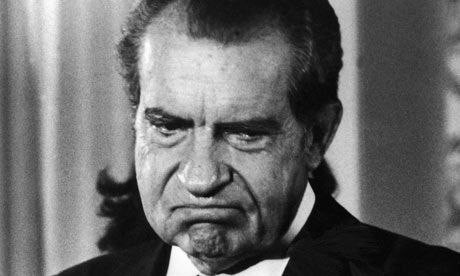
Don’t Blame Nixon

They can’t lay this one off on you, Dick.

I know it is much the vogue in Washington these days for leaders to blame previous leaders for persistent problems rather than to accept accountability and responsibility for not successfully solving them. Trendy though this attitude may be, however, Washington Post columnist Kathleen Parker’s column assigning fault for the U.S. public’s growing and frightening distrust of government institutions to Richard Nixon and the Watergate scandal shows its folly. It flies in the face of history and fairness, and lets literally thousands of subsequent leaders, elected officials, journalists, pundits and assorted knaves and hypocrites off scot-free.

Parker writes,

“Beyond the obvious, Nixon and the Watergate episode did great, perhaps irreparable, harm to the American spirit. A generation already traumatized by a war that ended up killing 58,000 of its brothers, boyfriends, husbands and fathers lost any remaining innocence, as well as trust in authority and faith in governmental institutions. The flag our forefathers raised on the moral high ground looked suddenly shabby and soiled. When even the president of the United States was willing to burglarize the American people, there was no one left to trust”

Oh, nonsense. The Watergate scandal, by the end, was one of the American system’s finest hours. The system worked, and worked on live television for all to see. A brave judge, John Sirica, showed integrity and grit in refusing to cave in to Presidential intimidation, ordering Nixon to turn over the tapes that ultimately proved his guilt. Senators and House members of both parties handled a complex inquiry diligently and well, with ethics heroes emerging on the Republican side, in individuals like Sen. Howard Baker, and the Democratic side, with the inspiring Senator Sam Irwin and others. When Nixon decided to fire the Special Prosecutor, Archibald Cox, who was getting too close to the truth, his own Cabinet member, Attorney General Eliot Richardson, resigned rather than do Nixon’s dirty work. Ultimately, Republicans and Democrats alike on the House Judiciary Committee voted for impeachment, forcing Nixon to resign. Yes, Tricky Dick was unethical and untrustworthy, but Americans had known that—and called him Tricky Dick— for decades. Then as now, too many Americans decided that “policies” trumped character, so they elected a man whose flawed values and integrity was a matter of public record—twice. Nonetheless, when he and his minions violated the law and threatened the principles of democracy, the vital institutions of the House, the Senate, the judiciary and the press showed their strength and virtue. Nixon was corrupt, not the Presidency, not the government. Continue reading
Ethics Train Wreck on “Morning Joe”

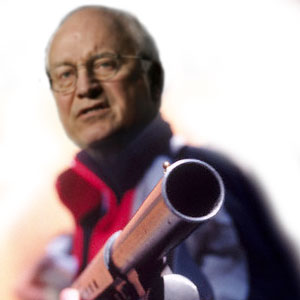
Coincidentally, the previous VICE President was frequently called a "Dick"

Time Magazine editor Mark Halperin, a frequent contributer to MSNBC’s “Morning Joe” program,  took one more chunk out of the tradition of gentility and civility in public discourse, not to mention broadcast journalism, by referring to the President of the United States as “a dick” Thursday morning. He was promptly suspended by the network, which was also the scene of Ed Schultz referring to conservative talk show host Laura Ingraham as a “right wing slut.”

Obviously the inhibitions supposedly bred into Americans about vulgar language in inappropriate places—like live TV—are crumbling fast, along with the tradition of respect for the office of President. What is more interesting about the incident, however, is how Halperin was egged into his gaffe by co-host Joe Scarborough, with an assist from Mika Brzezinski. Scarborough then took no responsibility for the incident at all. Continue reading

Unethical U.S. Presidential Candidacies: Is Trump’s the All-Time Worst?

There have been many unethical candidacies for U.S. President in American history, and some of them have been successful.

I am not referring to unethical candidates for the job, for there have been too many of them to count. An unethical candidacy occurs when a candidate’s purpose for seeking the job, method of doing so, and/or the effect on the nation of his or her campaign is especially reckless, harmful, or irresponsible. Perhaps the first unethical candidacy was that of Aaron Burr, who attempted to exploit a flaw in the election process to steal the presidency from his position as a vice-presidential candidate. Rutherford B. Hayes allowed himself to be put in office by an undemocratic back-room deal when his opponent, Samuel Tilden should have won both the popular and electoral vote.

Teddy Roosevelt’s decision to oppose his old friend, President Taft, in 1912, splitting his party, breaking his word (he had earlier refused to run for what was in essence a third term, agreeing it was best to hold to George Washington’s tradition), and all-but-insuring Woodrow Wilson a victory, was an exercise in ego and hubris. Eight years later, Sen. Warren G. Harding, who privately expressed doubts about his ability to fill the highest post in the land, may have allowed himself to be manipulated and used by corrupt political operatives for their own purposes. Franklin Roosevelt recklessly ran for his fourth term knowing that he was seriously and perhaps terminally ill, and didn’t take care to ensure that he had a competent Vice-President. (He, and the U.S., were lucky in that regard.)

Gov. George Wallace’s third party presidential run in 1968 was explicitly racist. The beneficiary of that candidacy, President Richard Nixon infamously pursued re-election with a new low of unethical and even illegal tactics against the Democrats. There have been others.

Donald Trump’s revolting candidacy, as yet unannounced, cannot fairly be called the most unethical presidential candidacy, but it is early yet. It may well prove to be one of the most harmful. As the United States faces some of the most difficult challenges in its history, Trump has chosen to use the nation’s process of deciding on its leader for his own ego gratification and self-promotion, without  preparation for the job, deference to fair campaign rhetoric, or acknowledgment of his own fatal flaws as a candidate. Continue reading

Rangel’s Corruption Continues, Whatever He Calls It

“In all fairness, I was not found guilty of corruption, I did not go to bed with kids, I did not hurt the House speaker, I did not start a revolution against the United States of America, I did not steal any money, I did not take any bribes, and that is abundantly clear.”

—-Rep. Charles Rangel, less than a week following his historic censure by the House of Representatives for repeated violations of House ethics rules

Thus did Charlie Rangel embrace the Clinton Standard after proven unethical conduct, which can be loosely translated as “it’s not what I did that matters, it’s what I didn’t do that should have counted.” In Clinton’s case, the defense was that his lies and obstruction of justice were in the context of what he and his defenders dubbed “personal” misconduct, not the official “high crimes” required by the Constitution, and that his real offense was being a Democrat. Rangel’s adaptation: sure he broke rules, but that was not what the House has called “corrupt” in the past, and thus he can hold his head up high. Continue reading

Be Thankful Tom DeLay Is Going To Jail

“As for DeLay, his time will probably come. He has ethical blind spots galore, and is only getting bolder with time. The more the Republicans move to protect “The Hammer,” the more damaging DeLay’s inevitable fall will be to the party. As the old newspaper columnists used to say, “You read it here first!”

I posted that almost exactly six years ago. In the years I have been doing ethics commentary, no figure inspired (or perhaps depressed) me more than Tom DeLay when he was G.O.P. Majority leader in the House. Now he has finally been convicted of the legal violations that his contempt for ethics virtually guaranteed.  From “Too Dumb to be Ethics Dunces,” posted in 2005: Continue reading

Halloween Ethics! Facebook Ethics! Political Ethics! Blackface Ethics! It’s Tennessee’s Aunt Jemima Affair, the Ethics Controversy That Has Everything!

It’s just after Halloween, and followers of the ethics wars know what that means: somewhere, somebody is in trouble for their choice of costume.

Actually, in this case it’s someone in trouble for her choice of someone in costume to pose with: Tennessee Republican state Rep. Terri Lynn Weaver posted a picture on the Internet of her standing with her pastor, who had dressed up as Aunt Jemima—of syrup fame and black stereotype infamy— for some Halloween festivities. Her caption to the photo:

“Aunt Jemima, you is so sweet.”

Weaver has apologized, swearing that when she posed for the picture with her pastor, she did not know the photo would upset anybody. “It was fun, done in innocence. My friend is dressed up as syrup. He wife was going to be a pancake,” said Weaver. “I never intended to offend anyone. I took the picture off my Facebook. I apologize if it ever meant to offend anyone.”  Weaver,who apparently has lived in a cave since 1957,  also said she was not aware that Aunt Jemima represented black stereotypes to many people, and was unaware that wearing blackface was also considered offensive to the vast majority of Americans. Yes, she really did. (Note: I know Aunt Jemima as a brand of pancake mix; I did not think the logo  gracee any syrup containers. I assumed Weaver confused confused the good Aunt with her white rival. Mrs. Butterworth, who is a syrup brand. Aunt Jemima obviously hangs out with pancakes, so the pastor’s wife was on firm ground, no matter what. But thanks to a syrup-minded reader, I have been set straight: there is Aunt Jemima syrup, too)

State Sen. Thelma Harper, an African-American, said she and members of the Black Caucus want to put Harper before the House Ethics Committee.“This is what we have had to live with, making a mockery of being black and copying the language that Aunt Jemima used,” said Harper.

This controversy has everything! Halloween ethics! Blackface ethics! Facebook ethics! Political ethics! Syrup ethics!

Let’s go through them, shall we? Continue reading

DeLay and Blagojevich: Not Vindicated, Not Innocent, and Not Ethical

Both Rod Blagojevich and Tom DeLay were taking victory laps this week, Blago because a jury failed to come to an agreement on his trial for selling political favors, DeLay because the Justice Department dropped its prosecution of  him. In the minds of both of these corrupt and shameless politicians, they were indeed vindicated, because both operate under the delusion that if one’s conduct manages to avoid breaking laws to the point where one could be found guilty beyond a reasonable doubt, then that conduct is “ethical.” This same delusion has been shared by many other human blights on American society and ethical corrupters in business and politics, including Presidents Richard Nixon, and Bill Clinton, Ken Lay, the executives at Goldman Sachs and AIG, Marion Barry, Maxine Waters, and too many others to mention. It is still a delusion. Continue reading

What is the “Worst” Behavior? Don’t Ask Conservative Bloggers!

John Hawkins of Right Wing News persuaded 43 conservative bloggers to send him their list of the twenty worst Americans in history. He then compiled a list of “The 25 Worst Americans” using their responses, with the rankings based on the number of blogger who listed an individual.

The list is disturbing, but not for the reasons you think.  What does it say about the priorities and values of conservative bloggers that the “worst American” among all the criminals, serial killers, scoundrels and sociopaths America has produced is, by this method of measurement...wait for it…

...Jimmy Carter? Continue reading