Jacoby Ellsbury, Catcher’s Interference, And The Perplexing Ethics Problem Of “Using A Shield As A Sword”

interference

I led two legal ethics seminars for the Oregon State Bar yesterday. For some reason the issue of “using a shield as a sword ” kept coming up.

“Using a shield as a sword” is when lawyers game the ethics rules. Many local bar associations include a pledge within their creeds promising not to intentionally use the ethics rules as a tactical weapon; still, it’s not an enforceable promise. Examples are limited only by a lawyer’s devious ingenuity, but they usual involve one side creating a conflict of interest for the opposing firm or lawyer that will force the lawyer to withdraw from the case. One ploy: a lawyer recruits a key expert witness specifically because she was once a client of the the lawyer on the other side, making it impossible for her to be impeached on the witness stand by that lawyer because he would have confidential information about her that he would be bound to keep secret, even while being required to represent his current client by ripping her credibility to shreds.

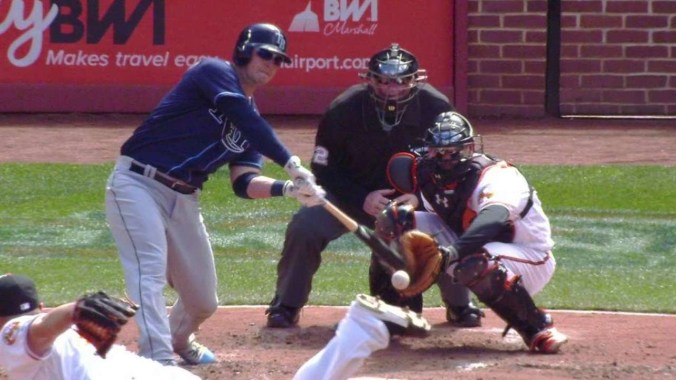
What does this have to do with Yankee centerfielder Jacoby Ellsbury? Well, Ellsbury is in the process of shattering an obscure baseball record: number of times reached base on catcher’s interference during a season. Catcher’s interference refers to instances in which a catcher makes any contact with a batter or his bat during a pitch. Usually, this involves the batter’s bat hitting the catcher’s glove, as in the photo above. When that happens, a player is awarded first base. The rule is based on fairness and  designed to protect the batter, but apparently Ellsbury has perfected the weird practice of using it as an offensive weapon.

Jacoby Ellsbury became the single-season record holder in catcher’s interference calls  in July with his ninth instance  getting rewarded for it. The record was formerly held by Roberto Kelly, who did this eight times in 1992.  Since breaking the record, Ellsbury has gotten catcher’s interference called three more times, for a current total of 11 with almost a month  left to the season. He is also second all-time in catcher’s interference with 23. The career record belongs to Pete Rose with 29; since Rose is baseball’s all-time leader in games played and career at bats, we would expect him to hold this record. No one else in baseball history has more than 18. Ellsbury is only five catcher’s interferences shy of Rose’s mark, and has done it in less than a third of the at bats. Continue reading


Comment of the Day: “Ethics Dunces : Michigan State University Student Feminists”

fairness

Here’s the always provocative Extradimensional Cephalopod, discussing the core ethics value of fairness in his Comment of the Day on the post, Ethics Dunces: Michigan State University Student Feminists:

…Anyone who says that a situation in life is not fair is committing what Nasssim Nicholas Taleb called in his book The Black Swam the “ludic fallacy.” That is, treating real life as though it were a game, with a bounded range of outcomes. The way I’m using the term “ludic fallacy”, it also includes assuming that everyone agreed to rules coming in.

Where do you start defining if a race is fair? Do you start with everyone following the rules? Do you start with everyone having the same amount of free time to practice? Do you start with everyone having the same environment to practice in? Being born with the same physiology? Having the same opportunity costs in their life? Having the same psychological predilection for diligence? Where do we stop?

If you wanted to make things perfectly fair, you’d make everyone perfectly the same, or you would account for every difference and statistically measure their relative skills. But what are we measuring? Their bodies? Their brains? Their will? At some point it becomes a simple scientific fact who is more skilled and fit on average, which defeats the point of the game! The game is supposed to be the process by which we find out who would win, and the fun is in not being able to tell beforehand.

No, we need to stop at the beginning of the game. Everyone agreed to the rules going in; they knew the possible outcomes, and they accepted them. If the rules are followed, then it’s “fair.”

Continue reading

Lasers, Ethics, And Baseball

"TOO MUCH! TOO MUCH!"

“TOO MUCH! TOO MUCH!”

Out of the ever-rich world of major league baseball comes another excellent example of how technology challenges, stretches and confounds traditional ethics.

Over the last decade or so,  it has become possible to track exactly where every ball put into play by every batter goes, and even how fast it gets there. As a result, computers can generate spray charts that will indicate the optimum defensive placements for the opposing team’s players, maximizing the chance that a batter will hit a ball within reach of a fielder. When Cleveland manager Lou Boudreau positioned four infielders on the right side of the field to foil Ted Williams, the “Williams shift” was considered radical and revolutionary. Today, there are shifts designed for a majority of players.

The problem is that with so many shifts, making sure each defensive player is in the right place becomes a challenge.  Now some teams are experimenting with using lasers to mark the grass, so a player will know exactly where to position himself. Continue reading

A Federal Court Reinstates Tom Brady’s Suspension For Cheating

Good.

What Brady doesn't get: When people think you cheated, the smirk is does as much damage as the conduct.

What Brady doesn’t get: When people think you cheated, the smirk is does as much damage as the conduct.

The U.S. Court of Appeals for the Second Circuit appeals court reinstated the NFL’s four-game suspension of New England Patriots quarterback Tom Brady yesterday. This overturned last year’s ruling by U.S. District Judge Richard M. Berman, who had nullified the league’s suspension of the superstar quarterback. The three-judge panel of the appeals court wrote…

“We hold that the Commissioner properly exercised his broad discretion under the collective bargaining agreement and that his procedural rulings were properly grounded in that agreement and did not deprive Brady of fundamental fairness.”

It is important to note that the Court only ruled on whether NFL Commissioner Roger Goodell had the power to suspend Brady and did not violate the player’s rights as a players union member by doing so. The NFL’s current deal with the players gives Goodell the kind of power Major League Baseball gave to its first commissioner after the 1919 Black Sox Scandal, when gamblers fixed the World Series. Goodell, like Landis, can use his discretion to punish a player for “conduct detrimental” to the game and the NFL. They did this because a disturbing number of NFL players were getting headlines for doing things that don’t comport with what the public expects of its paid heroes, like sucker-punching women, shooting people, getting in bar fights, and engaging in assorted felonies. The game also has a very successful coach, Brady’s coach, in fact, who has made it very clear that he will cheat whenever he can get away with it..

I’m not going to rehash the “Deflategate” incident: I wrote enough about it when it occurred. Nobody knows for certain if Tom Brady in fact did conspire with Patriots employees to cheat when his team was behind in a crucial play-off game, but we know this: Continue reading

Jenrry Mejia, The Inexplicable Ethics Mega-Dunce

mejia

What is the explanation for this?

Jenrry Mejia is a young New York Mets relief pitcher who until recently had a bright future as a star closer and a guaranteed multi-millionaire.  Now, entirely on his own initiative, he has become the first player ever banned from baseball for using steroids .

This is not easy, though Mejia did it with ease…and speed.  After recovering from Tommy John surgery, Mejia was establishing himself as the Mets closer by the end of the 2014 season. But he began the 2015 season with an 80-game suspension for testing positive for a common PED (Performance Enhancing Drug), then, even before completing that punishment,  flunked another urine test and earned himself a 162-game suspension a few months later.

Knowing full well that a third positive test would end his career, Mejia tried a different banned steroid, was caught again, and that third strike triggered a lifetime expulsion from major league baseball under the sport’s rules. Nobody has been that reckless and stupid, not even Manny Ramirez (who was caught twice), and Manny’s picture is in the dictionary under “reckless and stupid.” Continue reading

The Lesson Of The Pete Rose Saga: It’s Hard Being Ethical When You’re Stupid

Rose rejected

Pete Rose’s final appeal to have his ban from Major League Baseball lifted was rejected, as Commissioner Rob Manfred delivered a stinging rebuke. (You can read his letter here.) The very first ethics post I ever wrote was about Pete, and I have posted about his character and plight several times since. Rose, the all-time leader in hits and undeniably a great player, was banned from the game in 1989. An investigation concluded that he had bet on baseball games while a manager of the Cincinnati Reds, a violation of MLB’s famous “third rail” no-gambling rule, which makes it an automatic expulsion from the profession to place bets on baseball games as a manager, coach or player. This is regarded as an existential rule for baseball, which was nearly ruined when gamblers fixed the 1919 World Series.

Rose maintained his innocence of the allegations for decades, then admitted(to sell a book) that he had been lying, and did gamble. Just a few months ago, evidence surfaced that he had also bet on baseball while a player, which Rose has always denied.

In his letter rejecting Rose’s appeal, Commissioner Manfred noted that one of the conditions that had long been set for Rose to have any chance of reinstatement—though Rule 21 has no exceptions, MLB was willing to do almost anything not to have the holder of the record for lifetime hits on its blacklist—Rose would have to earn a pardon by showing he had turned his life around, meaning that Pete was no longer a sleazeball.

Manfred wrote that Rose, who had, among other black marks, served time in prison for tax evasion, asserted in his latest appeal that he indeed was a new and better man. Nevertheless, Rose…

1. Refused to admit that he had bet on baseball as a player, when the evidence was incontrovertible, and

2. Revealed that he still gambles on horse racing and professional sports, including baseball.

Manfred came to the obvious conclusion that “Charlie Hustle,” who pretty clearly has a gambling addiction, has taken no positive steps toward addressing it, is still a risk to gamble on baseball games or get himself in debt to gamblers if he returned to the sport, and  can’t be trusted.

All of the above could be more concisely summarized by six words: Pete Rose is a stupid man. As comedian Ron White says, “You can’t fix stupid.” Manfred, in his letter telling Pete that he can forget about any future employment in baseball, noted more than once that Rose does not appear to understand the import and purpose of the rule he violated, which exists  to protect the integrity of the game. Indeed,  Pete Rose wouldn’t know what integrity was if it sat on his face. Continue reading

World Series Ethics: Another Pine Tar Sighting, As Baseball Ethics Rot Gets A Thumbs Up From Legal Ethics Rot

Sal Perez

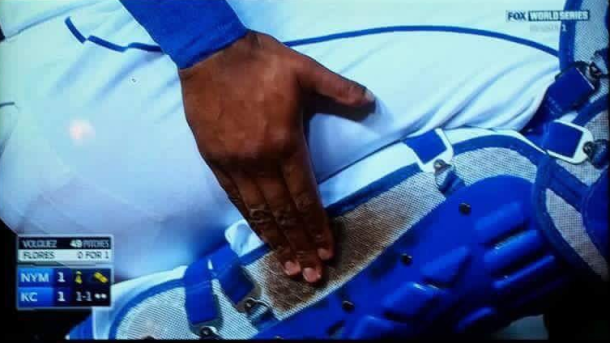
Cameras during Game #2 of the 2015 World Series revealed that Kansas City Royals catcher Sal Perez had what appeared to be pine tar on his shin guard during the game. This would presumably be there for the purpose of surreptitiously smearing some of the gunk on the ball, then throwing it back to the pitcher so he could “get a better grip on the ball,” a.k.a “tamper with the baseball so it can do loop-de-loops.” This is illegal. It is cheating. According to Rule 8.02(a)(2), (4) and (5), the pitcher shall not expectorate on the ball, on either hand or his glove; apply a foreign substance of any kind to the ball; [or]  deface the ball in any manner. The rule is unambiguous, and if a pitcher or a catcher is caught violating the rule, they are thrown out of the game with a suspension and fine to follow.

None of this happened to Perez or his pitcher that night. According to NBC Sports blogger Craig Calcaterra, a former practicing lawyer who I am officially disgusted with, the reason was that “Nobody cares,” including Calcaterra.

I wrote extensively about Major League Baseball’s unethical attitude toward violations of this particular rule last year, after an absurd sequence in which Yankee pitcher Michael Pineda was caught by TV cameras apparently using pine tar on his pitches without compliant from the opposing Red Sox, followed by Sox manager John Farrell saying that he hoped he would be “more discreet” about his cheating “next time,” and then when Pineda was more obvious about it next time, Farrell complained to the umpires, who threw Pineda out of the game (he was also suspended). I wrote, Continue reading

Why Ethics Rules Are Useless Without Common Sense

HIPAA

An ethicist’s pet peeve: People who misuse formal ethics rules to justify unethical or stupid behavior because they never thought about what why the rule exists.

This happens a lot. My favorite example was the famous athlete enmeshed in a scandal. Ay a press conference, he said that he couldn’t answer specific questions because of “atttorney-client privilege,” and not one of the reporters had the education to say, “Huh? You’re the client! The attorney-client privilege prevents your lawyer from revealing what you told him. It doesn’t stop you from revealing anything, you cretin.” In my seminars, when an attendee cites a professional ethics rule as the reason why he shouldn’t do something, I often ask, “And why is that a rule? What’s wrong with what it forbids?” Often, disturbingly often, the individual has no idea.

The New York Times today featured another example: medical providers and others not even subject to the law using HIPAA to avoid giving out information they could and should give out, in mots cases misinterpreting the law to do so. Among the examples in the Times story:

  • A retirement home refusing to tell friends of a resident that the resident had died (only health care providers, health insurers, clearinghouses that manage and store health data, and their business associates are covered by The Health Insurance Portability and Accountability Act of 1996. a.k.a. HIPAA)
  • A hospital that  refused to accept information about a patient’s allergies from the patient’s daughter (Wow: hospitals can receive medical information; HIPAA restricts the ways they can disclose it)
  • Another relative of a patient reprimanded by hospital staff for talking about her loved one’s medical problems in the cafeteria, because, she was told, it was a HIPAA violation.
  • A minister told a church staff not to announce the names of ailing church members because it was would violate HIPAA  (That’s right: he really thought it was against the law to tell congregation that someone was sick.)
  • Some providers cite HIPAA to block patients from seeing their own records.

This is why morality alone doesn’t make people ethical, especially if they aren’t very bright. Continue reading

What A Surprise: The Patriots Cheated. Now Comes The Integrity Check For The NFL And Its Fans

deflated-football

From the New York Times:

…On Wednesday, the N.F.L. released its report on its investigation into the scandal surrounding the surreptitious and rule-violating practice of deflating game-day footballs. Using detailed accounts and circumstantial evidence, it implicated Brady as part of the operation, saying he surely knew that the two employees, McNally, 48, and Jastremski, then 35, were purposely deflating footballs to a level beyond the permissible threshold for Brady’s benefit.

“There is less direct evidence linking Brady to tampering activities than either McNally or Jastremski,” the report said. “We nevertheless believe, based on the totality of the evidence, that it is more probable than not that Brady was at least generally aware of the inappropriate activities of McNally and Jastremski.”

The N.F.L. report absolved other top Patriots officials, including Coach Bill Belichick, the owner Robert K. Kraft and the equipment manager Dave Schoenfeld, saying that there was “no wrongdoing or knowledge of wrongdoing” on their part….

I wrote the headline before I remembered: the NFL has no integrity, and neither do its fans. It was very clear that the Pats had cheated to get to the Super Bowl, and had the NFL cared anything about integrity, it would have completed its investigation in time to tell the Indianapolis Colts that they, and not the New England Serial Cheats, were going to the biggest game of the year, since it had lost the chance to a dastardly opponent. Instead, the league basked in the marquee match-up and one of the best games ever, and waited until now, four months later, with football as far out of mind as it can be, to announce that the New England Patriots, again, had cheated. Clever. Too clever.

I wrote a lot about this when it occurred, and had to put up with the predictable “innocent until proven guilty” crowd, the “it’s only a game ” crowd, the ” they would have won anyway” crowd, the “everybody cheats” crowd, the “it’s not like he invaded Iraq” crowd—essentially Barry Bonds defenders, Obama enablers, and Bill Clinton fans with football jerseys and Patriots beer mugs.  Now I get the Hillary Clinton crowd, who will ask, “What difference, at this point, does it make?” The NFL can make billions being as corrupt as it is, maiming athletes and turning colleges into shams, because so many, many Americans value a visceral rush on winter Sundays over fairness, justice, and honesty.

Observations: Continue reading

Late Deflategate Update: Patriots Owner Robert Kraft Does A Full Corleone

Tom Hagen

Ruthless mob “Godfather” Michael Corleone had lied  to the fictional Congressional committee investigating organized crime. The smoking gun witness who had cut a deal to destroy Michael’s fake stance as a persecuted patriot and honest businessman had just been intimidated into recanting, seeing his older brother sitting with his targets and knowing that if he betrays the Family, his brother’s head would end up in his bed. So lies and corruption have triumphed, and as the scene from “Godfather Part II” fades, Michael Corleone’s lawyer, Tom Hagen, is shouting over the gavel and the crowd noise, to the disgusted and defeated Committee chair,

“SENATOR! SENATOR! This committee owes an apology, this committee owes an apology — an apology Senator!”

This memorable scene was immediately what my mind was jerked back to when I read New England Patriots’ owner Robert Kraft’s defiant statement regarding his team’s latest cheating scandal, in the section where he said…

“If the Wells investigation is not able to definitively determine that our organization tampered with the air pressure in the footballs, I would expect and hope that the League would apologize to our entire team and in particular, Coach Belichick and Tom Brady for what they have had to endure this past week. I am disappointed in the way this entire matter has been handled and reported upon. We expect hard facts as opposed to circumstantial leaked evidence to drive the conclusion of this investigation.”

I see now from a brief Googling of “Tom Hagen Robert Kraft” that I was not alone, and no wonder. Kraft’s guys have stonewalled, denied, mocked, deflected, tap-danced, and allowed loyal ethics-challenged sportswriters, bloggers and fans to block for them.  Belichick and Brady almost certainly have covered their tracks sufficiently to avoid their just desserts, and Kraft is demanding an apology when it is he who should be apologizing—to the NFL, to opposing teams, to New England, to Boston, and to the fans, for allowing a corrupt and unethical culture to flourish under his ownership. Has any criminal, having avoided conviction because he or she could not be found guilty beyond a reasonable doubt, had the chutzpah to demand an apology from the prosecution? Did Casey Anthony  or O.J., as despicable as they are, dare to rub society’s nose in their triumph like that? Continue reading