Ethics Dunce: Ronan High School Principal Tom Stack

This is a dream Gerald Molen had about Tom Stack. Stack is the one on the toilet.

Gerald Molen is a major Hollywood producer, and one of the best; among his accomplishments are “Rain Man,” “Schindler’s List,” “Jurassic Park,” and “Twister.” He was invited to deliver a speech to graduating seniors at Ronan High School in Ronan, Montana, and out of the graciousness of his heart,  agreed. Molen prepared a speech evoking the heroism of Oskar Schindler, and planned to ask the students to “imagine your future is a movie. Forty years from now, you’re writing a script about your accomplishments. What would that script look like?”

When Molen arrived to give his speech ( the high school is a 90 minute drive from his Montana home) the school  principal, Tom Stack, informed him that he had  decided to disinvite Moler. Apparently some parents had complained that Moler was a “right winger,” and objected to him speaking to the seniors. Stack didn’t care what the actual speech was about; mustn’t upset those progressive parents! Molen wasn’t welcome because of his political beliefs, and not even any specific belief. He was just one of those cruel and mean conservatives—you know, the ones Nancy Pelosi, Ed Schultz and Lawrence O’Donnell are always condemning—and his contagion couldn’t be allowed to spread. Molen, understandably insulted,  told the story to the Hollywood reporter.  Continue reading

The Schizo Principal’s Facebook Dilemma

Principal Losos, a.k.a Suzy Harriston. Don’t ever call  her “Sooz”.

In Clayton, Missouri, the high school principal has resigned after being outed as a fake student on Facebook. Posing as Clayton High student Suzy Harriston, Principal Louise Losos amassed over 300 student friends from her school, until a former student pierced her false identity and urged everyone to de-friend it. Poor, fictional Suzy vanished, and shortly afterward so did Louise, who was placed on a leave of absence. Now she has resigned.

Can anyone think of a good reason why Losos should not have lost her job? In addition to being creepy, her posing as a student was a lie, and hardly proper conduct for the head of a school, a role model, and an ethical exemplar. If she were investigating a murder, or a series of unexplained thefts, or a suspected Al Qaeda cell working out of the Science Club, she might have some ammunition on her side, but the only use she seems to have put Suzy to was building student support for a friend of hers, a physical education teacher, whose job was in jeopardy.

There was one note in the Yahoo! report that complicates the analysis: Continue reading

The Jack Berghouse Cheating Conundrum: Bad Father? Good Father? Ethics Corrupter?

Should we condemn Jack Berghouse for being a good lawyer?

Should a parent defend a bad egg? A cheating bad egg?

Berghouse has intervened to keep his son, a sophomore at Sequoia High School in Redwood City, California, from being kicked out of the honors program for copying his homework assignment from the work of another student. He doesn’t dispute that his son cheated—-his son admits it, and was caught red-handed. Dad is suing the school because he says its policies are conflicting, and thus his son was deprived of due process. He may be right about that. He is also doing it because, as a father concerned about his son’s future, he worries that the blemish on his record will affect his ability to get into an Ivy League college. He’s probably right about that, too.

But is it right—that is to say, responsible and ethical— for parents to use lawyers and the court system to intimidate schools into whitewashing a student’s records? The vast majority say no, which is doubtlessly the reason why Berghouse reports that he is getting hate mail. Continue reading

The Principal Who Helped Gaby Rodriguez Fake Her Pregnancy Just Won “Principal of the Year.” The Frightening Thing Is, He Might Have Deserved It.

Note that it says "Principal." It doesn't say anything about "principles."

I received this news from Ethics Hero Harris Meyer, the journalist who has been trying to preserve some semblance of integrity in his profession by reminding it what ethical investigative journalism is not, through his efforts to rebut the praise for Gaby Rodriguez, the high school student who deceived her family and classmates by pretending to be pregnant as her senior project. The news: Trevor Greene, the principal who helped devise Gaby’s unethical stunt and assisted her in lying to the rest of the school, has been named the state’s top high school principal by the Association of Washington School Principals.

He received this  honor, the release says, by virtue of his organizing a system of student-teacher mentorships, and guiding the school’s effort to expand and improve its science, technology, engineering and math curriculum. The fact that he also mentored a student in a blatantly unethical exercise that was, as I wrote in my original post about Gaby’s scam, Continue reading

Ethics Flashback: A Letter From Kurt Vonnegut

Mr. Vonnegut

[From the lovely website Letters of Note comes the memory  of this, a letter sent on November 16, 1973 to the Chairman of the Drake, North Dakota, School Board by the late author Kurt Vonnegut. The Chairman, Charles McCarthy, (a name evoking, appropriately, both the rights-flattening Senator of “Have you no decency?”  fame and the dummy) had been outraged that a teacher at the high school had used Vonnegut’s classic novel, “Slaughter-House Five,” in class, and with the support of his board, saw that all the copies of the book purchased were burned in the school’s furnace, followed by others that he deemed “obscene.” Vonnegut, whose novels teem with ethical themes, especially the importance of kindness, learned about the book-burning from news reports, and wrote the following correspondence.

Apparently he received no reply.]

“Dear Mr. McCarthy:

I am writing to you in your capacity as chairman of the Drake School Board. I am among those American writers whose books have been destroyed in the now famous furnace of your school.

Certain members of your community have suggested that my work is evil. This is extraordinarily insulting to me. The news from Drake indicates to me that books and writers are very unreal to you people. I am writing this letter to let you know how real I am. Continue reading

Three Tales of Ethics-Free Horror in American Schools

Common sense-free, too!

Today we have three tales to drive you to private school, home school, or to move to Bolivia. The first poses a challenge for readers who object to “The Naked Teacher Principle.” I call it…

“The Porn Star Teacher Corollary”

In Oxnard, California, rumors were flying at Richard B. Haydock Intermediate School that one of the teachers could be seen in at least one porn film. Eventually other teachers  came forward and showed administrators an X-rated video on a smartphone that appeared to confirm  that the educator, who teaches science to seventh- and eighth-graders, was moonlighting in the pornography industry. She is on leave, and don’t bet that the teachers union won’t fight to protect her job. Meanwhile, the school district decided to make certain that as many kinds as possible would find Miss Brooks doing God knows what online, by sending this message to parents:

“It has been alleged that one of our teachers is depicted in at least one pornographic video and possibly others on the Internet. These allegations do not involve any Oxnard School District students… We are asking teachers to discourage the children from searching for and/or visiting these inappropriate sites. We ask that you be particularly vigilant over the next few days with respect to the Internet content being accessed by your child on his or her telephone or other Internet-ready device.”

Yeah, that should work.

Oh, I almost forgot. What is “The Porn Star Teacher Corollary”? It’s simple, really: “If you are or were a porn star, don’t teach in secondary school. If you teach in secondary school, don’t start making make porn films…whether you’re naked in them or not.”

The next two horrific sagas show school sensitivity at its rock bottom worst. First we have…

“Mother’s Day”

The Wingate Elementary School in Gallup, New Mexico discovered that 15-year-old student Shantelle Hicks was pregnant, so it kicked her out. This a school cannot do in 2012, and when a terse letter from the ACLU got her back into the 8th grade, the administrators had to get creative about how they would deal with this bad apple corrupting the good students. Two weeks after her readmission, they forced Shantelle to stand up in a  school assembly and announce her condition.  She says that until then, none of her classmates knew.  After that, according to her law suit, school officials told Hicks she was a detriment to her school mates, and requested she attend another school.

You just can’t train school administrators to come up with solutions like this.

It has to be an innate talent.

Finally, we have a chiller about another school that is alien to the concept of fairness, which I have dubbed, cheaply but appropriately,

What??”

St. Scholastica High School in Chicago expelled a senior for disciplinary problems that included not listening to her teachers, ignoring directions, and failing to respond to requests.

“This pattern of poor behavioral performance is an indication to us that she is unable to meet our behavioral standards,” Principal Colleen J. Brewer wrote in the girl’s expulsion letter.

You guessed it! The girl is deaf. She has hearing aids in both ears. A doctor who examined her found that her hearing problems were “severe enough that, even with hearing aids (it would) affect her ability to not only appreciate the spoken word but also nuances and interpretation of speech. This may lead to an attempt on her part to react to her on interpretation of a communication without realizing she is misinterpreting part or all of a conversation.”

And yes, there is another law suit here as well. Law suits, however, at best only get money for the damage done by teacher and school administrator incompetence. The damage to the children involved may never be repaired.

“No Tolerance,” Expulsion, and Poisoned Coffee

A post this weekend discussed the case of an elementary student who was expelled for showing a pocket knife to friends on school grounds. Dig around in the Ethics Alarms archives, and you’ll find many other “no tolerance” stories in which schools levied harsh punishment for perceived student infractions such as describing murderous fantasies about teachers on Facebook; a pizza bitten into the shape of a gun; taking possession of a knife from another student in order to turn it over to school authorities, and even more outrageous examples. In several of these incidents, the police were called in. You may recall the case from last year in which a Spotsylvania (Va.) high school student was expelled and charged with criminal assault for the equivilent of blowing spit-balls at a student in class.  Now we have a shining example of why this decade-long trend is not only devoid of justice and common sense, but also counter-productive. It undermines the school’s ability to send a coherent message to the students who need it—the truly dangerous. Continue reading

School Insanity: A Warning From Canada…

Jessie Sansone and his trouble-making daughter

…And the warning is: the police and schools aren’t this crazy and irresponsible in the U.S. yet, but all the signs are present. From the news in Ontario:

Police arrested a Kitchener, Ont., father outside his daughter’s school because the four-year-old drew a picture of him holding a gun. Jessie Sansone told the Record newspaper that he was in shock when he was arrested Wednesday and taken to a police station for questioning over the drawing. He was also strip-searched.

“This is completely insane. My daughter drew a gun on a piece of paper at school,” he said.

Officials told the newspaper the move was necessary to ensure there were no guns accessible by children in the family’s home. They also said comments by Sansone’s daughter, Neaveh, that the man holding the gun in the picture was her dad and “he uses it to shoot bad guys and monsters,” was concerning.

Police also searched Sansone’s home while he was in custody. His wife and three children were taken to the police station, and the children were interviewed by Family and Children’s Services. Continue reading

Yuri’s Tweets, Flawed Analogies and the School’s Defenders

[Why is it that when I’m traveling and stuck in airports where the supposedly free WiFi doesn’t work and on airplanes that can’t keep on schedule, some post that I assumed was fairly straightforward turns into the Battle of Antietam? I apologize to the various commenter’s whose work product languished waiting for moderation—I just didn’t have the chance. This odyssey ends tonight; I apologize for slowing things down. On the other hand, it’s good to know that my presence is not required for there to be lively and interesting discussions here…thanks, everyone. Good work.]

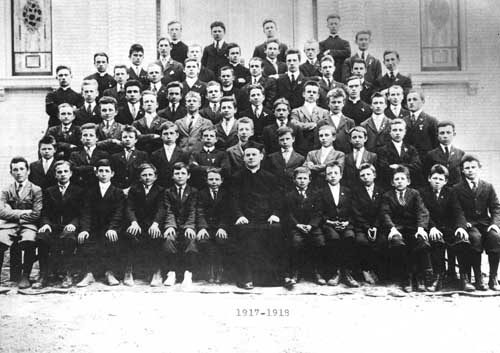
Don Bosco Prep High School, Class of 1917-1918

That is not to say that sending gross, obscene, or abusive tweets is exemplary conduct; obviously it is not. I have concluded, however, that the proper and ethical use of social media is something that people, including minors, have to learn for themselves by trial, error, research, observing the mistakes and experiences of others, making dumb mistakes and suffering because of them.  Parents and schools, as well as the popular media, have roles to play by giving advice and calling attention to cautionary tales, but heavy-handed attempts to manage social media conduct attempted by authority figures who, as a general rule, neither use nor understand what they are attempting to regulate are both irresponsible and doomed to failure. Like it or not, social media is a primary, and growing, means of communication and interaction in American society, and students are wise….that’s right, wise...to learn how to use it. I was just speaking to a room full of lawyers, and asked them how many used Twitter. The answer: none. But their clients use Twitter, and their client’s adversaries use it, and certainly their children. Their bar associations are making rules about what these lawyers and judges should and shouldn’t be able to do on social media, and most of those bar committee members don’t use Twitter either.As a result, the various jurisdictions have inconsistent rules, based on a lack of knowledge, that are already archaic.

It is fine and responsible for any adult to try to warn a young person that comments on social media need to be considered carefully, that they have a reach far beyond any intended audience and are essentially broadcasts, and that messages or photos can reach people who they hurt or upset, or cause to have a poor opinion of the sender. Ultimately, however, the pioneers in this new frontier of personal expression and mass communication are going to have to learn their own lessons, and better that they learn them now than when they are members of Congress. All punishing students for their tweets teaches them is that people with authority abuse it, and that adults just don’t understand. Because, for the most part, they don’t.

Now the analogies and comparisons:

Public schools vs. Private schools: I gather that the theory here is that if a student voluntarily attends a private school, the student has voluntarily submitted to whatever the school regards as proper discipline, whereas public schools, since they are mandatory and creatures of the government, are constrained by the Constitution. I think I may have encouraged this by a careless reference to the ACLU, which was, of course, a mistake (and I have removed it.) This is ethics, not Constitutional law, and the values are autonomy, fairness, respect, privacy and abuse of power and authority, not Freedom of Speech. I have dealt with several private schools and one Catholic school, and none of them suggested in their printed materials or regulations that they reserved the right to punish my child for what he said, wrote, or communicated during non-school hours, or when he wasn’t physically on school grounds. Neither does Don Bosco, which states as its “philosophy”:

“Don Bosco Prep educates young men so that, through a process of self discovery, each student will come to recognize and acknowledge his talents and limitations, while pursuing academic, athletic, artistic and personal excellence.

“Mindful of both our role and responsibility as a Salesian college prep school, we respect each student as a unique individual. Through active presence in his life, we promote a joyful spirit, intellectual curiosity, self-esteem and emotional maturity. We encourage the development of character and personal responsibility, love for one’s fellow human beings, a concern for the environment and an active commitment to social justice, all of which serve as the cornerstone of each student’s spiritual growth.”

I take none of that, including references to being “an active presence” in a student’s life, “promoting” emotional maturity, and “encouraging” development of character to mean “we can punish your child for absolutely anything he does or says that we disapprove of, no matter where or when it occurs.” It, the school, does all of the things relating to its philosophy in the school, based on the student’s activities and interactions in the school. Any other reading is giving a group of strangers whose biases, background and motivations I can only guess at a blank check to manipulate a child’s life, thoughts and personal activities.

When one teacher from a private school called me to tell me that she felt it was cruel of my son to exclude a classmate whom he did not like from his birthday party, I told her that it was none of her business, and filed a complaint with the school.. Private school does not mean “we can meddle in your child’s private–as opposed to school—activities.

Catholic vs. Secular: All schools should teach character; it happens that Catholic schools do it with more fervor, but that gives them neither a greater obligation nor additional authority. Schools teach good conduct and civility by insisting on appropriate conduct and deportment in school. Are people really prepared to argue that a Catholic school can justify punishing its students for not doing household chores, not washing their hands after using the bathroom in their homes, being cruel to a younger sibling or being disrespectful to a parent? Not only is personal social networking use as unrelated to the school  as any of these, it is also far less significant. How much of a blank check do we want school administrators to have? The right answer to that is that they shouldn’t have a blank check at all, and being a Catholic school changes nothing.

High schools vs. Military Academies: This is just a bad analogy. The student at a military academy has no personal life, and has no privacy. The academy is in loco parentis; the student lives there; authority is total. There is an honor code and a code of conduct, and it applies to everything a student does, including communications. That’s the military. That’s not high school.

High Schools vs. College: Several commenters have referenced the incident from last March when Brigham Young University suspended a star basketball player for having pre-marital sex. Brigham Young is famous for its strict and far-reaching conduct code, which bans drinking, pre-marital sex and many other activities that are virtually courses at other schools. If a student agrees to attend B.Y.U., the student has also agreed to certain conditions unique to the university. Should a more typical college be applauded for suspending a student who has sex with his high school girl friend over Christmas break, in his parents’ home? No; this is none of a college’s business, and attempting to extend its authority beyond the campus and even over state lines in such a fashion is intolerable. If Yuri Wright and his parents signed a document promising that Yuri would never send an offensive tweet during his years at the school, I withdraw my condemnation of Don Bosco’s punishment.

High schools vs. the Workplace: It is true that if an employee engages in conduct outside of work that embarrasses or reflects badly on an employer, ot that interferes with the employee’s ability to do his or her job, the employer is behaving ethically if it chooses to terminate the employee. It is not ethical for an employer to terminate an employee for any private conduct it happens to disapprove of, however. It can’t tell me that I can’t drink or smoke or have sex with men in my own home. It  better not tell me that I can’t vote for Ron Paul or root for the Red Sox, either. The Naked Teacher Principle applies, of course: if I’m a Coca-Cola VP and a Facebook picture shows me chugging Pepsi, that image could undermine my effectiveness at work, and Coke can can me; it’s ethical. If I write an ethics columns for a newspaper and I am caught in an adulterous affair with Marianne Gingrich, the newspaper is only being responsible to fire its unethical, untrustworthy ethicist. None of this applies to Yuri’s tweets. They don’t reflect on the school, or shouldn’t, because the school shouldn’t have any control over his personal communications. They  don’t interfere with his studies, or make him a worse football player.

Expression vs. Conduct: Tweets aren’t conduct. Even if I accept the proposition that a school may, in extreme situations, have some legitimate role in attempting to control student conduct outside of school (and I’m not sure I do), allowing a school to punish a student for the content of his words, uttered or written away from school, is a slippery slope with no braking. If sexually and racially objectionable tweets can get a student expelled, why not tweets critical of President Obama, or cheering on Newt Gingrich? Does Don Bosco’s commitment to “social justice” mean that Yuri can’t tweet that Occupy Wall Street is a crock?


Attention Schools: You Do Not Own Your Students

This must stop.

Yuri? Your school just called; they want slightly more understated smile from you in the future. Or else.

Yuri Wright, a top ranked high school football player who is being sought by schools in the Big Ten, Pac-12, ACC, SEC and Big East, was expelled from Don Bosco Prep High School in Ramsey, N.J.for sending sexually graphic and racial Twitter posts to his more than 1,600 followers. The action jeopardizes his chances of getting a big-time football scholarship. Continue reading