Comment of the Day: “Make Voting Compulsory, Because We Can’t Let THAT Happen Again”

Maybe Ruth Marcus would like this system better...

Maybe Ruth Marcus would like this system better…

Theories of democracy and political science, Robert Heinlein, minimizing bias from self-interest, scientist suspicion, GIANT BUGS…okay, it doesn’t quite get to the bugs. But what’s not to like about texagg 04’s reflections and exposition sparked by the post on Ruth Marcus’s plug for compulsory voting? Here is his Comment of the Day on the post, Make Voting Compulsory, Because We Can’t Let THAT Happen Again: Continue reading

Ethics Quote of the Week: Prof. Robert Kolter

"Miss me? I'm baaaack!!!"

“Miss me? I’m baaaack!!!”

“The scientists doing this work are so immersed in their own self-aggrandizement, they have become completely blind to the irresponsibility of their acts.”

Robert Kolter, professor of microbiology at Harvard Medical School, condemning the work of Professor Yoshihiro Kawaoka of the University of Wisconsin-Madison and his research team, which managed to recreate the Spanish Flu virus that killed an estimated 50 million people in 1918.

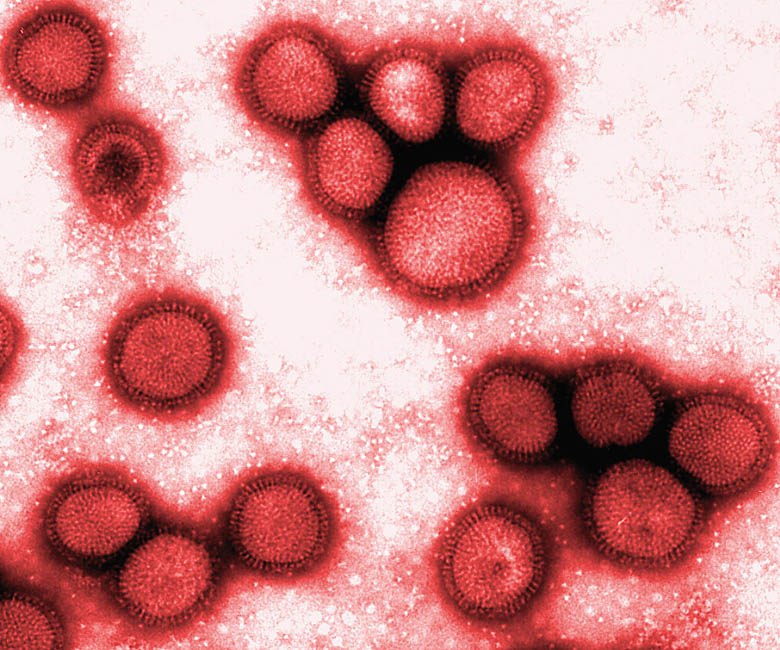
The reincarnated 1918 virus was recreated from eight genes found in avian flu viruses isolated from populations of wild ducks. Using a technique known as “reverse genetics,” Kawaoka’s team rebuilt the entire virus so that it was 97 % identical to the 1918 strain, identified from viruses recovered from frozen 1918 corpses.  Said Kawaoka: “The point of the study was to assess the risk of avian viruses currently circulating in nature. We found genes in avian influenza viruses quite closely related to the 1918 virus and, to evaluate the pandemic potential should such a 1918-like virus emerge, identified changes that enabled it to transmit in ferrets.”

And, in order to assess that risk, the research created a completely unnecessary one that if mankind proves fallible again, could, as various Stephen King and Michael Crichton novels and movies have shown, kill us all.

Eventually, one of these hubris-warped and ethics-free fools might just eradicate humanity…all in the interest of scientific inquiry, of course.


KABOOM! “Discrimination In Portugal,” The Sequel

exploding_head

First I checked, double-checked and triple-checked to see if this was a hoax. Then, once I was confident that it was true, I allowed my head to explode.

The headline to today’s head-blasting post requires a bit of explanation.

As a senior at Arlington High School (Massachusetts), I was editorial editor of the school newspaper, The Arlington High Chronicle. I had to choose, edit and publish the best of the submissions from the staff, and usually wrote the lead editorial myself. Well, one week I was up against a deadline and had nothing to fill an empty space on the page except a dog’s breakfast of miserably written options. Desperate, I decided to turn the crisis into an opportunity. I took the worst of the articles, cut out each line, mixed them up in a bowl and picked them out at random. Then I retyped the incomprehensible result, adding capitals and punctuation, and headlined it “Discrimination in Portugal.” That was how it was published. I always suspected that nobody read the editorials; this was my chance to find out if my suspicions were correct.

Nobody said a word. The paper got one letter from a student saying that he disagreed with the piece, but other than that, there was no evidence that anyone noticed that one of the editorials was complete gibberish.

Now this, from Nature:

“The publishers Springer and IEEE are removing more than 120 papers from their subscription services after a French researcher discovered that the works were computer-generated nonsense.

“Over the past two years, computer scientist Cyril Labbé of Joseph Fourier University in Grenoble, France, has catalogued computer-generated papers that made it into more than 30 published conference proceedings between 2008 and 2013. Sixteen appeared in publications by Springer, which is headquartered in Heidelberg, Germany, and more than 100 were published by the Institute of Electrical and Electronic Engineers (IEEE), based in New York. Both publishers, which were privately informed by Labbé, say that they are now removing the papers.” Continue reading

Well, Let’s Kill All The Lawyers, Then!

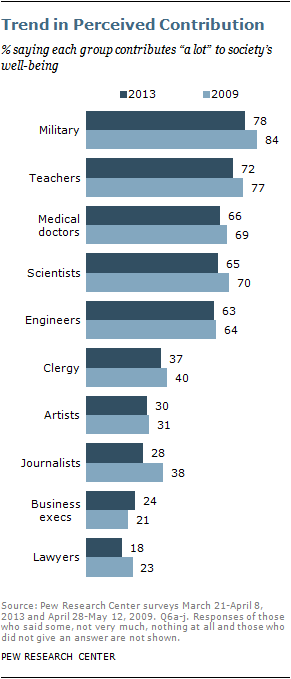
One reason why democracy doesn’t seem to be working very well is that the public is becoming increasingly ignorant about what makes it work at all. Evidence of this trend comes by way of a provocative study by the Pew Research Center, which polled the public regarding which professions it believes contribute the most to society.

The results can be found in this press release, this summary, and this article in The Careerist, but here is a snapshot:

Worth study

Continue reading

The Difference Between Unemployed Scientists and Unemployed Lawyers

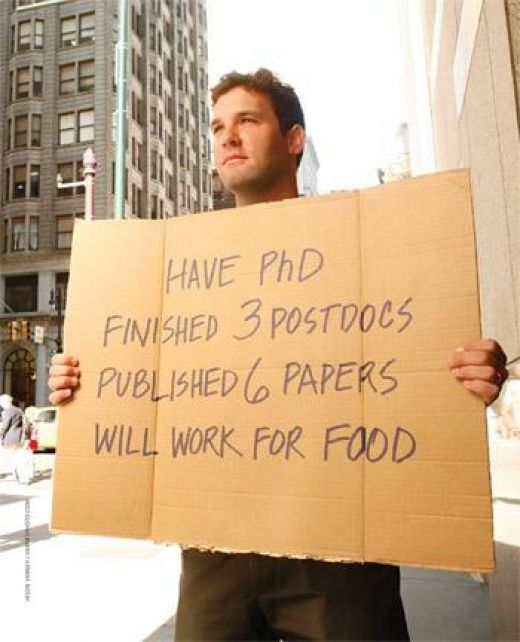
A front page story in today’s Washington Post casts interesting perspective on an Ethics Alarms rumble that broke out here a couple of weeks ago. One of the many websites where underemployed, over-indebted law grads hang out to commiserate—sites with pathetic names like “butidideverythingrightorsoithought”—discovered a post from the days when people were taking Occupy Wall Street seriously, in which I chided a protester whose sign blamed his law school  for his failure to  find a job, without giving due weight to the fact that sitting in a park whining about his plight wasn’t doing him any good either. Suddenly Ethics Alarms experienced an avalanche of indignant and often personally insulting comments introducing me to the strange world of the JD conspiracy theorists, who maintain that law schools engaged in an intentional conspiracy or “scam” to gull naive college grads into believing that a law degree was a sure-thing ticket to Easy Street and six-figure starting salaries.

In the Post’s report, we learn that other advanced degree-holders, namely PhDs in scientific fields, are also unable to find work or toiling in fields unrelated to their degrees. The Post says:

“Traditional academic jobs are scarcer than ever. Once a primary career path, only 14 percent of those with a PhD in biology and the life sciences now land a coveted academic position within five years, according to a 2009 NSF survey. That figure has been steadily declining since the 1970s, said Paula Stephan, an economist at Georgia State University who studies the scientific workforce. The reason: The supply of scientists has grown far faster than the number of academic positions.”

Sounds a lot like the legal market to me! Continue reading

Unethical Headline of the Month

From the Scientific American website:

“Should Global-Warming Activists Lie to Defend Their Cause?”

"Hmmm... that's a real brain-teaser!"

The fact that this question can even be asked in seriousness, or be deemed worthy of debate in scientific circles, tells us all we need to know about why climatologist Peter Gleick decided to use deception and theft to try to discredit the Heartland Institute, a vocal critic of global warming research. It also makes it impossible to know who to trust and when, in the global warming debate and others.

Great.

Nice job, everybody.

Genome Sequences, Consent, and Scientist Ethics

What...you don't trust this guy???

Few things are scarier than when scientists start debating ethics.

A current debate in the scientific community involves whether it is ethical to publish your genome sequence without asking permission from family members. It is increasingly common for people to pay to have their genome scanned for the presence of traits, including genetic diseases. Scientists agree that releasing this information without the permission of the individual whose genes are described would be a clear ethical breach. The controversy involves whether an individual is ethically obligated to get consent from family members before publishing his or her own genome sequence, since to some extent that means publishing theirs as well.

The argument proceeds from the unauthorized release of someone’s genome sequence by a third party to the plight of an identical twin whose sibling wants to publish his own sequence, which, of course, also describes his twin’s.  This is ethically clear too: it would be wrong not to seek permission. But what about the rest of the family? Continue reading

The Professions Most Likely to Cheat on Their Taxes?

Gee, where do "Treasury Secretaries" fall on the list?

A study of I.R.S. data by a University of Chicago graduate student, now Doctor, Oscar Vela,  produced the following list of the professions most likely to file fraudulent tax returns, at least according to his analysis. Make of it what you will. The Time Magazine website blog post about the list is worth reading, first for the blogger’s highly questionable theories explaining, for example, why lawyers aren’t on it, but mostly to see conclusive proof that Time is hiring English-as-a-second-language night students, relatives of Ko-Ko the talking gorilla, or stroke victims to write their blogs. Sample sentence: “His conclusion was that as much as we would like to think so we pay taxes out of  the goodness of our hearts, or even because we are fearful of fines or worse.” Henry Luce just did a back-flip in his grave.

Dr. Vela’s theory is that the professions that are required to maintain a perception of integrity are less likely to cheat. Let us say that I am dubious. Why then are scientists so high on the list?

Here it is: Continue reading

Home-Grown Mengeles, And What We Must Learn From Them

Josef Mengele: researcher, utilitarian, monster

We knew, or should have known, that this extremely ugly shoe was bound to drop eventually.

Last autumn, when the U.S. apologized for federal doctors infecting prisoners and mental patients in Guatemala with syphilis 65 years ago, it put us on notice that a vile and unethical cultural standard had taken hold of the American medical and scientific communities in the 20th century, one that held  it was “right” for the weakest, most powerless and most disposable of human beings to be tricked, coerced or bribed into serving as subjects for experiments that could lead to miraculous cures and treatments for the rest of the population. This–depriving human beings of their rights and lives in the interest of science—is “the ends justify the means” at its worst. But the Guatemala experiments proved that this was once flourishing and respectable in the U.S. scientific and medical research communities, so it would have been surprising if there weren’t more stories of home-grown Mengeles, and sure enough, there were. The U.S. acknowledged as much when it apologized for the Guatemalan tests. Now we have details. Continue reading