Ethics Observations On The Rep. Chris Collins Insider Trading Indictment

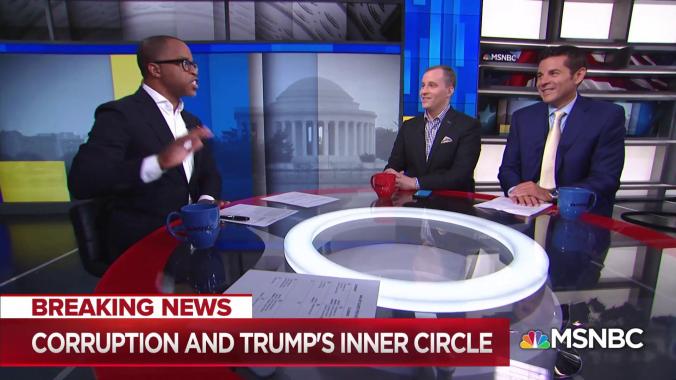
Three-term GOP congressman Chris Collins was indicted for insider trading after prosecutors determined that after Innate Immunotherapeutics  alerted him to the failure of company’s clinical drug trials for a promising multiple sclerosis drug, Collins tipped off his son, allowing him and others to  save hundreds of thousands of dollars by selling their stock in the firm before the news was made public. Now Collins faces prison time if convicted.

 Collins was a member of the company’s board until May of this year, and at one point was its largest shareholder.

Speaker of the House Paul Ryan has stripped Collins of his seat on the Energy and Commerce Committee and asked the House Ethics Committee to investigate the allegations of insider trading. Collins has ended his re-election bid, but maintains that he is innocent. Such statements are like the puzzle about the White Foot and Black Foot tribes that look and sound identical but have one difference: the White Feet always lie, and the Black Feet always tell the truth. If you ask a member of either tribe, “Are you a truthful Black Foot or a lying White Foot?”, you will always get the same answer no matter what tribe the individual belongs to: “I am a truthful Black Foot!” And whether an indicted Congressman is guilty or innocent, he will always say, as Collins did, that the charges are “meritless” and that he will fight them to have his “good name cleared of any wrongdoing.”

Until the plea deal.

Collins’s involvement with Innate dates back all the way to 2005, before he ran for Congress. He organized support from wealthy friends and neighbors,  many of whom would later become his political donors,  to help bail out the company, which was flailing at the time. In addition to Innate Immunotherapeutics,  Collins has held leadership roles in other biotech companies.  Until his indictment, he was chairman of the board of directors of ZeptoMetrix, a private lab company based in Buffalo that he co-founded. That one has received millions of dollars in federal contracts, according to government records.

Collins reported owning between $25 million and $50 million in shares of  ZeptoMetrix. In June, he sold about a million dollars of stock in Chembio Diagnostics, a medical tests and equipment manufacturer, according to his ethics disclosure forms.

The congressional ethics office found last summer that  Collins may have violated ethics rules by asking the National Institutes of Health for help with the design of Innate’s now-failed clinical trial.

Observations: Continue reading

Sunday Morning Ethics Warm-Up, 5/27/18: On Bullies, Dogs, Signs, Cheats, And The Worst WWII Movie Ever

Good morning.

1. BOY, is that a lazy and inaccurate movie! As usual, they are playing every war movie they can dig up on Memorial Day weekend. I just watched the tail end of  “The Battle of the Bulge,” the 1965 Cinerama Hollywood portrayal of the decisive 1944 WWII battle in the Ardennes that reminds me of my dad, buried in Arlington National Cemetery, more than any other war film, and not because it was in that battle that my father earned his Silver Star. No, the film reminds me of Dad because he hated it so much. He regarded it as an insult to the veterans who fought the battle, and  a cretinous distortion of history in every way. His name for the movie was “How Henry Fonda Won the Second World War.”

The most striking of the endless misrepresentations in the movie is the absence of snow. The battle’s major feature was that it was fought in freezing, winter conditions, on snow covered terrain sometimes up to two feet deep. Some battle scenes are shown being fought on flat and bare plain, about as distinct from the mountainous, thickly forested territory where the actual battle took place as one could imagine. My father also started complaining during the film, loudly, about the use of modern American tanks to portray the German Tiger tanks.

Former President (and, of course, former Allied Commander) Eisenhower came out of retirement to hold a press conference to denouncing “The Battle of the Bulge” for  its gross  inaccuracies. THAT made my father happy.

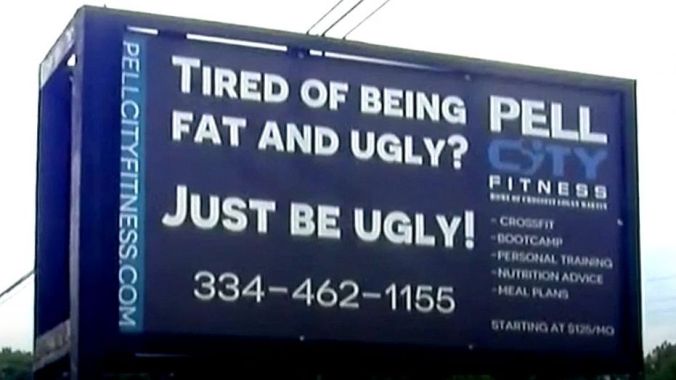
2. Funny! But…no, it’s just funny. Scott Campbell, the owner of the Pell City Fitness gym in Pell City, Alabama,  put up a sign that says “tired of being fat and ugly? Just be ugly!” City officials told him to take down the sign or be fined, saying it is too big and needs a permit, but other business owners told the local news media that they have never heard of the ordinance the city is citing being enforced. The suspicion is that Campbell is being singled out because some have complained that the sign is “insensitive.” No, it’s just funny…

This is the ethical problem with excessively restrictive laws, rules and regulations that are not consistently enforced. Prosecution can be used for ideological and partisan discrimination. Not only is the sign benign, it is not even original: that same language is on fitness company ads all over the country. So far, it looks like the community is supporting Pell and that the city will back down, but this is Alabama. Call me pessimistic, but I doubt the sign would be allowed to stand for long in Washington State or California if an ordinance could be found to justify pulling it down.

The First Amendment dies in increments. Continue reading

Ethics Quote Of The Month: Ann Althouse

battery

“To everyone who likes that Lewandowsky got charged: Will you agree that everyone who does nothing more than that should undergo criminal prosecution? Are you willing to pay the taxes to cover that? Are you ready to find out that you’ve already done it and you’re going to be needing to hire a lawyer? Oh, but it’s so funny when it happens to somebody else, somebody you don’t like. If that’s what you think, please just admit to yourself that you are entirely morally corrupt.”

–Law professor and blogger Ann Althouse, taking the popular position among the talking legal heads on CNN and elsewhere that charging Trump’s campaign manager for the technical crime of battery for for what appears to be minor contact on videotape is an abuse of prosecutorial discretion.

Ann is playing law professor here, and it’s hard to tell if she is asking these questions to provoke thought from the knee-jerk partisans and virulent Trump-haters, or if she really believes everything she wrote. I;m a fan of Professor Althouse, so I want to find  a way to justify this post of her’s, which raises valid points and ignores others equally valid.

Do I “like” the fact that Lewandowsky was charged? I probably wouldn’t have charged him, but I’m not sorry he was charged. Why was a campaign manager grabbing a reporter? Why did the Trump organization react to the reporter’s complaint by attacking her honesty and character? I know the law shouldn’t be used to inconvenience people who act badly, and that doing this is usually an abuse of power. Still, do I like the fact that one of Trump’s thugs isn’t getting away with the thuggishness encouraged by his boss? Yes, I guess I do.

The charge can be justified on utilitarian grounds. Today I saw a cable TV news exchange regarding Fields’ complaint on CNN, where a lawyer explained that any unconsented touching is battery, and the interviewer was shocked. “What?” she said. Yes, I remember a lot of classmates in first year of law school being surprised at that too.

It’s the Common Law: nobody has a right to touch anybody else. I love that principle, myself: I don’t touch people unless I have permission, and they better not touch me. It’s  per se battery, and while we usually don’t press it, we might if the batterer is enough of a jerk, or does more harm than he intended. If charging Lewandowsky makes people think twice before laying their hands on me or anyone else, good. Sending a message to discourage others from wrongful acts is always a valid reason to charge someone. Continue reading

I’m Dreaming Of A Zombie Christmas

Zombie Nativity

I didn’t say it was a pleasant dream.

Hmmm, how should I describe this? I would say that a law is being used to violate the First Amendment rights of an unethical jerk who is intent on abusing them.

Or, in the alternative, Jasen Dixon may just be an idiot.

Sycamore Township, which is just outside Cincinnati, has responded to complaints by neighbors by applying various ordinances against Dixon’s unusual Nativity scene that he constructed in his front yard. It features life-size figures portraying Joseph and Mary as the walking dead, and a zombie baby Jesus, who has pale skin and pure white eyes. Here, here’s a close-up of Zombie Baby Jesus:

Zombie-nativity-scene

Awwwww!

Dixon suspects that the township laws, which prohibit structures in the front or the side yard of a residence that occupy more than 35 percent of its total area, and require that the primary structure must be 3 feet from the street and 6 feet from the dwelling, are really being selectively enforced against him because his holiday display offends some people….well, almost everyone. I suspect this as well.

Poor Jason says he doesn’t mean any harm: he’s just doing the best he can to celebrate the birth of baby Jesus. “I wanted a Nativity and I worked with what I had,”  says Dixon, who manages a nearby haunted house called “The 13 Rooms of Doom.” He says his First Amendment rights are being infringed.

“I’ve lived here for 15 years and I’ve never had a violation of any kind,” Dixon said. “It’s a holiday decoration. I know if it was a real pretty Nativity scene they wouldn’t be saying anything.”

I’ll agree with that too. Continue reading

Ethics Quiz: You’re the Prosecutor!

The facts are simple. The ethics are not.

Near Shiner, Texas, a father arrived home to find a 47-year old man sexually molesting his 4-year-old daughter. So the father beat him to death, apparently in the process of stopping him.

Assuming that the father has no criminal record or history of violence, and that this is really what happened—and ignoring the fact that the incident occurred in Texas—your Ethics Quiz is this: If you were the local prosecutor, would you seek to prosecute the father? Continue reading

Ethics Dunce: Buzz Bissinger

It took about an hour after the  Barry Bonds verdict for the first ethics-challenged national sports writer to write something outrageous about it. Not surprisingly, it was Buzz Bissinger, a the member in good standing of the Daily Beast’s stable of annoyingly hypocritical, biased or appallingly cynical writers, Bissinger belonging to the last category.

His post, which pronounced the Barry Bonds conviction “a travesty” in the title, contained one ethics howler after another, any of one of which would have justified an Ethics Dunce prize.

Here they are:

“It is true that the case of Barry Bonds does hit a new low, a new low in the waste of millions of dollars of taxpayers’ money, a new low in the witch hunt of a player who, because he was considered surly and arrogant and unlikable, is now having intimate details of his life revealed (such as testicle shrinkage), a new low in outrageous abuse of government power.” Continue reading