Comment of the Day: “Comment of the Day: ‘Observations On The Instapundit’s Tweet'”

charlotte4

I am often disappointed in the volume and balance of comments on particular posts here. Yesterday, I was waiting for someone to defend the extreme reaction to Glenn Reynold’s unseemly tweet regarding the Charlotte riots, and was especially interested in hearing arguments why Mariners catcher Steve Clevenger’s blunt tweets were “racist” as so many headlines were calling them. Admittedly, I was waiting for such arguments because it would be so easy and fun to reduce them to rubble, but still: where are the people who want to stifle speech and opinion, and who believe that criticizing violent rioters and Black Lives Matter should be punished so severely? Clevenger has been docked about $28,000 for expressing an opinion on Twitter, and sportswriters, who get paid to opine, often cretinously, on the web every day, are cheering. I know defenders of speech and opinion suppression are out there, but they are mute, rationalizing, I think, that they are right but those brutes on Ethics Alarms are too primitive to understand.

At least many of the comments that the posts have spawned are of high quality and extremely thoughtful. This is the second Comment of the Day inspired by them, by Chris Bentley:

I was thinking about a particular topic as I drove home from work today, about why people, mostly people on the left, justify and rationalize the behavior of looters during riots. After reading Jack’s initial post regarding Instapundit, I went to read the linked Reason.com article, and then checked out the comments section. One person, with the screen name Krabapple, made the following comment:

“Yeah sorry I can’t take seriously moderation from a company that allows the hashtag #killallwhitepeople but not this.” Continue reading

Comment of the Day: “A Daughter Sues Her Parents For Being Assholes. Good.”

growth-sequence

Having just returned from an eight-day (and partially laptop-less) speaking tour  that has me about ten posts behind, it was nice to have Steve-O-in-NJ deliver a textbook Comment of the Day, expanding on the original post with relevant and useful observations about photography -obsessed parents and photography ethics.

I do object from an ethical standpoint to his tit-for-tat endorsing last line.

Here is his good and thoughtful work in response to the post, “A Daughter Sues Her Parents For Being Assholes. Good.”

What are the ethics of taking 500 pictures of your child? I wish that I could say that the ethics of taking large numbers of pictures are always the same but they are not. I am in the middle of a two-week vacation and I have been taking a large number of pictures. I see absolutely nothing wrong with shooting a large number of pictures during an air show, particularly where the opportunity to get a particular shot is very limited. I see absolutely nothing wrong with taking a large number of pictures at a place like Colonial Williamsburg, where the actors are deliberately dressed up in costumes designed to attract attention. The same ethics generally applies to any event where there are costumed individuals who are seeking attention. The same ethics probably apply to sporting events. Of course the shooting of inanimate objects like in a museum is perfectly all right, subject to whatever policies the institution puts in place and makes known. Continue reading

A Daughter Sues Her Parents For Being Assholes. Good.

photo

An 18-year-old Austrian woman is suing her parents for continually posting embarrassing childhood photos of her on Facebook without her consent. Since 2009, she alleges, they have willfully humiliated her by constantly posting intimate images from her childhood—about 500 to date. Among them are potty training photos and pictures of her having her diapers changed.

The abused daughter told reporters, “They knew no shame and no limit – and didn’t care whether it was a picture of me sitting on the toilet or lying naked in my cot – every stage was photographed and then made public.” Her parents have  700 Facebook friends.

The technical term for them is “cruel and merciless assholes.”

They have refused to delete the photos, with her father arguing that since he took the photos he has the right to publish them to the world.

Oh, what does the law have to do with this? If the parents had any decency, and sense of fairness, respect and caring, the law wouldn’t have to be involved in any way.  Their daughter feels humiliated, as most of us would be, by having such photos published. There is no ethical principle under which publishing photographs (or videos) of anyone that were taken without consent when the subject objects or one knows or should know that he or should would object can be justified. This controversy, if ethical parents were involved, would be settled with a simple exchange:

Her: “Please don’t put anymore of those photos on Facebook, and take down the ones that are up now. They are embarrassing.”

Them: “OK!”

How hard is that? I know it’s hard for parents to resist posting photos of their adorable infants and toddlers while they are too young to protest, but the protest should be presumed. The Golden Rule rules, and I go further: this is an absolute. Children should not have their lifetime privacy scarred by parents selfishly indulging themselves by treating their children like pets. Children should be able to trust their parents to respect their sensibilities and vulnerabilities, and not to sacrifice them for cheap Facebook “likes.”  Obviously, many of them can’t.

Continue reading

Ethics Hypothetical: Rules, Compassion, Integrity, Fairness, And A Looming Race Card

clock2

[The hypothetical is inspired by two recent events I witnessed in the past week.]

Preface: The state requires new bar admittees to take a one-day course covering the basics of practicing law in the jurisdiction—how the courts work, special procedural rules, unique aspects of local practice, horror stories, the works. They must complete the course or they can’t be certified, and the court-ordered series of lectures and presentations is held only once a month.

A company runs the mandatory curriculum under contract to the state, and is required to confirm in writing to the courts that its requirement have been fulfilled. One key requirement is that every attendee must be present for every minute of the presentations, except for brief emergencies, like using the rest rooms. The course administrators carefully monitor attendance. The published description of the course directs that once the course begins, theoretically at 9 am sharp, no late-comers will be admitted.

As you might imagine, missing the session can be quite a hardship, as participants often live and work in other jurisdictions.

The Event: It is 9:08 am on the day of the program, and the introductory video that begins the orientation is almost finished. It consists of interviews with members of the bar about the benefits of practicing in the state, the importance of ethical practice, etc: to say it is not substantive is an understatement. Literally nothing that is said and shown in the video is anything but boilerplate.

A young man, sweating profusely, bursts in the door, looking unhappy and desperate. “I’m sorry I’m sorry!” he babbles. He says that he had to drive up from a neighboring state and had an accident. “Can I still get in?” he pleads.

The male staffer responsible for the session chats briefly with an associate. The program was late starting, and this late arrival will miss nothing if he goes in now. “All right,” the honcho says as the young man heaves a sigh of relief. “I shouldn’t do this, but you haven’t missed anything.” As he goes into the auditorium, one can here the opening remarks of the first speaker, a judge. It is now 9:12 am, and another young man bursts through the door on a dead run. “My crazy cabbie’s been driving me all over the city for an hour!” he shouts. “I flew in last night from Arizona! Please, please, don’t make me do this again…I barely was able to afford this trip.” The administrator is wondering if he had seen the previous guy go into the auditorium. He’s heard this judge’s spiel many times: all that has been missed, to be honest, are a few (lame) jokes. “All right, all right, get in there quick!” he tells the new supplicant. “I’ll finish your paperwork during the break!” The kid looks like he’s going to cry, he’s so relieved.

I’m there, watching this (I’m on the program) and say to the administrator, “I bet this happens every time.” He says, “It does. I know that nobody misses anything that isn’t in the printed materials until 9:15, so it’s a hard stop after that.”

And another late arrival bursts through the door. It’s a bit after 9:14. The staffer has just told me that the final final deadline is 9:15, and it’s not that yet. This poor guy is bleeding through his pants,  has a big bruise on his face, and is saying something about a bicycle accident. By the time he gets himself settled—he is told that there is no time to clean up—it’s past 9:16. He starts toward the auditorium door as the other staffer says, “OK, that’s IT,” and starts to take the registration materials and lists away….just a very stressed young African-American woman enters, in plenty of time to see the bicycle rider, who is white, enter the auditorium. I can hear the judge through the open door. He’s still telling jokes, longer this time than usual.

Issues and Observations

1. The young woman was not admitted, and told that she had to come back another month. She too was from out of state. She also had a legitimate-sounding excuse.

  • Was that fair to her?
  • Should it have mattered that the program had not yet reached a serious stage?
  • She was told that 15 minutes was the absolute, unwaivable deadline. That was true, but it was not the deadline the company was contracted and pledged to enforce. That deadline was 9:00 am.

2. Should the explanations used by the latecomers play any part in the decision to allow them in? Why? Continue reading

The Ethical Dilemma Of The Successful, Failing, Local Small Business

Now THIS is a gyros sandwich!

Now THIS is a gyros sandwich!

The little restaurant opened the same year my wife and I moved into the neighborhood. It specialized in yummy Greek fare like gyros, souvlaki, and Greek salads, but also made terrific hamburgers, subs and pizzas, and quickly became our reflex fall-back when we were too tired to make dinner or wanted a treat for lunch. The place was a family operation: the tiny, spunky middle aged woman who seemed to run the place—taking the orders, filling bags, taking the payment—had a Greek accent that reminded me of my grandmother and all of my relatives from her generation; her husband, silent, imposing, who was the chef; and over time, the two children, both of whom worked there when they weren’t in school.

The food was consistently delicious, fresh and authentic, but it was also satisfying to see an old-fashioned family business growing and thriving. A restaurant consultant would probably have said it was too old-fashioned, for the menu never changed, the faded prints of the Parthenon and the Aegean coast were the only decorations in the place, and it dealt only in cash. Still, the little Greek lady greeted you with a knowing smile when you walked in the door, and you knew you were going to be treated like a neighbor.

Then suddenly, the family was gone. The couple decided to sell the place and retire, and a long-time employee who had worked in various jobs over the years took the restaurant over. I knew him, of course, and we talked often. He’s a nice guy, determined, ambitious, hard working. He threw himself into the job of making the business boom. Now the restaurant accepts credit cards and delivers, is open on Sundays, has daily specials, and sports a newly-painted and (somewhat) less austere decor. He also jacked up the price on everything.

The new owner’s formula for success worked almost immediately. The restaurant, he told me, has almost doubled its business. The problem is, as my family gradually discovered, is that the entirely non-Greek staff, including the owner,  has no idea what their food is supposed to taste like. You know you’re in trouble when the entire staff mispronounces everything on the menu, (It’s GIR -Os, hard G, not, ugh, “JY-row,” like the name of the goose inventor in Donald Duck comics), but it’s worse than that. The feta cheese in the Greek salads, which are suddenly mostly iceberg lettuce, is scant and low quality. The once-marvelous cheese steak subs are bland; the onion rings are charred, and every now and then a carry-out order includes something inedible, like the freezer-burned veal parmigiana I had a few months ago. The owner was apologetic, but his candid “I thought that meat looked funny when I microwaved it” didn’t inspire confidence. Continue reading

Stupid Cops Matter

Perfect match.

Perfect match.

In a case where Hanlon’s Razor (“Never assume malice is the explanation if stupidity will suffice”) applies but one can’t really blame a mother for thinking otherwise, police in Newark  inexplicably mistook an innocent pre-teen black boy for an adult robbery suspect and chased him through a Newark neighborhood with guns drawn. This is stupidity, not racism. Well, who knows: there could be racism mixed in there too, but what jumps out is the jaw-dropping incompetence.

Legend Preston, just ten years old, was fetching a basketball that had rolled into the street when he looked up and saw armed cops running towards him as if they meant business. So he ran.

“I was scared for my life,” Legend told reporters. “I was thinking that they were going to shoot me.” Good thinking, kid. If these cope were inept enough to get a ten-year-old  confused with Casey Joseph Robinson, a 20-year-old, dreadlocks-sporting perp with facial hair (he was arrested in the next block), who knows what they might do?

Legend was quickly surrounded by neighbors  who emphatically pointed out to the police that they were chasing a child, as the officers stammered that he “fit the description” of the criminal. Well, sort of. Okay, okay, now that we’re up close, we see that he’s under five feet tall, dressed like a kid, doesn’t have dreadlocks or facial hair, and looks nothing like the guy, except that he’s black, which means we also could also mistake him for Bill Cosby, Jesse Jackson, Morgan Freeman, or LeBron James. Continue reading

Ethics Observations On The Naked Trump Statues

Naked Trump

Last week, five identical statues of a grossly caricatured nude Donald Trump  appeared overnight on street corners in San Francisco, Los Angeles, Cleveland, Seattle, and New York City.  The Washington Post reported that the anarchist collective INDECLINE made and placed the statues. It called the  project “The Emperor Has No Balls.” Indeed, the otherwise anatomically correct statues showed the Trump effigy missing those particular features, though not bright yellow pubic hair. If you really want to see these assaults on your consciousness and sanity, go here.

I advise against it.

Ethics Observations: Continue reading

Ethics Hero: Angela Martin, As St. Paul Strangers Prevent A Suicide

Angela Matin

Remember Raymond Zack?  In 2011, 50-year-old Raymond Zack waded into the surf at an Alameda, California beach and stood calmly in the 54-degree water, apparently waiting to die. His suicide took nearly an hour, but eventually he drowned, with no rescue attempts from any of the 75 San Franciscans, including firefighters, who gathered on the shore to watch the entire tragedy. I am so used to reading about bystanders allowing desperate people, sick, wounded or otherwise in peril, to perish because they “didn’t want to get involved” that a story like this one, the opposite of the Raymond Zack tragedy from St. Paul, Minnesota, comes as a shock.

How sad is that?

Motorist Angela Martin  saw a woman  climb onto a concrete wall and scale a chain-link fence above Interstate 94 in St. Paul, Minnesota. Martin could have continued driving, but she acted immediately, parking her car and calling 911. But she sensed there was no time to lose. Martin ran over to the woman, who  having climbed over chain-link fence was now clinging to it with her fingers above heavy highway traffic.

“ No, honey. Don’t do this,” she shouted. Martin told reporters that the distraught young woman kept repeating,  “My mom don’t love me. My mom don’t care for me.’”

“No, we love you, ” Martin told her. Martin reached through the links  and grabbed the woman’s shirt and  belt, just as the would-be suicide released her grip so she could fall to her death. Other motorists on the overpass saw the unfolding scene and came to Martin’s aid, and joined her in reaching through the fence to keep the woman from falling. Continue reading

“Such Is Life,” The Kindness Of Strangers, And The Wonderful Ethics Saga Of Moises Treves And Judy Anderson

Such is life

This is an old story, but I’ve never written about it, and I need to be reminded that there is good in the world.

In the mid 1970s, Moises Treves was a day cook at a small taco stand on the island of Cozumel, Mexico, By all accounts he made the best tacos in town, and  American tourist Judy Anderson, a school teacher who visited the island several times, was a special fan of them. On one visit in 1977, Judy, traveling alone as usual, invited him to accompany her to the Mayan pyramids in the Yucatan Peninsula. Moises happily agreed and served as her tour guide. They had  lunch, speaking as best they could to each other using Judy’s limited Spanish and Moises’ broken English.

During the meal, Judy asked Moises if he had any ambition to open his own restaurant. Ah, he said, that was his dream, but he despaired of it ever coming true. He just didn’t have the money, and couldn’t seem to save anything.  Judy responded,”Such is life!,” an expression that Moises had never heard. He asked Judy about it, and the saying stuck in his mind.

As the lovely day came to a close, the two friends said goodbye:  Moises was about to take  the ferry back to the Cozumel, and Judy was heading o the airport and then home to United States. Mysteriously,  Judy gave Moises a sealed envelope and told him not to open it until he was home.

When Moises opened the envelope, he found five $100 bills.  They were accompanied by a letter that said,

“Dear Moises. Go make ‘Such is Life’ happen. Love Judy.”

Continue reading

Behold..THE DUMBEST ETHICS STORY EVER TOLD!!!

peetoy

Are you ready?

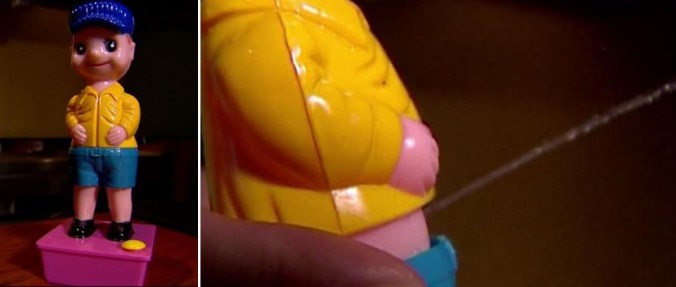
James and Isabelle Lassiter, who hail from Texas, were visiting Murfressboro, Tennessee and stopped into a Wasabi Japanese Steakhouse recently with their children. Apparently the sense of humor at hibachi restaurants has declined precipitously since the last time I ate at one, for I am told that the gag the Lassiters endured is now common fare. One of the Wasabi chefs held up a plastic toy depicting a little boy, and when the boy-toy dropped his shorts, he squirted water in a long, thin stream, as if urinating. The children were delighted! They were especially delighted when the stream hit their mom in the face.

Isabelle Lassiter was not delighted. In fact, she and her husband called the police, and accused the chef of sexual assault. “It peed on me…basically, out of his… wee wee area,” Isabelle explained, delicately.”It really didn’t have a wiener, but you got the point.” Investigators, who briefly took the toy into custody, indeed noted that the toy wasn’t anatomically correct. An officer wrote, “I observed the toy to have no penis and just a hole for the water to shoot out.”

PLEASE don’t tell me that if the toy did have a plastic penis, the claim of “sexual assault” would have been taken more seriously.

The Lassiters agree that this detail should not matter. “Just because somebody cut off a piece of plastic…doesn’t change the fact that you’re getting peed on,” said James Lassiter. “It was a sexual style assault on my wife.”

This is not a hoax. I wish it was a hoax. Reading about it has temporarily disrupted my capability to organize my thoughts, so I’ll just note the following in no particular order:

1. It was not sexual assault, by any stretch of the imagination. Nobody “peed on” Mrs. Lassiter. The cook squirted water on her, using a juvenile, risqué version of a squirt gun.

2. If Isabelle thought even  for a second that the stream of liquid was urine, she has a cognitive problem. Isabelle, pay attention: plastic figures do not urinate. They are toys. They have no bladder or kidneys. Even if the liquid comes from the toy’s “wee wee area,” it can’t possibly be urine.

3. Calling the police was beyond an over-reaction; it was truly idiotic, and it should be punishable. I’m trying to think of any reason not to have an ordinance that declares a spurious and wasteful call for police a misdemeanor carrying a hundred-dollar fine. Of course, such an offense should only be declared in extreme circumstances…like this, for example.

4. The manager of Wasabi did issue an apology to the couple, but claims he has never had any complaints about the toy in the past. “The kids like it, they think it’s a water gun, kind of like a water gun you know,” said Mr. Huang. Ah! The old “if kids think it’s funny, it’s ethical” standard. This standard is not reliable. The Lassiter kids might well have also found it hilarious if the chef hit their surprised mother with a cream pie, a pillow, or a dead cat. Continue reading