Comment of the Day: “Ethics Hero: Toya Graham, The Baltimore Riot’s ‘Mom of the Year’”

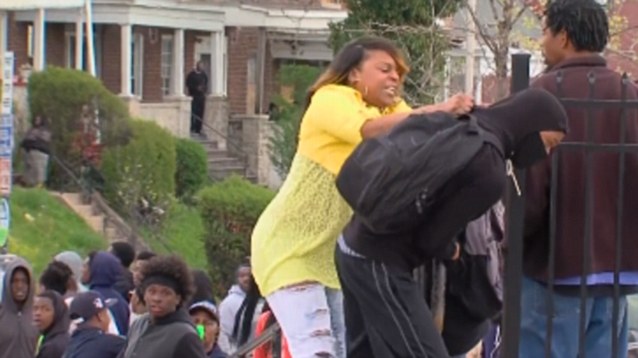
Baltimore mom

I don’t know if a 24 hour period has ever produced as many provocative, passionate and well-argued comments on Ethics Alarms before. This, commenter Holly’s reaction to my designation of the viral  Baltimore mom Toya Graham clobbering her rioter son during the Freddie Gray disruptions in Charm City, is just one of several. I’ll address some of the issues she raises after the post; in the meantime, here is Holly’s Comment of the Day, in a day that will probably have more than one, on the post, “Ethics Hero: The Baltimore Riot’s ‘Mom of the Year’”:

I am surprised at this response. For a number of reasons. In any other circumstance, this woman probably would be going to jail. But if we watch the video more closely, the following observations can be made:

1. This child was leaving with his mother and she was so angry that she chases him to pull him back towards her to continue the beating. He appeared to be complying and in her anger continued to the assault the kid during the walk away.

2. The child was not in imminent danger. There are bystanders all around I saw no rocks being thrown in this video nor police for that matter. It does not appear the threat of losing his life was immediately in front of them.

3. The assault starts with a few close-fisted strikes as well as continuing with open-fisted strikes or what people are calling “smacks”.

Exemplary action on the part of this mother would not have been beating her son as he walked away from the riot, however.  It would have included not allowing a 16 year out of her supervision to wander in the riot in the first place. Continue reading


Ethics Hero: Toya Graham, The Baltimore Riot’s “Mom of the Year”

It is odd that the now-anointed “mom of the year” is a woman videotaped beating her son, and rather violently at that. That’s the Ethics Incompleteness Principle for you: even conduct that is “always” unethical may be made ethical by unusual circumstances. Seeing your grown son participating in looting and rioting that are destroying your neighborhood changes the rules, or perhaps makes them inapplicable.

Here is what the unidentified woman (UPDATE: Her name is Toya Graham) was doing that is an ethical duty: she was fixing the problem to the extent she could. Utilitarian? Yup. Would Kant approve? Well, if every mother of those rioters intervened, they would have had more success than the Baltimore police did.

As for the Golden Rule, her conduct passes that test as well. If I were getting pulled into violent, mindless mob violence like that kid, I would want my caring parents to stop me by any means short of shooting me. If it were my son wearing that hood, I’d be tackling him.

I don’t know if she’s really “Mom of the Year”—I’d like to think that a really exemplary mother won’t raise a rioter.  She’s an Ethics Hero, though, beyond question.

Ethics Dunce: GoFundMe

“DESTROY THE EVIL CAKE DISCRIMINATORS!!!!”

If GoFundMe isn’t going to have the integrity to avoid taking sides in complex political and cultural disputes, it is functionally useless.

Perhaps it should change its title to “GoFundMyPoliticallyCorrectCause.”

Pusillanimous GoFundMe caved in to pressure from vindictive gay marriage activists and pulled the crowdfunding campaign on the site that had raised more than $109,000 for the Christian-owned bakery,  Sweet Cakes by Melissa.

The cake shop in Gresham, Oregon, became ground zero for the same-sex marriage debate  in January 2013, when it turned away customers who wanted cakes for a same-sex wedding. The spurned couple filed a complaint to the Oregon Bureau of Labor and Industries, claiming their civil rights under the Oregon Equality Act had been infringed. In defense, the owners of the business stated that they  refused to cater  the wedding because of their religious beliefs, and thus their decision was protected by the U.S. Constitution. They subsequently closed the shop, and carried out their business from home. The Oregon Bureau of Labor and Industries proposed a damages award Friday of $135,000 against Aaron and Melissa Klein, the owners, for being in violation of the state’s anti-discrimination law. The award, which is not final, would provide $60,000 in damages to Laurel Bowman-Cryer and $75,000 in damages to Rachel Bowman-Cryer for “emotional suffering stemming directly from unlawful discrimination.”

After taking down the page raising money for the bakery in the belief that they have been unfairly targeted, victimized and mistreated, GoFundMe said in a statement that the campaign violated the site’s policy against raising money “in defense of formal charges of heinous crimes, including violent, hateful, or sexual acts.”

Continue reading

Ethics Dunce: Alexandra Robbins, The Mocking Nurse

Mockery

If you set out to defend ethically indefensible conduct in print, you better be able to do a better a job of it than this.

Alexandra Robbins, in an op-ed causing quite a bit of controversy in the Washington, D.C. area, attempted to not only justify the despicable conduct of medical professionals deriding and ridiculing their unconscious patients, but to sanctify it, arguing, lamely, that doctors and nurses are mocking the unwitting and vulnerable human beings who have placed their lives in their hands in order to “rejuvenate [the medical personnel] and bond them to their teams, while helping to produce high-quality work. In other words, the benefits to the staff — and to the patients they heal — outweigh occasional wounded feelings.”

Right.

Robbins’ protests of virtue amount to a desperate raid on the Ethics Alarms Rationalization List, which, as always, operates as virtual Rotting Ethics Detector, or RED. If you find yourself thinking these corrupting self-delusions, you’re on the verge of unethical conduct; if you find yourself saying them, you’ve applied for membership in the Dark Side, and if you are so rationalization-polluted that you proclaim them in print, like Robbins, you shouldn’t be trusted to mail the water bill, much less to cavort in the operating room.

Rationalizations aren’t the only ethical problem with her loathsome essay. The entire thing is a Jumbo, denying the blatantly undeniable. “Oh, no!” readers are told. “We aren’t being disrespectful to patients when we mock their weight, sex organs, or the maladies that placed them in pain, peril and in our care!” Robbins expects us to believe that insults constitute “non-destructive coping measures” that help nurses and doctors “provide the best possible care, even if those methods might seem unprofessional outside of the health-care setting.”

They seem unprofessional because they are unprofessional. Continue reading

Comment of the Day: “Unethical Website Of The Month: Michael T. Slager Support Fund”

Now, let's not jump to conclusions...

Now, let’s not jump to conclusions…

UPDATE (MAY 3): I have been convinced that the original post that generated this Comment of the Day went too far. Asking for support for Slager’s defense cannot be unethical: Slager has a right to a defense, and the best one available. My thoughts on that issue, in relation to the Freddie Gray cops, are here. I still think it is obvious that the individual who posted the appeal is doing so for unethical reasons, and is likely a racist, an apologist for a bad cop, and an idiot. But the appeal itself is not unethical, hence the website was not unethical to post it.

________________________________________________

How can a website dedicated to paying for the defense of fired police officer Michael T. Slager be unethical, when every citizen is guaranteed the right to a defense before a jury of his peers? I thought I made my ethical objections to the site clear when I wrote:

Slager deserves a fair trial and will get one, but anyone whose immediate reaction to seeing the horrific video is sympathy for this killer cop needs psychiatric treatment, and quickly.

I also made it clear—I thought–that the text of the appeal betrayed a strange and ugly urge to shield Slager from the consequences of his conduct, which was per se, on its face, undeniably illegal under the laws of every state in the land, including South Carolina. He shot a fleeing man in the back; he cannot claim self-defense. Deadly force is forbidden in such situations. Unless Slager noticed that victim Walter Scott had death-ray shooting eyes in the back of his head, Scott’s death is a homicide, and it’s an open and shut case. The only remaining question is what level of homicide.

The appeal said that the poster supported Slager. Wrong. We should not support police officers who shoot citizens in the back. It attempted to minimize Slager’s offense by calling it a “mis-step.” Intentionally shooting someone illegally is not a mis-step. It’s murder. Then the appeal reminded us that Slager has a family, and didn’t do anything bad before he shot a man to death. Well, “first offense” is not a big mitigating factor when it comes to executing people.

However, I appreciate Ethics Alarms newcomer Gustav Bjornstrand‘s comment, though I don’t think this is the best context for it. Here is his Comment of the Day on the post “Unethical Website Of The Month: Michael T. Slager Support Fund.” I’ll be back at the end.

I venture to say that to offer support to Slager is certainly ethical, in and of itself. That is, if one believed that he or anyone deserves monetary support in order to raise a defence. It is conceivable that even someone who was certain he had committed a crime would choose still to aid him in getting good representation. It is unethical, I suggest, for anyone to assume that Slager is guilty of murder before a court decides the issue. It is possible, even if improbable, that there were circumstances prior to Slager firing that may shed light on his decision to fire. Additionally, there are a few other factors that need to be taken into consideration: Continue reading

Ethics Quiz: What’s Fair Punishment For The Chick-Fil-A Video Vigilante?

orestes

I previously wrote about Adam M. Smith, the ex-CFO of  a Tucson medical supplies manufacturer who filmed himself dressing down a Chick-fil-A drive-in employee and placed the video on YouTube. I said in part…

“He’s a vile bully and a jerk, who thinks it appropriate to embarrass and abuse an innocent employee of a restaurant because he happens not to agree with the politics and moral positions of the company’s owner…The video served to alert millions to beware of this rude, rabid and self-righteous champion of gay rights, who equates faith-based advocacy for the current law of the United States of America with “hate.”

I was more accurate than I knew. Now we learn that since that August, 2012 fiasco which cost him his job, Mr. Smith has fallen on hard times. His self-posted indictment of his own character has poisoned his reputation and career. When he found a new job, he was later fired for not alerting his employers about the incident. When he has raised the video to potential employers, they have declined to hire him. Where he was once earning a six-figure salary, had $1 million in stock options, and lived in a stylish home, he now lives in an RV with his wife and four children, and is existing on public assistance.

It all sounds like the plot of an Adam Sandler movie.

Your Ethics Alarms Ethics Quiz today is…

Is Adam M. Smith the victim of excessive social media punishment for one ill-considered act?

Continue reading

Musings On The “You Can’t Even Spell” On-Line Debate Tactic

dooleyIn a debate on a live thread here between two esteemed commentators, one of the contestants expressed vivid annoyance when the other derided the quality of his text in a retort. I’ve witnessed this many times online, as have you, I’m sure: someone registers an opinion while making a blatant typo, a bad misspelling, a misuse of a word, or a grammar gaffe and the opponent immediately focuses on it. What is this, exactly, and is it always wrong?

1. What is it? As I mentioned on the thread in question, it’s pretty close to an  ad hominem attack once removed, right? The sense of such a comment is, “Why should I respect your opinion? You can’t even spell “inaugural!” which in turn suggests that the individual is an ignoramus rather than a worthy adversary. It needs a name though. Is there one?

2. Is the tactic ever justified? Clearly it is not fair and indeed an unethical deflection if the issue is a typo or two. Or, in my case, or six. Anyone who visits here often knows that I have a serious typo problem, paired with an even worse proof-reading problem. I have dinged job applicants for resumes and job letters that contain “your” for “you’re” and “recieve” for “receive”? Indeed I have. Is there a difference? I think so: if someone wants to make a good impression and still makes these mistakes, I am justified in concluding that this is really the best that applicant can do, or, in the alternative, that he or she doesn’t care very much.

I wasn’t blogging 2000 words a day then, however.

3. Mentioning a gaffe seems to be mandatory if the comment or text containing it was complaining about carelessness, illiteracy or stupidity generally. Again, though, what does this mean? Is it essentially another variation of an ad hominem attack: “Hey, you’re so dumb you make the same kind of error you’re bitching about! Your argument must be dumb too!”? I think it is, but it also falls in the category of “Boy, I asked for that!” In “Twelve Angry Men,” the bigoted Juror 10 derides the character of a witness, saying, “He’s an ignorant slob! He don’t even speak good English!” Whereupon the heavily-accented naturalized citizen in the group corrects him, saying, “He doesn’t even speak good English,” humiliating his fellow juror. Ethical? In that setting perhaps; generally, however, I would think that the Golden Rule should apply, but most of us can’t resist the hanging curve over the center of the plate. Continue reading

Ethics Quiz: Eddie Murphy’s Golden Rule Moment

Wait..that's all?

Wait..that’s all?

As the long, live, “Saturday Night Live” 4oth anniversary show was being aired on NBC, twitter and various websites gave moment by moment accounts of what was occurring. Everyone was puzzled by the much-ballyhooed appearance of Eddie Murphy, who had a returning hero’s introduction, and was on screen for about a minute, never to return. Why didn’t Eddie do anything funny? Later we found out, though backstage revelations by SNL mediocrity Norm McDonald.

From “Rolling Stone”:

At the tail end of the “Celebrity Jeopardy” sketch – which reintroduced Darrell Hammond as Sean Connery, Will Ferrell as Alex Trebek and Macdonald as Burt Reynolds/Turd Ferguson – a Video Daily Double appeared in the Potent Potables category. Current SNL cast member Kenan Thompson played Bill Cosby revealing his cocktail recipe, a nod to the sweeping allegations against the comedian.

As Macdonald revealed on Twitter, that cameo was originally written for Murphy, who – after a few days of being pursued by Macdonald, Michaels and even director Brett Ratner (the latter serving as an intermediary for the comic) – decided not to appear in the sketch.

“Murphy knew the laughs would bring the house down. Eddie Murphy knows what will work on SNL better than anyone. Eddie decides the laughs are not worth it. He will not kick a man when he is down,” Macdonald wrote.

Your Ethics Alarms Ethics Quiz is…

Is Eddie Murphy an Ethics Hero?

Continue reading

Facebook’s Unconstitutional News Hoax Policy

I've got your backs, you contemptible jerks...

I’ve got your backs, you contemptible jerks…

Boy, there’s a lot of pro-censorship sentiment going around these days. I wonder why?

The latest comes from Facebook, which now is going to attempt to shield us from “hoaxes.” I don’t trust the government to decide what I should read and I don’t trust Facebook to do it either. Nobody should.

Back in the sixties, Economist John Kenneth Galbraith wrote papers and books asserting that large corporations were becoming the new nations and states, and that it was their power, not elected governments, that would decide how we lived. Galbraith wasn’t the best professor I aver had (he was the tallest), and his assertions in this realm were certainly exaggerated, but a lot of what he foresaw has come to pass. It is true that the First Amendment prohibition against government censorship of expressive speech doesn’t apply to private entities, but it is also true that huge corporations like Facebook weren’t even a twinkle in the eye of the Founders when that core American value was articulated. Any corporate entity that has the power to decide what millions of Americans get to post on the web is ethically obligated to embrace the same balance of rights over expediency that the Constitution demands of the state, specifically free speech over expediency, period, exclamation point, no exceptions. Embodying Clarence Darrow’s statement that in order for us to have enough freedom, it is necessary to have too much, the Supreme Court has even pronounced outright lies to be protected speech.

For this reason, Facebook’s well-intentioned anti-hoax policies—boy, there’s also a lot of well-intentioned lousy policies going around these days, being applauded for their goals whether they work or not. I wonder why?—add one more offense to core American ideals.

You can read Facebook’s new policy here. The key section: Continue reading

News From The “Pay It Forward” Front: Neal Shytles

Neal-Shytles-buys-goodies

At the beginning of this month, Ethics Alarms honored Ashley McLemore of Norfolk, Virginia, who answered the ad placed by a homeless man, Neal Shytles who wanted to spend Thanksgiving with a family. He spent the day with hers, and for Christmas, Shytles devised a way to help others like himself in need of holiday kindness.

Neal resolved to make goodie bags for the hundreds of men who always assemble for dinner at his local mission, creating a Facebook page to collect Walmart gift cards to purchase socks, gloves, hand warmers and candy. His efforts raised more than a thousand dollars that was matched by the local TV station that first broadcast the story of Ashley McLemore’s kindness.   Then WTKR took Neal to Walmart, where he filled four carts, and its staff helped him  assemble the gifts  into dozens of brown paper bags.

Thanks, Neal. I needed this story.