Comment of the Day: “The Golden Rule Distortions”

bread

In a comment on the post about the various versions of the Golden Rule, including popular distortions of it, Isaac revisited the ever-popular “Les Misérables” scenario, in which a desperate man steals a loaf of bread to achieve a greater good. Is such law-breaking still unethical? I have consistently maintained that it is from society’s standpoint, if not from the perspective of the lawbreaker. The issue has arisen in the past in relation to illegal immigration.I think Isaac nails it.

Here is his Comment of the Day on the post, The Golden Rule Distortions: Continue reading

Some content on this page was disabled on November 29, 2017 as a result of a DMCA takedown notice from Tara Margetson. You can learn more about the DMCA here:

https://wordpress.com/support/copyright-and-the-dmca/

The Golden Rule Distortions

golden-rule distortedA recent unpleasant visitor here sought to defend unethical conduct—or perhaps it is more accurate to say that she argued that no one was qualified to assess the conduct as unethical—by citing the hoary theory that only someone who has “walked in the shoes” of the wrongdoer in question may judge the ethical nature of his actions. This is a dodge, of course, and one which I need to add to the list of rationalizations. It is an appeal to purely subjective ethics, and ultimately no ethical standards at all, since if every individual is the only one who can judge his own or her own conduct (since each individual’s experiences are unique), then everyone is free to construct their own ethics rules that seem right from their self-centered perspective. The argument is also a convenient way to shut off dissenting voices: only the poor have standing to criticize the poor, only blacks can find fault with the acts of African-Americans, and since men can’t get pregnant, how dare they have any opinion at all on abortion?

But before I added this irritating trick to the Rationalizations List—I think it will be called “The Foreign Shoes Defense”—I realized that it is also another one of The Golden Rule distortions: flawed ethical arguments that seem logical to some because they are based on a warped version of the principle of reciprocity.

The Golden Rule, usually stated as “Do unto others as you would have them do unto you,” is frequently attributed to Jesus, but in fact it is much, much older, and is a basic ethical tenet, reciprocity, of most religions and many philosophies. Here are some examples; there are many, many more: Continue reading

Tip Shaming Fraud On The Web: NOW Do You See Why Applebee’s Was Right To Fire Its Vigilante Waitress?

bad-tip-fraud

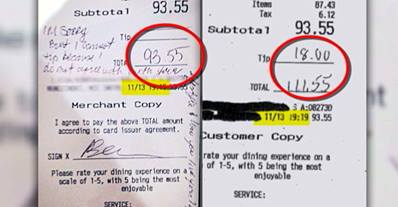
At the beginning of the year, we had a real donnybrook on Ethics Alarms over my contention that Applebee’s correctly fired a waitress for web- shaming a customer who refused to tip another server on the grounds, as the customer wrote on her credit card receipt, that the automatic tip of 18% was excessive since she (a pastor as well as a jerk) gave God only 10%. The indignant waitress posted the receipt on Reddit, which led to locals recognizing the pastor’s handwriting and appropriate antipathy being directed her way. Since the waitress’s conduct was a clear violation of Applebee’s employment terms and because publicly shaming customers who exercise their right not to leave tips is a poor customer relations strategy, she was sacked. Subsequently the unapologetic waitress received a lot of sympathy, while equally misguided observers vowed to punish Applebee’s for not wanting to be known for having  waitresses on the payroll who are prone to misappropriate customer receipts and post them online to bring opprobrium down on the niggardly diners’ heads.

I think Applebee’s is looking prescient and wise right now. Ask Red Lobster, which did not fire Christina Jenkins, a 19-year-old African-American server at the Red Lobster restaurant in Franklin, Tennessee. Jenkins served a $44.53 order to Devin Barnes and his wife. Barnes wrote the word “none” by “tip, ” and, Jenkins claimed, wrote “Nigger” on the receipt as well.  Jenkins then posted a photo of the racist receipt on her Facebook page, writing, “This is what I got as a tip last night…so happy to live in the proud southern states. God Bless America, land of the free and home of the low class racists of Tennessee.” Going the Applebee’s vigilante one better, Jenkins allowed Barnes’ signature to be visible on the receipt.

The photo, and story, went viral on the web and the news media gobbled it up. Mr. and Mrs. Barnes denied that they would write such a thing (they didn’t tip because the order was a carry out), but nobody believed them. After all, everyone knows that white customers in southern states are likely to write “nigger” on receipts, just as everyone knows that sort-of white neighborhood watch members racially profile black kids in hoodies for carrying bags of Skittles. Jenkins, in contrast, was besieged with sympathy and cash contributions: the latest tally was $10,749. A handwriting expert hired by Barnes, however, proved that “nigger” was not written by the customers, but by the waitress herself. Now Jenkins and Red Lobster are being sued by the Barneses, who have been subjected to harassment and threats.

And that’s not all… Continue reading

Ethics Poll: The Amityville Kidney

"Wait---you're going to put THAT  inside me???"

“Wait—you’re going to put THAT inside me???”

In the comments to the post The Kidneys of Orlac, Texagg04 raises a fascinating angle that I had not considered. I have previously written, regarding state regulations that do not require realtors or sellers to disclose that a grisly murder or six occurred on a property, that a purchaser has the right to know about such conditions that may bother him personally, and that regardless of the laws involved, there is an ethical duty inform  a potential purchaser know that he is buying the site of the Amityville Horror (for example). Texagg04 suggests..

“Much like real estate agents ought to reveal that a house had a grisly murder in it, I’d submit that recipients of organ donations of this kind should get to be informed of the donor’s convictions.”

Hmmm. I’m not so sure. One of the reasons for my views about the death houses is that they may be difficult for the uninformed buyer to sell later if the home’s history is known or becomes well known. Also, there are always alternatives to buying a particular house—given a choice between the site of a murder and a similar house with no such history, I might opt for the latter—I’ve seen too many of the “Paranormal Experiences”  and “The Grudge” movies, I guess. But with donated organs, the options are more limited. Maybe not telling the recipient that he has the heart of the Green River Killer is the fair and kind thing to do.

Let’s vote!

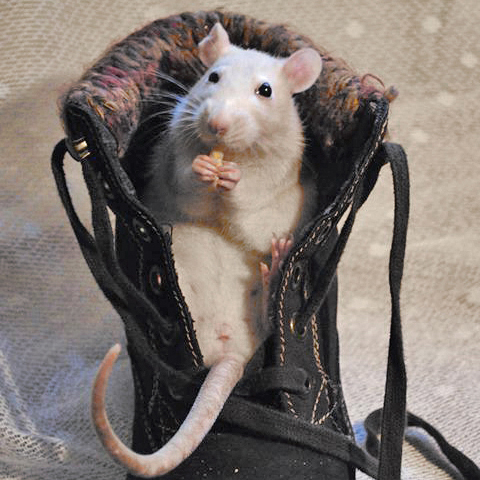
Joke Ethics, Jay Leno, And The Rats In The Pantyhose

Ugh. Come on.

Fortunately, Jay's successor is ready to go...

Fortunately, Jay’s successor is ready to go…

Jay’s ethics alarm was sure malfunctioning during THAT taping. The Golden Rule is made for situations like this. Surely Jay knew about it? Once?

Louann Giambattista, a former American Airlines flight attendant, had sued the airline in June, claiming that American had discriminated against her as a result of her co-workers’ false allegations that she carried pet rats on board planes in her pantyhose and underwear. I get it: it’s an inherently funny story.  But Jay charged over every line of fairness, respect, compassion and common sense when he showed Giambattista’s photo to his national TV audience, and then, in a repeating segment called  “Woulda, Coulda, Shoulda,” challenged three guest comics to make their best jokes about the material. They were rolling, too—some examples..

  • “If I were one of those rats, I would’ve been very upset. I prefer not to sit in cooch.”
  • “I don’t understand this woman at all. If she wanted something that creepy in her underwear, she should have hooked up with me.”
  • Giambattista “coulda used what the rest of us ladies use … a Rabbit” (a popular vibrator).

Classy as ever, I see, Jay! Continue reading

Fairness And George Zimmerman

squashed 2George Zimmerman is in trouble again, this time from a domestic abuse incident. Presumably the justice system will work, and protect his pregnant girlfriend, as well as give Zimmerman whatever punishment the evidence indicates that he deserves.

In the meantime, the news media should be giving his misadventures back page rather than front page attention. I have heard Zimmerman described in the news media as the new O.J. Simpson, which is a slur (O.J. murdered two people in cold blood, with intent and malice aforethought), but which correctly describes how reporters want to treat him. In truth, he is the new Rodney King. Like Zimmerman, King was a maladjusted individual with poor judgment and a penchant for violence, who nonetheless did not deserve the fate that befell him, and was a reluctant celebrity. After the events and the trials stemming from his arrest (which was warranted), his resisting it (which was wrong) and his brutal beating (which was also wrong), King had more arrests and incidents involving law enforcement. These were news items, but not major ones, and the minor coverage they received was proper and appropriate.

Why is Zimmerman’s arrest the lead on this morning’s cable shows? It is because so many in the media fervently wanted him convicted of murder, and to have an official declaration that he stalked and killed Trayvon Martin out of racial prejudice, although there was, and remains, no evidence this was the case. Now they want to frame his current legal issues as proof that he should have been convicted, which is a biased, warrantless, illogical and unfair assumption. A far more plausible conclusion is that Zimmerman’s conduct and instability today arises from the chaos of his life, which was inflicted on him by a culture-wide, media-assisted effort to turn him into a national villain, and the face of racism in America. Continue reading

Ethics And Civility 101: Rep. Joe (“You Lie!”) Wilson Has NOT Been Vindicated

Shut up, Joe.

Shut up, Joe.

Sometimes really incompetent and corrupting ethical verdicts run through the media and the culture like a bad flu, sickening our values and weakening our comprehension of what “good” is. These come with equal frequency from the Right and the Left—right now, they are flying in from both directions, which means that the United States is likely to get even sicker that it already is from an ethical perspective, and it is perilously ill already. From the Left, we have choruses proclaiming that the President apologized for lying to the public about how the Affordable Care Act would work, when he did nothing of the sort by any reasonable and honest analysis based on what an apology is. (I’ll discuss that in an upcoming post.)

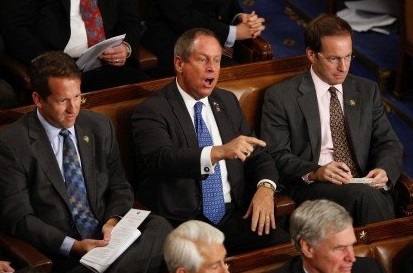
From the Right, we are now hearing that because it is past denying that the President in fact did lie about Obamacare, Rep. Joe Wilson (R-S.C.) is owed an apology (as long as he gets as much of an apology as the faux example the President offered on Wednesday, I might not object too much) for the criticism he received after shouting out “You lie!”  as President Obama was giving his 2009 address touting his health care legislation to Congress.  Wilson is not owed any apology, nor has he been “vindicated,” as thousands of commenters on websites and bloggers have been claiming for weeks. Continue reading

Workplace Ethics: 62 Things That Are Legal, But 22 Of Them Are Unethical

"Oh, sure, he's hell to work for, but he never breaks any laws, so you'll be fine."

“Oh, sure, he’s hell to work for, but he never breaks any laws, so you’ll be fine.”

I have been remiss in not adding the terrific blog Evil HR Lady to the Ethics Alarms links, and will finally do so as soon as I post this entry. No profession deal s with ethical nuances and dilemmas more frequently than human resources professionals, and they can be very difficult, even gut-wrenching. In a recent post, EHRL searched through the archives of questions she has answered over the past years, and compiled an eye-opening list, especially for non-lawyers, of the conduct employers could engage in legally, which is to say, get away with and not be successfully sued, to employees, together with some questionable kinds of conduct that are legal for employees to do to each other.

She listed 62 of them, many of which are reasonable ( it’s okay to fire an employee for “being a jerk”) and some are obvious, or should be;  it is legal to quote the Bible in the office, for example. What is legal is not always good, fair, or right, however, and I perused the list with an eye out for legal workplace conduct that was legal but still unethical. About a third of the types of conduct on the Evil HR Lady’s list made mine. What follows is the sub-list of the 62 things it is legal to do at work, the 22 things it may be legal to do at work, but which are still unethical. The reasons for my unethical verdict follow Evil HR Lady’s items.

Here’s the list of the unethical 22 workplace practices: Continue reading

Ethics Hero: Keisha Thomas

Keisha Thomas

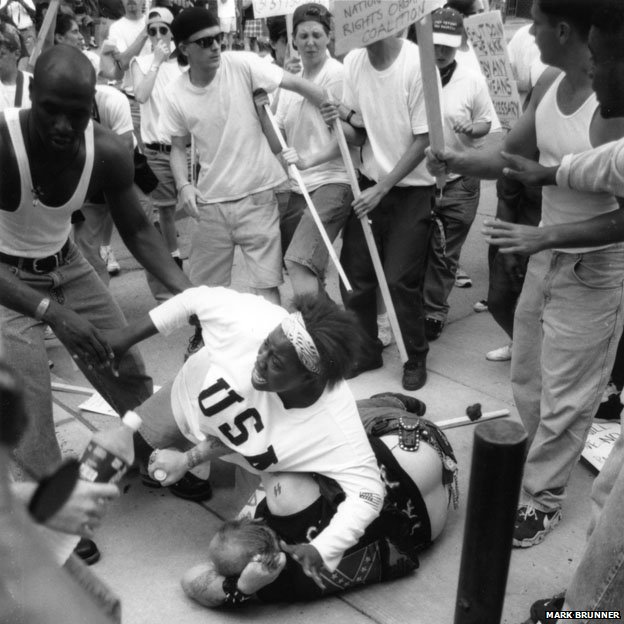
It is never too late to recognize an Ethics Hero, and thanks to a recent retrospective by the BBC, Ethics Alarms can salute Keisha Thomas, who 17 years ago exhibited both courage and other outstanding ethical values like kindness, sacrifice, responsibility, empathy and valor, by coming to the rescue of a man who would never have done the same for her.

In 1996, Keshia Thomas was just 18. The Ku Klux Klan held a rally in her home town, Ann Arbor, Michigan, then as now a college town and a bastion of liberalism. Predictably and as planned by the KKK, plenty of local protesters gathered to jeer the white robed marchers and to show their contempt.Thomas stood with a group of anti-KKK demonstrators on the other side of a security fence, as police in riot gear positioned themselves between the angry demonstrators and the Klan members. One of the anti-Klan counter-demonstrators spotted a white, middle-aged man with an SS tattoo on his arm and wearing a Confederate flag T-shirt  standing among the spectators.  “There’s a Klansman in the crowd!”  she shouted into her megaphone, and a group of protesters began to chase him, shouting threats and “Kill the Nazi!” He was knocked to the ground, and the group, now a mob, began kicking him and hitting him with wooden bases of their placards.

Thomas, an African-American girl still in high school, came to his rescue. She forced herself between the mob and their victim, fell to her knees, draped herself over him and became his shield, saving the stranger from serious injury. Continue reading

Comment of The Day…And An Ethics Quiz, Too! : “Ethics Quiz: The United Airlines Give-Away”

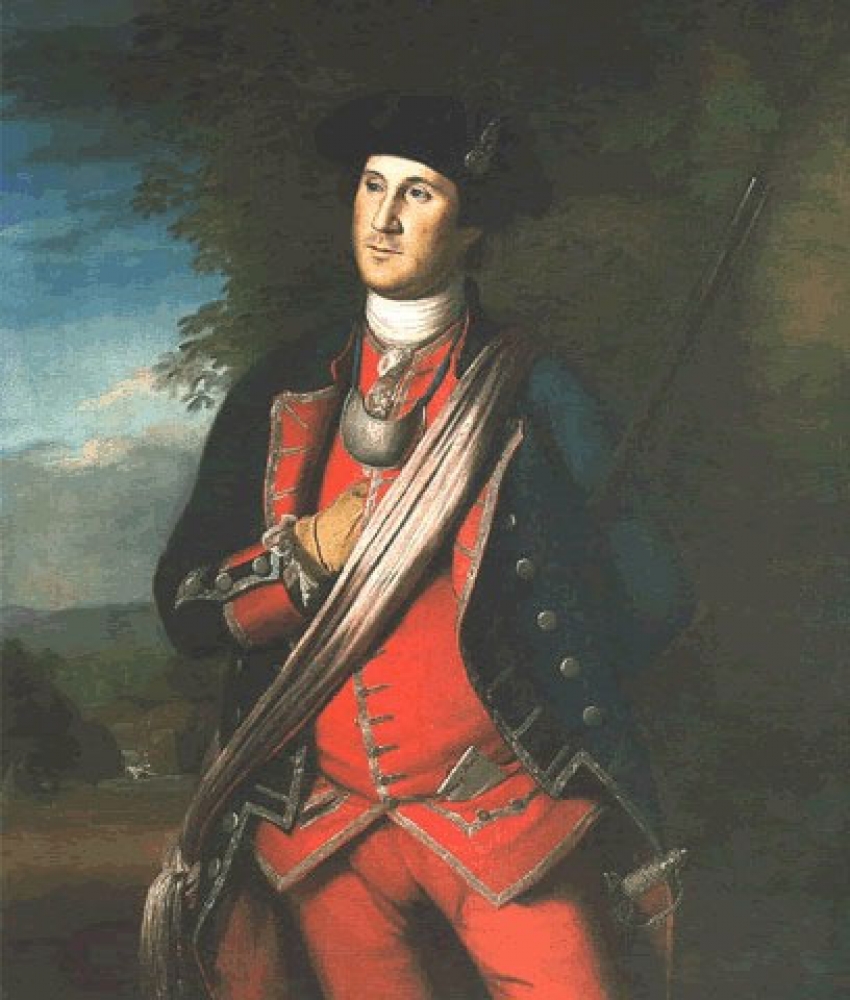
"Oh, this piece of junk? Yeah, who knows who its supposed to be---some guy named Veal or Beale or something painted it, I think. It's been in the attic. Make me an offer!"

“Oh, this piece of junk? Yeah, who knows who it’s supposed to be—some guy named Veal or Beale or something painted it, I think. It’s been in the attic. Make me an offer!”

The Ethics Quiz regarding whether or not it was unethical to take full advantage of United Airlines’  accidental fire sale on tickets spawned several good hypotheticals, including this one, from Tyrone T., an occasional Ethics Alarms commenter who, I happen to know, thinks about these matters as his occupation. I know the answer to this one (I’ve seen it before), so I’ll hold off until you’ve thought about it a while.

Here is Tyrone T.’s Comment of the Day on the post “Ethics Quiz: The United Airlines Give-Away”:

“So, if you are hired by your client to find the cheapest fare, can you act ethically and refuse to take advantage of the error? Consider the following:

“Alexander Mundy is a lawyer and an acknowledged expert in American painting. He has several clients who regularly retain him to negotiate the purchase of museum quality art. Recently, a client hired Mundy to negotiate the purchase of a portrait of George Washington as a young man.

“The client explained, ‘I saw it on a house tour five years ago and tried to buy it then, but the woman who owned it said it was a family heirloom and wasn’t interested in selling. I heard that she died recently and her husband is having an Estate Sale. You have authority to purchase the painting for up to $500,000.’

“Mundy goes to visit the old widower and asks whether he would be willing to sell ‘that picture of the young man there.’ Continue reading