Casey Anthony’s Lawyer is Pronounced Unethical By an Expert

Jack Thompson knows incivility

Ah, the Casey Anthony trial continues to be the legal equivalent of “Jersey Shore,” or some other annoying TV reality show. In today’s episode: Hypocrisy! Revenge!  Irony! Abuse of process! Incivility!  And a special guest!

Cheney Mason, one of Casey Anthony’s defense attorneys, gave a raised middle finger (the international symbol of “I have nothing but contempt and utter disdain for you and your untoward words and conduct, so please have some form of unpleasant sexual intercourse with yourself!”) to a spectator who was verbally harassing Mason and others celebrating Anthony’s July 5 acquittal at a restaurant immediately after the trial.  Such public conduct by a lawyer is rude, undignified and inappropriate, but it is also rude, undignified and inappropriate for sea captains, puppeteers and plumbers, too. Incivility by a lawyer has to be especially egregious and must in some way threaten to undermine the administration of justice to raise the possibility of bar discipline, and flipping the bird to a jerk in a restaurant just plain doesn’t qualify. Now, a lawyer running all over town giving the finger to everyone for weeks on end, or a lawyer making the gesture to judges, opposing counsel or jury members in court would be very different matters. Such conduct would call into legitimate question a lawyer’s fitness to practice law. One such incident? No. I won’t speculate on what percentage of lawyers have given the upturned finger to someone during their careers, but you can.

Nevertheless, a Florida citizen decided to file an ethics complaint against Mason, which is his right. But this wasn’t just any Florida citizen; the complainant was Jack Thompson, a once nationally prominent attorney who managed the nearly impossible: he got himself disbarred for life in Florida for incivility, along with other ethical misconduct. Continue reading

The Provocative T-Shirt Problem

Dress codes+grievance-mongers+freedom to be rude...oh, it's hopeless.

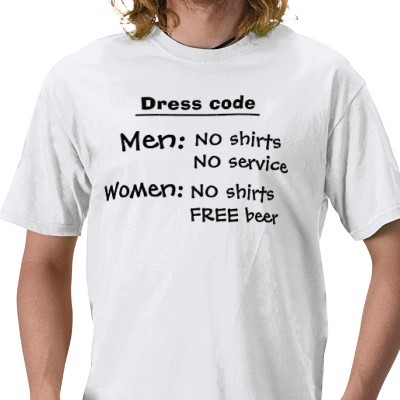
An ethical dilemma occurs when a clear ethical principle clashes with a strong non-ethical consideration. An ethical conflict occurs when multiple ethical principles suggest diametrically opposed results. The question of what is ethical conduct when it comes to wearing apparel bearing controversial messages has the elements of both a dilemma and a conflict.

                                                                                Welcome to Dollywood!

A same-sex couple visiting Dollywood Splash Country with friends and their children was told by a park gatekeeper that one of the women had to wear her T-shirt inside-out because its message—“Marriage is so gay”— “might be objectionable” to some visitors at the “family-friendly” park.

   <Sigh.> Continue reading

Comment of the Day: “Ethics Hero and Dunce: A Tale of Two Windfalls”

In a classic example of  “Be careful what you wish for,” I had been thinking about how none of the recent comments, excellent though many were, quite struck the “Comment of the Day” gong for me, and then, like the answer granted by a perverse genie, this turns up. A reader named Lawrence Reliford argues that Stephen McDow had every right to spend the money erroneously deposited in his bank account, and in the process evokes—let’s see—six rationalizations, three misconceptions, two bad analogies, one wonderful Malaprop and a partridge in a pear tree.  (I may have miscounted; this can also be an ethics quiz.) On a more depressing note, I am quite certain that a larger portion of the population than any of us would be comfortable admitting agree with Lawrence. You can find my response to his comment with the original post, here...but please feel free to write your own. Lawrence needs all the guidance he can get. Here is The Comment of the Day: Continue reading

When Business Rejects Ethics: the Sorabella Story

"So sorry about your wife's cancer, Carl. Let me know if there's anything we can do. Oh, by the way...you're fired."

I usually feel that organized labor rhetoric about cruel and heartless employers is archaic and exaggerated for political effect. This story, however, is almost enough to make me pick up a sign and start picketing.

Carl Sorabella, 43, got a merit raise in November for Haynes Management,  a real estate company in Wellesley, Mass., where he has worked as an accountant for almost 14 years. Then he learned that his wife, Kathy, had been diagnosed with advanced cancer. Told that the likelihood was that she had only months to live, Carl approached his boss. Sorabella explained that his wife’s illness would require him to have flexible hours as he supported her during her tests and treatment. He assured her that he would do whatever was necessary to keep his work up-to-date and complete his duties.

She fired him anyway. Continue reading

The Offensive Battle Over “Seven in Heaven Way”

"There goes Fred, getting all religious again...."

With some hesitation, I must re-open the issue of officious inter-meddlers and grievance-mongerers who get satisfaction and empowerment from claiming to be offended by things that could not possibly harm them or genuinely infringe on their rights. The atheists are at it again.

My position has been stated here and elsewhere many times: in the absence of genuine long or short term harm, the ethical human response to a symbolic grievance is to keep one’s response proportional to the offense, which sometimes means considering how many individuals will be made miserable in order to satisfy one individual or a small group, and letting it go. Forcing a university to change the long-standing name of its football team based on a dubious argument that the name is an offense to Native Americans when most Native Americans couldn’t care less, for example, is wrong. Forcing a school to stop teaching kindergarteners to sing “Rudolf the Red-nosed Reindeer” because a Jewish parent thinks the song promotes Christianity is wrong.

Now a group of New York City atheists is demanding that their city re-name a street that was dedicated to the memory of seven firefighters killed in the Sept. 11, 2001, terrorist attacks.  Continue reading

Ethics Hero and Dunce: A Tale of Two Windfalls


You can trust Robert Adams. Well, that's ONE....

Stephen Reginald McDow of Laguna Beach, California found an unexpected $110,000 federal tax refund in his bank account. He knew it wasn’t his; he also had to realize it was an error. But what the heck…he took a shot. McDow spent the money on foreclosure debts and  paying off his student and car loans.

He’s been charged with one felony count of theft of lost property, with a sentencing enhancement for taking property over $65,000, and faces a maximum sentence of four years in state prison.

There is a lot of sympathy for McDow; you can see man in the street interviews on cable where people say things like, “Hey, are you kidding me? If I found all that money in my bank account, I’d spend it too! Anyway, it isn’t his fault!” A lot of people apparently think this way, which means they are ethically inert. The issue isn’t who was responsible for the money landing in the wrong account (the rightful recipient of the refund had given the IRS the wrong bank account number), but that someone had lost money that rightfully belonged to her, not McDow, and it became his duty to fix the problem.Instead, he spent it, and crossed his fingers. Continue reading

The Chivalry Curse, the President, and the Dazzling Smile

The Chair of the Democratic National Committee

The Republicans seldom look more silly—and politics seldom looks more cynical— than when the GOP complains that the media or liberal interest groups are ignoring conduct by a progressive politician that they would vociferously criticize if a conservative politician behaved similarly, even though the Republicans themselves see nothing wrong with the conduct, and would scream that the criticism was unfair if it was focused on a conservative. This is yet another of the funhouse mirror versions of the Golden Rule in action, being employed for a dubious “Gotcha!”: “Do Unto Others As You Would Do Unto Me, Even Though If You Did That Unto Me, I Would Condemn You For It.”

It is the game Republican women’s groups and  conservative pundits are playing now, because the National Organization for Women hasn’t rapped the knuckles of President Obama for calling Rep. Debbie Wasserman-Schultz (D.-Fla.), the Democratic National Committee Chair, “cute.”

Wendy Wright, president of Concerned Women for America (a conservative women’s organization), called out NOW on its double standard, and said,“Of all people who ought to be offended at President Obama’s statement it should be an ardent feminist like Wasserman-Schultz. Isn’t objectifying women by their looks a mortal sin among feminists?” Charlotte Hayes, a senior fellow at the Independent Women’s Forum, the conservative twin of NOW, argued, “If a conservative had said this, [NOW] might have gone quite crazy. The Democrats might have gone quite crazy and tried to have his head on a platter. I guess Democrats could get really mad because you say a woman has a charming smile.”

But, she added, “I’m not one of those people who gets mad if you said I have a charming smile. I would be flattered.”

For its part, NOW has said that it has more pressing matters than criticizing a major ally’s politically incorrect gaffe, much as it couldn’t be bothered to criticize Bill Maher for calling Sarah Palin a “dumb twat” or MSNBC’s Ed Schultz for describing conservative pundit and single mother Laura Ingraham as a “right wing slut.” The President and the woman with the cute smile, meanwhile, are ignoring the whole thing.
Here is the irony, and the problem: they are all wrong. Continue reading

Unethical and Unfair Advertising With No Laws or Rules Against It…So That Makes It OK, Right?

Justice Holmes warned about people like this.

From Wisconsin we have a perfect example of how new technology creates opportunities for the unethical to find new ways to exploit it, uninhibited by either basic fairness or formal ethics rules that were written before the technology was available.

The Wisconsin law firm Cannon & Dunphy purchased the names of the two named partners of their biggest competitor in personal injury law, the firm Habush, Habush & Rottier, for a sponsored link, meaning that  every search for “Habush” or “Rottier” produces an ad for Cannon & Dunphy at the top of all the search results.  incensed that their names were being used to promote their competitor, Robert L. Habush and Daniel A. Rottier sued, alleging a breach of privacy and a misuse of their publicity rights. Milwaukee County Circuit Judge Charles Kahn Jr. rejected the suit, holding that purchasing a competitor’s name as an advertising key word on the Internet is reasonable commercial use. Continue reading

Unraveling the Ethical Dilemma of the Unappreciated Treasure

“I’m passing this on to you, son. You know how how much I loved old Nibbles.”

As I have mentioned here before, I give ethics advice to inquirers on AllExperts.com, when the rare individual can actually find “ethics” among the categories—it’s buried somewhere under “philosophy,” which is doubtlessly why so many of my questions are from students who want me to write their homework essays for them. (I decline, but a lot of experts on the site don’t. A topic for another time…)

Today I received a question on one of those difficult family problems that any of us could face. The writer’s elderly father, with some ceremony, gave his only son one of the father’s most cherished possessions, something that had sentimental value to the father that far exceeded its monetary value, which was considerable. “I recently moved into an apartment,” the writer explained, “and after rent and bills, I only have about $200 a month to live on.” He said he could barely afford food, and had an urgent need for clothes, shoes, and other essentials, so he sold the heirloom for a pretty penny.

Now his father is heartbroken, and his mother is furious, demanding that he get the heirloom back, or else she won’t speak to him again. He wrote that he was depressed, and doesn’t know what to do. Continue reading

When The Ethics Alarms Don’t Sound: A Cautionary Tale From Seattle


%$#@*#!!!

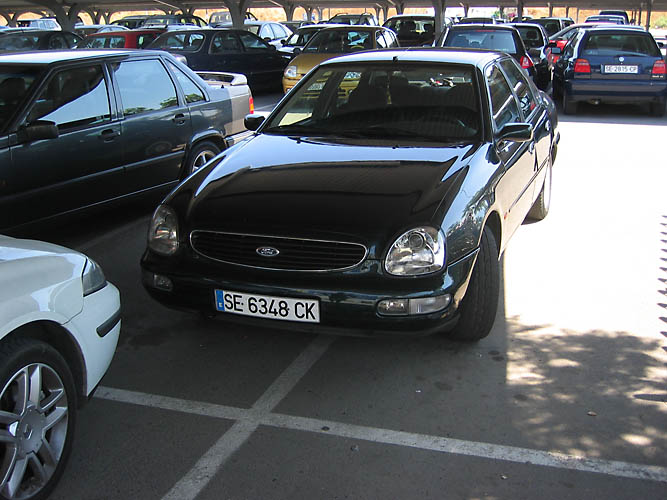
Like all of us, Seattle attorney Ronald Clarke Mattson was infuriated when he found cars parked straddling the lines in crowded parking lots and garages.

It really is rude, inconsiderate, obnoxious and unethical behavior, especially when it is blatant, as when the owner of the Lexis or the Jaguar intentionally takes up two spaces to guard his baby against any accidental dings. This is a statement that rings out loud and clear: “My car is more important than your convenience, and I’ll take up two spaces, robbing you of your right to one, because I matter, and you don’t.” 

I’ve left nasty notes for these jerks, for all the good that does. I’ve complained to stores, and even had them make announcements over their public address systems. On a couple of occasions, when one was handy, I’ve recruited a police officer, and several times I’ve waited for the owner of the car so I could tell him off (if he wasn’t armed or too big).

Once, when the car was a brand new, loaded, shiny  sports convertible, I engaged in the intentional infliction of emotional distress, leaving a note that said that I had used a tool to leave a fairly deep, but small, indentation on his now no-longer-pristine car, and I hoped he had fun looking for it. (There was no such wound, but I am not proud of this.)

If I had a momentary desire to really harm the car, as I may have had once or twice, several considerations set off my various ethics alarms. The Golden Rule alarm wouldn’t sound, because this isn’t a Golden Rule situation: I would never take up two spaces.  Others, however, would:

  • The “Two Wrongs Don’t Make a Right” alarm.
  • The “It’s Against the Law” alarm.
  • The “What If Everybody Did This?” alarm
  • The  “Don’t Take Action That Has No Purpose Other Than To Do Harm” alarm
  • The “Sons of Maj. Jack Marshall Sr./ Lawyers/Ethicists Don’t Act Like This” alarm
  • The “I Would Be Ashamed If Anyone Found Out” alarm, and most of all,
  • The “You Know This Is Wrong” alarm.

And if they all failed to sound, due to poor installation and maintenance? Then I might have done as Ronald Clarke Mattson did, more than once. He pleaded guilty this week to a reduced count of attempted second-degree malicious mischief, a gross misdemeanor, for keying three automobiles in retribution for their owners’ parking misconduct.  He received a one-year suspended sentence, 240 hours of community service, restitution for the three victims, and has to attend an anger-management class.

But his problem isn’t anger management. His problem is malfunctioning ethics alarms.

Mattson has been a lawyer since 1972, and could now face punishment from the Washington State Bar Association, which is charged with making sure that attorneys with faulty ethics alarms seek immediate repairs.