Memorial Day Weekend Ethics Warm-Up, 5/26/19: The Fish, The Fist Bump, And Harriets’s Lament

Good Morning!

Here is another of my father’s favorite Sousa marches, “The Black Horse Troop.” I remember thinking about the march when I saw that the riderless horse in my father’s Arlington funeral procession was all black.

1. Let’s start with a fish story…

That’s Tom Volk holding  the nearly 17-pound walleye he caught along the Heart River in Mandan, North Dakota. Little did he know that what was briefly a happy experince for him would end up with him being attacked on social media and prosecuted by the state. A fish is considered hooked illegally—it’s actually a crime—if the hook was in the fish’s back rather than its mouth. As soon as Volk claimed the record, he was accused of cheating. The Game and Fish Department opened a criminal investigation. Volk had to hire  a lawyer, and the prosecution could have an impact on his career:  Volk serves as a city councilman in North Dakota and works in drug prevention for the state government.

Finally game wardens compiled an 11-page report on the fish after conducting witness interviews. The county prosecutor said  his office had reached “a consensus view” that the walleye had been improperly hooked. The chief game warden said he was convinced that the fish was “foul-hooked,” but also believed that Mr. Volk might not have known about the infraction until after he left the riverbank. His department issued a written warning, disqualifying the fish from record consideration, but no criminal citation.

The walleye could not be reached for comment. Continue reading

From The “Easy Ethics Questions That Some People Think Are Hard” File: “Should A Father Warn His Daughter’s Boyfriend That She’s A Sociopath?”

Of course not.

On the the sub-Reddit “AmITheAsshole” board,  a father consulted the group as to whether it would be  wrong for him to warn daughter’s fiancé-to-be  that she’s been diagnosed  as a clinical sociopath. She is  attracted to her boyfriend, he said, she has told him in the past that  she doesn’t feel love or empathy towards anyone, nor guilt or  grief.  Yup, that sounds like a sociopath, all right. A doctor diagnosed the daughter as suffering from antisocial personality disorder at age 18.

“She exhibited odd, disturbing behavior at a young age, and after a serious incident of abuse towards her younger sister, I realized she needed professional help,” Dad wrote. “Throughout her elementary years she struggled heavily, getting in lots of trouble in school for lying, cruelty, and all other types of misbehaviors. With an enormous amount of therapy and support, her bad behavior was minimized as she grew older.”

Her boyfriend has no idea, the father believes, what kind of person he will be marrying, and the father believes that he has a right to know, saying,  “I really like and respect this young man, and would feel awful keeping this ‘secret’ from him, and letting him walk into a marriage without this piece of knowledge.”

Yet since her diagnosis, the daughter seems to have her behavior under control. She has a good job, successfully navigated through college and has  many friends. She is also popular on the dating scene.

The Reddit participants seem to have been flummoxed by the father’s dilemma. I’m not. The ethical course is clear. Continue reading

Saturday Ethics Notables. 5/18/2019: More Social Media Partisan Censorship, A-Rod’s Potty And Ian’s Potty Mouth…

Why, I asked, on such a beautiful May day, am I inside writing about ethics? And my wife turned into Hymen Roth…

1. PLEASE stop making me defend Alex Rodriguez, who is one of my least favorite human beings, never mind former athletes, on the planet, and yet…this is a strict Golden Rule issue. The ex-Yankees (also Texas and Seattle) slugger  was photographed sitting on his toilet in his luxury apartment’s bathroom. The shot was apparently taken by a rogue photographer in a high rise office building next to the apartment building where A-Rod shares a  $17.5 million apartment with Jennifer Lopez, whose movies are now beneath those of Adam Sandler and Tom Arnold on my playlist.

Legal precedent in New York suggests than  Rodriquez has no case, because in 2015, an appeals court ruled that a gallery show of images snapped through less famous New Yorkers’ windows by an “artist” was not a privacy violation. (I wrote about that photographer here; perhaps the title gives you a sense of where I came out on my analysis: “Why Photographer Arne Svensen Is An Unethical Creep”]

Fine, I see the legal point. If you don’t want people taking photos of you, then keep your window blinds down. However,just because you can do something crappy to another human being doesn’t make it right.

Even if it’s a crappy human being. Continue reading

Crosswalk Ethics

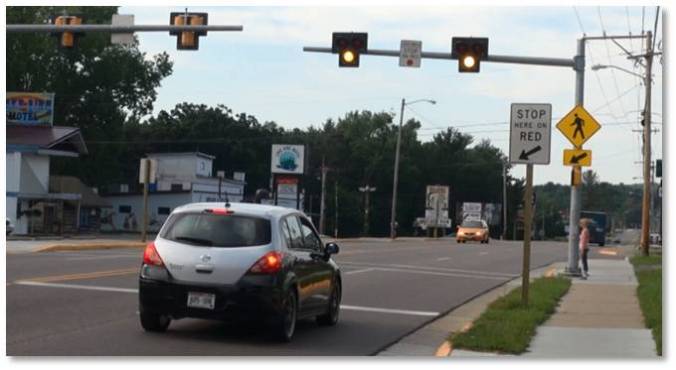
I was waiting at red light in Alexandria, on the way home from a brief acting coach gig for a friend.  On one side of street, preparing to cross, was a striking African-American couple, the women in a formfitting orange and white pattern dress, he in an open white blazer and slacks, highlighted by a pocket hanky that matched the orange in the woman’s dress.

When the “Walk” light finally flashed on, they crossed in front of my car, and as they passed, I rolled down my window and called out, “Best dressed couple I have seen all say!” and saluted.

They beamed. They waved. They shouted, in unison, “Thank you!” and walked on, laughing. I think I may have made their day.

And I thought, I really need to be on the look-out for opportunities like that. This is the way to combat the metastasizing nastiness, incivility and distrust in our culture. Be nice. Reach out. Socialize. Try to make meeting you a positive experience, no matter how brief or trivial.  It takes almost no time at all. It’s not hard. All it requires is committing to making the people around you as happy as possible.

I also had two thoughts. One: if they had been talking on their smart phones, texting or otherwise not interacting with the world around them, I wouldn’t have said anything at all.

Two: I wish I had been wearing a MAGA cap.

Ethics Quiz: The Dog-Poisoners [UPDATED]

This is, I know, a poor topic for Christmas, but it just came down the chimney.

While shopping yesterday, we encountered a man who lived in the neighborhood. Rugby had enjoyed conversing with the two dogs owned by the man and his wife, two friendly, lively min-pins. As shoppers bustled around us, our neighbor announced that he was more our neighbor than ever: he and his wife had moved from where I had met them to a home less than a block away from ours, on the long street that our cul de sac opens onto. The reason for the move: their next-door neighbor had poisoned their dogs. One had survived.

Our neighbor said that they had called the police, who investigated. Based on motive (the there had been a property dispute, and the resulting law suit had gone our friends’ way), opportunity, and the demeanor and comments the police got while questioning the suspects as well as accounts about their threats and general sociopathic tendencies from others on the street, the police reported that they were pretty sure my neighbors’ neighbor were the culprits, but that they did not have sufficient evidence to make an arrest.

This story had unpleasant resonations for me. My Dad, when he was a 10 year-old only child being raised by a single mother during the depression and having to move to new neighborhoods constantly, owned a large, loyal Airedale named Bumbo. One day someone put ground glass in his beloved dog’s food dish, and my father had to see his best friend die in agony in his arms. It was one of the great tragedies of his life. His mother was certain who had killed the dog, but again, there was insufficient proof.

Your Ethics Alarms Ethics Quiz of the Day:

Is my neighbor obligated to tell anyone who is interested in renting or buying his now-abandoned property that the neighbor poisoned his dogs?

Continue reading

Ethics Alarms Sheepishly Presents Rationalization #69: John Lyly’s Rationalization, Or “All’s Fair In Love And War”

Why sheepish? Well, for an authority on rationalizations, it’s pretty embarrassing to have one of the most famous and oldest rationalizations of them all not appear until the 91st entry on a list being compiled for ten years.

Most people would guess that the old saying comes from Shakespeare. Nope: household name John Lyly, a poet, included the idea in his novel “Euphues: The Anatomy of Wit,” published in 1579, about ten years before the Bard wrote his first play. The novel recounts the romantic adventures of a wealthy and attractive young man, and includes the quote “the rules of fair play do not apply in love and war.”

As often happens, I stumbled on this prominent hole in the list while on another mission. A reader had questioned my criticism of George Bailey and his mother in the Ethics Alarms guide to “It’s a Wonderful Life,” in which they plot to snatch the lovely Mary (Donna Reed) away from George’s obnoxious  (“Hee haw!!”) old childhood friend and wheeler-dealer, Sam Wainwright. The reader’s argument was that Mary and Sam had made no commitment, and that she was obviously looking for a better match, so she was fair game for George. This sent me back to the movie, which I watched again last night. The key scene is this one: George is talking to his mother party for younger brother Harry and his new bride… Continue reading

Rationalization 32 B: “The Comforting Accusation,” Or “You Would Have Done The Same Thing!”

It’s been a long time since the last new rationalization joined the list. This one, “The Comforting Accusation” or “You would have done the same thing!“, follows #32. The Unethical Role Model: “He/She would have done the same thing,” and #,32A. Imaginary Consent,  or He/She Would Have Wanted It This Way.”

32 B adds the nasty little element of alleged hypocrisy to the mix, making it especially effective. How can someone criticize your conduct if they couldn’t or wouldn’t resist the same thing? Thus the author of an unethical act deflects his or her own accountability by making someone else the target of an accusation, albeit based on assumption rather than fact. The rationalization attempts to transform the wrongdoer into the judge’s reflection.

There are four problems with #32. First, it may be that the assumption that someone else would have taken the same unethical course is wrong, and, of course, it is just speculation anyway. Second, it doesn’t matter: this is just a personalized fractal of the hoariest rationalization of them all, Numero Uno, “Everybody does it.” Unethical conduct is not cleansed because it has company, or, as in this case, might have company.

Third, it’s a sneaky evocation of #14. Self-validating Virtue, in which an act is judged by the perceived goodness the person doing it, rather than the other way around. Most people, because of bias, automatically think of themselves as the most ethical person they know. The Comforting Accusation recruits the cognitive dissonance scale to elevate an unethical act by attaching it to something deep in the positive end of the scale for just about everyone: themselves. #32B is ultimately an appeal to bias.

Most important of all, the fact that I may have done what you did under similar circumstances doesn’t make what you did less wrong, It only means I have some sympathy for you, and am more likely to apply the Golden Rule if I am assigned the responsibility of holding you to account—which I should apply anyway.

Your Tuesday Evening Brett Kavanaugh Nomination Ethics Train Wreck Report

I. Let’s give a whole car to USC.

Nearly 100 students  attended a rally at noon on Monday demanding a tenured professor be fired after he sent a reply-all email last Thursday to the student body noting that “accusers sometimes lie.”

Professor James Moore, a tenured professor at the University of Southern California, replied to a campus wide email fatuously demanding that students  “Believe Survivors” on the day of Christine Ford’s testimony with a reply-all message that…

“If the day comes you are accused of some crime or tort of which you are not guilty, and you find your peers automatically believing your accuser, I expect you find yourself a stronger proponent of due process than you are now.”

For a teacher, this was a responsible and important point to make. It is also undeniable, except in dishonesty, ignorance and hysteria. So what was the campus response?  Hundreds of  emails from “concerned” students and alumni condemning the engineering professor. USC students Audrey Mechling and Joelle Montier  organized a Facebook rally against him, entitled “Times Up for James Moore.” Nearly 100 students gathered to shout, “Times Up, No Moore!” The crowd then paraded its bias and ignorance, and marched  to the office of Dean Jack Knott. He, of course…

...sided with the protesters...

“What [Professor Moore] sent was extremely inappropriate, hurtful, insensitive. We are going to try to do everything we can to try to create a better school, to educate the faculty,” said Dean Knott to the crowd. “This is going to be a multi-pronged effort. We are going to have a faculty meeting later this week around implicit bias, sensitivity towards [sexual assault]….”

That’s academia today! At Georgetown, a professor tweets that white males should be killed and castrated, and the administrators shrug and say she has a right to her opinion. AT USC, a professor corrects  indefensible cant that rejects basic ethical and judicial principles, and a dean says that he must be punished.

People actually pay to send their children to be warped by these places.

II. Let’s always believe survivors who know how to beat lie detectors.

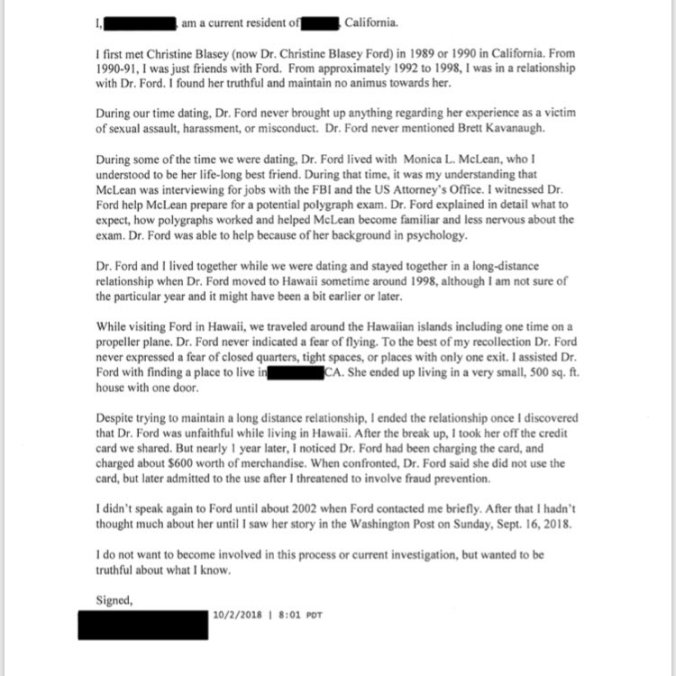
The fact that Dr. Ford had been declared “truthful” in her polygraph test was always one of the worst reasons to believe her, but now that test throws legitimate suspicion on her account. The machines are notoriously unreliable, but the argument was that the fact that Ford was eager to take the test indicated her confidence in her account. Today, Fox News received this letter from a man who claims to be Ford’s ex-boyfriend:

Of course, it could be completely innocent that a woman who suddenly dredged up a forgotten alleged incident just in time to use it to derail the confirmation of a SCOTUS nominee her party opposes and submitted to a lie detector test as evidence of her veracity considered herself an expert on beating lie detector tests.

III. Ethics Hero meets Ethics Dunce Continue reading

Ethics Quiz And Poll: The Siblings’ Betrayal

Whatever the answer to the quiz, I view this development as a bad sign for all of us.

Republican congressman Paul Gosar ‘s six siblings all agreed to participate in an attack video by his opponent, Democrat David Brill, in the race to represent Arizona’s 4th District in Congress. They all endorse Brill in the ad, while denigrating their brother’s positions on  health care, immigration, and the environment.  “He’s not listening to you, and he doesn’t have your interests at heart,” Tim Gosar said.

Nice.

Your Ethics Alarms Ethics Quiz Of The Day:

Is this conduct by Gosar’s family members ethical as responsible citizenship and political advocacy, or unethical as disloyal and unfair?

I think I know my answer, but it is a close call, hence the quiz. Now the poll:

The Attack Of The Unethical Women

I had pretty much concluded that Christine Blasey Ford was contemptible based on her willingness to impugn a public servant’s integrity, derail what should be an orderly and fair political process, and manipulate the U.S. Supreme Court’s membership using a three decades old allegation that involved, at worst, teenage misconduct. She did this with full knowledge of how #MeToo has unjustly harmed other men simply by raising unprovable rumors and characterizations. In fact, it seems clear that she chose her course of action knowing that she could harm Brett Kavanaugh the same way. If the allegation was politically motivated, as I strongly suspect it was, she is unethical and despicable. If the motive was late vengeance for a teenager’s indiscretion, she is unethical and despicable.

Imagine someone you may have harmed when you were an immature teen. That individual never calls you to account, privately or officially. She never urges you to apologize, accept responsibility, or make amends, or gives you an opportunity to do so. No, she maintains the grievance in escrow, to bring it out years or decades later when the accusation will not only do the most damage, but will also be impossible to defend against. What a cruel, horrible, inhuman way to treat anyone.

First Ford attempted to harm Kavanaugh anonymously. Then, when that wasn’t going to work, she announced her accusation in the news media.

What is being ignored by all those rationalizing Ford’s actions is that that the harm to alleged wrongdoers is magnified and multiplied the longer a victim delays calling for accountability. If Kavanaugh did what he is alleged to have done, he should still have the right to deal with the consequences, accept punishment if any, and be able to get on with his life, set a straight course, and prove his character and values as an adult. Wouldn’t anyone want that opportunity? Shouldn’t any 17-year-old miscreant have that opportunity? As I have already noted, Ford’s conduct is an anti-Golden Rule monstrosity.

It also creates the equivalent of ethics toxic waste. In a just society, nobody is pronounced guilty until guilt is proven, and nobody is publicly accused unless the offense is provable.  A prosecutor who knows that there isn’t evidence to convict someone of an offense is violating prosecutoral ethics to bring charges. Ethically, the principles follow. If you cannot prove an accusation, if all you have is your word and nothing else, if there is no chance that any evidence will arise that supports your version of events, you must be, at very least, absolutely certain that you are correct. Ford cannot be 100% certain. Not after more than 30 years, and especially after a long period in which she says she had forgotten about the alleged episode. There are many, many memorable episodes in my life, and I have always had a remarkable memory for events I witnessed or took part in. Such memories, however, shift and blur over time. No 30 year-old memory is 100% reliable, and because we, well, those of us who are fair and honest, know that is true, no 30-year memory should be employed as a weapon or personal destruction. Ford’s memory is both destructive and impossible to defend against exactly because it is so old. Continue reading