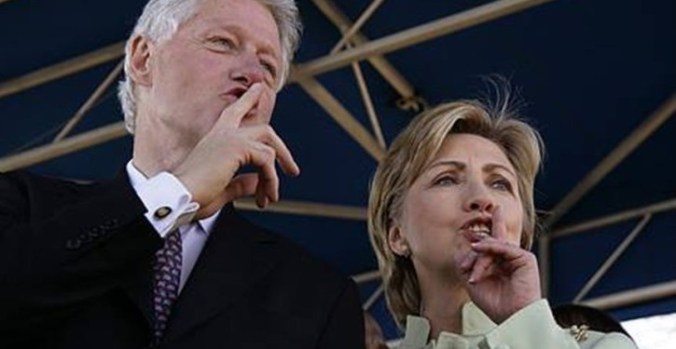
Franken’s Accuser Presents: A Perfect Rationalization #42, The Hillary Inoculation, or “If he/she doesn’t care, why should anyone else?”

I haven’t seen such a perfect example of Rationalization #43 since Bill Clinton was caught with his pants down, a blue dress within range and a good cigar.

In case you haven’t perused the Ethics Alarms Rationalization List lately, and if so, shame on you, Al Franken’s accuser’s interview today on “Good Morning America” (if you don’t watch “Good Morning America,” good for you) laid the foundation for a virtual #43 orgy.

This rationalization description one is fun to read now, written as it was long before Hillary’s two candidacies for President, and the current Washington, D.C. leg of the Harvey Weinstein Ethics Train Wreck.

42. The Hillary Inoculation, or “If he/she doesn’t care, why should anyone else?”

This is a complex, hybrid rationalization that draws upon the warped and corrupting logic of “Everybody does it,” the Biblical rationalizations, Comparative Virtue (“there are worse things!”) and a few others to reach an absurd argument that nevertheless sometimes carries the day.

One example that will live in infamy, and the inspiration for #42’s title, was Bill Clinton’s Monica Lewinsky scandal, which exposed him beyond all doubt as a liar, a power abuser, a hypocrite and, incidentally, an adulterer, not that anyone was surprised at that. His wife, First Lady Hillary Clinton, prominently defended her husband, somehow keeping her feminist creds at the same time, a neat trick. She knew which side of the bread her butter was on, as the saying goes: her loyalty was going to pay off more than righteous indignation. Thus she obfuscated, spun and lied for Bill, and gave his defenders this jaw-dropping argument, which they used liberally:

“If Hillary is willing to forgive him, why shouldn’t we?”

Let us count the ways. Why?

1. Because her relationship to him is as a wife to a husband, and ours is as citizens to a national leader. The standards are different, the stakes are different, and the consequences of the betrayal of trust are different.

2. Because the seriousness of an ethical or legal violation is not defined by who chooses to tolerate or forgive it.

3. Because her decision to ignore, forgive or tolerate may be the product of bias, self-interest, or other non-ethical considerations that make the decision unreliable, untrustworthy, and a poor template for the response of others, as well as societal standards.

4. Because she may be wrong, mistaken, or a fool.

5. Because we each are responsible for making our own ethical judgments, and to delegate those judgments to a third party, especially to a third party who is not objective or likely to be affected by conflicts of interest, makes neither logical nor ethical sense.

[Hmmmm. Caught two typos there, and also needed to make an edit. I guess I haven’t read the list lately. Shame on me.] Continue reading

Baseball All-Star Game Ethics Musings: Taking Confirmation Bias Out Of Appeal Plays, and More

Max-Scherzer

Some baseball ethics musings on the night of the All-Star Game:

1. Why is MLB going ahead with letting Pete Rose take a bow at the All-Star Game? This made sense–barely–when it was announced, since Pete is a hometown hero despite being a rest-of-the-world slime-ball. But after that announcement, it was revealed that Rose had bet on baseball as a player, thus rendering all of his statements to the contrary the lies they were. He should have been banned from the game just to make sure this latest revelation of his sliminess adds something to his punishment.

2. The best ethics controversy of the 2015 season’s first half? This: Washington National pitcher Max Scherzer was one strike away from a perfect game, leading  the Pirates in a 6-0 win, but hit Jose Tabata with a pitch to make it “only” an-hitter. A perfect game is 27 consecutive, outs, and the most difficult feat in baseball. Tabata had fouled off four pitches, before he  was hit on the elbow. Many believed that he that Tabata allowed the ball to hit him intentionally, just to wreck the masterpiece. This violates one of the “unwritten rules” of baseball, which are ethics rules. After all, any perfect game could be ruined the same way, and the pitcher is powerless to stop it. This is correctly deemed to be unfair to the pitcher, the fans, and the game.

Real rules also are involved. A batter hit by a pitch is supposed to be awarded first base only if he attempts to avoid a pitch or doesn’t have an opportunity to avoid it. If the ball is in the strike zone when it hits the batter, it should be called a strike, according to the Rule Book:  “If the ball is outside the strike zone when it touches the batter, it shall be called a ball if he makes no attempt to avoid being touched.” (Rule 6.08(b).)

Thus  home plate umpire Mike Muchlinski could have awarded Tabata a ball to make it a 3-2 count if he felt Tabata should have gotten out of the way.

Seven points:
Continue reading

Ethics Quiz (Movie Division): “The Impossible,” Whitewashing, and Betrayal

"Bennett" and Belón

“Bennett” and Belón

I suppose some of you may have thought about this two years ago, when the Spanish film “The Impossible” was first released. I, however, take a while to catch up with my movie-viewing, and though the film was much praised by critics and got Naomi Watts an Academy Award nomination, I had not seen the film until recently. “The Impossible,” about as accurately as a motion picture can, tells the amazing story of how Spanish physician María Belón, her husband Enrique Álvarezs, and her three young sons miraculously  survived the 2004 Indian Ocean earthquake and tsunami when the family was on vacation in Thailand.

It is an engrossing, harrowing movie. I was surprised to find out, however that the family’s name wasn’t “Bennett,” and that they weren’t British, as the movie presented them. Apparently to maximize box office receipts, the film makers decided to take the heroic story of a real family and make the characters “more relatable” by recasting them as English-speaking Brits. There was a minor controversy about the film “whitewashing” the story*, but not much of that made it into the mainstream media. Belón, after all, is white. She was an active participant in the appropriation of story and that of her husband and sons, and they all profited from it, at least financially. Still, the movie’s point of view left a bad taste in the mouths of some international critics. Here is Australian critic Ruby Hamad:

“Based on the true story of a dark haired and darkish-skinned Spanish family, the filmmakers admitted to changing their nationality and casting lily-white actors in order to make the story ‘universal’. In other words, only white people can stand in for the human race as whole. For this reason, Thailand and its people are mere backdrops for the story of a Caucasian family who learn the hard way that even western privilege is no match for the brute force of mother nature.”

Your (two-year late) Ethics Alarms Ethics Quiz, therefore, is:

Is “The Impossible” unethical”?

Continue reading

Two and a Half More Rationalizations: “The Hillary Inoculation,” “The Unethical Tree in the Forest,” and a Sub-Category of “The King’s Pass”

42-hitchhikers-guide-to-the-galaxy-5139489-1024-768

“There are more rationalizations in heaven and earth, Horatio, than are dreamt of in your philosophy.”

It certainly seems so, Hamlet.

And stop calling me “Horatio”!

While writing about the McDonnells, I found myself citing some obvious and common rationalizations that I discovered (to me shame and embarrassment)  had never been added to the Ethics Alarms Rationalizations List, which two days ago stood at an even 40. I wrote them up and added then, placing “The Unethical Tree in the Forest” at #10, since it is so common, and designating the other, “I deserve this,” as a sub-category under “The King’s Pass,”at #11 (a). Then, in today’s comments to yesterday’s post about the perfect Naked Teacher (if only all those who clicked on that post were just slightly interested in ethics!), came a ridiculous argument that I immediately recognized as particularly infuriating rationalization I had heard before, too often, in the days when Democrats were churning out rationalizations like the chocolates on Lucy’s conveyor belt. I have dubbed it “The Hillary Inoculation.” These put the current count of rationalizations at forty-two, and a half. Here are the new additions.

Learn to recognize them, but don’t use them.

10. The Unethical Tree in the Forest, or “What they don’t know won’t hurt them.” Continue reading