Morning Ethics Warm-Up: 7/7/17

1. I am afraid that today’s posts may be heavily tilted to the ongoing mainstream media implosion, depending on what other issues surface and what the Ethics Alarms ethics scouts sleuth out. Afraid, because I know that many readers here, like the news media itself (not surprisingly, but tellingly, the legacy news media isn’t reporting this story, but it is being thoroughly reported in the “new”–as in online–news media) want to pretend that it isn’t a story at all. The repeated deflection—they are deflecting, whether the mainstream media defenders can admit it to themselves or not, because the news media is destroying itself with unrestrained anti-Trump bias, and its defenders like anti-Trump bias, as they are suffering from it themselves—is “Isn’t an untrustworthy President worse than an untrustworthy news media?” The answer is absolutely not. A President’s job isn’t to be trustworthy, though being trustworthy is crucial to doing the job and maintaining the vitality of his Office. A President’s job is lead the government and use his power to keep the nation safe, free and prosperous while upholding the Constitution. A trustworthy President is more likely to accomplish those goals, and I insist that a trustworthy (that is, ethical) individual should always be preferred over an untrustworthy one who claims to have more popular policies in mind. Nevertheless, untrustworthy Presidents can have successful administrations, and have before in our history. Moreover, a President who is untrustworthy can be replaced in four years.

We don’t elect journalists. What is happening to our pampered, privileged, arrogant  journalistic establishment cannot be remedied at the ballot box, and indeed impedes effective elections. A news media that increasingly sees its function as manipulating public opinion to serve its own ideological and partisan ends threatens democracy itself. That makes the rogue news media of today a far greater threat than one incompetent President, and the more urgent ethics concern.

How will this professional ethics abdication be addressed and repaired? It must be, and the starting point has to be the journalism field’s  own recognition that there is a crisis.

2. There was a flicker of hope on the self-recognition front yesterday, when former CNN chairman and CEO Walter Isaacson, being interviewed on Bloomberg’s “What’d You Miss, lamented the current state of the media, saying that news coverage and bias was the at least partially at fault for the “enormous political divide” in the U.S.  Now leading the Aspen Institute’s education and policy studies, Isaacson said that the polarization and partisan hostility “have been exacerbated by all forms of media. People are getting more and more partisan.” He also pointedly refused to accept the standard “It’s all Fox News’ fault” rationalization, saying, “I put everybody [in the media] in the category, including all of us, that we can step back from knee-jerk partisan elections…that would be good.”

Isaacson’s statements are too mild and meek, and not exactly a ringing rebuke, but it’s a step in the right direction. I’ll take what I can get. Continue reading

Morning Ethics Warm-Up: 7/1/17

Good morning, and welcome July!

Once famous American radio news commentator Gabriel Heatter (September 17, 1890 – March 30, 1972) sued to begin his World War II-era  broadcasts by  saying, “There’s good news tonight!” I’ve been trying to find an equivalent up-beat introduction for the Warm-Up from an ethics perspective. The problem is that this requires there to be some genuinely good ethics news. Not today. Maybe tomorrow…

1. The furor over President Trump’s pathetic attack tweets on two pretty awful MSNBC cable TV hosts continues, with “the resistance”—you know, like the New York Times—citing it as proof of madness, and right-wing media and bloggers increasingly rationalizing that it’s high time someone slapped down “media bullies” like silly Joe and biased Mika. The Left’s reaction is disingenuous, and the Right’s is incompetent.

Yesterday on the progressive echo chamber end of my Facebook spectrum, they were going nuts over the tweets, and one woman posted that she had voted for Trump but she regretted it now. She never would have voted for him, she said, if she thought he would act like this. I don’t know this idiot, but I had to reply:

“What? Trump tweeted and talked exactly like that for the whole campaign, and had been similarly gross and boorish publicly for thirty years! Remember Trump talking about blood coming out of Megyn Kelly’s “wherever” after the very first debate in 2015? “Little Marco”? Mocking Carly Fiorina’s face?” 

One could reasonably hope that being President might cause Trump to curb this habit, but one could not reasonable vote for him and not realize that similar conduct was a distinct possibility. On the news media and political side, the tweets prompted a re-run of the exact same (undemocratic, unethical) arguments they have made from the beginning for trying to overturn the election, as if something was new. This isn’t new. That’s part of what’s wrong with it. It also is the predictable conduct of the man elected by voters who were well aware he acted this way. I know you think they are cretins, Good People in Progressive Land, but that’s not a justification for invalidating their votes, and you are not going to get away with it if you try.

As for defenses of Trump like the opinion piece at Mediaite (“President Trump Deserves Credit For Taking On Bullies Like Mika Brzezinski“), how silly can you be? He’s the President of the United States: you can’t “bully” him. Even powerful media figures can’t bully him. He has all the power. They are punching up (more like slapping and griping and sneering up), and he is punching down, provoked by mites, lowering himself and his office by doing so.

2. Remember the Frye Festival fiasco? Billy McFarland, the inept con man/idiot who set it up has been arrested and charged with fraud.

Good. Continue reading

Ethics Observations On The President’s “So-Called Judge” Tweet

Donald J. Trump - ø@realDonaldTrump The opinion of this so-called judge, which essentially takes law-enforcement away from our country, is ridiculous and will be overturned! 1:12 PM - 4 Feb 2017 Donald Trump Tweet

Ugh.

In case you were lucky enough to miss it, after Judge James Robart temporarily blocked  President Trump‘s Executive order halting  immigration from seven Middle East nations teaming with terrorists, nationwide, the President responded on Twitter yesterday:

Tweet 1.:

When a country is no longer able to say who can, and who cannot , come in & out, especially for reasons of safety &.security – big trouble!

Tweet 2.:

Interesting that certain Middle-Eastern countries agree with the ban. They know if certain people are allowed in it’s death & destruction!

Tweet 3.:

The opinion of this so-called judge, which essentially takes law-enforcement away from our country, is ridiculous and will be overturned!

The last one inspired expressions of alarm and horror:

Senator Schumer: “POTUS’s attack on Judge Robart shows a disdain for an ind. judiciary that doesn’t bend to his wishes & lack of respect for the Constitution.”

Bernie Sanders: “Trump has to learn the very important truth stated by Washington AG Bob Ferguson: “No one is above the law, not even the president.”

Representative Jerry Nadler: ” No “so-called.” Judge Robart is a GWB appointee who was confirmed 99-0. We are watching closely your contempt for our Judicial Branch.”

Evan McMullin—remember, the Independent who ran to be President of Utah?—wrote,

“Disagreeing with a court decision is fine, but undermining the legitimacy of a judge and the Judiciary Branch is a threat to the Republic.”

(Somehow I just don’t think that a President who has for three months watched an entire political party seek to undermine the legitimacy of a duly elected POTUS–him–with protests, riots, recounts, an Electoral College rebellion, calls for impeachment, calls for military coups, Hitler comparisons, accusations of incest with his daughter,  insanity, and conspiracy theories involving Russia will take too seriously the argument that three words in a tweet is a “threat to the Republic.” I could be wrong…)

Naturally bloggers, pundits and social media users have reacted to the three words with even more intensity.

Ethics Observations: Continue reading

Supreme Court Vacancy Ethics: A Competent Choice, An Unethical Announcement, And An Irresponsible Reaction

gorsuch

You know, if every day is going to set off multiple political ethics controversies, I’m not going to have time to write about lobster hats.

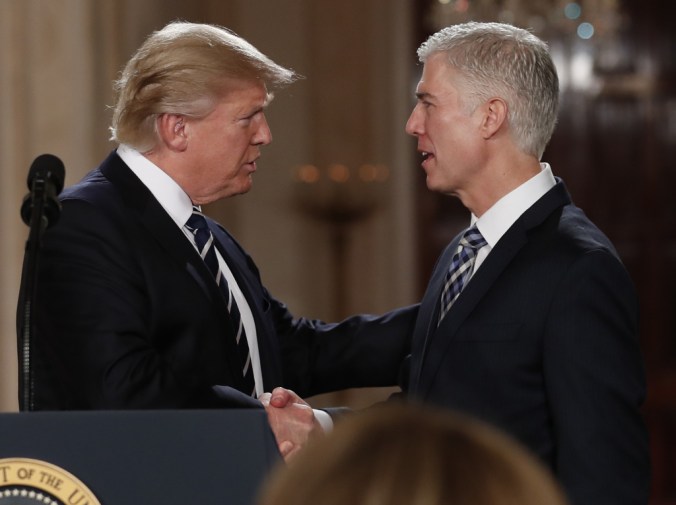
Last night, President Trump selected Colorado federal appeals court judge Neil Gorsuch as his Supreme Court nominee.

A. The Choice

Except for those who literally are determined to freak out and condemn anything President Trump does, this was a competent, responsible choice. He would be one of the best of the available choices for any Republican President, more qualified than Obama’s snubbed selection, Merrick Garland, to fill the same vacancy, and Garland was certainly qualified. It’s ridiculous that Gorsuch is one more Harvard grad on a Court that is exclusively Harvard and Yale, but that aside, he adds some diversity of outlook by being from the middle of the country rather than the coasts. He writes clearly, unlike, say, Justice Kennedy, and is not a pure political ideologue, like Ginsberg or Alito.

Before the Democrats’ rejection of Robert Bork shattered the tradition of allowing every President the privilege of having his SCOTUS nominations approved absent real questions about their competence or honesty, a nomination like this one would have garnered bipartisan praise. Trump made a responsible, competent, choice. Really. He did.

B. The Announcement Continue reading

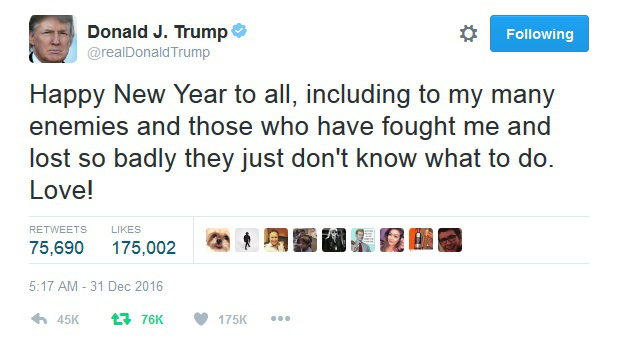
The President Elect’s Happy New Year Tweet, With Musical Reflections From Ethics Alarms

trump-tweet-happy-new-year

It’s hard to know whether to laugh or cry.

The reactions to Donald Trump’s tweet above were so predictable.  Trump-haters are continuing their meltdown, because he used that scary word “enemies,” and imagining political foes being hung by piano wire and shot against a wall…maybe even THE wall. Trump’s fans are cheering, “That’s our guy!” Predictable or not, here is the official Ethics Alarms reaction to what may be Trump’s first tweet destined for the Yale Book of Quotations:

1. Get used to this. He’s not going to stop. I recommend re-reading this post from last year, on the Julie Principle. In fact, heeeeere’s Julie!

2. Oh, let’s get this out of the way: it’s a juvenile, undignified, un-Presidential message, and a deliberately provocative thing to do. It also  made me laugh out loud, I have to admit. Really, if you’re going to let this sort of thing drive you crazy, you’re not going to make it through four years. You’re not even going to make it through one. Reserve a padded room. I’m serious. Think about this song, because this is where you’re headed…

Continue reading

“The 2016 Election Is a Disaster Without a Moral”? Only If You’re In Denial, Mr. Chait!

That should be "lessons," plural...

That should be “lessons,” plural...

The many outbursts of  liberal anger, resentment, accusations and denial over the election have been revealing, and not in a good way. Few have been as directly and stubbornly misguided and biased, however, as the current New York Magazine article by Jonathan Chait, with the clickbait title, “The 2016 Election Is a Disaster Without a Moral.”

It is, in essence, yet another example of Democrats attempting to argue away any accountability for their own misfortune, making Chait’s piece itself a denial of several moral lessons, such as “I am the architect of my own destiny,” “Take responsibility for your failures,” and “Don’t blame others for your own mistakes.” The post-election progressive freak-out, of which Chait is a part, also has a very important moral lesson in store, the one embodied in the Serenity Prayer authored by theologian and philosopher Reinhold Niebuhr (1892–1971):

God, grant me the serenity to accept the things I cannot change, the  courage to change the things I can, and wisdom to know the difference.

Clearly, this moral lesson is completely elusive, with pointless recounts underway supported by the Clinton campaign; round the clock complaining about the Electoral College, part of the 225 year-old rules of the game the Democrats accepted when they ran a candidate in the election; unethical and futile attempts intimidate electors or convince them to violate their vows;  embarrassingly infantile laments and near-breakdowns of whining students on college campuses,; and “Not My President!” protests and riots.

The lessons are there to learn, Jonathan, you just don’t want to learn them. He actually writes—and if this isn’t denial, I don’t know what is, “It is hard to think of an election defeat more singularly absent of important lessons.”  What??? To the contrary, it is hard to think of an election that taught more important lessons than this one. Continue reading

Trump’s Critics And The “Julie Principle” Follow-Up: And If You Don’t Pounce On Every Silly Trump Tweet Like It Was A Threat To The Constitution, You Won’t Be As Likely To Have THIS Happen…

doh-dohFrom PHILADELPHIA (CBS/CNN)

“President-elect Donald Trump is coming under fire that there should be “consequences” for flag burners, but in 2005, Hillary Clinton backed a bill that would have criminalized burning the American flag.

While she was senator of New York, Clinton co-sponsored the Flag Protection Act of 2005, which would have outlawed “destroying or damaging a U.S. flag with the primary purpose and intent to incite or produce imminent violence or a breach of the peace.”

You see, another benefit of practicing”The Julie Principle” is that it provides some protection from confirmation bias, which, as Ethics Alarms keeps telling you, makes you stupid, and cognitive dissonance, which warps your perception. Let me return to another section of the original “Julie Principle” post: Continue reading

Trump, His Critics, And The Julie Principle

We return now to “The Julie Principle,” an ethics concept I introduced three and a half  years ago. “The Julie Principle lies at the center of tolerance in its most productive sense. It also will keep you from going crazy “ was how the post was introduced. Here is the guts of it.

When a characteristic or a behavior pattern appears to be hard-wired into someone, it makes no sense to keep complaining about it. You either resolve to tolerate it ( and accept responsibility for the consequences of doing so), or decide that it is too much to endure, meaning that the relationship has to end.  “Fish gotta swim, birds gotta fly…” [ Note: this is the most famous lyric in the second most famous song in “Showboat,” “Can’t Help Lovin’ Dat Man o’ Mine,” sung by the tragic, abused mulatto Julie.]

The Julie Principle comes in handy in resolving many ethical dilemmas. In making an ethical analysis requiring balancing, the illusion, when it is an illusion, that a major part of the equation can be removed by just a little more advocacy, education or pressure permanently warps the process. We have been debating same-sex marriage here in several threads, and the illusion that gays can change their orientation, that it is a choice rather than part of their essence, is a massive impediment to reaching a rational accord. The Julie Principle applies. Do we want gay Americans to be part, and feel like a part, of the American fabric, or do we want to make what is essential to their being a deal-breaker? We’re the ones with the choice, not them.

I think the Julie Principle makes the choice obvious. It makes the choice obvious in the immigration debate as well. All those illegals are here. They have ties to family, the economy and the community: they aren’t leaving. “Fish gotta swim, birds gotta fly…” Does it make sense to keep punishing million of people for what they can’t change, or do we accept them for the good they can do from this point on? Sure, it would be preferable if we hadn’t allowed so many to walk across our boarders…But it’s too late to do anything about that. 

Fish gotta swim, birds gotta fly…”

The challenge in executing the Julie Principle is how you accept your bird or fish without letting that act corrupt your own values, or stop you from continuing to advocate and fight for them.

The left-wing media and still-bitter Democrats and progressives really need to learn the Julie Principle regarding Donald Trump, and fast. It might be too late to stop them from going crazy, but if they don’t learn it, they will drive everyone else crazy, and still accomplish nothing. Continue reading

Marion Barry and The Julie Principle

Poor Julie. Luckily for her, she didn't exist. Washington, D.C. does.

Poor Julie. Luckily for her, she didn’t exist. Washington, D.C. does.

The Washington Post just discovered that D.C. Councilman Marion Barry is unethical, and boy, is it steamed!

Well, that’s not quite fair. The Post editors authored an editorial about Barry’s latest example of his complete rejection of ethical principles other than his guiding star, which is “If it’s good for Marion Barry, it’s good for everyone else.” Barry recently published a self-congratulatory, delusional autobiography (I nearly wrote about it, but I was afraid doing so would make me nauseous), “Mayor for Life,” and right in the acknowledgments, he announces that one of his council aides, LaToya Foster, spent “nights, weekends, and many long hours of assistance” working on book at taxpayer expense.  Using D.C. government employees as his personal staff was standard operating procedure for Barry during his various pre- and post-crack terms as mayor, so there is little chance that he played it straight this time. No chance, really. A Washington City Paper investigation of calendar entries and emails showed that Foster’s work on Barry’s book “stretched far beyond her off-hours and into the D.C. Council workday, an arrangement that appears to violate D.C. Council ethics rules.”

The Post should stop editorializing about Barry’s ethics and instead focus attention where it might do some good: the D.C. voters and citizens he has thoroughly exploited and corrupted. Barry is a prime example of what I have dubbed The Julie Principle, evoking the famous lyrics of Julie’s lament in “Show Boat,” “Fish gotta swim, birds gotta fly…”   If Oscar Hammerstein was writing those lyrics today about Barry, the song, sung by voters of D.C.’s Ward 8, would go,

Fish gotta swim, birds gotta fly”

Marion Barry will cheat, steal and lie..

Can’t help loving that man of mine. Continue reading

“Noah” Ethics

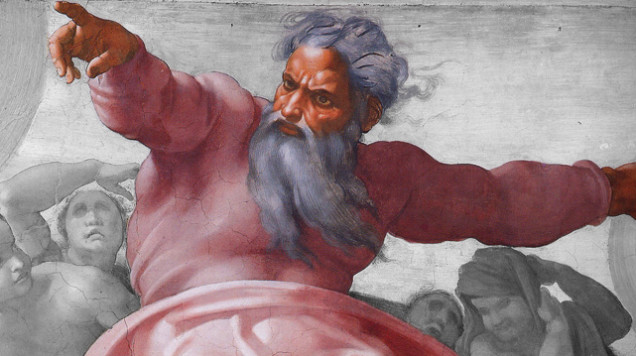
God

There is nothing unethical about “Noah,” the biblical spectacular that harkens back to the grand old days when Cecil B. DeMille reigned supreme. I haven’t seen the movie, and yet I can say that with absolute certainty. The reason I can say it that there is no way on earth that a movie about Noah and the Ark, in this day and age, could possibly be unethical. Even if the Old Testament were literal fact, which it is not, cannot be and in all likelihood was never intended to be, “Noah” couldn’t possibly be unethical, because it is a movie.

Never mind that of all the Biblical fables, with the possible exception of Adam and Eve, the tale of Noah is perhaps the most obviously impossible. The movie is art—of one kind or another—and does not represent itself as a documentary or make any factual assertions whatsoever. Thus it can be distinguished from a truly unethical film like Oliver Stone’s “JFK,” which intentionally misrepresented recent historical facts to “prove” a theory of the Kennedy assassination that was irresponsible and almost certainly false. Is “Noah” dishonest? It is impossible to be dishonest about a presumptively non-historical event about which there is no direct evidence whatsoever, and when there is no intention to deceive. Is it disrespectful? Art has no duty to be respectful. Is it fair? Fair to who? An artist’s stakeholders are those who appreciate his or her art. Does it do harm, or intend to? No. Continue reading