
Comment Of The Day: “Comment Of The Day: ‘Catching Up: Professional Ethics And The Challenger Disaster’”
A friend on mine from the Gilbert and Sullivan crowd issued a challenge to write a parody of Koko’s “I’ve Got A Little List” from “The Mikado.” Well, I couldn’t pass that up: I wrote my first parody of the song when I was 16 and played The Lord High Executioner in high school. I wrote another one years later when I played the part again in my 20’s, and yet again, several times, when I wrote and directed a political satire revue that played at a D.C. hotel for several months.It’s also a very easy song to write new lyrics to, which was by Gilbert’s design.
This took me only a bit longer to write than it took to type it. It’s not an ethics post, but hell, if I can’t post something on my own blog just because I feel like it, what’s the point?
I promise not to abuse the privilege.
Here’s the Wuhan virus version of Koko’s list…
Prologue
When I was a junior in high school, I played Ko-Ko in the Gilbert and Sullivan Club’s production of “The Mikado.” The head of the music department directed, a Jewish teacher named Mr. Einsig. He had the staging notes for all of the Gilbert and Sullivan works from the director who had gained great acclaim from his work with the Boston Light Opera Company, and I must admit, I cribbed many of that director’s ideas myself, through Mr. Einsig.One effective staging concept was for the encores to “The Flowers That Bloom in the Spring.” Each one was performed as a different ethnic parody, with Ko-Ko singing translated lyrics. It began with Japanese, of course, then French, a Brooklyn dialect, and the biggest hoot of them all, German. I performed it, in my kimono, with an over-the-top Hitler imitation, complete with mustache, ending with an emphatic “Heil” gesture.
It brought down the house. Ten years later, at Georgetown University Law Center, I played Ko-Ko again, did the same Hitler parody again, and brought down the house again. Nobody complained. My late father, crippled for life in the fight against Hitler, detected nothing wrong with the routine. He also loved “Hogan’s Heroes,” with the show’s reluctant, inept, heiling Nazis, and the other Heil-filled spoofs of Hitler by Chaplin, Mel Brooks, and even the Three Stooges.
Now here is what happened to a private school teacher: read the whole, awful thing here. The short version: he was gesturing while explaining something in class, and noticed that his arm was raised Nazi-style, and said, “Heil Hitler,” jokingly. There was no question whether he was serious or not: everyone knew he was joking, and why he was joking. He even stopped and explained to the class that Once Upon A Time, in less enlightened eras, it was considered amusing to mock Hitler and the Nazis.
Ben Frisch, the teacher, a practicing Quaker whose father was Jewish and who had two great-grandmothers killed at Auschwitz, was fired by the private school anyway. The school principal who fired him explained his reason to the New York Times magazine by saying, “One of our pledges is to make all of our students feel safe. And that is something that I take very, very seriously.”
Says the Times reporter in part in reaction to this: Continue reading

Jerry Richardson (above), the 81-year-old original owner of the Carolina Panthers in the NFL, has decided that rather than ride out the sexual harassment allegations recently reported by Sports Illustrated, the wisest (and most lucrative course) will be to sell the team after this season. His profit will be somewhere in the billions, not that he isn’t a billionaire already.
New York Times sportswriter Juliet Macur is grievously offended by this, writing,
“Here’s what would make more sense: For Richardson to announce that the proceeds of the sale — or even just a couple hundred million? — would be donated to the women he harassed…[Many men] have been chased from the top of their professions for disgusting behavior involving women they worked with. They are suddenly pariahs, their reputations destroyed. But they remain very rich men, and their families, for generations, will be able to live off the financial rewards they collected while perpetuating these offenses….Richardson, who made his fortune in the fast-food industry, might be the richest of all the men accused in the #MeToo movement so far. Perhaps it’s appropriate, in a legal sense, that he is able to sell his company and walk off the stage. But it doesn’t seem morally fair that he should benefit so richly from it.”
This is pure, unadulterated emotionalism and indignation unfiltered by thought or coherent societal values. If these are the kinds of ethical arguments—and it is an ethical argument–major information sources are going to publish as worthy of being injected into public discourse, we might as well tear up the laws, forswear ethical systems, embrace passion, anger, vengeance and the rest as our sole tools to govern human affairs, and resign ourselves to chaos. Continue reading
1 Save the “Mikado”! Yesterday I was honored to be able to participate in a Smithsonian Associates lecture on the careers and operettas of Gilbert and Sullivan. The Georgetown Gilbert and Sullivan Society was kind enough to invite me to sing “Tit Willow” as part of its segment at the event, which played to a full house. It’s a shame, and alarming for the future of live theater, operetta, and the vitality of the G$S canon, that the average age of participants appeared to be approximately 94, give or take a decade.
Before I warbled “Tit Willow,” once as well-known to the average U.S. adult as “My Way” (John Wayne sings the chorus in “The Shootist”) I went off-script to say, “As you all probably know, this song is from ‘The Mikado.’ It is a wonderful show, and don’t believe anyone who tells you otherwise.” The statement got nods and knowing looks, because they knew exactly what I was talking about.
Right now, the more than 80 Gilbert and Sullivan performance groups in the U.S., plus various opera and regional theater companies, have almost abandoned the best and most performed of the 14 sui generis shows by the great duo for fear of getting into a political correctness battle. “The Mikado,” you see, is now considered “racist,” because Gilbert had the ridiculous (and typical) idea of presenting a satire of English foibles and personalities as if Great Britain had suddenly been turned into an upside-down version of Japan. The script is self-referential on the gag (“I often wonder, in my artless Japanese way…”; “He might have had initials on his pocket handkerchief, but Japanese don’t carry pocket handkerchiefs!” ), as Gilbert was one of the fathers of post-modern humor. The show has been popular in Japan, and all over the world. A popular Broadway adaptation (“The Hot Mikado”) had an all-black cast—still in Japanese costumes—speaking and singing jive versions of the dialogue and songs. Gilbert included a song (“I’ve got a Little List”) that accommodated current events updates, so the show is arguably the most continuously topical of all the Victorian operettas—and all of them are still funny.
Never mind all that. “The Mikado” has been targeted by offense-mongering progressives, and theater companies, which are always a bad decision or two from bankruptcy, find it easier to cave and just produce “The Pirates of Penzance” instead.
“The Mikado, ” directed and performed properly, is better than 85% of all Broadway musicals. It is also cheaper, can be performed effectively by all ages, is infinitely adaptable, and is free: it’s in the public domain. It is a cultural treasure, as important to preserve as the best Shakespeare tragedies or “David Copperfield.” The battle for “The Mikado” has to be fought, and if there is any theater company out there, amateur or professional, who has the guts to fight it, call me. I can help.
2. Ridiculous Roy Moore defense of the week. I haven’t been listening to Rush Limbaugh for a long time: is he finally losing it? This week he appeared to be suggesting that because Roy Moore was a Democrat when he was lusting after teen-age girls, there is some kind of hypocrisy involved in the controversy over his Senate campaign, saying,
“Did you know that before 1992, when a lot of this was going on, that Judge Moore was a Democrat? Nobody said a word. When he supposedly was attracted to inappropriately aged girls — he was a Democrat.”
So what? Moore could have been a Rosicrucian when he was molesting girls, and it wouldn’t matter. He’s running for the U.S. Senate NOW, and as a Republican. Either Rush is deliberately making what he knows is a terrible argument that will confuse idiots in his audience, meaning that he is dishonest, or he really believes that it is some kind of mitigation to the GOP’s irresponsible support for Moore that he was a Democrat when he broke the Alabama child molestation law. This would mean that Rush is now an idiot himself. Continue reading
Cultural events earlier this month brought to light, on two continents, the problem of maintaining the integrity of art and literature under the onslaught of political correctness.
In Sweden, a controversy has erupted over the re-broadcast of a 1969 television adaptation of the Pippi Longstocking books, the children’s classics authored by Astrid Lindgren. The Swedish national TV station, SVT, announced that it is revising a scene from the 1969 television series about Pippi which she says her father is “king of the Negroes,”a direct quote from one of the stories. Believe it or not, this has set off a contentious national debate.
The family has approved the station’s desire to change the TV version, but is keeping the term in future editions of the books. In 2006, the family added a preface explaining that today, the word is considered “offensive,” but that when the books first appeared, “Negro was a common expression for people with black skin who lived in other parts of the world than ours.” That’s a sensible solution. Period and context is important in art and literature: the urge by some to constantly purge the world of any reference, word or attitude in past creations that seem out of place now leads to a form of cultural self-lobotomy. Erik Helmerson, a columnist at Dagens Nyheter, an influential Stockholm newspaper, called the changes a form of censorship. “I’m very sensitive to the fact that people are offended by the N word,” he said in an interview. “I’d never use it myself.” He even called revising the TV series “a huge interference into freedom of speech.” “Where do we draw the line? What do we cut and what do we keep? Who should decide? Who needs to be offended before we cut a word?” Continue reading
[Here…listen to this while you read the post.]
I am apparently the official protector of Gilbert and Sullivan’s “The Mikado” from ridiculous accusations of ethics offenses, so once again, I will charge into the breach. No thanks needed, Mr. Gilbert, Sir Arthur—I owe you debts that can never be repaid.
In a brain-endangering op-ed for the Seattle Times, Sharon Pian Chan expresses the opinion that the operetta is a “racial caricature,” and thus “every snap of the fan was a slap in the face.” The nature of the complaint has old origins: the original show in 1885 nearly caused an international incident, as Japan registered an official complaint to Great Britain claiming a grievous insult to its people. W.S. Gilbert, who was skilled at such things (a few years later he stifled French indignation over a song in “Ruddigore” that pretended to make fun of the French while actually ridiculing British bravado), explained that “The Mikado” in no way ridicules anything about Japan or its people, but is entirely a witty and original satire on everything British. This was true then, and is true now. Then, however, people, including the Victorian era Japanese, were able to see distinctions, and were not seeking victim status and leave to play public censor under the authority conferred by political correctness. Today, people like Ms. Chan are not so easily calmed.
Thus is art harmed, entertainment stifled, laughter stilled and music forgotten. A good argument could be made that “The Mikado” is the greatest musical comedy entertainment ever written.* It certainly caused the biggest international sensation (the closest rival is another Gilbert and Sullivan classic, “H.M.S. Pinafore”): it is estimated that by the end of 1885, at least 150 companies in Europe and the U.S. were producing the satire. As recently as the 1960s, it was credibly claimed that a “Mikado” was going on somewhere in the world every minute of the day.
The show is fun in every respect: comedy, music, lyrics, satire, characters. It is also fun to act in and produce, for children as well as adults. Unfortunately, several factors have led to the gradual scarcity of productions in recent years, from the cyclical (Gilbert and Sullivan go out of style, but always come back) to the ridiculous ( it seems like every production has to cope with some absurd controversy, like the 2011 Montana production that was accused of threatening Sarah Palin’s life). Political correctness aversion has been the biggest factor in making the very best G&S show rare while productions of Broadway musical junk flourish, however. Since the characters are supposedly “Japanese,” shouldn’t all the singers be Asian? Isn’t Asian make-up offensive like blackface? Oh, hell, let’s just do “The Pirates of Penzance.”
The New York Times is taking fire from diverse commentators on the Right for publishing a political satire cartoon that includes this panel:

It is part of a larger cartoon japing at the supposed aftermath of a harsh winter:
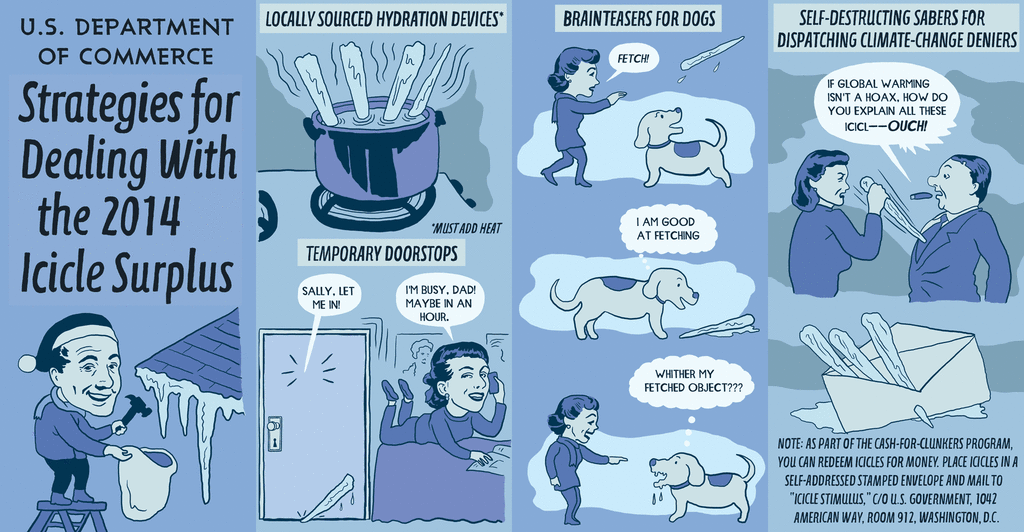
Among the ethics complaints against the drawing:
I am sorely tempted to just scream, “ARRRRRRRGGHHHHHHHH!!!!” and leave it at that.
This time around, the humorless, metaphor-challenged, unfair individuals and media outlets misrepresenting an innocent, non-violent, non-provocative use of the imagery of putting someone on a list doesn’t hail from the lunatic Right, like Ronbo and his Missoula Maniacs (an excellent name for a rock band, if you ask me), but from the Left….proving that when it comes to allowing ideological fervor turn your brain to mush and your ethics to applesauce, there are no partisan limitations.
But…you are not going to believe this, but it’s true…this one started in Missoula, Montana too, just like the Missoula Mikado Affair!
Get this:
But first: ARRRRRGGHHHHHHHHHHHHHHHHHH!
OK, I feel a little better. Let’s proceed: Continue reading
Ron Barbour, Tea Party warrior, has a priceless post on his website in response to Ethics Alarms’ flagging of his letter “demanding” that the Secret Service arrest the director of the Missoula “Mikado” for updating “The Lord High Executioner’s” gag list of societal irritants to include Sarah Palin.
I would normally post highlights at this point, but everyone should check out his website to see the face of hateful extremism first hand, and how it burns up IQ points like kindling. This is political activism mutated into a total war mentality, where fairness to the perceived enemy is translated as proof of alliance with the enemy. Ron thinks I am a Leftist, which is tied only with “New York Yankee fan” as the thing I have most seldom been accused of being.
Don’t miss this…you will find it here.
 Ethics Alarms
Matthew B. scored a Comment of the Day by raising an issue I had never thought about before: how the misapplication of PowerPoint leads to inadequate training and information dissemination within organizations and bureaucracies. He also references the reluctance of managers to know when to hand over decision-making to subordinates. That is something I have thought about, a great deal.
Two of my favorite movies illustrate how competent leaders and managers know when to delegate a crucial decision down. “Topsy-Turvy,” the superb 1999 film depicting the creation of “The Mikado” by Gilbert and Sullivan, accurately depicts the real incident when, after the final rehearsal, W.S. Gilbert told the “Mikado” cast that he was cutting “My Object All Sublime,” also known as “The Mikado’s Song.” Gilbert was a tyrannical director, and the cast was terrified of incurring his wrath. This time, however, they stood up to him. The cast as one told him that he was making a mistake. The soloist, Richard Temple, they told their shocked and steaming director who also had conceived of the song, should have the chance to perform it in front of an audience. His fellow cast members were certain it would be a hit. Gilbert, recognizing the certitude the cast must have had to risk his fury at being contradicted, decided that his performers might have a clearer understanding of the show even that he had, and relented. Temple would sing about letting “the punishment fit the crime” on opening night.
The song was an instant sensation, like “The Mikado” itself, and is still one of the most quoted of all G&S songs.
The other example is at the climax of “Hoosiers,” the great basketball film based on the true story of the miraculous Indiana state championship won by a tiny school from Milan, Ind. in 1954. During the last time-out before the team’s last chance to score, which would, if successful, give the team a one-point victory over their greatly favored competition in the championship game, the coach (Gene Hackman), who has led the ragtag group this far by emphasizing teamwork over individual achievement, lays out a play in which the team’s superstar, Jimmy Chitwood will be a decoy. He plans for another player to take the final shot, but the team doesn’t move. “What’s the matter with you?” he shouts as his players just stare, looking hesitant. “If I get the shot, I’ll make it,” Jimmy says, after a long pause. So the coach, who has insisted all season that his word was law, makes the same decision Gilbert did. When your subordinates are that sure, trust them. They know better than you.
Jimmy shoots and scores the winning basket as time runs out.
Here is Matthew B.’s Comment of the Day on “Comment Of The Day: ‘Catching Up: Professional Ethics And The Challenger Disaster’”:
Continue reading →