Comment Of The Day: “From The Ethics Alarms ‘Do The Ends Justify The Means?’ Files: The Breast Cancer Survivor’s Inspiring Scam”

Glenn Logan took off from the post about Paulette Leaphart’s self-promoting breast cancer awareness 1,000-mile walk and CNN reporter Jessica Ravitz’s strangely equivocal exposé to muse on the toxic influence of social media. It’s a great post, as usual for Glenn, and I’m especially grateful because I’m behind on posts today but I have an ethical obligation to watch the Red Sox Opening Day game. (Pirates-Red Sox tied 0-0 in the 5th.)

Here is Glenn Logan’s Comment of the Day on the post “From The Ethics Alarms “Do The Ends Justify The Means?” Files: The Breast Cancer Survivor’s Inspiring Scam”:

This is yet another social media-driven disaster. We have proven ourselves unable to handle the medium, either as consumers or producers of content. In the grand scheme of things, social media has probably been the vehicle for more scams, dissociation from the real world, submersion into self-congratulatory alternate reality, fake news, and general mayhem than any innovation in my memory.

I have occasionally referred to Twitter as “the Devil,” and my loathing for Facebook knows no bounds. I still use it once a week or so just to check on friends and family (for which it is at least useful), but 99% of my input to Facebook consists of “Happy birthday, (first name here). Many happy returns” or to message Jack a link. No Luddite I, as I have been using the Internet since the early 1990’s Usenet days, and Linux as my primary operating system since 1997, so technology and I are old, old friends.

But the temptation of social media to generate attention in the name of good causes is, to me, the lesson here besides the obvious ethical wreckage caused by “the ends justify the means.” Many of us see the apparent benefits of fame, and want our 15 minutes of it very badly, usually for entirely selfish reasons. When we can achieve that in the name of a good cause, it becomes all the more insidious as a rationalization for otherwise self-serving and dishonest behavior. Continue reading

From The Ethics Alarms “Do The Ends Justify The Means?” Files: The Breast Cancer Survivor’s Inspiring Scam

At one point, profiling the double-mastectomied Paulette Leaphart’s 1,000-mile walk from  Mississippi to Washington, D.C….topless…CNN reporter Jessica Ravitz writes,

“If even one woman’s life was saved thanks to a conversation Paulette started, wasn’t that enough? So what if our hero was flawed?”

Oh, no: the “just one child/just one life” rationalization again! (Which, I now notice, isn’t on the Rationalizations List, and it should be.)

Ravitz writes this to begin a long, detailed, infuriating narrative about the well-publicized and much-hyped crusade of Leaphart, whose journey, displaying her scarred chest,  was to ostensibly demand more funds for cancer research cure and  better and more affordable health care. She said she was a champion for women without breasts “to believe in their beauty and be proud of their strength.”

“By showcasing and embracing her scars, she hoped to inspire others to do the same,” Ravitz writes. “Her journey was bold, visual, moving. It offered a hero to admire and, given Paulette’s audacious decision to walk shirtless in the face of strangers, a rich spectacle to witness. It spoke to African-American women, who face the highest breast cancer mortality rate. It inspired legions of survivors. And it spoke to many who’d lost someone to the disease.”

Ravitz is conflicted, clearly, as she tells the complicated story of the woman whose official cause is admirable, but whose motives are murky, and whose credibility is non-existent. While explaining the mounds of evidence she uncovered that the woman has a record of deception, venality and financial flim-flam, that she sees the long walk as a ticket to fame and cash, and that she has lied and fabricated aspects of her ‘inspirational story” repeatedly while the efforts of journalists to pin her down. Yet Ravitz still ends up by  being wishy-washy and equivocal:

“There’s no way to measure how much of a difference Paulette Leaphart made in shaping the conversation about cancer in this country. She touched many minds and hearts, but whether she did so in the most honest and transparent way remains questionable.”

What? There is nothing questionable about whether Leaphart has been honest and transparent—she hasn’t. Ravitz documents her deceptions impressively. She lied about her cancer treatment. She lied about her eligibility for Medicaid and financial resources. She lied to a documentary team that had arranged to follow her, leading them to end the relationship. She lied on her Facebook page, representing her health travails by using the experiences of a friend. Her unguarded comments suggest that she began the walk as a way to make money for herself as well as research. She accepted contributions under false pretenses.  Yet the journalist still seems to want to say that all of this doesn’t matter,  if some good resulted from it: Continue reading

It’s Sexual Harassment Day!

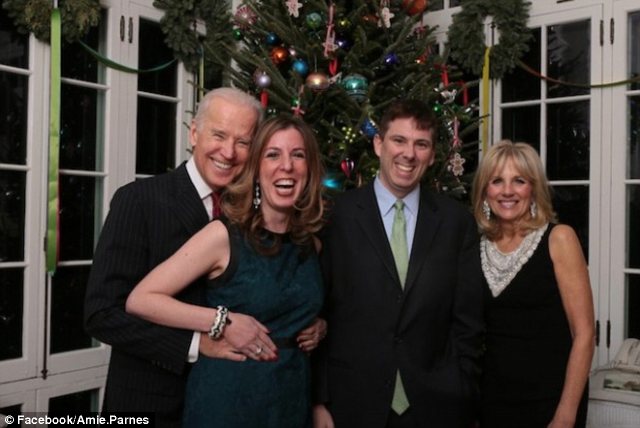
biden-harassment

Unfortunately, it will be a while before I get to the next ethics topic. Accompanied by the ProEthics acting troupe, The Ethical Arts Players, I’ll be running not just one but two harassment awareness and avoidance trainings today. Avoiding harassing conduct is only applied ethics after all; it should be easy, but it isn’t.

I’ll be talking about some high profile cases that have been discussed here: the Trump-Billy Bush video, naturally; Ellen Degeneris’s cute sexual harassment of Jake Gyllenhaal on television that nobody complained about because…she’s Ellen! ; and the most relevant of all for the group I’ll be talking to, made up of scientists and academics, this story.

Sexual harassers come in many varieties, and this reminds me that I need to write more about the topic. Here are 15 types that have been identified in the wild so far, but hybrids and mutants are also out there:

  1. The Power Player: A “quid pro quo” harasser: the boss.
  2. The Counselor: Exploiting mentor relationships, abusing tryst
  3. The Leader of the Pack: Leading group embarrassment or marginalization
  4. The Serial Harasser: The Intentional and shameless abuser. With all that has gone on in the law and public eye, they are still out there in force.
  5. The Groper: Hands and Eyes. Yes, that’s Joe Biden…
  6. The Opportunist: Awaiting their chances, and ready to pounce on the trusting, vulnerable and needy
  7. The Bully : Sexual harassment as punishment, manipulation or just for sadistic fun
  8. The Confidante: Building trust to abuse it, that Platonic friend who’s not really platonic.
  9. The Pest: Polite, but not taking “no” for an answer
  10. The Sympathetic Harasser – Exploiting a crisis
  11. The Gallant: Misusing compliment and manners to marginalize, the kind of harassment women often don’t notice. (Barack Obama is one.)
  12. The Nerd: Socially inept individuals who desire the attentions of their targets, and who often don’t see that they do not reciprocate these feelings.
  13. The Stalker: Watching, trailing, bothering, tracking. The most dangerous harasser.
  14. The Blunderer : An accidental or clueless harasser
  15. The Star: The open harasser who’s status prevents him from being called one, or called to account.


Obamacare’s Epitaph: “Live By The Rationalization, Die By The Rationalization”

obamacare-gravestoneRemember in 2010, when the Democrats ensured that the Affordable Care Act would clear its final hurdle to passage this way?

Democrats will finish their health reform efforts within the next two months by using a majority-vote maneuver in the Senate, Majority Leader Harry Reid (D-Nev.) said. Reid said that congressional Democrats would likely opt for a procedural tactic in the Senate allowing the upper chamber to make final changes to its healthcare bill with only a simple majority of senators, instead of the 60 it takes to normally end a filibuster.The move would allow Democrats to essentially go it alone on health reform, especially after losing their fillibuster-proof majority in the Senate after Sen. Scott Brown’s (R) special election victory in Massachusetts.

Republicans have protested the maneuver as a hyperpartisan tactic to ram through a health bill, and have said that plans to use the reconciliation process make moot a bipartisan summit at the White House this week, where both GOP and Democratic leaders are supposed to present their ideas on healthcare.

At the time, Republicans, as is their wont, over-stated their objections to the maneuver, calling it unconstitutional and a breach of rules. No, it wasn’t quite that, nor was it as unusual as the GOP claimed. It was within Senate rules, but still the first time it was ever used to amend a bill that had already passed the Senate via cloture, and under such contentious circumstances.  Reconciliation was legal, all right, but since the Affordable Care Act was so revolutionary and controversial, its passage needed to be seen as democratic, and it wasn’t. Democrats ignored the Golden Rule, and extended the acceptable use of reconciliation by using a number of rationalizations, as well as “the ends justify the means.”

Let’s see: “Everybody Does It” wouldn’t work, because the problem with using reconciliation was that everybody didn’t do it, at least not very often.  So Democrats opted for 13. The Saint’s Excuse: “It’s for a good cause”23. Woody’s Excuse: “The heart wants what the heart wants”#24. Juror 3’s Stand (“It’s My Right!”)25. The Coercion Myth: “I have no choice!”28. The Revolutionary’s Excuse: “These are not ordinary times.”31. The Troublesome Luxury: “Ethics is a luxury we can’t afford right now” 40. The Desperation Dodge or “I’ll do anything!”59. The Ironic Rationalization, or “It’s The Right Thing To Do”…and perhaps a few other rationalizations on the list. Continue reading

Ethics Dunce: Texas Elector Christopher Suprun [UPDATED]

Shut up, Chris; shut up, Alexander.

Oh, shut up, Chris; you too,, Alexander.

Another faithless Texas elector has announced himself. This time, it’s Christopher Suprun, the latest previously anonymous figure to exploit the 2016 Presidential candidacy of Donald Trump for 15 minutes of fame. Let’s see: there was Trump’s former lawyer, who breached or nicked several legal ethics duties to get a column in the Huffington Post, Trump’s ghostwriter, and all of the women who never saw fit to complain of being sexually assaulted by the President Elect until their accusations could do maximum harm and spark maximum exposure. Now we have Suprun, who penned a self-righteous op-ed for the New York Times explaining why he feels he is entitled, all by himself, to ignore the will of the people and cast his vote as elector for someone other than the candidate Texas insisted he pledge to vote for: the winner of the most votes by participating Texas citizens in the November 12 election.

The measure of Suprun’s gravitas and qualifications to take this responsibility on himself is aptly illustrated by the first of his justifications for his untenable position: “Mr. Trump goes out of his way to attack the cast of “Saturday Night Live” for bias.” Naturally, he appeals to the authority of Alexander Hamilton, whose various employments in the post-election train wreck has convinced me that he, not Old Hickory, really should move off the currency and make way for someone with the right number of chromosomes. If I hear one more quote from Federalist Paper 68—which no one is 100% certain that Hamilton even wrote—I may strip off my clothes and run screaming Norse epithets into the night. Assuming, as most do, that the author was Hamilton, so what? The paper was written after the Constitutional Convention. Hamilton’s concept for that document and the structure of the government was rejected. He didn’t trust the public, or democracy, wanted George Washington to be king, and championed a system the resembled Great Britain’s. Using him to justify a concept of the Electoral College that has never been employed or accepted in the United States is a classic logical fallacy. Continue reading

Comment Of The Day: “The Democrats’ Petition To Overturn The Election”

William Plumer---the first faithless elector. Jerk.

William Plumer—the first faithless elector. Jerk.

The effort of many Democrats to reveal their party as one rapidly evolving into an anti-democratic one that will try to take and hold power by divisive, coercive, and extra-legal means continues, so this Comment of the Day is not stale, fortunately, though I am four days late posting it. The discussion regarding the Ethics Alarms post about the Change.org petition to persuade state electors to try to reverse the results of the election was enlightening, and complaining about the Electoral College continue. Much of that is just unethical citizenship seasoned by ignorance. This post, unlike most of the others, made an articulate, measured case that provided useful information. Here is Jim Nevertrump‘s Comment of the Day–I’ll be back briefly for a final comment—on the post, “The Democrats’ Petition To Overturn The Election”

We are at a critical juncture. The choice as to the next leader of the most powerful nation in history could well spell disaster for our collective future, for the future of the globe and the human race. Devastation awaits humanity from either of two crises – we can foreseeably suffer nuclear annihilation on the one hand, or broad environmental decimation on the other. A misstep here is one that we cannot chance. With a miscalculation once made, there’s no recovery. Beyond those two vital dangers, there are enormous questions pertaining to life and death, health and disease, wealth and destitution, power and servitude, crime and punishment. All these are on short fuses, and a wrong turn will inflict suffering on a great many.

On the question of anointing the next president, the book is not closed. The Constitution challenges us to take a good hard look. Continue reading

The Democrats’ Petition To Overturn The Election

petition-electors

There is a petition on Change.org calling for Trump’s electors to violate their pledges and vote for Clinton when the Electoral College convenes on December 19. The originator is a Democratic cheating advocate, liar and Ethics Dunce named Elijah Berg. 3.5 million fellow cheaters, ignoramuses and sore losers have now signed the silly thing, on the way to the goal of 4,500,000, which will obligate the White House to respond to it. The proper response would be a Bronx cheer.

The petition makes me feel even better about not voting with these people, who now, fully corrupt, believe that it is just and right to achieve power by any means necessary, and ethics be damned. These are 3.5 million people I wouldn’t dare play cards with, or trust to mail my water bill.

Let’s focus on some of Elijah’s points, shall we?

On December 19, the Electors of the Electoral College will cast their ballots. If they all vote the way their states voted, Donald Trump will win. However, they can vote for Hillary Clinton if they choose.

Yes, and they can defecate on the floor, too, but their duty is to vote according to how their state’s citizens directed them to vote, and their assumption that the electors would perform that duty. Continue reading

Presenting Rationalization 13 A. “The Road To Hell”

hell

The post earlier today regarding three examples of ethics duncery (or worse) in foreign lands included three examples of Rationalization 13A at work. All could be, and in one case was, excused with the claim that “we meant well.” I checked: this infamous rationalization wasn’t among the seventy plus rationalizations on the Ethics Alarms list, which proves just how sinister these little buggers are. As its name suggests, Rationalization #13A is named after the famous quote, “Good intentions pave the road to hell,” or, alternatively, “The Road to Hell is paved with good intentions,” which nobody seems to know who was the first to utter it.

It was a major omission, and I’m thrilled to rectify it.

13A. The Road To Hell, or “I meant well”

This sub-rationalization to the Saint’s Excuse is related to its parent but arguably worse. Rationalization 13 is one of the really deadly rationalizations, the closest on the list to “The ends justified the means”:

 The Saint’s Excuse is that the ends justify the means, because the “saint” has decided that the ends are worth any price—especially when that price will have to be paid by someone else. 

But while the wielder of the Saint’s Excuse typically at least has a beneficial or valuable result to claim as justification for unethical and inexcusable acts, the desperate employers of 13A only have their alleged good intentions, which may be the product of emotion, misunderstanding, ignorance or stupidity. How a bad actor intended his unethical conduct to turn out is no mitigation at all. The underlying logic is that the wrongdoer isn’t a bad person, so the wrongful act shouldn’t be held against him or her as harshly as if he was. The logic is flawed (it is the same logic as in The King’s Pass, #11, which holds that societally valuable people would be held to lower standards of conduct than everyone else) and dangerous, encouraging the reckless not to consider the substance of a course of action, but only its motivations.

The Saint’s Excuse attempts to justify unethical actions that accomplish worthy goals The Road to Hell attempts to justify unethical conduct even when it does undeniable harm, just because it was undertaken with admirable intent.


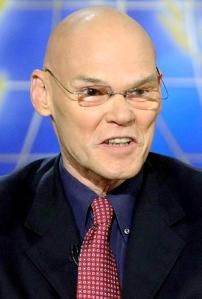
From James Carville, The Epitome Of The Saint’s Excuse

Now, you might think I'm violating my promise not to use unattractive photos of unethical people to make them look bad, but I'm not. James Carville looks like snake no matter what photo you use. Condign justice.

Now, you might think I’m violating my promise not to use unattractive photos of unethical people to make them look bad, but I’m not. James Carville looks like a snake no matter what photo you use. Condign justice.

Veteran Clinton hired minion (I think that’s fair) James Carville’s reaction to the latest news about how Hillary used the State Department to reward Clinton Foundation donors (that’s a fair description too, and illegal) is wonderful in its way, as it comes as close to a perfect example of one of the most sinister and historically destructive rationalizations on the list, the Saint’s Excuse, as one is likely to see in a lifetime. It’s also useful, because if you find yourself finding his logic persuasive, then you are as devoid of ethics as James Carville is.

Trust me: you don’t want that.

[For various views on the emerging proof that, as honest journalists and analysts concluded many months ago, Hillary traded State favors for cash that went to Clinton Foundation initiatives and, incidentally, into her family members’ bank accounts, see these links: Fox News, Guardian, New York Times, Lawyers, Guns & Money, Washington Monthly, Washington Times,Politico, Power Line, Associated PressMediaite, BizPac Review and the Wall Street Journal]

 Carville said this morning on MSNBC’s “Morning Joe” that if the Clinton Foundation had decided not to accept foreign donations while Hillary Clinton was Secretary of State —as the Obama Administration swore to Congress that it would not do, as government ethics rules and laws forbade it to do, and as anyone with the tiniest understanding of conflicts of interest knows it could not do,

“…you’d be out hundreds of millions of dollars that are doing good. What the Clinton Foundation does, it takes money from rich people and gives it to poor people. Most people think that’s a pretty good idea.”

Most people? If so, those “most people” are also the ones who are completely ignorant of what corruption is, and exactly the kind of people that Bill and Hillary Clinton, and Carville, happily recruit to prey upon the rest of us. Continue reading

Katie Couric And The Anti-Gun Documentary: Not Just Vanishing Journalism Ethics, But Vanishing Consensus That Journalism Has Any Obligation To Be Ethical

Just in time for the Presidential campaign, old friend Katie Couric has been kind enough to remind us just how little we can trust journalists, how arrogant they are regarding their unethical methods, and how the profession that is supposed to protect democracy is now a threat to it.

Having failed in her effort to be a network news anchor and a talk-show host, the former “Today Show” star  is now biding her time at Yahoo News waiting for a comeback opportunity. She served as executive producer and narrator of “Under the Gun,” an anti-gun documentary written, produced, and directed by anti-gun activist Stephanie Soechtig. In one powerful scene (above) , Couric is seen asking members of the Virginia Citizens Defense League, gun rights supporters all, “If there are no background checks for gun purchasers, how do you prevent felons or terrorists from purchasing a gun?” The pro-gun members of the group with the motto “Defending Your Right to Defend Yourself”can’t answer the question! The documentary shows blank stares and a damning, awkward, 9 second period of total silence.

Fortunately, one of the gun owners in the sequence, VCDL President Philip Van Cleave, recorded the actual event before it was edited to make gun owners look like mutes. There was no pause. The members offered several answers. They were omitted from the documentary, with a pause inserted instead to bolster an anti-gun agenda.

Couric was aware of the deceptive editing, apparently questioned it, but allowed it to remain in the documentary. This is signature significance: no ethical journalist—if there even is such a thing any more—does this, ever, even once. While various media reporters on the left have expressed their disapproval, they have also muted their criticism to try to minimize the damage to their own profession. Here is NPR’s David Folkenflik, for example:

This manipulation — and that’s what it was — would not pass muster at NPR under its principles for fairness in handling interviews. It should be noted that documentaries operate with a different ethos than straight news. “Under the Gun” has a take, strongly suggesting there is a quiet consensus in favor of background checks among gun owners, aside from gun rights advocacy groups. This is not deception on a grand scale, but this handling of the interviews with the Virginia gun owners group is clearly unfair and unwarranted. People deserve to recognize themselves in how they appear in interviews.

Spin. It’s not “manipulation.” Its lying. It is presenting false information, not “manipulated” information. The film affirmatively represented that the response to a question was dumbfounded silence. That is as much a lie as recording fake answers like “Duh, well dang me, I never thought of that! I guess them background checks ain’t such a bad idea after all!” and dubbing them in. Lying isn’t just “unfair;” lying is dishonest and sinister. Continue reading