The Special Needs Student, the Compassionate Teacher and the “Awww!” Factor (UPDATED)

Debra Fisher

Regular readers here are familiar with the “Ick Factor,” the common phenomenon where a situation that causes an emotional response of revulsion, disgust or fear is labelled unethical when there is nothing unethical about it. Many kinds of conduct are icky, but still on the right side of ethics, if only one can put aside the gag reflex. The reverse of the Ick Factor is the less common “Awww!” Factor, where particular conduct seems loving, caring and nice, but is in fact unethical in one or more respects. Such is the case of New York City special needs teacher Debra Fisher.

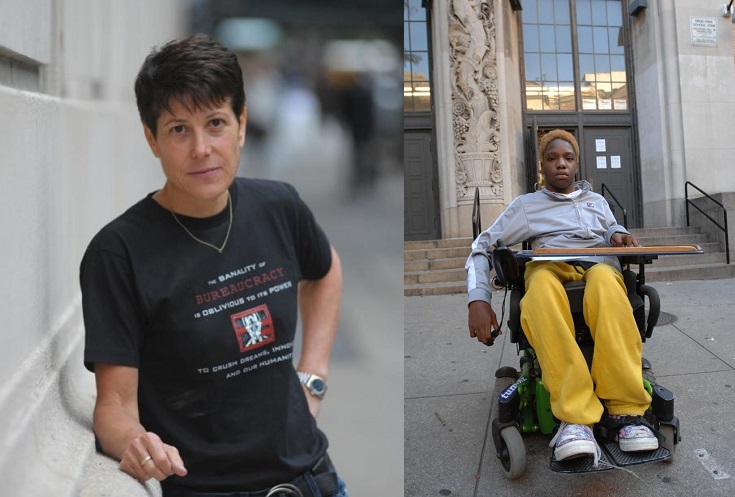
In October, Fisher was suspended when e-mails were discovered on the school computer system showing that she had been spending school time raising funds for a special project on behalf of Aaron Phillip, a thirteen year old special needs student who is an aspiring animator with his own blog. The project’s goal was to raise $15,000 for a nonprofit devoted to developing Aaron’s talent, an organization called “This Ability Not Disability” founded and administered by Fisher.

Awww!

The problem was that while her efforts on behalf of the student were supported by the school, Fisher, an occupational therapist at Public School 333 with nine years of service, did not have permission to perform them during school hours. Thus she was suspended for six weeks. Now she is suing the school system for back pay, telling reporters, “I’m just trying to fight for what I believe is right.”

If she believes she is right, then she shouldn’t be working at the school at all, because she is in fact dead wrong.

But awfully nice. Continue reading

On Forced Acceptance Of Same-Sex Marriage: The Slippery Slope Stops Here

Hitching-Post-Idaho

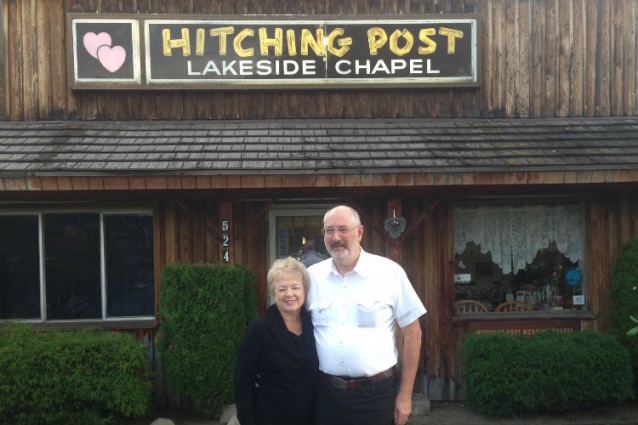
Donald and Evelyn Knapp, pictured above, are ordained ministers who conduct weddings at their for-profit chapel in Coeur d’Alene, Idaho, called “The Hitching Post.” After this year’s ruling by an Idaho federal judge that the state had to recognize  same-sex weddings, a City of Couer d’Alene deputy city attorney went on  local TV to say that for-profit wedding chapels could not legally turn away a gay couple without risking a misdemeanor citation. The Hitching Post, he noted, “would probably be considered a place of public accommodation that would be subject to the ordinance.” The Knapps say the the City Attorney’s office has made the same assertion in telephone conversations with them.

Now, the Volokh Conspiracy reports, the Knapps have moved for a temporary restraining order, arguing that applying the anti-discrimination ordinance to them would be unconstitutional and would also violate Idaho’s Religious Freedom Restoration Act.

They have to win. As Professor Volokh, a First Amendment authority of fame and renown, explains, Continue reading

Natasha Leggero’s Stand: Protecting The Jester’s Privilege


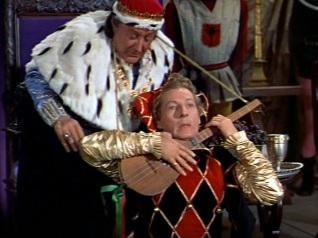
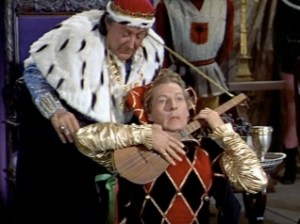
"Sing what you like, Fool. Just make sure I laugh."

“Sing what you like, Fool. Just make sure I laugh.”

In days of old when knights were bold, it is said, the King’s Fool was able to safely say outrageous, disrespectful things to the sovereign that might get anyone else drawn and quartered. This lucky exemption came to be known as the Jester’s Privilege, and it existed, and exists, for valid reasons. Humor, satire and all the other permutations of comedy are essential to societal sanity, and it makes sense to give the broadest discretion to practitioners of the craft in their efforts to provoke laughter—which is, as Reader’s Digest still reminds us monthly, “the best medicine.” That means that comics should not fear decapitation if their inspiration of the moment fails to provoke the desired mirth, or touches an audience member’s sensitive areas. In addition, the jester is sometimes able to expose a truth that will not be reached any other way.

It sounds like a good rule, and it is a good rule, but as with most ethics-related rules, applying it is difficult. Who gets the Jester’s Privilege…only professional comics, or does it apply to amateurs too? What about non-jesters just trying to be funny? “It was just a joke!” is a classic excuse invoked by insensitive and vicious people, including politicians, when they say something outrageous, as they try to use the privilege without a license, and in so doing, make it less effective for the humorists who really need its protection. Not everyone should assume that they have the full armor of the Jester’s Privilege. Mockery and ridicule are too often used as political weapons of targeted destruction.

Should some subjects be exempt from the Jester’s Privilege? The official position of comics, comedians, wags and wits has long been “No,” but even in Ye Olde Days, jesters sometimes went too far, and ended up with their heads on pikes. The problem any humorless king had after doing this, of course, was finding a jester willing to hazard a joke more edgy than “Why did the king cross the road?” For that reason, I think it’s vital that the Jester’s Privilege be strong and a near absolute. The sin that matters is not being funny, which means topics of unusual sensitivity take care of themselves.For centuries, for example, comics imitated and mocked those afflicted with speech impediments, especially stuttering, with big laughs guaranteed. Somewhere along the line, though, Porky Pig stopped being funny. The absence of laughs was enough to retire him; no heads had to roll.

On NBC’s New Year’s Eve show, the following exchange occurred between host Carson Daly, comic actress Jane Lynch and rising comedienne Natasha Leggero:

CARSON DALY: SpaghettiOs on Pearl Harbor Day, they sent out a tweet featuring their mascot holding an American flag asking people to quote “take a moment to remember #PearlHarbor with us.” It offended a lot of people, corporations glomming on to, you know, sentimental American historic traditions, seemingly looking for people in business. It wasn’t good. But you were offended for another reason.

JANE LYNCH: I’m offended because they were referring to SpaghettiOs as pasta.

NATASHA LEGGERO: I mean, it sucks that the only survivors of Pearl Harbor are being mocked by the only food they can still chew. It’s just sad.

Hilarity ensued, as the NBC gang laughed uproariously. Almost immediately, Leggero was getting flamed all over the social media and the wbs for denigrating the Greatest Generation. Steve Martin, I assume, would have humbled himself and apologized immediately, but not Leggero. Continue reading

The “I ♥ Boobies” Saga

boobies bracelet

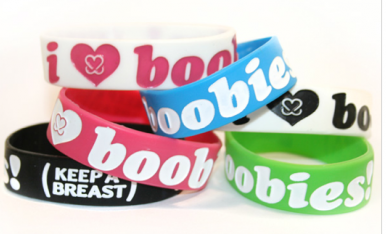
Some time in the foreseeable future, we may have the pleasure of reading the various opinions of sages like Antonin Scalia and Ruth Bader Ginsberg regarding the import of bracelets bearing the message, ” I  ♥ Boobies,” and whether it is a constitutional violation for public schools to ban students from wearing them. In August, the Third Circuit U.S. Court of Appeals rejected Pennsylvania’s’ Easton Area School District’s  prohibition of the breast cancer awareness bracelets on the grounds that they were potentially disruptive and inappropriately vulgar.

In late October, the District voted  authorize the district’s solicitor to file a petition with the U.S. Supreme Court seeking to have the high court hear arguments in the case. The controversy has been going on for three years, has cost the district  thousands of dollars in litigation costs that should have been spent on education, and will result, you can bet, in even more egregious expansion of vulgar language in the schools.

This easily avoidable Ethics Train Wreck occurred when two middle school students in Easton wore the bracelets to school with their parents’ permission despite a school ban that called them “distracting and demeaning.”  ETHICS FOUL #2  School is about learning and facilitating learning, not making an effort to intentionally pick fights  in the shadowy realm of First Amendment law. Why did the parents do this? Are the provocative bracelets really essential school fare? Will their presence in the schools have a measurable impact on breast cancer awareness? Was the ability of the girls to wear the bracelets, and their opportunity to bend the school to its will worth all the cost, time and disruption this defiance of a dress code was likely to cause a legitimate utilitarian trade-off?  I don’t think so. Continue reading

Annals Of The Ethics Incompleteness Theorem: The Snuggle House And “The Dress Code Effect”

Awww! Who could object to a little snuggle?

Awww! Who could object to a little snuggle?

Almost any rule, low or ethical principle can be deconstructed using what I call border anomalies. The first time I was aware of it was as a Harvard freshman in the late Sixties, when all assumptions, good and bad, useful and not, were considered inherently suspect. The college required all students to wear jackets and ties to meals at the student union, and up until my first year, nobody objected. But that fall, my classmates set out to crack the dress code, so they showed up for meals with ties, jackets, and no pants, or wearing belts as ties, or barefoot. (Yes, there were a lot of future lawyers in that class.) Pretty soon Harvard gave up, because litigating what constitutes ties, jackets and “proper dress” became ridiculously time-consuming and made the administration look petty and stupid. Of course, there are good reasons for dress codes—they are called respect, dignity, community and civility—-but never mind: the dress code couldn’t stand against those determined to destroy them by sending them down the slippery slope.

If any rules are to survive to assist society in maintaining important behavioral standards, we have to determine how we want to handle the  effects described by  the Ethics Incompleteness Theory, which holds that even the best rules and laws will be inevitably subjected to anomalous situations on their borders, regarding which strict enforcement will result in absurd or unjust results. The conservative approach to this dilemma is to strictly apply the law, rule or principle anyway, and accept the resulting bad result as a price for having consistent standards. The liberal approach is no better: it demands amending  rules to deal with the anomalies, leading to vague rules with no integrity—and even more anomalies. The best solution, in my view, is to regard the anomalies as exceptions, and to handle them fairly, reasonably and justly using basic principles of ethics, not strictly applying  the rule or law alone while leaving it intact. Continue reading

“Rubbish” and Ethics

That's me!

That’s me!

Cognitive scientist and philosopher Daniel Dennett has a brilliant and original mind. One of the seven tools he advocates (in his most recent book) for those of us who want to think more clearly and make better use of our time caused me to reflect on one of the most persistent criticism I receive about Ethics Alarms. one of America’s foremost thinkers. Here are the seven, with a sample of Dennett’s comments about them:

1. USE YOUR MISTAKES

“Try to acquire the weird practice of savoring your mistakes, delighting in uncovering the strange quirks that led you astray. Then, once you have sucked out all the goodness to be gained from having made them, you can cheerfully set them behind you and go on to the next big opportunity. But that is not enough: you should actively seek out opportunities just so you can then recover from them.”

2. RESPECT YOUR OPPONENT

“Just how charitable are you supposed to be when criticizing the views of an opponent? If there are obvious contradictions in the opponent’s case, then you should point them out, forcefully. If there are somewhat hidden contradictions, you should carefully expose them to view – and then dump on them. But the search for hidden contradictions often crosses the line into nitpicking, sea-lawyering and outright parody. The thrill of the chase and the conviction that your opponent has to be harboring a confusion somewhere encourages uncharitable interpretation, which gives you an easy target to attack….” Continue reading

Jordan Sheard And The No-Capital Punishment Slippery Slope

Ah, come, on, show some compassion! All he did was set a guy on fire for being gay! Anyone can make a mistake!

Ah, come, on, show some compassion! All he did was set a guy on fire for being gay! Anyone can make a mistake!

One of these days, when CNN’s designated miracle-worker Piers Morgan (because making Larry King look brilliant is a miracle) is extolling the superiority of the land of his birth over the stupid, violent, individual rights-obsessed U.S., someone should ask him about Jordan Sheard. Sheard, a sadistic 20-year old bully, set his sights on a young gay man, Steven Simpson, whose offenses included, in addition to his sexual orientation,  a speech impediment, epilepsy and having Asperger’s  Syndrome. Sheard forced Simpson to strip down to his underwear and wrote gay slurs over his body, covered him with tanning oil, and set him on fire.

At his birthday party. Continue reading

Hand-Out Ethics: Buying Junk Food With Food Stamps, Or A Leap Down The Slippery Slope?

Maybe I got something out of law school after all.

11-nanny stateWhen I read opinion columnist Charles Lane’s lament that food stamp regulations didn’t limit the kinds of nourishment that could be bought by them to things Mrs. Obama would approve of, my mind flew back many decades to a memorable Contracts class in my first year of law school. The late Professor Richard Alan Gordon was thundering in his most stentorian tones—and boy, did he have stentorian tones!— about the class reaction to a case we had just discussed involving a Washington, D.C. family on welfare that had gotten itself in legal trouble by purchasing a stereo system on credit. One poor student was the target of the verbal barrage, having just opined that the family should have spent its government assistance on necessities like food, and not entertainment.

“And who are you, Mr. Anderson, to make the determination of what is a “necessity” for a fellow citizen? Shall the family in question not be permitted to feed its soul, as well as its gut? Is it the attitude role of the government to assume that accepting its assistance in dire circumstances involves one’s surrender of the basic human rights of choice, preference, taste and self-determination?”

I miss Dick Gordon, who became a cherished friend (and a terrific Learned Judge in “Trial by Jury”), and I miss the scathing letter he would have written to Charles Lane. In his column, Lane writes:

“The point is to increase the amount of real nutrition per taxpayer dollar. The counterargument is that it’s not fair to restrict poor people’s grocery choices. You hear this a lot from the food and beverage industry, for which SNAP has grown into a significant subsidy. Sorry, I don’t get it — morally or pragmatically. Of course the federal government should be able to leverage its purchasing power for socially beneficial purposes. If you take Uncle Sam’s help, you play by his rules. I repeat: This is a nutrition program, or so the taxpayers who fund it are told. It should nourish.”

“If you take Uncle Sam’s help, you play by his rules.” This is the crux of Lane’s argument, Mr. Anderson’s, and all the Nanny State advocates who cheer on Mayor Bloomberg’s assault on personal freedom. Ethically, there are strong arguments in all directions: Continue reading

Social Science, Group Research and Bigotry: The Most Slippery Slope

Typical...

Decades ago, Arthur Jensen became a target of critics and a pariah in his field by publishing a controversial study that indicated that differences in racial performance on intelligence tests probably had a genetic component. He was, and is, called a racist, though Jensen has continued to produce respected research. Since the publication of the 1969 Harvard Educational Review article that made him infamous, Jensen has won the prestigious Kistler Prize in 2003 for original contributions to the understanding of the connection between the human genome and human society.

The problem with Jensen’s research results, whatever the legitimacy of the data and his methods, was this: What do you do with it? Like other studies that show women, as a group, with less aptitude for the sciences, or those that show superior traits in other races and ethnic groups, this information just serves as a catalyst for bigotry. Whatever the trends within a large group may be, they tells us nothing about any individual in that group. Yet the existence of a study creates a natural tendency to apply the claimed group characteristics to every group member. Most people think like that, always have and always will. This is similar to the problem with stereotypes. Many, perhaps most, stereotypes have some truth in them. I was raised in a Greek family, and Greeks are reputed to be clannish, cheap, bigoted, and gifted in the kitchen. Well, that would describe a large proportion of my relatives, too, but not all of them. My Aunt Bea is fanatically liberal. My Mom couldn’t cook a lick.  All right, they all were cheap, but the point is that it would be foolish and unfair to assume what any of them would be like without knowing them.

Knowledge is an absolute good, but perversely, some knowledge also guarantees abuse, and thus results in more bad than good. Jensen’s study, as far as I can see, has no good use in a democracy where every individual has the right to be assessed according to his or her conduct and character. Nor do any studies that “prove” character or ability differences in broadly defined groups.

This is all a prelude to my conclusion that the now widely publicized National Academy of Science study that has this conclusion-“Higher social class predicts increased unethical behavior”—is just throwing gasoline on a fire, and has no useful or benign purpose at all. Continue reading

The Fat Kid, the Slippery Slope, and the Cliff

"Bill! They're putting me in foster care! How will you make THAT funny?"

Several recent ethics issues have raised the slippery slope question, which is itself a slippery slope. The rationale for any reasonable principle or act can usually be ratcheted forward in degrees until it becomes malevolent, dangerous or repugnant, including freedom, trust, loyalty, charity and honesty. Thus the easiest argument, at least for the mentally dexterous, that anything is unethical is the dreaded slippery slope.

The simple rebuttal to this is usually “let’s wait and see.” To claim that conduct is unethical for what it might lead to rather than for what it actually does is often, perhaps even usually, based on an unwarranted assumption, or a worst case scenario specifically concocted to foil otherwise unobjectionable conduct. When it is not based on an unwarranted assumption, however, is when proposed conduct or a new policy permitting it shatters a social norm or cultural standard that had previously been considered sacrosanct. In these cases, the slope isn’t merely slippery—which suggests “Be careful where you step next!”—but greased, meaning there is no longer any traction at all to stop a rapid slide to the bottom. A better cliché to use in such cases is “opening the floodgates.” Or perhaps “off a cliff.”

The recent post about the Dartmouth researchers who suggested that all manipulations of graphic images of celebrities be labeled as such is, I would argue, more floodgates than slippery slope. There is no obvious delineation point to stop the principle behind this oppressive constraint on illusion from spreading far beyond its origin. Similarly, the argument being made by the family of the mother with Stage 4 cancer that US Air is ethically obligated to refund the non-refundable tickets they could not use because of her terminal illness has no clear limits or coherent application. Are the refunds required because the mother is terminal? If she goes into remission, would the family be obligated to give the money back? What if she was only paralyzed? If the whole family was squashed by a boulder, would the airline be obligated to refund the money to their next of kin? What if the mother wounded herself terminally in a suicide attempt—would that change US Air’s supposed obligation of compassion? If so, would that mean that if the mother’s Stage 4 breast cancer occurred because she neglected to follow a physician’s recommended treatment, US Air could then refuse to refund the money without being pilloried for it? Sometimes that greased slope carries us into a swamp.

Now from Cleveland comes the story of the 200 lbs. + 8-year-old Cleveland Heights boy who has been taken from his family and placed in foster care because county case workers decided that his mother wasn’t doing enough to control his weight.  Continue reading