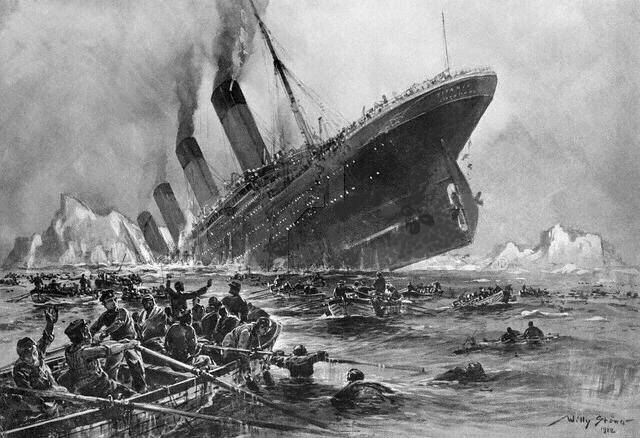
Another epic and irritatingly rational Comment of the Day from Extradimensional Cephalopod, this one on the thorny topic of discussing unlikely conspiracy theories with true believers. Almost all of E.C.’s contributions to Ethics Alarms topics are helpful and impressive; this is one of his—its?—best.
This is Extradimensional Cephalopod’s Comment of the Day on the post, “How Should We Deal With Friends Who Believe Ridiculous Conspiracy Theories?”:
Your friend has arrived at a conclusion that is based on, generously speaking, an implausible interpretation of the evidence surrounding the Titanic’s disaster. If he were looking at the evidence with no biases, he presumably would not have come to this conclusion. Therefore, I suspect that he has either an emotional attachment to the conclusion, or an emotional attachment to the process he used to reach it.
An person’s attachment to a conclusion might be as personal as a belief about what that conclusion says about them or someone they respect, or it might be as impersonal as preferring a more pleasant view of the world, such as one where disasters don’t just happen by accident.
An attachment to the reasoning process may be based on a fear of not having a good alternative reasoning process to turn to, a fear of what conclusions those alternative processes might lead to, or (similarly) an attachment to another conclusion that they arrived at through their current process. For example: “I have to believe this person wearing a cape is a bad person, because if people who aren’t bad can wear capes, that means that maybe I did a bad thing by attacking those other people for wearing capes.”
I’d like to talk with your friend and see how his worldview compares to what I suspect it is. My preliminary hypothesis is that your friend’s subconscious reasoning process is loosely based on the following premises, which I am not rendering judgment on at this time:



 Ethics Alarms
Michael West has written a remarkable Comment of the Day in several respects. For one thing, it is a comment on a post that is almost eight years old, a record for Ethics Alarms. For another, he becomes the first commenter to comment on the same post under two different screen names. Finally, there is the fact that his point is one with historic validity, yet seldom if ever mentioned by the many critics of James Cameron’s epic yet intermittently ridiculous film, including me. Follow the tag: there are a lot of references to “Titanic” here.
One note in prelude to Michael’s essay: the cruel misrepresentation he alludes to can be partially laid at the now dead feet of Walter Lord, who wrote the influential and popular account of the Titanic’s sinking, “A Night To Remember.” It is an excellent account, but he decided to use Charles John Joughin as comic relief, and the movies, including the one based on his book, distorted his portrayal, which itself seems to have been unfair.
Here is Michael West’s Comment of the Day on the 2012 post, “Titanic Ethics”