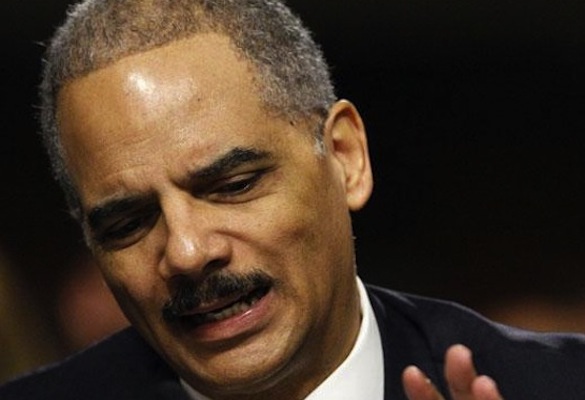
If Someone Praises The Job Eric Holder Did As Attorney General, That Tells You All You Need To Know

eric_holder_ap1

Eric Holder was the most political, biased, inept and undemocratic U.S. Attorney General  in at least 70 years, with the  exception of Nixon’s AG, John Mitchell, who went to jail. And the Attorney Generals have been uniformly terrible in this period; being one of the two worst takes talent, determination, broken ethics alarms and wretched judgement.

Those who praise Holder either are doing so without any idea about his record, or because they want the justice system in the United States to be racially and ideologically biased. The results of the latter, which is Holder’s real legacy, can be seen in the rising distrust between races, and the frequent description of Holder as being Obama’s “scandal goalie.”  The latter isn’t completely fair, because the news media has also been the President’s scandal goalie. The proof: few of the mainstream media retrospectives on Holder’s tenure mentioned the Justice Department’s refusal to hold a thorough and open investigation of the still unfolding I.R.S. scandal, which should have, and under any Republican administration, would have, included an independent prosecutor, because the news media would be screaming for one. This abdication of duty and naked partisanship by Holder alone condemns him. Unfortunately, there is a lot more.

You can begin with the “inside baseball” reports that Justice, under his administration, is a confused mess. That’s hardly surprising, for since the President eschews management and oversight, this is the tendency up and down the system. Without well-regulated policies and oversight, partisan meddling flourishes.

I have neither the time nor the energy to detail each and every example of Holder’s toxic racial and partisan biases, or his flat out ineptitude; there are too many to list, and I am sure I don’t know about some whoppers. Never mind: a fraction of the list would have made the resignation of any other Attorney General mandatory and beyond debate.  Holder is black, and this guaranteed that short of setting fire to the Supreme Court, he would only leave when he was ready. That alone is disgusting.

Here are some other Holder achievements:

1. “If Holder had his way, Khalid Sheikh Mohammed, the mastermind of the Sept. 11 terrorist attacks, might now be on death row,” says ABC. This is the media spinning for Holder: his efforts to have the terrorist tried in New York City was when I first realized how out of his depth he was.

In the contentious Congressional hearings on the matter, Holder told the nation that“Failure is not an option. These are cases that have to be won.” “That have to be won”? Failure, as in acquittal, is “not an option”? This was a confession of the muddled, simultaneously alpha and omega false logic that would become a hallmark of Obama World. Holder proclaimed that the world had to see the United States give its enemies a fair trial, then told Congress that the “fair trial” he was proposing was a show trial,  a kangaroo court, in which justice meant a guilty verdict. It was a stupid, stupid thing for any lawyer, much less an Attorney general to say. Tragically, it was no aberration.

2. Holder refused to defend the Defense of Marriage Act, though it was a law passed by Congress and signed  by a Democratic President. I think he should have been impeached for that. Slate, among others, says that he was “vindicated” because the Supreme Court held the law unconstitutional. They didn’t vindicate his refusing to do his job. It is not the prosecutor’s duty to veto laws duly passed by the legislature and signed into law, nor should he have the power to do so. Holder’s precedent took a bite out of the rule of law, and stood for stunning arrogance. He viewed DOMA as a civil rights incursion: gee, what other laws don’t you like, sir? We found out: he didn’t like drug laws, because he sympathized with the poor, black criminals that tended to violate them. His solution? Minimize the penalties, and send the message that abusing illegal drugs was no big deal. Democrats wanted to curry favor with the Hispanic-American voting bloc? Holder was eager to assist by not enforcing the Federal laws, and by doing everything he could to prevent the states from policing illegal immigrants as well. In a system of laws, favoring authorities that pick and choose which to enforce according to their political beliefs is endorsing obstruction over process, and politics over justice.

3. When acting unconstitutionally suited Holder’s partisan masters, however, he would do it. In 2013, the Justice Department  seized Associated Press phone records, and monitored Fox News reporter James Rosen following a story he published in 2009 on Iran.

4. Holder oversaw specious and intellectually dishonest justifications for the U.S. policy of assassinating suspected terrorists without providing them with a trial, and or any evidence that they were planning imminent attacks. By defining the word imminent in the broadest possible way, this advocacy for the elimination of due process equaled the worst deceits of the Bush Torture Memos, the only difference being an official pass from the Obama-enabling press. The policy, basically a license to murder, ensured that assassinations could be carried out against anyone who the U.S. government feared if the person was located on foreign soil and could not be captured.

5. Then there is Operation Fast & Furious, the proof positive that Holder was going to get away with anything and everything. The Bureau of Alcohol, Tobacco, Firearms and Explosives lost an estimated 1,400 weapons in Mexico, among them: two guns that were used to kill U.S. Border Patrol agent Brian Terry in December 2010.  Holder is the supervisor of the ATF, but testified before the House Judiciary Committee that he had only known about the sting named “Operation Fast & Furious,” for a few weeks. Then investigators uncovered memos on Fast & Furious sent to Holder in July 2010. A reasonable conclusion was that Holder had lied under oath. Oh, no, Holder “explained,” he never read the memos. He was incompetent, not culpable. Despite all evidence to the contrary, Holder indignantly denied a DOJ cover-up, saying that“This operation was flawed in concept, as well as in execution,”  and refusing to be held accountable for his own department’s deadly botch. Bolstered by Obama’s assertion of executive privilege, which prevented future prosecution, Holder refused to turn over documents related to the fiasco. Congress held Holder in contempt in June 2012, and he thoroughly deserved it, because the American people had a right to know the extent of the bungling in the highest reaches of the Obama Administration.

6. Although the supporters of Holder claim that his legacy was built on a dedication to civil rights, this was only in the narrow areas where the Democratic Party saw political advantage. He was not concerned, for example, in the civil rights of Americans when the government wanted to use modern surveillance technologies to spy on them. In the 2012 Supreme Court case U.S. v. Jones, Holder’s Justice Department argued that the police did not violate the Fourth Amendment by attaching  GPS devices to cars so they could know where they were going and where they had been, with that evidence used to acquire evidence. incriminate, try and imprison.  The Supreme Court rejected that position unanimously, because it was a mark of a burgeoning police state.

7. When Democrats wanted to create racial divisions, however, to rile up the base, Holder reported for duty. He assisted the unconscionable effort, still ongoing, by Democrats to characterize a responsible and necessary protection of the integrity of the voting process—photo IDs—as a racist plot, though the measure had long ago been approved by liberals, and only recently became stigmatized as “voter suppression.”

8. Holder’s major wound that he inflicted on the nation was his clear intention to project the image of a black Attorney General whose concern was minorities, whose assumption was that whites were the enemy, and whose biases were front and center. An early cue was his department’s abandonment of charges against two New Black Panthers who stood armed outside a Philadelphia polling place. The controversy, assisted by the media, devolved into an argument over whether this was an example of Justice receiving orders from the political Machiavellis in the White House, or just a lousy, bigoted example of “discretion.” A long official investigation found the latter, but either way, the message sent to white Americans was that this Justice Department was not especially interested in protecting their rights. In the Trayvon Martin shooting and the Ferguson episode, two local issues that should not have been his concern, Holder made statements, engaged in gestures and took actions that signaled his allegiance to the black victims, and opposition to the white (or “white Hispanic”) individual accused. He repeatedly spoke collaboratively before Sharpton’s followers, endorsing their diagnoses of a racist nation, and, by extension, a white population aligned against African Americans. Especially revolting was his repeated attempts to duck legitimate accountability for, you know, being terrible at his job, by race-baiting, such as when he explained Congressional criticism of his handling of Fast & Furious—a career-ender for any white Attorney General, or an appointee of any President who believed in accountability, by saying in 2011…

“This is a way to get at the president because of the way I can be identified with him, both due to the nature of our relationship and, you know, the fact that we’re both African-American.”

It shouldn’t have to be said, but I’ll say it anyway: the job of Attorney General, like the job of President, must be, and must be seen as being, absolutely neutral regarding race. Holder intentionally projected himself as an AG who cared more about minorities than non-minorities, increasing distrust, undermining respect in the justice system, and dividing the nation.

9. Not that he wasn’t feckless and incompetent too: for example, Holder’s Justice Department, almost certainly to ensure later campaign support, allowed multiple corporate criminals to escape serious punishment. For example, the Justice Deportment made a ridiculous plea deal to allow Halliburton executives to avoid jail time after they destroyed evidence of their culpability in the Deepwater Horizon oil spill. The company agreed to pay the maximum allowable fine of $200,000, accepted  a three-year probation;  continued its cooperation with the government’s criminal investigation (which it had to anyway), and  made a voluntary contribution of $55 million to the National Fish and Wildlife Foundation to clean off those oil-covered sea birds and otters. It could do this with the confidence that hard-core Democrats, being total hypocrites, would still attack the Republican party as a cadre of soulless corporate fat cats and insist that any criticism of Holder’s Justice Department and his boss’s administration was rooted in racism.

And again, the amazing thing is: That’s not all.

Any politician, elected official, pundit, columnist, civil rights leader or President who declares that Eric Holder was a wonderful public servant and a great American is telling you one of three things, or all of them:

  • They are liars.
  • They don’t know anything about Eric Holder, or
  • They believe the integrity of the nation’s laws should be warped and the public trust should be forfeited for a race-based, partisan agenda.

I don’t know about you, but I’ll be taking names.

Question: Why Is Supporting The Use Of Children As Soldiers Better Than Using Torture In Interrogations?

child-soldier5

The Child Soldiers Prevention Act of 2008 requires the United States to withhold any form of aid from nations that use children in their armies, a clear human rights violation.  President Obama  waived the provision in 2010, as Samantha Power, then the National Security Council senior director for multilateral affairs and human rights, assured the media and the nation  that “the waivers would not become a recurring event.” By the terms of the law, the President has to notify Congress that he is waiving it within 45 days of making the decision. Monday afternoon, with Congress on the eve of a government shutdown and knowing that any such announcement would be largely ignored by the public and the press, the White House press announced yet another waiver of the law The new Child Soldiers Prevention Act waiver applies fully to Chad, South Sudan and Yemen. Congo and Somalia received partial waivers.

Here’s the text of the Presidential determination, signed by Mr. Obama: Continue reading

Incompetent Elected Official Of The Month: New York State Senator Greg Ball (R)

Trust me, guys, you really don't want to vote for Greg Ball again...he's embarrassing your district.

Trust me, guys, you really don’t want to vote for Greg Ball again…he’s embarrassing your district.

Every now and then, a public official says something so brain-meltingly ridiculous that I wish I had a traditional blog and could write, “What an idiot!” and leave it at that.  This is one of those times.

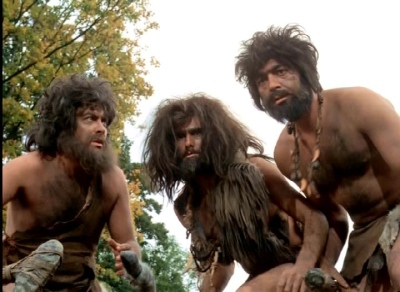
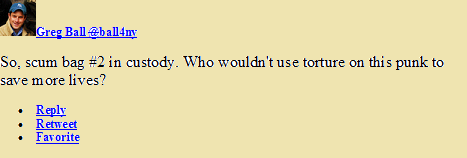
Republican New York State Senator Greg Ball must represent the troglodyte section of New York—you know, that famous district heavily populated with prehistoric cave-dwellers who were discovered frozen in 1989, thawed out alive, and became politically active?—based on his unapologetic,nail-spitting, un-American tweet regarding the younger, surviving terrorist brother who engineered the Boston Marathon bombing:

Ball

What an idiot.

No, no, I can’t say that.

This is an unethical tweet. It’s an irresponsible tweet. Supporting torture “to save more lives” explicitly rejects the principles of the Declaration of Independence as well as the Constitutional requirements of Due Process and the Bill of Rights prohibition against cruel and unusual punishment and compelled testimony against self-interest. The “anything to save more lives” illogic, though recently adopted, to his shame and disgrace, by the presumably less idiotic President Obama in his quest for more gun regulations, is, of course, the open door to martial law and the permanent trade of liberty for security. I wrote about this at some length in the wake of the Abu Ghraib fiasco; reading “The Ethics of American Torture” again now, I would hold the same today, as would, I hope, most of you. (Don’t bother to read this, Senator Ball; it’s more than 140 characters, and you wouldn’t understand it anyway.) I wrote in part, Continue reading

Comment of the Day: “From ‘Psychology Today’: How To Be A Better Liar—And A Negligent Endorsement Of Deceit”

Every adult a lawyer: the politician's worst nightmare!

Every adult a lawyer: the politician’s worst nightmare!

The second Comment of the Day comes from Australia, as zoebrain flags an excellent example of deceit at work, in her comment to my post about the dangerous tendency to regard deceits as less unethical than straightforward lying, and yes, that’s quite an oxymoron.

One of the many points of contention between me and the lawscam crowd is that many of the aggrieved out-of-work and under-employed lawyers only obtained their law degrees as a means to achieve what they believed were guaranteed riches, and thus feel cheated that the current economic mess has shown that to be a false assumption. I, in contrast, assert that a law degree pays for itself over a lifetime regardless of whether or not it leads to well-compensated employment as a lawyer, and one of the reasons is that legal training inoculates you against the deceit of others. If nothing else, law students learn to pay attention to what words really mean, making it much harder for masters of deceit to fool them with carefully chosen weasel words. A nation of citizens trained in the law would not so easily fall victim to the deceit of politicians, those who peddle bad loans and investments, weight loss scams (“results not typical!”) and the predations of other con-artists….including, sadly, other lawyers.

Here is zoebrain’s Comment of the Day on the weekend’s post, “From ‘Psychology Today’: How To Be A Better Liar—And A Negligent Endorsement Of Deceit”:

“Here’s an example for you: testimony in an Australian Senate inquiry on same-sex marriage”:

Senator Pratt: But what if someone is of indeterminate gender? I am unclear whether they should have the right, according to the way you would argue it, to be part of such a union.

Mr Meney : People suffering from Turner syndrome, Klinefelter syndrome and things of that ilk are typically infertile or regarded as being mentally handicapped in some way. Many things about marriage require people to have the capacity to consent to what marriage is all about, so a significant mental incapacity might be something that might mitigate against a person being able to consent to a contract of marriage. But that is true of any marriage.

Every word true, as befits testimony from the Director of the Life, Marriage & Family Centre, Catholic Archdiocese of Sydney.

“Although they are not mentally retarded, most XXY males have some degree of language impairment. As children, they often learn to speak much later than do other children and may have difficulty learning to read and write.”

——Understanding Klinefelter Syndrome — National Institute of Child Health and Human Development.

“Mental retardation is not a feature of Turner syndrome, despite such claims in older medical textbooks. Thorough psychological studies show that these women are normal intellectually, but often have a characteristic pattern of intellectual functioning. While their verbal 10 usually is average or above, their non-verbal IQ may be considerably lower because of problems visualizing objects in relation to each other. This difficulty may show up in poor performance in math, geometry, and tasks requiring manual dexterity or sense of direction.”

—–Turner Syndrome — Human Growth Foundation.

He didn’t lie: it’s true that “People suffering from Turner syndrome, Klinefelter syndrome and things of that ilk are typically … regarded as being mentally handicapped in some way.” They’re not, of course, as he well knows, but that’s not what he said, is it?

That was his defense when the Organisation Intersex International took him to task for this. He didn’t actually lie. As a good Catholic, he wouldn’t do that – it would be a sin.

______________________________

Graphic: Financial Post

From “Psychology Today”: How To Be A Better Liar—And A Negligent Endorsement Of Deceit

Tommy Flanagan

“Psychology Today” has tips for Tommy Flanagan and the other aspiring liars out there.

Jeff Wise provides what he calls “The Ten Secrets of Effective Liars” on the “Psychology Today” website. I have some problems with his list, among them that despite his protestations to the contrary, it sure reads more like a handy-dandy self-help list for the George Costanzas, Tommy Flanagans and Bill Clintons among us.

My main objection, though, is to his #3 on the list, #3 Tell the truth, misleadingly. He correctly points out that a statement that is technically true will often be the most effective way of misleading others, but writes, “Technically, it’s only a prevarication – about half a sin.” I don’t know or care about how it ranks on the sin scale, but he is describing deceit, and deceit is a lie, period, no question about it. Wise is passing on a misconception himself, one that allows the most effective and destructive liars among us deceive routinely and then rationalize that they “really weren’t lying.” Spreading this common, popular and useful—to liars—myth does more damage than any of the supposedly beneficial results of his list could make up for.

Among the sinister results of promoting deceit as only half a lie, and therefore twice as forgivable as a “real” lie, is that it gives deceit masters (like Clinton) an effective excuse when they are caught. “Oh! Oh, I’m sorry! When I said ‘I didn’t have sex with that woman,” you thought I meant that I didn’t use my superior power and influence to persuade my young female intern to give me a hummer! I should have been clearer!” Right. Thus the liar switches the real blame onto the listener who was originally deceived. If that listener likes the liar and was inclined to trust him (or her), the rationalization that it was all a big misunderstanding will often be enough to allow the party deceived to keep trusting the liar…and be set up to be deceived again. Continue reading

Drone Ethics: The Policy and the Memo

Hey, Fox News! INCOMING!!!

Hey, Fox News! INCOMING!!!

With the leak of the Obama Administration’s Justice Department memo laying out  alleged legal and Constitutional justification for targeted drone killings abroad, the ethical debate over this practice finally began in earnest. Back in October of 2011, I visited this topic in a post titled, “The Ethically Messy, Legally Muddled, Drone Killing of Anwar al-Awlaki,” who was an American citizen and also an al-Qaida leader and terrorist, and wrote…

“I am far less confident of a conclusion that the killing was legal than I am that the killing was ethical in a situation where traditional rules and considerations don’t fit the situation well, meaning that decision-makers must go outside the rules to find the right, meaning ethical, course of action.  And I’m even not 100% confident of that.”

This still accurately encompasses my view, although my confidence in the position has declined materially, in part because of the memo. However, my position in 2011 was based on the assumption, using the Bush Administration’s position, that the United States was engaged in a de facto war with al-Qaida, and as a tool of war, killer drones  are within ethical bounds by my analysis. The leaked memo, however, begins with the assumption that the drone strikes are not part of ongoing declared warfare, but rather a new variety of cross-border lethal intervention that has no legitimate statutory basis. I think that under those assumptions, targeting drone killings are illegal, unethical, and to the extent that they give the President of the United States the power to kill someone in any nation based on his assessment that person needs killing, ominous.

I’ll leave the legal analysis of the memo to others. For now, other than pointing readers to my earlier analysis of drone killings in the context of warfare, I just have some observations: Continue reading

Comment of the Day: Ethics Bob Asks: “Did Torture Lead Us To Bin Laden”? My Answer: “So What If It Did? It Was Still Wrong.”

How did we end up discussing torture on Christmas Eve?

Sorry about that.

timebombHere is a stimulating comment by Zoebrain in the “Zero Dark Thirty” torture thread. I’m especially fond of it, because as theoretical and probably impossible as her resolution would be in practice, it neatly addresses the central problem conflict in the “torture is an absolute wrong but you might have to use it to save the world” scenarios, like the familiar “ticking bomb” hypothetical.  In her analysis. one violates the absolute rule, but accepts a proportional penalty for doing so.

I advocate a similar approach in legal ethics in situations where a lawyer decides as a matter of personal conscience that he or she must violate core legal ethics values, like keeping the confidences of a client, in furtherance of a higher objective not recognized be the Rules of Professional Conduct, such as keeping a serial killer from going free.

Here is Zoebrain’s Comment of the Day on the post, Ethics Bob Asks: “Did Torture Lead Us To Bin Laden”? My Answer: “So What If It Did? It Was Still Wrong.” Continue reading

Ethics Bob Asks: “Did Torture Lead Us To Bin Laden”? My Answer: “So What If It Did? It Was Still Wrong.”

It's all for the best.

It’s all for the best.

The last time my friend “Ethics Bob” Stone blogged about ethics, it was way back in August, and he was writing about some guy named “Romney.” Now he’s back on the job, thank goodness, with a comeback post titled “Zero Dark Thirty: Did torture lead us to Osama bin Laden?”. And he’s ticking me off.

“Zero Dark Thirty” is Hollywood’s treatment of the search, apprehension and execution of Osama Bin Laden. The film suggest that methods of torture were employed by the CIA to uncover crucial intelligence that led to the terrorist mastermind’s demise. Torture opponents, including some U.S. Senators, are alarmed by this, and disputing the film’s account. (Imagine that: a movie that misrepresents history!) Meanwhile, conservatives, neocons, Bush administration bitter-enders, talk radio hosts and admirers of Dr. Fu Manchu and James Bond villains are citing the film as confirmation that they were right all along: torture is a wonderful thing.

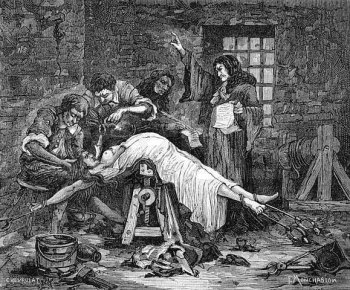
I am puzzled that Bob got in the middle of this debate as an ethicist. “It worked!” and “It came out all right in the end!” are not valid ethical arguments or justifications. The first is an embrace of a pure “the ends justify the means” rationale, a favorite tool of Auric Goldfinger and Dr. No. The other is consequentialism. When ethicists and principled opponents of torture allow the issue to be adjudicated on this basis, they are surrendering their principles at the outset. “Torture doesn’t work” is a pragmatic argument, not an ethical one. If the societal consensus regarding torture is going to be determined by how much we can benefit by returning to the rack and wheel, then ethical considerations have already been jettisoned. Continue reading

If You Liked “Enhanced Interrogation,” You’ll Love The “Disposition Matrix”

Is THIS the Administration’s secret weapon against terrorists?

The Washington Post launched a three-part series today about the U.S. drone strike program, in which terrorists abroad are targeted and assassinated from the sky. I’m not prepared to attempt an ethical analysis of this deadly tool against international terrorism, although I will acknowledge that my initial, gut level assessment is that the unique nature of terrorism requires adjustments in the ethics of national security and warfare, and drone killings seem to be a fair and reasonable adjustment.

Yet it is still killing. It is also controversial, with many human rights activists, international law specialists and ethicists vehemently condemning the tactic, especially when used against turn-coat Americans abroad without due process of law. Consequently, the Post’s revelation that the Administration’s “kill list” is called something else rings the ethics alarms.

The Post:

“Over the past two years, the Obama administration has been secretly developing a new blueprint for pursuing terrorists, a next-generation targeting list called the “disposition matrix.” The matrix contains the names of terrorism suspects arrayed against an accounting of the resources being marshaled to track them down, including sealed indictments and clandestine operations. U.S. officials said the database is designed to go beyond existing kill lists, mapping plans for the “disposition” of suspects beyond the reach of American drones.” Continue reading

Ethics Hero Emeritus: Eric Lomax, 1919-2012

Eric Lomax was a hero of forgiveness.

Eric Lomax, his book, the Bridge on the River Kwai,, and his friend, the man who tortured him.

In 1942, Eric Lomax, was a 19 year old  member of the British Royal Corps of Signals stationed in Singapore when he joined thousands of British soldiers in surrendering to the Japanese. It was 1942. He was one of those shipped to Thailand and became one of the slaves laboring to build the Burma Railway, also known as the Death Railway. The building of the railroad and the brutal treatment of the English prisoners by their Japanese captors  formed the plot of the classic 1957 David Lean film, “The Bridge on the River Kwai,”

After Lomax was discovered to have built a radio receiver from spare parts, he was mercilessly tortured and interrogated by his captors.  After his release, fantasies about murdering his main torturer, a man named Nagase Takashi, obsessed him. Lomax spent the early years of his retirement in the 1980s looking for Takashi, and eventually learned that he had become an interpreter for the Allies after the war. In 1992, he stumbled across an article profiling Nagase and noting that he was haunted by guilt over his mistreatment of one British soldier. That soldier, Lomax realized, had been him. He arranged to meet the man who tortured him, and whom he had spent the rest of his life dreaming of murdering.

Torturer and victim met in 1993, on the infamous bridge Lomax had been forced to help construct (and which was not blown up, the film ending notwithstanding). Continue reading