Afternoon Ethics Jolt, 8/3/2018: A Lawyer Finds A New Way To Be Unethical, Verizon Makes Our Kids Obnoxious And Ignorant, And The Times Decides To Show Its Colors…


Good…afternoon.

Yes, I couldn’t get this up before noon again. Mornings have been crazy lately. And no, I’m not at the beach…I just WISH I was at the beach.

1. A legal ethics “Kaboom! From the New York Times account of the litigation surrounding New York Yankee great Thurmon Munson’s death when his private plane crashed in 1979:

James Wiles, one of FlightSafety International’s lawyers at the time, still contends there was no culpability in Munson’s death on the part of either company. But a trial, he said, was just too risky…. Wiles, who was present for all the depositions…said that when Yogi Berra testified, he put a box of 24 baseballs in front of him and requested he sign them. Berra, who was a Yankees coach when Munson died, grudgingly obliged, but at one point asked if Wiles was authorized to make such a demand.

“It’s my deposition,” Wiles said he told Berra.

My head exploded after reading that. There is no rule I can find that declares such a blatant professional abuse unethical, unless it is the deceitful “It’s my deposition” response, which is literally true but falsely implies that the lawyer has the power to force a witness in a deposition to do something completely unrelated to the case for the lawyer’s personal benefit. Rule or no rule, this was incredibly unethical, and a perfect example of how lawyers will come up with ways to be unethical that they can’t be sanctioned for.

2. More on the New York Times’ new editor: Yesterday, I covered the astounding—but maybe not so astounding—appointment of far-left journalist Sarah Jeong as its technology editor despite a huge archive of explicitly racist and sexist tweets. The Times’ defiant explanation, a rationalization, really, stated:

“We hired Sarah Jeong because of the exceptional work she has done … her journalism and the fact that she is a young Asian woman have made her a subject of frequent online harassment. For a period of time she responded to that harassment by imitating the rhetoric of her harassers. She regrets it, and The Times does not condone it.”

Jeong’s statement was simply dishonest:

“I engaged in what I thought of at the time as counter-trolling. While it was intended as satire, I deeply regret that I mimicked the language of my harassers. These comments were not aimed at a general audience, because general audiences do not engage in harassment campaigns. I can understand how hurtful these posts are out of context, and would not do it again.”

The issue is not whether she will “do it again”—presumably even the Times wouldn’t stand for that, but whether her many racist outbursts online do not raise the rebuttable presumption that she is, in fact, a racist. Nothing in her statement tells us that she doesn’t believe such things as “white men are fucking bullshit,” only that she didn’t aim these comments at the general public.

I find it hard to believe that the even Times is so stupid and arrogant that it will dig in its metaphorical heels and refuse to admit its gross mistake. As Glenn Reynolds writes today, Continue reading

Ignore The Spin: It Was Unethical For Michael Cohen To Secretly Record His Client, Donald Trump

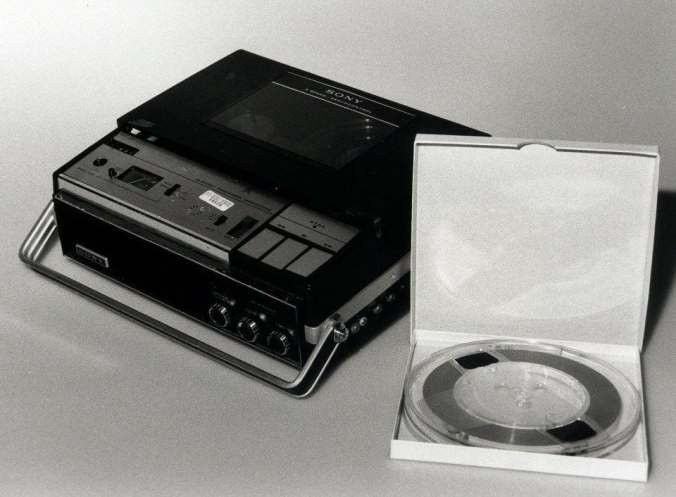
This morning the Washington Post tries to spin the clear ethics violation by Michael Cohen when he surreptitiously recorded his client, Donald Trump, when his client didn’t know or have any reason to suspect that such a recording was taking place. It was unethical. I have never spoken to a lawyer or ethics authority who didn’t believe such a recording would be unethical, at least until such an ethics breach was made against this particular betrayed client. Now, since the legal profession is one of many that have abandoned integrity and professional standards in the fever of anti-Trump madness, I’m sure several, maybe many, will change their tune. You know: they don’t want their friends to be angry with them.

Yes, Cohen’s taping was legal, because it occurred in New York, where only one party to a conversation has to know it is being taped. That is irrelevant to the ethics breach at issue. For a lawyer to tape a client secretly is always unethical. That’s my position, and I know of no persuasive argument against it. The Post article says that the matter isn’t clear cut. Oh yes it is.

Until 2001, there was little dispute that a lawyer was violating Rule 8.4, which pronounces it misconduct for a lawyer to engage in misrepresentation, dishonesty, fraud or deceit. Taping anyone secretly is misrepresentation. Does anyone want to dispute that? Try. If I am talking to you privately, and you do not tell me that I am being recorded, then you are representing to me that I am NOT being recorded, unless our previous conversations were recorded and I knew that. A few states just ducked the issue, and held that a lawyer could do what any other citizen could do in a state that made one party recordings legal. The American Bar Association, however, right through the 20th Century, held that it was per se unethical for a lawyer to surreptitiously tape anyone.

The absolutist position was an Ethics Incompleteness Principle accident just waiting to happen. In other words, there had to be exceptions, and since almost all states allowed District Attorneys to surreptitiously record suspected criminals without the threat of ethics sanctions, exceptions were already recognized. Thus, in 2001, the ABA revised its position with equivocal, muddled, Formal Opinion 01-422, “Electronic Recordings by Lawyers Without the Knowledge of All Participants,” which the ABA summarized this way:

A lawyer who electronically records a conversation without the knowledge of the other party or parties to the conversation does not necessarily violate the Model Rules. Formal Opinion 337 (1974) accordingly is withdrawn. A lawyer may not, however, record conversations in violation of the law in a jurisdiction that forbids such conduct without the consent of all parties, nor falsely represent that a conversation is not being recorded. The Committee is divided as to whether a lawyer may record a client-lawyer conversation without the knowledge of the client, but agrees that it is inadvisable to do so.

It does not “necessarily” violate the ethics rules because, the opinion explains (as various state opinions have as well), sometimes recording a third party serves the interests of justice, as when, for example, a client is trying to show domestic abuse, or when there is an allegation of illegal loan or housing discrimination. 01-422 wanders into Clintonesque rhetoric, however, when it states, Continue reading

Morning Ethics Warm-Up, 7/27/18: Welcome Nausea, Disillusionment, Guilt, And Apathy…

Well, it’s morning.

1. Nausea. This is a real headline from this morning’s New York Times:

Truce on Trade Follows Route Obama Paved; Trump Claims Victory in Crisis He Started

Gee, the Times morphed into Media Matters so slowly that I hadn’t noticed!* In fact I had noticed, but that headline is a virtual declaration that the Times is now a fully committed partisan organ of the Democratic Party, and is no longer even pretending to be practicing ethical or objective journalism. Not only does the headline represent opinion rather than reporting, the Times was so desperate to color the story of the European Union tentatively reaching a new trade agreement with the U.S. that it felt it had to project its bias before anyone could read the story.

*With a nod to blogger Glenn Reynolds, who uses this as a regular jibe

2. Disillusionment. Netflix has finally concluded “The Staircase,” the now 13 episode documentary following the bizarre case of novelist Michael Peterson, who was convicted of murdering his wife Kathleen in 2001. Directed by French filmmaker Jean-Xavier de Lestrade, the first eight episodes aired on the Sundance Channel in 2005 and were an immediate sensation. It would be unethical to spoil the story or the documentary for you if you haven’t seen it, but a couple of spoilers lie ahead.

Anyone who continues to argue that it is ridiculous and “treasonous” for anyone to challenge the competence, objectivity, motives and trustworthiness of law enforcement, including the FBI, and prosecutors after watching this horror show has astounding powers of selective outrage.

The series also made me want to throw heavy objects at the TV screen as a result of the lazy, passive, indefensible conduct of the prosecutors and the North Carolina judge, who resided over every iteration of the case for 15 years. Since there was no way a rational jury could find Peterson guilty beyond a reasonable doubt based on the evidence, ethical prosecutors would never have charged and tried Peterson. (A jury finding a defendant guilty on inadequate evidence doesn’t necessarily mean that the case was a just one.) It is especially infuriating for the viewer (so imagine what Peterson thinks) to hear the judge today blandly concede that two controversial pieces of evidence he allowed into the trial were, upon reflection,  unjustly prejudicial, and that he believes that there was ample reasonable doubt for the jury to acquit. Then he tries to make the argument that the “system works” based on a mess of a case and an investigation that still hasn’t explained how Kathleen Peterson died.

It does explain, however, why so many Americans don’t trust the justice system or the alleged professionals who run it. Continue reading

Ethics Dunce: ME. An Abashed Apology From Your Host…

It was the blog equivalent of coming home and finding that you left the bathtub water running.

At 6: 56 this morning, I read reader Marie Dowd’s comment that said,

“7: ‘This cover’ has no link and a search showed a cover with people in the spray of a fire hydrant?”

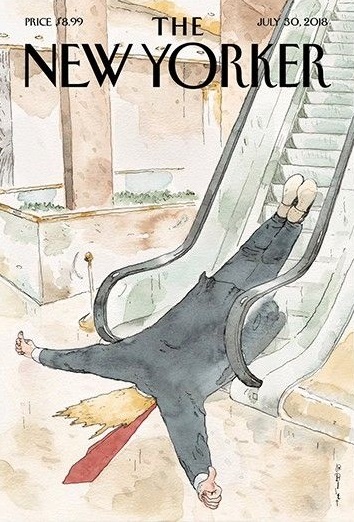
Initially I had no idea what she meant, and then, when it dawned on me, I rushed to check out yesterday’s Warm-Up while screaming “NOOOOOOOO!” in slow motion. Sure enough, I had never posted the New Yorker cover showing the President looking flat and arguably dead at the bottom of an escalator, and that was what I was writing about. Thus the post made no sense. Here, for anyone who cares, and apparently few did, is what was supposed to be shown. Does it make  sense now?

7. Is this New Yorker cover responsible?

It is perilously close to Kathy Griffin’s severed head: many read the image as the President being dead, and members of “the resistance” have openly alluded to Trump’s death or hope thereof over the past 18 months.  (Note the double thumbs up, however.) I rate the cartoon as well within the boundaries of political commentary, but, again, wonder what the reaction would have been if a similar image of President Obama was run on the cover…and it easily could have been, many, many times, with justification.

It’s fixed now, but 14 hours after I posted it. Continue reading

Comment Of The Day: “Ick Or Ethics? The Officers’ Coin Flip”

I haven’t posted a Comment of the Day this month, and it’s me, not you. I have a high quality backlog, in fact: my apologies. I’ll be working diligently to catch up.

First in the queue is Arthur in Maine‘s deft reflections on the post about the police officers who flipped a coin to decide whether or not to arrest a reckless driver.  (I tend to think that it is a very well-argued “Everybody does it” rationalization, but never mind…).

Here is his Comment of the Day on the post, Ick Or Ethics? The Officers’ “Coin Flip”:

When I was going to school in Boston, I made my beer money by working in emergency medical services. Part of that work was in a district of the city, and part of it was in the northern suburbs; the latter company was a private concern that had the EMS contract for three contiguous towns and did a boatload of transfer work on top of it. A terrible company, long since sold out, but that’s another story. Suffice to say that I liked the work itself, even if the company itself was lousy.

In that role, I came to know a lot of cops and firefighters really well. They weren’t that different from us, other than the fact that their jobs were a lot more dangerous than ours – and ours were dangerous.

First-response work requires that the teams work in very close proximity with one another, and teams are mostly together for their entire shifts. Depending on the branch, shifts can last between eight hours and 48 (yes, you sleep if there’s nothing going on). Inherent in a smoothly functioning unit in all three first-response disciplines is a good relationship between crew members; partners or teams at odds with each other become a huge problem. If they can, supervisory personnel will usually do their best to ensure that the personnel in a given car or truck get along well. It’s remarkably intimate. Continue reading

Saturday Ethics Warm-Up, 7/21/18: Seven Questions For A Rainy Day: UPDATED!

Good afternoon!

1. What did you expect? Following close on the heels of Scott Pruitt’s firing from the EPA as a result of blatant ethics violations, Commerce Secretary Wilbur Ross said last week that he would sell all of his stock holdings to “maintain the public trust” after the Office of Government and Ethics pointed out that his financial transactions could get him into legal trouble.

“I have made inadvertent errors in completing the divestitures required by my ethics agreement,” Ross said in a statement. “To maintain the public trust, I have directed that all of my equity holdings be sold and the proceeds placed in U.S. Treasury securities.”

To maintain that public trust. Right.

The culture of CEOs and business executives is so alien to ethics that this kind of thing was assured as soon as Donald Trump was elected President. I wouldn’t say the business culture is necessarily more unethical than the political culture, it is juts unethical different ways. However, President Trump brought this brand of malfunctioning ethics alarms with him, and we shouldn’t expect it to abate until he leaves the White House.

Then we will get back to the good old-fashioned political versions of unethical conduct we’re become numb to. Ah, those were the days!

2. A question of degree. Professor Brian McNaughton, a former professor at Colorado State University, is facing a felony charge for fabricating an outside job offer to get a higher salary. This meets the technical definition of fraud. Apparently he presented the school with fabricated offer letter from the University of Minnesota. McNaughton resigned his position and apologized, and returned the fruits of the ill-gotten  raise,  about $4,000 per year over four years.

He also says that he was urged to use the tactic by other faculty members, who said it was a standard ploy. When does the “I have other job offers” gambit cross the ethics line into fraud? Clearly when you use a forged letter, but short of that, it’s just lying—unethical, but not criminal.

Writes one idealistic commentator:

…if an employee is performing a job and is good at it, that person should be compensated for it accordingly and in line with individuals within the same organization at an equivalent level professionally (ideally pay should be bench-marked against similar-sized institutions in states or parts of the country with comparable income ranges). Does a job offer and the suggestion that the employee is desirable to another organization change how well that person is performing? Promotions and rewards should be directly related to performance and an individual’s contribution to the organization and to science.

Well, yes, but competition and reality interferes with this nice, fair but overly simplistic and impractical theory. In fields where employees are not fungible, basic economic theory comes into play: you can’t deny the influence supply and demand. The fact that there is competition for an individual’s services does increase that individual’s value. Just saying “it shouldn’t be that way” doesn’t change reality. That’s what makes McNaughton’s lie fraudulent: he’s misrepresenting his value, and using false means to do it.

3. Would you fire Dan Coats for this?

Naturally the anti-Trump mob loved it, and that was the director of national intelligence’s intent: he was playing to the mob and virtue signaling to the detriment of his boss. Either than, or he’s thoroughly unprofessional and can’t be trusted to be on TV. Washington Post reporter Dan Baltz is either foolish, naive or dishonest when he writes: Continue reading

Morning Ethics Warm-Up, 7/19/2018: The All-Denial Edition

Good Morning!

On this day in ethics, 1918: Washington catcher Eddie Ainsmith claimed that he should be deferred from the draft because he was a major league baseball player. Uh, nice try, Eddie, but no,  Secretary of War Newton D Baker ruled, as he tried to suppress uncontrollable eye-rolling..

1. “California, here I come!…here I come!…here I come!…” Oh. Never mind. The California Supreme Court took a measure off the ballot that would have allowed Californians to vote on whether the state should be divided into three smaller states, like this:

In its opinion, the Court argued that the changes demanded by the ballot measure exceeded California voters’ broad authority to enact laws by initiative, established in 1911. If enacted, the measure would have in effect abolished the state Constitution and all existing laws, which would have to be replaced by lawmakers  in the three new states. The measure would also alter the laws that define California’s boundaries, amending the state Constitution. That cannot be done by initiative, but instead requires approval by two-thirds of both houses of the Legislature to be placed on the ballot.

I know that the splitting up of California was a transparent effort to hijack the Senate by adding four more guaranteed Democrats. It was also doomed, since this plot would need to pass Congress and not be vetoed by the President. Still, wouldn’t something as obvious as violating the state Constitution arise before the wacko measure was placed on the ballot? How incompetent can you get? How much more incompetent can California get?

2. THIS will end well… Facebook claims that it will be removing false information from its pages when it threatens to cause violence, before it will cause violence. Sure, we all trust Facebook as an objective, trustworthy arbiter of speech, don’t we? Don’t we? Especially since they use the ever-reliable Snopes to check. During an interview with ReCode’s Kara Swisher, Mark Zuckerberg cited Holocaust denials as the kind of misinformation Facebook would allow to remain on the platform.  “At the end of the day, I don’t believe that our platform should take that down because I think there are things that different people get wrong,” Zuckerberg told Swisher. “I don’t think that they’re intentionally getting it wrong.”

He doesn’t? I’m not sure Holocaust denial is automatically eligible for Hanlon’s Razor; on the other hand, there are good faith idiots. Speaking of idiots, Zuckerman was surprised when his ignorant shrug sparked angry attacks like that of Jonathan Greenblatt, CEO of the Anti-Defamation League, who said, “Holocaust denial is a willful, deliberate and longstanding deception tactic by anti-Semites that is incontrovertibly hateful, hurtful, and threatening to Jews.Facebook has a moral and ethical obligation not to allow its dissemination.”  Continue reading

Nah, Snopes Isn’t A Spinning, Left-Biased Fake Fact-Checking Organization! OK, I’m Kidding, It Really Is. [UPDATE]

If you hear about a social media company of a media organization that cites Snopes and a reliable authority, that’s all you need to know. They’ll lie to you, just like Snopes, and probably to assist a progressive political agenda.

Here’s an especially blatant example of Snopes’ fake fact-checking, as opposed to what they claim to do, which is to check fake facts, from 2016. It’s actually pretty funny.

The fact being checked:

Bernie Sanders has been criticized as hypocritical for only paying his interns $12 an hour despite his campaigning to raise the minimum wage to $15 an hour.

Snopes’ unbiased and objective analysis:

WHAT’S TRUE: Bernie Sanders pays his interns $12 an hour.

WHAT’S FALSE: Bernie Sanders pays his staff workers $12 an hour.

Ah! It’s misleading to say that Bernie, who said during the campaign,

“Millions of Americans are working for totally inadequate wages. We must ensure that no full-time worker lives in poverty. The current federal minimum wage is starvation pay and must become a living wage. We must increase it to $15 an hour over the next several years.”

was a hypocrite who, as a meme circulating in 2016 claimed, he only payed his “staff interns” $12 an hour while simultaneously campaigning to raise the national minimum wage of $15.

Says Snopes, spinning like mad: Continue reading

Ethics Analysis: My CVS Confrontation

As with many ethics problems, the most important question to answer  is “What’s going on here?”

This is what happened.

I take quite a few drugs, some of which keep me breathing. My doctor now e-mails the full slate, usually a three-month supply, but with automatic refills, after every check-up. This time, I actually witnessed the prescriptions being sent. From the start, however, there was a screw up. The first three drugs I tried to get refills for turned up expired: there was no record of the directive from my doctor. Each time, the same thing happened: the CVS pharmacy automated line said the order “was being filled;” when I arrived to get it, I was told that the prescription had expired; I explained that they had a glitch in their system; one of the staff agreed (“Ugh! This ticks me off! Someone is automatically cancelling these orders!”); and I eventually got my drug, sometimes after giving me a partial refill and my having the doctor call CVS to confirm. The last time, however, the prescription I sought was ready. (They all had been e-mailed at the same time.) They also offered me another drug, and extremely expensive one, that I didn’t need immediately. I said I didn’t care to spend the money just then, and they told me they would hold it.

Yesterday I needed that drug, the previous supply having run out the day before. I had no opportunity to go to the pharmacy until nearly 9 PM, but it shouldn’t have mattered: the pharmacy during the week is open until the CVS closes at 10 pm, and I knew the prescription was ready, because of my previous visit.

But it wasn’t. The pharmacist, a young woman, told me that I had no valid prescription. “Nope,” I said. “Wrong.” And I explained what had been happening with my drugs, how I was told that the system glitch had been fixed, and also that I actually saw the filled prescription I now needed when I picked up my last prescription. AND, I said, firmly, skipping a day was not an option. This drug was one of the ones I could not skip.

Then the excuses started. Continue reading

Ick Or Ethics? The Officers’ “Coin Flip”

OK, it wasn’t really a coin flip, as many news sources inaccurately reported. And, true, there is no definitive evidence that the virtual coin flip two police officers allegedly resorted to in order to make the call whether to arrest a reckless driver or not actually was the reason they arrested her. It is even possible that they did the opposite of what the cell phone app told them to do.

Never mind. It’s still an interesting ethics story. I would make it an ethics quiz, except that I am sure of the answer.

Here is the background: In the city of Roswell,  outside of Atlanta on April 7,  Sarah Webb was running late for work. Police saw her go by at what they estimated was over 80 miles an hour, caught up to her, and told her she was diving recklessly, especially since the roads were wet.

She was arrested. Then it came out that this happened, (from the New York Times account):

In the footage of the arrest, the officers can be heard talking about what to do. One said that she had not been able to measure the exact speed of Ms. Webb’s vehicle but had to drive as fast as 90 miles per hour to catch up with her. Then she could be seen pulling out a phone.

“A, head. R, tail,” said one of the officers — A for arrest, or R for release.

“O.K.,” said the other.

Then a sound effect can be heard: a cartoonish chime and click, like a coin flipping and landing.

“This is tail, right?” said one officer.

“Yeah. So, release?” said another.

“23,” came the reply, referring to a police code for an arrest. Ms. Webb was handcuffed moments later.

In the aftermath, the charges were dropped and the officers involved have been suspended, with the police chief saying, “This behavior is not indicative of the hard-working officers of the Roswell Police Department. I have much higher expectations of our police officers and I am appalled that any law enforcement officer would trivialize the decision-making process of something as important as the arrest of a person.” Meanwhile, the reckless driver, in an exhibition that should at least be entered for the 2018 Gall of the Year award, is vocally claiming victimhood, saying, Continue reading