Law vs. Ethics #2: The Supreme Court Unanimously Says Colleges Can Use Tuition To Run A Professional Sports Business

In NCAA v. Alston, handed down yesterday, a unanimous Supreme Court ruled that the National Collegiate Athletic Association (NCAA) violated the rights of student athletes and the Sherman Antitrust Act by restraining colleges from compensating student athletes. Justice Gorsuch wrote the opinion, upholding the U.S. Court of Appeals for the 9th Circuit. Justice Brett Kavanaugh wrote a concurrence.

The decision was a slam dunk for the players. Gorsuch vivisected the NCAA argument that its compensation rules should not be subject to a “rule of reason” analysis because it is a joint venture to offer consumers the unique product of intercollegiate athletic competition. The NCAA has monopoly power in the market, Gorsuch explained, so it deserves no such deference. The NCAA’s argument that it should be exempt because it offers societally important non-commercial benefits is ridiculous on its face, and Gorsuch explained why.

Justice Kavanaugh’s concurring opinion went further:

Continue reading

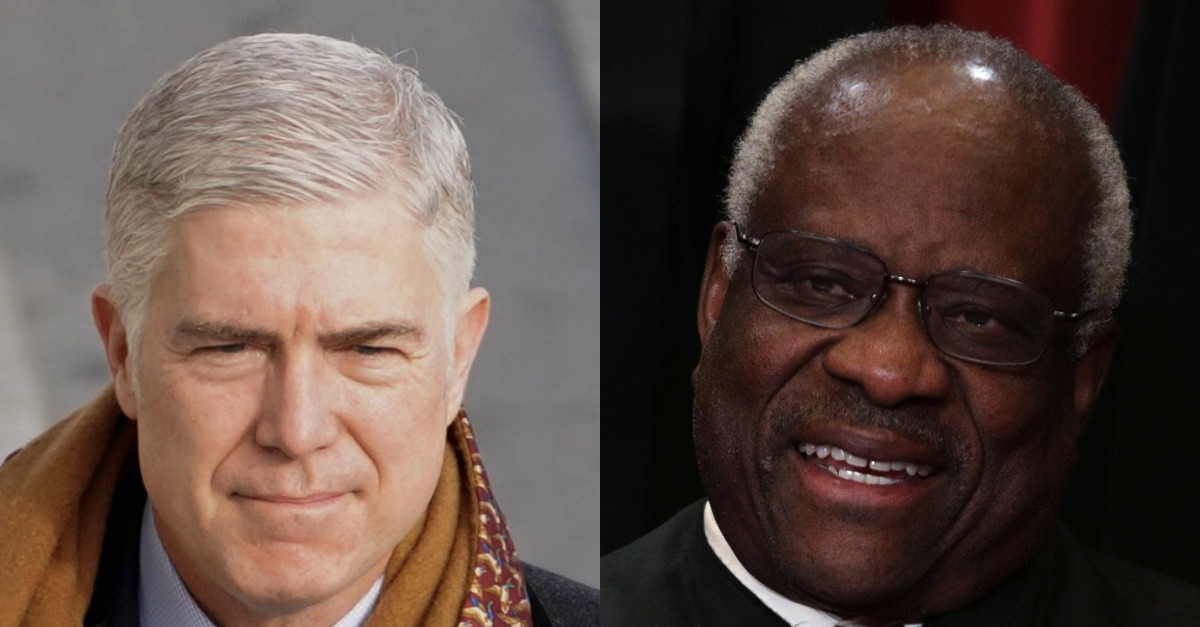
In Borden v. US, Justices Gorsuch And Thomas Indicate They View The Law As Taking Precedence Over Ideology

Gorsuch-and-Thomas

Good. That’s two: maybe there are more.

So- called “three strikes” laws are a conservative invention to bind the hands of liberal judges inclined to give too-lenient sentences to repeat offenders because of superfluous factors like a tough childhood. As a result, liberal justices generally detest the device, arguing that it takes the judgment out of judging.

In Borden v. US, a case that asks if a conviction for a violent felony based on recklessness or negligence rather than malice should count as a “strike,” the three bedrock progressives on the U.S. Supreme Court, Justices Breyer, Sotomayor and Kagan, voted predictably, against the application of a “three strikes” law. If all six conservative justices showed similar fealty to their biases, the petitioner, Charles Borden, Jr., would face an enhanced sentence after pleading guilty to possessing a firearm as a convicted felon, because he had three previous convictions for “violent felonies” according to Tennessee. Confounding the Supreme Court politicizers who don’t believe judges are capable of being ethical—which requires putting aside personal biases and loyalties to do the right thing—Justices Clarence Thomas and Neil Gorsuch voted with the liberals. They did so because they were following the letter of the law, and that is the Supreme Court’s job.

In Borden, prosecutors argued for the mandatory 15-year sentence based on three earlier convictions that included on for “reckless assault.” Borden argued that such a conviction was not a “strike’ according to the wording of the law, and in law, words are supposed to matter. His claims were rejected in the lower courts, and Borden was sentenced as a “career-criminal.”

Continue reading

Incredibly, A Unanimous U.S. Supreme Court Rules Against The Democrats’ Theory That Illegal Immigrants Can Be Transformed Into Legal Immigrants After The Fact

See? The government isn’t completely crazy. Not for the first time, the Supreme Court has emphatically sided with the rule of law, confounding the Biden Administration and such Democratic Party stars as Senators Mazi Hirono (D-Hawaii), Richard Blumenthal (D-Conn.), Ed Markey (D-Mass.), Elizabeth Warren (D-Mass.), Sheldon Whitehouse (D-RI), and former DNC chair Debbie Wasserman Schultz (D-Fla.), among others. Along with them, we also had the Democrat attorneys general of Washington, D.C., Massachusetts, California, and 17 other states arguing for one more step on the way to open borders.

Best of all, the slap-down opinion was authored by Obama appointee Justice Elena Kagan, who wrote in Sanchez v. Mayorkas, issued today,

Continue reading

Two Wins For Law And Ethics Over Ideology

DC RULES_blind justice

Judges are proving less partisan and ideologically driven than the increasingly totalitarian Left had hoped.

1. In Vitolo v. Guzman, the 6th U.S. Circuit Court of Appeals at Cincinnati ruled last week that the federal government violates the equal protection clause when it considers race or sex in in allocating Wuhan virus relief funds. Following the same track as the earlier case discussed here, the Court agreed that the U.S. Small Business Administration violated the Constitution by giving preference to minority- and women-owned restaurants.

Antonio Vitolo and his wife own a restaurant called Jake’s Bar and Grill. Vitolo is white, his wife is Hispanic, and they each own 50% of the restaurant. Of course, Jake could have gamed the easily manipuated SBA system by just handing his wife the extra 1%. The government requires small businesses to be at least 51% owned by women, veterans or “socially and economically disadvantaged” people to jump to the head of the line, because someone is presumed to be socially disadvantaged if they are a member of a designated racial or ethnic group. A person is considered economically disadvantaged if they are socially disadvantaged, and they face diminished capital and credit opportunities. In such a system, whether the business owner being given preference has actually been disadvantaged doesn’t matter. He or she is presumed to be disadvantaged. This nicely follows the circular logic of Critical Race Theory.

The group preferences are taken into consideration during the first 21 days in which the Small Business Administration awards the pandemic grants to restaurants. After priority applications submitted during that period are processed, the Small Business Administration processes grant requests in the order that they were received. That is, white men come last.

The 6th Circuit majority said Vitolo and his wife are entitled to an injunction forcing the government to grant their application, if approved, before all later-filed applications, and that their color and gender should be irrelevant. The government did not demonstrate a “compelling interest” justifying preferences based on race or sex.

Continue reading

Oops! So Much For That Gun Confiscation Plan…

SCOTUS cartoon

…at least until they pack the Supreme Court, of course….but with lackeys, not liberals.

The Biden Administration, eager to pave the way for the gun confiscation it claims it never would dream of, is eager to expand the “community caretaking” exception from a 1973 case, Cady v. Dombrowski, in which an officer took a gun out of an impounded car without a warrant. The Supreme Court ruled then that police could conduct such warrantless searches as a “community caretaking function” as long as they did so in a “reasonable” manner.

Since the Progressive Borg considers “sensible gun controls” inherently reasonable, and since they (it?) regards the Second Amendment as inherently dangerous to the community, the government argued that“community caretaking” should extend to homes as well as cars.

A Rhode Island man, Edward Caniglia, sued after police officers searched his home and seized two handguns without a warrant in 2015. During an argument with his wife, Caniglia had placed a handgun on the dining room table and asked her to “shoot [him] and get it over with.” His wife left and called the police the next day. She was worried that her husband had shot himself. The police found Caniglia on his porch, alive. He agreed to go to the hospital for psychiatric evaluation “on the condition that the officers would not confiscate his firearms.” But when he did, the police searched his home anyway, and seized his gun.

Continue reading

Just Bake The Damn Cake, Jack!

trans cake

Jack Phillips, the stubborn Christian baker who owns Masterpiece Cakeshop in Lakewood, Colorado, is being sued again, this time because he refused to make a custom cake celebrating a clients’ gender transition. In 2012, the baker refused to bake a custom cake for a same-sex wedding and was accused of unlawful discrimination on the basis of sexual orientation.

In Masterpiece Cakeshop v. Colorado Civil Rights Commission (2018), the Supreme Court ruled 7-2 for Phillips overturning the decision of the Commission on the grounds that it was obviously biased against him as well as devout Christians. One commissioner even compared Phillips’s invocation of his Christian beliefs to justify rejecting the cake design to defenses of slavery and the Holocaust. Yeah, I remember that the Nazis were really unreasonable about cakes. SCOTUS never reached the constitutional question of whether the government can compel people to create speech or artistic expressions they object to on religious grounds or otherwise.

If a custom cake design is art, then I think the answer to this is easy: no. Similarly wedding photographs, though if you used what we got from our wedding photographer, calling them “art” is a stretch.

With a conservative Supreme Court, the baker wins. And yet…

The first time around, after finally getting all the facts, I held that both Phillips and the gay couple who obviously targeted him to bend him to their will were being jerks. My position hasn’t changed a bit. I wrote here,

Continue reading

Ethics And Common Sense Win Out Over Law: SCOTUS Weakens “Qualified Immunity” [Updated]

The one constant recommendation by critics of police brutality and those trying to find ways to mitigate the problem without, you know, rioting, looting and burning every time a black man is killed by police is to eliminate or sharply curtail qualified immunity. Taylor v. Riojas, handed down in November by the Supreme Court in a 7-1 decision, might do just that.

A government officer sued for damages on a claim of violating the Constitution, such as violating an individual’s civil rights, must overcome the defendant’s claim of immunity. Judges (and Presidents) have absolute immunity for their conduct in the pursuit of their duties, no matter how outrageous or incompetent. Legislators cannot be sued for their decisions as lawmakers. Prosecutors cannot be sued for prosecuting. Other government officers, like police officers, have qualified immunity if they are sued for money damages for harming individuals in the course of their duties.

The Supreme Court has set up a tough standard for plaintiffs to meet in order to establish liability. Overcoming qualified immunity requires that the defendant officer acted in violation of law and Constitutional principles that any reasonable government official should know, and that the civil right allegedly breached has been established beyond question.

In a 2018 case, District of Columbia v. Wesby the Court stated:

“Existing law must have placed the constitutionality of the officer’s conduct ‘beyond debate.’ This demanding standard protects ‘all but the plainly incompetent or those who knowingly violate the law.’ To be clearly established, a legal principle must have a sufficiently clear foundation in then-existing precedent. The rule must be ‘settled law,’ which means it is dictated by ‘controlling authority’ or ‘a robust consensus of cases of persuasive authority.’ It is not enough that the rule is suggested by then-existing precedent. The precedent must be clear enough that every reasonable official would interpret it to establish the particular rule the plaintiff seeks to apply.”

This extreme hurdle has proved nearly impossible to clear. From 1982 to 2020, the Court reviewed 30 qualified immunity cases. Plaintiffs prevailed in two.

Yet in the per curiam opinion issued last year (that means there are no signed majority opinion or concurring opinions) the Court signaled a major shift, and ruled that prison guards had no qualified immunity even though there was no precedent that would have alerted them that their conduct was illegal or unconstitutional.

Continue reading

Law Vs. Fallacy: The Jurisprudence Of Justice Sotomayor

us-supreme-court-justice-sonia-sotomayor

I haven’t been moved to do the research, but I would not be surprised if Barack Obama is owed the prize for the worst nomination for the U.S. Supreme Court ever to be confirmed by the Senate. That would be Sonia Sotomayor, the self-described “wise Latina” who was picked using the same criteria that led to Joe Biden choosing Kamala Harris as his VP: checking the right boxes. Obama was seeking a Hispanic judge (another first!) and a woman, but managed to choose a judge with weak credentials whose selection insulted better judges, female judges and Hispanic judges who were more qualified than her, and there were a lot of them. Since her confirmation, Sotomayor has introduced touchy-feely “compassionate” arguments exactly where they should never show their mushy heads: in Supreme Court oral arguments and opinions. Some of her opinions read as if they were composed by anyone with a law degree, though her law clerks are expert at stuffing them with the requisite number of case cites for appearances sake.

The latest example of Soromayor’s sentimental hackery was her dissent in the case of U.S. v. Dustin John Higgs, in which the Court, by a 6-3 vote (guess the three!) turned down the writ of certiorari of a man convicted of kidnapping and murdering three women, and sentenced to death. Justice Sotomayor began,

After seventeen years without a single federal execution,the Government has executed twelve people since July. They are Daniel Lee, Wesley Purkey, Dustin Honken, Lezmond Mitchell, Keith Nelson, William LeCroy Jr., Christopher Vialva, Orlando Hall, Brandon Bernard, Alfred Bourgeois, Lisa Montgomery, and, just last night, Corey Johnson. Today, Dustin Higgs will become the thirteenth. To put that in historical context, the Federal Government will have executed more than three times as many people in the last six months than it had in the previous six decades.

Such an approach is a logical fallacy called “appeal to emotion.” That’s not law, that’s sentiment, assuming one is moved to tears by the idea of multiple convicted murderers finally being executed after years of expensive appeals and stalls. Sotomayor seems to think the fact that the “Federal Government will have executed more than three times as many people in the last six months than it had in the previous six decades” and that it was 17 years before the Trump administration did what should have been done all along has more than trivia value. So what? The U.S. has a death penalty, and finally has decided to follow through on it. Good.

Continue reading

The Supreme Court And Taylor Swift Ethics

It is generally regarded as a sign of ethics, courage and character to take action “on principle.” In theory, this means that non-ethical considerations (like enrichment, power and popularity) are not the actor’s goals; making a statement for the enlightenment of society is. However, actions on principle can often be quixotic and even silly, causing greater damage, as well as wasting time and money, “on principle” than the message is worth. The folly was nicely illustrated in the ancient burlesque skit above known as “Pay the Two Dollars.”

The issue of how far it was reasonable to go “on principle” was recently explored, of all places, in the U.S. Supreme Court in the oral argument of the case Uzuegbunam v. Preczewski.

Chike Uzuegbunam, a student at Georgia’s Gwinnett College in Lawrenceville, was threatened with discipline under the school’s speech code that violated his and other student’s First Amendment rights. He sued the college but it quickly backed down, eliminating its speech restrictions and replacing them with one that allows students to “speak anywhere on campus and at any time without having to first obtain a permit.” State officials said the change made the case moot. A trial judge agreed, and the United States Court of Appeals for the 11th Circuit, in Atlanta, affirmed her ruling.

Uzuegbunam and his student supporters, however, felt strongly that an official declaration that their rights had been violated was important, and they appealed on the grounds that they should be able to pursue their case for nominal damages. This was the issue that got the case before SCOTUS.

Continue reading

Saturday Ethics Nightcap,12/12/2020: Bad Journalism, Bad Governors, Bad Santas

nightcap

That’s just ginger ale, in case you’re wondering…

1. “Nah, there’s no outrageous, flagrant, shameless mainstream media bias!” April Ryan, arguably the worst, most unethical, most biased and most unprofessional of CNN’s reporters (but it’s such a lively competition), attacked the confidential sources responsible for leaking a recording of Joe Biden making weaselly comments about his stance toward the “defund the police” movement. Ryan demanded to know who was responsible for allowing the embarrassing comments to be made public, because, as we all should know by now, the job of the media isn’t to report the facts, but to empower and protect Democrats. (She didn’t come out and say the last part, but after her performance over the last four years, she doesn’t have to.) Jonathan Turley appropriately nailed this one:

The fact is that Ryan was just stating what has become the approach of many in the media. As we recently discussed, we are moving dangerously close to a de facto state media with the cooperation of Big Tech companies.  Ryan believes that it is outrageous to rely on unapproved material if it is critical of Joe Biden (despite her use of such material for the last four years against Trump)…CNN has not expressed any disagreement with Ryan’s view of the new journalism.

2. Santa Claus Ethics: If you can’t do any better than these Santas, you shouldn’t even try. But they do provide one reason to be grateful for social distancing. I think my favorite is this one…

Continue reading