Sunday Morning Ethics Warm-Up, 7/8/18: Idiots, Bigots, Liars and Freakouts

Good Morning!

My favorite hymn, naturally: the first selection at my father’s 2010 funeral at Arlington National Cemetery, the stirring finale of “Mrs. Miniver,” and it was composed by none other than Sir Arthur Sullivan.

1. What’s the ethical response to these kinds of stories? I’m pretty sure I don’t have it, whatever it is. From today’s New York Times: “This year, a tourist in India was mauled to death when he tried to take a selfie with a wounded bear.” Last week, an Australian tourist was nearly killed when a shark that she was hand feeding dragged her into crocodile-infested waters. How should we feel about such people? “Serves the morons right” isn’t an ethical response, but that kind of clueless idiocy gets people killed all over the world, every day. Laughter is tempting, but seems cruel. I can’t apply the Golden Rule, because there is no way I can imagine myself behaving quite that stupidly. Is “I’m genuinely sorry that you’re an idiot” mockery, or compassion?

2. What’s going on here? I sure can’t figure it out. The quickest way for you to get up to speed is to click on the link and read the twitter feed backwards. Here’s a summary: two police officers claimed that they were harassed at a Raleigh, N.C. barbecue restaurant, with staff calling out “Fuck the police!” The police association wrote about the alleged incident on Facebook, the restaurant denied the account, and an investigation indicated that the complaints were exaggerated at most, and perhaps fabricated completely.  Then the association posted this:

Huh? The issue is NOT resolved until we learn what, if anything the officers were reacting to, why they made a false claim, and what kind of discipline they face, if any. Meanwhile, the story was reported on social media by a criminal defense attorney (all criminal defense attorneys hate and distrust cops, and vice-versa) whose characterization of the episode is that the police “terrorized a local business.” Terrorized? (Pointer: valkgrrl)

3. As the self-segregation of America continues...Outspoken conservative Hollywood actor James Woods was dropped by his agent, Ken Kaplan, who wrote, “It’s the 4th of July and I’m feeling patriotic. I don’t want to represent you anymore. I mean I can go on a rant but you know what I’d say.” Woods replied,

 “Dear Ken, I don’t actually. I was thinking if you’re feeling patriotic, you would appreciate free speech and one’s right to think as an individual. Be that as it may, I want to thank you for all your hard work and devotion on my behalf. Be well.”

Commenting on this, Constitutional Law expert Jonathan Turley opined, Continue reading

Sunday Ethics Warm-Up, “Welcome July And Hope It’s Better Than June” Edition [UPDATED]

Happy July!

(On an especially dead weekend on Ethics Alarms. But ethics never sleeps…)

1. But I thought everyone wants open borders! The Harvard-Harris poll on illegal immigration, North Korea, trade and tariffs, and the Russia investigation certainly isn’t reflected in the news reports. But then, we can’t trust polls, and we certainly can’t trust Harvard.

I suppose the theory behind yesterday’s protests is that the squeaky, angry wheel gets the insane national policy. My guess is that this particularly squeaky, angry wheel  gets a Republican Congress.

2. Nah, there’s no mainstream media bias! (Cont.)  Yesterday’s New York Times op-ed page managed to contain two of the more outrageous anti-Trump screed of recent vintage. One, by Dave Eggers, attacks “the cultural vacuum in the White House.” I suggest reading this one as a template for anti-Trump propaganda, and the kind of dishonesty underlying so much of it.  He begins,

Since his inauguration in January 2017, there have been no official concerts at the White House (the Reagans had one every few weeks). No poetry readings (the Obamas regularly celebrated young poets). The Carters began a televised series, “In Performance at the White House,” which last aired in 2016, where artists as varied as Mikhail Baryshnikov and Patricia McBride performed in the East Room. The Clintons continued the series with Aretha Franklin and B. B. King, Alison Krauss and Linda Ronstadt.

But aside from occasional performances by “The President’s Own” United States Marine Band, the White House is now virtually free of music. Never have we had a president not just indifferent to the arts, but actively oppositional to artists. Mr. Trump disparaged the play “Hamilton” and a few weeks later attacked Meryl Streep.

Normally, this is where I’d quit reading—when the writer deliberately distorts the facts and employs deceit to make his case. The President disparaged the cast of “Hamilton,” not the show itself, after its performers unethically ambushed Vice President Mike Pence, who was then only another audience member, and should have been respected as one. I have launched (let’s see) three theater companies and two professional performing groups, and I disparaged that cast as well. Meryl Streep, the well-known pal of Harvey Weinstien, went on national television and gratuitously insulted the President, who does not turn the other cheek. He didn’t  attack Streep because she is an artist. He attacked her for being a grandstanding partisan shill.

He engages in this kind of deceit throughout, such as when he writes, in conclusion,

“Admittedly, at a time when Mr. Trump’s policies have forcibly separated children from their asylum-seeking parents — taking the most vulnerable children from the most vulnerable adults — the White House’s attitude toward the arts seems relatively unimportant. But with art comes empathy. It allows us to look through someone else’s eyes and know their strivings and struggles. It expands the moral imagination and makes it impossible to accept the dehumanization of others. When we are without art, we are a diminished people — myopic, unlearned and cruel.”

Funny: art hasn’t made Eggers less dishonest and deceitful. The illegal immigrants at the border were not “asylum-seeking,” because they didn’t follow the procedures for seeking asylum. They were apprehended foreign citizens trying to sneak into our country and claiming that they were seeking asylum to hamstring border enforcement,  and were using their children as human shields, placing the Trump administration into the Catch-22 of either waiving the laws or giving open-borders activists a club to beat it with—as the Times knows, since it has explained this dilemma itself. To attribute  pure law enforcement decisions to the dearth of piano and cello concerts in the White House is forced even by the Times’ standards. Mostly Eggers is just revealing the classist snobbery underlying much of the elitist attacks on President Trump.

As an artist, and someone who has worked in the arts and indeed would have made it my career if it were financially feasible, I could not care less how many concerts a President hosts, or how many artists he fetes. I want him to do his job, and I don’t particularly care to be paying for his glitterati  nights, either.

A President’s taste in art and culture doesn’t affect the public one whit. I don’t think I would pay a dime to hear any of President Obama’s hip-hop artists or rappers. Meanwhile, Clinton having “Aretha Franklin and B. B. King, Alison Krauss and Linda Ronstadt” at the White House didn’t make him empathetic enough not to exploit Monica Lewinsky. Jack Kennedy was a  stone-cold sociopath: what did he learn from dining with “Arthur Miller, Tennessee Williams, Robert Lowell, Geraldine Page and George Balanchine”?

Hitler loved fine culture so much he had his Nazis steal thousands upon thousands of invaluable works of art across Europe, because he wanted a new explosion of creativity among the German people. Boy, if that made the Germans less “cruel,” imagine what they might have been like without their art!

And Nixon played the piano! Continue reading

Comment Of The Day: “Ethics Observations On The Masterpiece Cake Shop Decision”

How refreshing it is, while at least half the pundits and journalists are misrepresenting the Masterpiece Bakery decision to the public, to read an Ethics Alarms comment that both clarifies Justice Kennedy’s majority opinion’s flaws and also highlights an important issue that only the routinely-derided Justice Thomas focused on.

As it happens, I disagree with Thomas that a custom wedding cake for a gay wedding is  necessarily “compelled speech.” What is it saying? If it can’t be reasonably interpreted to express a position that can be fairly attributed to the baker, then it’s the customer’s speech, not the baker’s. I know there are cases where sign-makers and others have been upheld in their refusal to reproduce messages they personally find offensive. We saw a hint of that in the silly “Summa ___ Laude” cake fiasco. My position is that a business that creates a setting for speech by others should have no right to interfere with that message—hateful messages, obscene messages, it shouldn’t matter. It should be no more acceptable for a sign-maker to say “I won’t make that sign” than for a cabbie to say, “I won’t drive to that address,” or a haberdashery to refuse to let you buy a suit that makes you look fat.

Here is Glenn Logan’s excellent Comment of the Day on the post, Ethics Observations On The Masterpiece Cake Shop Decision:

Justice Thomas, in his partial concurrence:

“Ac­cording to the individual respondents, Colorado can com­pel Phillips’ speech to prevent him from “‘denigrat[ing] the dignity’” of same-sex couples, “‘assert[ing] [their] inferiority,’” and subjecting them to “‘humiliation, frustration, and embarrassment.’” Brief for Respondents Craig et al. 39 (quoting J. E. B. v. Alabama ex rel. T. B., 511 U. S. 127, 142 (1994); Heart of Atlanta Motel, Inc. v. United States, 379 U. S. 241, 292 (1964) (Goldberg, J., concurring)). These justifications are completely foreign to our free-speech jurisprudence.

States cannot punish protected speech because some group finds it offensive, hurtful, stigmatic, unreasonable, or undignified. “If there is a bedrock principle underlying the First Amendment, it is that the government may not prohibit the expression of an idea simply because society finds the idea itself offensive or disagreeable. Johnson, supra, at 414. A contrary rule would allow the govern­ment to stamp out virtually any speech at will.”

This is the opinion that should’ve carried the day. In fact, Kennedy’s opinion is a blatant special pleading, fallacious on it’s face when he claimed the CCRC disparaged Phillips’ position. Even if I allow the comments made by some CCRC members do in fact disparage Phillips’ religion, the law makes it clear that religion is inoperative as a defense against its requirements anyway. How, then, can hostility to religion matter one jot or tittle, and isn’t such expression protected in its own right? The CCRC needed not show the least deference to Phillips’ religion, because the law that creates it manifestly doesn’t: Continue reading

Morning Ethics Warm-Up. 6/5/18: Cakes And Fakes

Good morning…

1. Dummies or Liars? In a comment about yesterday’s 7-2 SCOTUS ruling favoring the Christian cake shop in another baker vs. gay couple controversy, Still Spartan wrote, ” I also don’t want to spend the next few months explaining the ruling to non-lawyer liberals who already are beginning to tear their hair out because they don’t understand the opinion.” Unfortunately, that’s exactly what she will have to do, and the rest of us, as there is already a deliberate effort underway to misrepresent the decision and deceive members of the public too lazy to read Supreme Court opinions, or too under-educated to understand them. (It really isn’t that hard.) This is fear-mongering, and also an effort to undermine the Supreme Court, which can be expected to be blocking a number of left-driven totalitarian measures in the not-too-distant future.

For example, on “The Late Show,” where a disturbingly high percentage of millennials get their news commentary, the smug, insufferable Stephen Colbert described the ruling this way:

“It’s a bad day for gay rights in America. And also for cake rights because this morning, the Supreme Court ruled in favor of a Colorado baker who refused to bake a cake to celebrate the marriage of a same-sex couple. That is tough news. But to lighten the blow the Supreme Court did send the gay couple a lovely cake” which was a cake in the shape of the middle finger.

Hilarious! And a complete misrepresentation of the opinion. The question is, did Colbert and his writers really not understand the ruling? What are the odds that any of them read it? If they didn’t know what the ruling was, isn’t it irresponsible to pass along false information? Or did they know that the opinion in no way undermined the rights of gays to be served in public accommodations like everyone else, but found, and correctly so, that the process was rigged against the baker because of open hostility to religious freedom? If so, the “joke” was deliberate misrepresentation.

The fact that the lie would have been in service of a joke is not a justification. Spreading falsity in public is harmful, and it does not matter who does it, or why.

2. From the “Stop making me defend the New York Yankees!” files:  This is an integrity vs. cash test for Major League Baseball. ESPN announced that it was picking up the Yankees’ one 1 o’clock Sunday, July 8 game with the Blue Jays in Toronto for its 8 p.m. Sunday night Game of the Week. This decision, however, was announced after the Yankees and Orioles players agreed to make up last week’s rained out game as part of a doubleheader on July 9.  As now scheduled, the Yankees will have to play three games in a 24 hour period. The Yankees would probably not leave the ballpark in Toronto until midnight, then have to go through customs, getting into Baltimore at 4 or 5 a.m., into their hotel rooms around 7, and be due at Camden Yards in a few hours.

This is potentially dangerous to the players (baseball is hard to play while asleep), and also undermines the team: the Yankees are expected to be in a neck-and-neck race with the Boston Red Sox for primacy in the American League East, and a single game could be crucial. If the Yankees are forced to play Sunday night on July 8, the Yankee management and players are threatening to retaliate against ESPN by refusing all interviews with ESPN broadcasters. Of course, killing those in-game interviews will only improve the broadcast.

Then the Yankees will claim that the Red Sox were colluding with ESPN, and there will have to be an investigation… Continue reading

Ethics Observations On The Masterpiece Cake Shop Decision

The Supreme Court ruled today in favor of Jack Phillips, the Christian baker in Colorado who refused to bake a custom wedding cake for a same-sex couple. The Court  found that the Colorado Civil Rights Commission infringed on Phillips’s rights in ruling that he violated the Colorado anti-discrimination law barring merchants from refusing service based on race, sex, marital status, or sexual orientation. The ruling is narrow; it does not empower merchants to deny service based on sexual orientation.  It is based entirely on  the Colorado Civil Rights Commission’s  hostility toward Phillips’s religious views in ruling against him.

Observations:

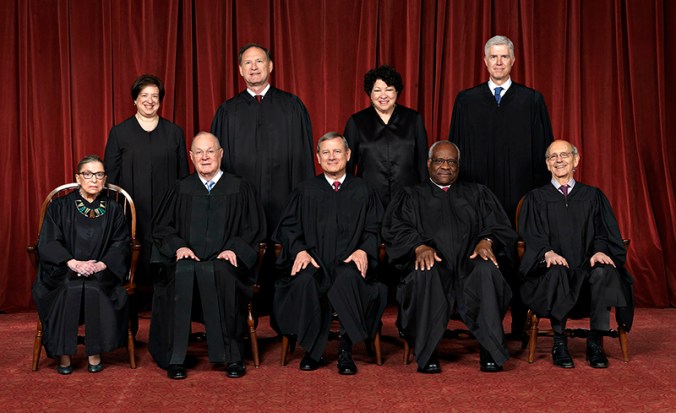
1. Justices Ruth Bader Ginsburg and Sonia Sotomayor were the only dissenting votes, meaning that the decision was 7-2, and not a “conservative vs liberal” outcome. Even the dissent is based on narrow legal and factual distinctions rather than ideological ones.

2. Read the opinion, and the dissent. Also, if you really want to impress your friends, access the resources available here.

3. These statements from Justice Kennedy’s majority opinion, cited by Justice Ginsberg, help clarify matters in the right legal and ethical direction:

  • “[I]t is a general rule that [religious and philosophical] objections do not allow business owners and other actors in the economy and in society to deny protected persons equal access to goods and services under a neutral and generally applicable public accommodations law.”
  • “Colorado law can protect gay persons, just as it can protect other classes of individuals, in acquiring whatever products and services they choose on the same terms and conditions as are offered to other members of the public.”
  • “[P]urveyors of goods and services who object to gay marriages for moral and religious reasons [may not] put up signs saying ‘no goods or services will be sold if they will be used for gay marriages.’ ”

The ruling could have hardly been less of a ringing endorsement of either “side.”

4. To which I say, “Good.” As I wrote the last time this case was discussed here,
Continue reading

Here Is Why Baseball Fans, And Almost Everyone Else, Are Ignorant Of How The Law Works…

Last night, while I was watching a lousy Red Sox loss to the Oakland A’s, the Boston broadcasters announced their mid-game poll: “Do you agree with the Supreme Court decision on sports betting?” Viewers were supposed to text one number for yes, another for no. It was quite clear that the Sox announcers themselves had no clue what the decision was, however, as Jerry Remy and Dave O’Brien began debating the pros and cons of legalizing sports betting. The debate was edifying, but had nothing to do with the Court’s decision in Murphy v. National Collegiate Athletic Association whatsoever.

They and thousands of Red Sox fans had no clue what the decision was, and their ignorance didn’t stop them from voting on what they thought it was. What they thought it was came from second and third hand social media posts, and misleading headlines (“Supreme Court Strikes Down Anti-Sports Betting Law”) as well as brain-dead reports on the meaning of the majority ruling. (“Today the Supreme Court opened the door to legalized sports betting by declaring the federal law banning it unconstitutional…”). On a local news channel in the D.C. area, a reporter was dispatched to “investigate” if the reporting on the decision was accurate. “We began by reading the decision itself,” he said,

Wow! What a concept! Read the opinion rather than depend on ignorant reporters who don’t know the Constitution from “Hiawatha” to explain it based on what they think they know, which is not remotely like knowing anything!

Quoting again from ScotusBlog, here’s what “the decision on sports betting” was…

The 10th Amendment provides that, if the Constitution does not either give a power to the federal government or take that power away from the states, that power is reserved for the states or the people themselves. The Supreme Court has long interpreted this provision to bar the federal government from “commandeering” the states to enforce federal laws or policies. [The] justices ruled that a federal law that bars states from legalizing sports betting violates the anti-commandeering doctrine…

…In a decision by Justice Samuel Alito, the court began by explaining that the “anticommandeering doctrine may sound arcane, but it is simply the expression of a fundamental structural decision incorporated into the Constitution” – “the decision to withhold from Congress the power to issue orders directly to the States.” And that, the majority continued, is exactly the problem with the provision of PASPA that the state challenged, which bars states from authorizing sports gambling: It “unequivocally dictates what a state legislature may and may not do.” “It is as if,” the majority suggested, “federal officers were installed in state legislative chambers and were armed with the authority to stop legislators from voting on any offending proposals. A more direct affront to state sovereignty,” Alito concluded, “is not easy to imagine.”

Later on, Alito makes it clear that the decision isn’t pro-sports betting or anti-sports betting. The decision is anti-the federal government telling the states that they can’t pass certain kinds of laws, and the subject matter of those laws are irrelevant to that principle. The decision in Murphy v. National Collegiate Athletic Association  no more approves legalized sports betting than it approves speed limits over 90 or letting felons vote in state elections. The decision says that while the federal government can pass its own laws, it can’t order the states not to pass laws.

Never mind! Thousands of Red Sox fans had opinions based on misunderstanding the decision, just as many bloggers and online commenters worked themselves into a frenzy about the evils or benefits of sports betting, aided by journalists who literally, not figuratively, didn’t know what they were writing about, and didn’t have the integrity or common sense to find out.

Good job, everybody!


Morning Ethics Warm-Up, 5/15/2018: Alito Gets One Right, Ellison Deceived, And An Ancient, Unethical Tactic Works Once Again…

To a glorious morning, Ethics-Lovers!

1. Bad Alito, Good Alito.  As I briefly noted yesterday (and hopefully will do in detail today), Justice Alito authored an unethical and embarrassing dissent defending a lawyer who deliberately betrayed his client by telling the jury that he had killed someone his client denied killing. Bad Alito. However, the arch-conservative jurist also authored the majority opinion in Murphy v. National Collegiate Athletic Association, in which the SCOTUS majority struck down a virtuous but unconstitutional law, and did so clearly and well.

These are, I think, my favorite Supreme Court opinions, where the Court ignores the motives and objectives of a law and simply rules whether the legislature is allowed to behave like that. I don’t know, but I would guess that most of the majority feel the way I do about organized sports gambling: nothing good can come of it, and a lot of harm is inevitable. One they get the green light, I’m sure that as many states will take over sports gambling for its easy revenue as now prey on its poor, desperate and stupid with their state lottery scams. Everyone involved–sports, fans, athletes, states, the public’s ethical compass—is going to be corrupted by letting the sports betting genie out of its bottle: just watch.

Nevertheless, the Professional and Amateur Sports Protection Act, a 1992  law known as PASPA, should have been struck down decades ago; I’d love to know why it took so long. No, it did NOT ban sports betting, though this is what far too many news reports tell you. Congress can ban sports betting directly if it chooses to, as it is interstate commerce. This isn’t in dispute. What it did in 1992, however, was to order states not to pass laws states have a constitutional right to pass. The distinction matters. From SCOTUS Blog, which is usually the best source for analysis of these things:

The 10th Amendment provides that, if the Constitution does not either give a power to the federal government or take that power away from the states, that power is reserved for the states or the people themselves. The Supreme Court has long interpreted this provision to bar the federal government from “commandeering” the states to enforce federal laws or policies. [The] justices ruled that a federal law that bars states from legalizing sports betting violates the anti-commandeering doctrine…

…In a decision by Justice Samuel Alito, the court began by explaining that the “anticommandeering doctrine may sound arcane, but it is simply the expression of a fundamental structural decision incorporated into the Constitution” – “the decision to withhold from Congress the power to issue orders directly to the States.” And that, the majority continued, is exactly the problem with the provision of PASPA that the state challenged, which bars states from authorizing sports gambling: It “unequivocally dictates what a state legislature may and may not do.” “It is as if,” the majority suggested, “federal officers were installed in state legislative chambers and were armed with the authority to stop legislators from voting on any offending proposals. A more direct affront to state sovereignty,” Alito concluded, “is not easy to imagine.”

…The court also rejected the argument, made by the leagues and the federal government, that the PASPA provision barring states from authorizing sports betting does not “commandeer” the states, but instead merely supersedes any state laws that conflict with the provision – a legal doctrine known as pre-emption. Pre-emption, the majority explained, “is based on a federal law that regulates the conduct of private actors,” but here “there is simply no way to understand the provision prohibiting state authorization as anything other than a direct command to the States,” which “is exactly what the anticommandeering rule does not allow.”

Got it.

Good decision. Continue reading

McCoy v. Louisiana

Today the Supreme Court ruled in favor of Robert LeRoy McCoy, who was convicted of three counts of murder after his lawyer refused to follow his instruction and plead not guilty as he directed. I had predicted that his convictions would be over-ruled; I also wrote,

“If the Supreme Court does anything but overrule Louisiana in this case by a 9-0 vote, I may turn in my law license in exchange for a free Whopper at Burger King.”

Well, the vote wasn’t 9-0. I think instead of turning in my license, I’m going to turn in my respect for the so-called conservative wing of the Court. The majority opinion was authored by Justice Ginsberg, with Kagan, Sotomayor, Breyer, Roberts, and Kennedy concurring. Two of the conservatives concurred in a dissent authored by Alito: Gorsuch and thomas.

I haven’t had time to read it as carefully as I have to to do a thorough analysis, but I read it well enough to flag it as an embarrassing collection of rationalizations. While the majority opinion interprets a straightforward case according to what is significant about it—a lawyer pleaded guilty for him when his client demanded that he plead non guilty, thus making the conclusion unavoidable, Alito resorts to desperate excuses. Well, this kind of case isn’t likely to happen again. So what? A man was robbed of his Sixth Amendment rights! His story was ridiculous. So what? If that’s his story, he has the right to tell it. The lawyer was placed in a tough situation by a client whose claims were unbelievable. The jury decides who to believe, and a defendant has the right to let them do that. McCoy’s lawyer didn’t believe him. So what? Welcome to criminal defense work. McCoy was going to be convicted anyway.

What????

I can’t believe a Supreme Court Justice is making these arguments. So what? The principle of the rule of law is that it is vital that the defendant, if he is convicted, is convicted the right way, constitutionally. The conduct of McCoy’s lawyer was indefensible under the ethics rules, and the Constitution.

Reading the whole opinion and the dissent is revealing, and not in a good way. The majority opinion shows us that the Supreme Court can’t say the sky is blue without making the case in the mots turgid way possible. This opinion should have been a few pages at most.

The dissent lets us know that Justices Alito, Gorsuch and Thomas look for minuscule fragments of justifications to avoid doing the right thing.


Windy Morning Ethics Warm-Up, 3/2/18: More Supreme Court Fun, Transparency Games, Ethical and Unethical Quotes Of The Day…

GOOD MORNING!

(Wind storms all over Virginia, knocking out power and my e-mail, and blowing over a tree that narrowly missed my son’s car!)

1 Lack of Transparency? What lack of transparency? During a lecture and moderated discussion at U.C.L.A. this week in which he was a a participant and invited guest, Treasury Secretary Steven Mnuchin was heckled with hisses, jeers, shouted insults and profanity from students and protesters, some of whom were ushered and even carried out by police officers. A programmed sixth grader in the audience even questioned him about the fairness of passing permanent tax cuts for companies and expiring cuts for individuals, because as we all know, 10-year-olds are well-versed in tax policy theory.

Afterwards, Mnuchin  revoked his consent for the official video of the event to be released, perhaps because he was flustered by the harassment and it showed. In response to criticism of this virtual censorship,

The Treasury Department, through a spokesperson, said that what the Secretary did wasn’t what he obviously did—a Jumbo, aka “Elephant? What elephant?”—saying,

“The event was open to the media and a transcript was published. He believes healthy debate is critical to ensuring the right policies that do the most good are advanced.”

He just doesn’t want anyone to see or hear the debate.

A related point: The protests were organized by Lara Stemple, a U.C.L.A. law professor, and students and faculty members participated. Protests are fine; disrupting the event is not. Faculty members who assisted in the heckling should be disciplined, and students who participated should be disciplines as well.  It’s an educational institution, and all views sgould be openly explored and heard without interference. No guest of the university should be treated this way. Ever. No matter who it is or what their position. The treatment on Mnuchin was unethical.

2. More Supreme Court fun with ethics! Minnesota’s law banning “political” clothing and buttons from polling places is being challenged as an affront to free speech. The law prohibits people from wearing a “political badge, political button or other political insignia” at a polling place on an election day, and a member of the tea party movement sued after his “Tea Party” message got him in trouble when he came to vote.

Here is Justice Samuel A. Alito’s exchange with Daniel Rogan of the Hennepin County Attorney’s Office, who was defending Minnesota’s law:

“How about a shirt with a rainbow flag?” asked Alito. “Would that be permitted?”

“A shirt with a rainbow flag?” Rogan repeated. “No, it would — yes, it would be — it would be permitted unless there was — unless there was an issue on the ballot that — that related somehow to — to gay rights.”

Justice Alito: Okay. How about an NRA shirt?

Mr. Rogan: An NRA shirt? Today, in Minnesota, no, it would not, Your Honor. I think that that’s a clear indication—and I think what you’re getting at, Your Honor—

A T-shirt bearing the words of the Second Amendment? Alito asked.

Probably banned because of the gun-control issue, Rogan said.

The First Amendment? Alito asked. Probably not, Rogan answered.

Got it. The First  Amendment isn’t a political statement, but the Second Amendment is. That led Justice Neil M. Gorsuch to observe: “Under your interpretation of ‘political,’ it would forbid people from wearing certain portions of the Bill of Rights into a polling place but not other portions of the Bill of Rights. And I guess I’m just wondering what compelling interest Minnesota has identified that requires a statute that goes so much further than the vast majority of states?”

In contrast, Justice Anthony M. Kennedy asked J. David Breemer, a lawyer for the Pacific Legal Foundation, representing the challengers, “Why should there be speech inside the election booth at all, or inside the what you call the election room? You’re there to vote.”

This is a problem requiring an “all or nothing” solution. Either all forms of political speech must be allowed, or no speech at all. In a sick time where citizens honestly argue that a MAGA cap or a picture of a gun makes them feel threatened and “unsafe,” the ethical option would seem to be Justice Kennedy’s. No speech, messages, no logos, no photos, no American flags. Last fall I voted wearing my Red Sox jacket.

Uh-uh. Continue reading

It’s A Comment Of The Day Weekend! First Up…Comment Of The Day (3): “An Ethics Alarms Holiday Challenge! Identify The Rationalizations, Logical Fallacies, Falsehoods And Outright Errors In This Essay…” AND, In Related News, Another Bakery Gets Slammed In Oregon

I’m not exaggerating: I have at least four Comments of the Day stacked up on the Ethics alarms runway after this one, and there are usually COTDs arriving on Saturdays. I can’t promise to get all of them up today, especially since I’m hacking away at the 2017 Ethics Alarms Awards, and this is a long working weekend at ProEthics. Still, I will get a lot of them to you, and it’s a provocative group, as you will soon see.

But first, a prelude and some context.

An Oregon appellate court this week upheld a ruling against the owners of the since-closed Sweetcakes by Melissa,  Aaron and Melissa Klein, forcing them to pay emotional-distress damages of $135,000 to Rachel and Laurel Bowman-Cryer, a lesbian couple for whom they refused to design and sell a wedding cake almost five years ago. The Klein’s argued that state Labor Commissioner Brad Avakian violated state and federal laws and their rights as artists to free speech, their rights to religious freedom and their rights as defendants to  due process.

The Oregon court ruled that the Kleins’ argument that their cakes entail an artistic expression is “entitled to be taken seriously,” but it’s not enough for the couple to assert their cakes are pieces of art:

“Although we accept that the Kleins imbue each wedding cake with their own aesthetic choices, they have made no showing that other people will necessarily experience any wedding cake that the Kleins create predominantly as ‘expression’ rather than as food.”

This mess commenced  when Rachel Bowman-Cryer went to the suburban Portland bakery with her mother in January of 2013. When Aaron Klein was told that the wedding did not involve a male partner,  he said that the bakery did not make cakes for same-sex weddings. They left, but soon the mother returned to argue with Klein as Rachel sat in the car, weeping. her mother went in to speak with Klein. The mother told Klein she had once thought like him, but having two gay children forced her to see the error of her ways.  Klein retorted with Leviticus: “You shall not lie with a male as one lies with a female; it is an abomination.”

The complaint and action by Oregon’s Bureau of Labor and Industries followed. You can read the opinion here.

Ugh.

This case is even worse than the one currently before the Supreme Court, discussed here. Continue reading