Was Jen Pawol the Most Qualified Umpire or Was She Just “Historic”?

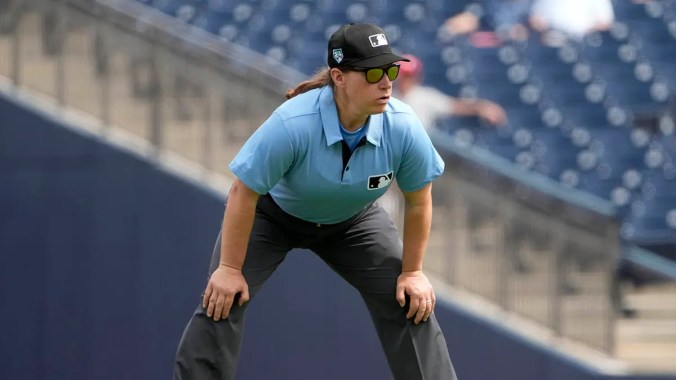
Over the weekend, minor league umpire Jen Pawol became the first woman to umpire in a Major League Baseball game, handling the bases in Game 1 of an Atlanta Braves-Miami Marlins doubleheader then moving behind the plate to call balls and strikes for Sunday’s game. Of course, MLB made a great hullabaloo over the momentous occasion. At various times during the season, minor league umpires are brought up to the big leagues to fill in for umpires getting their union-dictated vacations. Pawol is the only woman currently umpiring in the minor leagues. Thanks to baseball’s (and Commissioner Rob Manfred’s) wokeness obsession, she took her place in baseball history with a lingering and unavoidable doubt: would a man with her record and credentials have been chosen by MLB for the weekend umpiring chores? Were there more qualified and deserving male umpires who were passed over because they had y-chromosomes?

This is the scourge that the DEI fad has created. I feel sympathy for Pawol, but there is no avoiding it.

Naturally, MLB was ready for the questions and the suspicion. “Jen Pawol’s MLB debut is no PR stunt — she earned it the hard way” blared a Fox News headline, following an MLB press release. Methinks they doth protest too much. My suspicions were raised because just a few days earlier, the Boston Red Sox created team “history” by having an all-female broadcast team for a game. Why? Well, you know, because. The women were fine, professional play-by-play and color announcers, but nothing special except for their high voices. I’m sure there were plenty of long-time minor league male broadcasters who would have loved the chance to do a big league game, but, again, they wouldn’t be “historic,” so they were out of luck.

As with umpires, almost all baseball broadcasters are male and white. There’s no demonstrable discrimination at the heart of this: it’s self selection. Women don’t play hardball; blacks tend to be drawn to other sports as well. Why should that circumstance provide a special advantage to the minorities who do enter the field? Baseball doesn’t benefit from diversity of umpires: what matters is getting the calls right. Baseball fans want engaging, knowledgeable game broadcasts, and couldn’t care less about the sex and color of those providing it.

Meanwhile, there is still room for Manfred to carve out some more gratuitous history: baseball still hasn’t had a heterosexual female ump in the major leagues.

Oh Yeah, Pro Sports’ Greedy Embrace of Legalized Gambling Is Really Going Well…

In 2023, Ethics Alarms tersely predicted, regarding the full and loving embrace with which professional sports is snuggling up to online gambling, “This will not end well.” Ah, but there’s money to be made….so, for example, Major League Baseball allows Red Sox Hall of Famer David Ortiz to shill for one of the big online betting concerns during local game broadcasts. Not surprisingly, given that it is the most unethical of all sports organizations, the NFL had the first betting scandal under the new gluttony: In 2023, “Isaiah Rodgers and Rashod Berry of the Indianapolis Colts and free agent Demetrius Taylor were suspended indefinitely for betting on NFL games. Tennessee Titans offensive tackle Nicholas Petit-Frere was suspended six games for betting on other sports.

Next came the betting scandal involving baseball’s most famous star, pircher-slugger Shohei Ohtani, whose translator was caught illegally using the star’s name to pay off a bookie. But of course, there was, and is, more to come.

Toronto Raptors player Jontay Porter was banned from the NBA after an investigation last year found that Porter tipped off bettors about his health and then claimed illness to exit at least one game, creating wins for anyone who had bet on him to under-perform. Porter also gambled on NBA games in which he didn’t play, and once bet against his own team. Now another NBA player, Miami Heat guard Terry Rozier, is under investigation. He is suspected of manipulating his game performance “as part of an illegal sports betting scheme”when he was a member of the Charlotte Hornets.

Wait: pro athletes today make millions of dollars. The 1919 Black Sox scandal (Second mention today!) happened because the players involved were being exploited by their team’s owner and were barely able to feed their kids. Why would millionaire jocks ever get involved with gamblers?

Continue reading

Umpire Ethics: Robo-Ump Update and “Oh-oh!”

Regular readers here know about both my passion for baseball and my disgust with how many games are determined by obviously wrong home plate calls on balls and strikes. Statistics purportedly show that umpires as a group are correct with their ball/strike edicts about 93% of the time, representing a significant improvement since electronic pitch-tracking was instituted in 2008. What explains the improvement? That’s simple: umpires started bearing down once they knew that their mistakes could be recorded and compiled. In 2008, strikes were called correctly about 84% of the time, which, as someone who has watched too many games to count, surprises me not at all.

Even 93% is unacceptable. It means that there is a wrong call once every 3.6 plate appearances, and any one of those mistakes could change the game’s outcome. Usually it’s impossible to tell when it has, because the missed call was part of a chaos-driven sequence diverging from the chain of events that may have flowed from the right call in ways that can’t possibly be determined after the fact. Sometimes it is obvious, as in several games I’ve seen this season. An umpire calls what was clearly strike three a ball, and the lucky batter hits a home run on the next pitch.

Before every game was televised with slo-mo technology and replays, this didn’t hurt the game or the perception of its integrity because there was no record of the mistakes. (Sometimes it wasn’t even a mistake: umpires would punish batters for complaining about their pitch-calling by deliberately declaring them out on strikes on pitches outside the strike zone.) Now, however, a missed strike call that determines a game is both infuriating and inexcusable. As with bad out calls on the bases and missed home run calls, the technology exists to fix the problem.

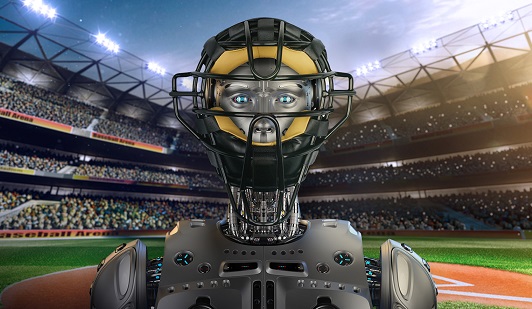
Baseball only installed a replay challenge system after the worst scenario for a missed call: a perfect game—no hits, runs or base-runners—was wiped out by a terrible safe call at first on what should have been the last out of the game. The game was on national TV; the missed call was indisputable. That clinched it, and a replay challenge system was quickly instituted. I long assumed that robo-umps would only be instituted after an obviously terrible strike call changed the course of a World Series or play-off game, embarrassing Major League Baseball. For once, the sport isn’t waiting for that horse to leave before fixing the barn door. It has been testing an automated balls and strikes system (ABS) in the minor leagues for several years now. Good. That means that some kind of automated ball and strike system is inevitable.

Continue reading

Encore: From “The Law vs Ethics Files: The July 24, 1983 Pine Tar Incident, When Baseball Chose Ethics Over Law, And Was 100% Wrong

Several things led me to re-posting this Ethics Alarms entry from 2017.

First of all, the MLB network showed a documentary on the career of George Brett today, and scene above, with Brett erupting in fury at the umpire’s call voiding his clutch, 9th inning home run, is one of the classic recorded moments in baseball history. There was also a recent baseball ethics event that had reminded me of Brett’s meltdown: Yankees manager Aaron Boone was thrown out of a game because a fan behind the Yankees dugout yelled an insult at the home plate umpire, and the umpire ejected Boone thinking the comments came from him.. When Boone vigorously protested that he hadn’t said anything and that it was the fan,Umpire Hunter Wendelstedt said, “I don’t care who said it. You’re gone!”

Wait, what? How can he not care if he’s punishing the wrong guy?

“What do you mean you don’t care?” Boone screamed rushing onto the field a la Brett. “I did not say a word. It was up above our dugout. Bullshit! Bullshit! I didn’t say anything. I did not say anything, Hunter. I did not say a fucking thing!” This erudite exchange was picked up by the field mics.

There was another baseball ethics development this week as well, one involving baseball lore and another controversial home run. On June 9, 1946, Ted Williams hit a ball that traveled a reported 502 feet, the longest he ever hit, and one of the longest anyone has hit. The seat was was painted red in 1984 (I’ve sat in it!), and many players have opined over the years that the story and the seat are hogwash, a lie. This report, assembling new data about the controversy, arrives at an amazing conclusion: the home run probably traveled farther than 502 feet.

But I digress. Here, lightly edited and updated, is the ethics analysis of the famous pine tar game and its aftermath:

***

 I have come to believe that the lesson learned from  the pine tar incident is increasingly the wrong one, and the consequences of this extend well beyond baseball.

On July 24, 1983, the Kansas City Royals were battling the New York Yankees at Yankee Stadium. With  two outs and a runner on first in the top of the ninth inning,  Royals third baseman George Brett hit a two-run home run off  Yankee closer  Goose Gossage to give his team a 5-4 lead.  Yankee manager Billy Martin, however, had been waiting like a spider for this moment.

Long ago, he had noticed that perennial batting champ Brett used a bat that had pine tar (used to allow a batter to grip the bat better) on the handle beyond what the rules allowed. MLB Rule 1.10(c) states: “The bat handle, for not more than 18 inches from the end, may be covered or treated with any material or substance to improve the grip. Any such material or substance, which extends past the 18-inch limitation, shall cause the bat to be removed from the game.” At the time, such a hit was defined in the rules as an illegally batted ball, and the penalty for hitting “an illegally batted ball” was that the batter was to be declared out, under the explicit terms of the then-existing provisions of Rule 6.06.

That made Brett’s bat illegal, and any hit made using the bat an out. But Billy Martin, being diabolical as well as a ruthless competitor, didn’t want the bat to cause just any out. He had waited for a hit that would make the difference between victory or defeat for his team, and finally, at long last, this was it. Martin came out of the dugout carrying a rule book, and arguing that the home run shouldn’t count.  After examining the rules and the bat, home-plate umpire Tim McLelland ruled that Brett used indeed used excessive pine tar and called him out, overturning the home run and ending the game.

Brett’s resulting charge from the dugout (above) is video for the ages. Continue reading

Now THAT’S An Unethical Umpire!

There is an ethical argument for this ridiculous, game ending call, though not a very persuasive one. At the college level, the umpire was teaching a young player a lesson: don’t show up the umpire, or your team might be hurt.

I said it wasn’t very persuasive. Obviously punitive calls like this hurt the game in the yes of fans while undermining trust in umpires. (Ethics Alarms is breathlessly waiting for robo-called balls and strikes). The late Red Sox TV color man Jerry Remy, a former player, used to talk about how certain umpires would deliberately “squeeze” him in their strike calls because Remy was a frequent complainer, but none, presumably, was ever as obvious about it as the ump in the video. That was both ridiculous and stupid; he has, reportedly, been suspended.

Good.

_____________

Pointer: Tim LeVier

Now THIS Is Incompetent Umpiring!

University of Washington infielder Will Simpson hit a two-run 6th inning homer to tie a game against Santa Clara for his Huskies, 6-6. His exuberance rounding the bases and after touching home plate was, by professional standards, restrained. Yet the umpires ejected the player for “excessive celebration.”

Morons.

Boy, everyone is getting into censorship on the West Coast now!

Baseball Integrity Flash! Automated Ball and Strike Calls Are On The Fast Track

If they ever play Major League Baseball again—the sport is in the middle of a lock-out over the distribution of billions of dollars between owners and players, among other contested issues—it looks like games being ruined by bad pitch calls will soon be history.

 MLB officials announced that computer umpires that use an automated system for determining ball and strike calls will now be employed in Triple-A baseball for the 2022 season. I had predicted that robo-umpires at home plate would arrive in five years, considering how resistant baseball is to change, but this puts the Automated Ball and Strike (ABS) system, which was used with success last season in some of the lower minor leagues,  just one level below the major leagues. Absent unforseen problems, this could mean that the days of batters being called out on strikes with the bases loaded in the bottom of the 9th by pitches six inches off home plate could end after the 2022 season.

This is a grand slam for integrity. Once games were universally televised and broadcasts could show exactly where a pitch crossed the plate (or didn’t), umpires’ mistakes, in some games with the worst umpires nearing 20% of all pitches, became intolerable. Replay systems already allow reversals of the most egregious calls on the bases, making far fewer games determined by “the human factor,” also known as “lousy umpiring.”

When there was no way to fix bad calls, it was fair to call human error “part of the game.” Now it’s just an unnecessary and annoying part of the game. There was no excuse for letting it continue.

I’m thrilled.

In The Dead Of Winter, Welcome Baseball Ethics News

The Athletic’s Jayson Stark reports  that automated ball and strike calling is now inevitable, and we may see it as early as 2022. He writes, “The mental games used to inch the strike zone this way or that has long been a tool of the game’s best – from the hitters whose impeccable eye define it, to the pitchers’ whose pinpoint control push to expand it – but an automated zone will all but abolish the in-game politicking of the strike zone, giving hitters a new advantage they have long been without: certainty. Robot umpires will define the strike zone with better precision than their carbon-based forerunners – but first the humans must decide what they want that strike zone to be. For those particularly fond of strike zone drama, appreciate it now, because deciding on the parameters of the automated zone might be one of the last great strike zone debates before the robots take over.”

Good.

Once computer graphics allowed TV viewers to see blatantly botched ball and strike counts in real time, this development became a serious matter of trust and integrity. The baseball Luddites who continue to argue that missed ball and strike calls are part of baseball’s charm and should be retained  as “the human factor” have sounded progressively more desperate and ridiculous as the seasons pass.

Statistical analysis has shown decisively how much a bad ball or strike call even early in the count can change the outcome of an at bat and a game. Look at this chart:

Continue reading

Monday Morning Summary Of What Would Have Been In The Sunday Ethics Warm-Up That I Was Supposed To Post But….Aw, Forget It. Here’s Some Ethics Stuff…

Good morning.

Boy, am I glad THAT week is over.

1. Moral luck saves the 2019 baseball post-season…for now. MLB missed a major disaster when an umpire missed a clear strike three (he ruled a foul) on Yankee slugger Gary Sanchez in a tied and crucial game between the Houston Astros and New York.  It was the 11th inning, meaning a tie-breaking run would mean a likely Yankee victory.  THAT would have meant that the Astros would have lost the first two games of a seven game series at home, a hole that very few teams in baseball history have been able to overcome.

Sanchez  struck out on the next pitch, and a Carlos Correia home run in the bottom of the inning sent the Astros to Yankee Staudium in a series tied 1-1. The botch was moot, and will soon be forgotten. But if he Sanchez hit a home run or otherwise led the Yankees to a decisive score, the ALCS might have been completely turned by a blown call captured on video for all to see.

http://www.youtube.com/watch?v=fS4YpElHG2c

And there would be no excuse: the rules allow no appeal on that kind of play, but there has to be.

Yes, it was “moral luck” again. The fact that the worst didn’t happen doesn’t change the seriousness of the fact that only luck saved the day and prevented a blot on the integrity of the whole 2019 post-season. Maybe it would have been better if the bad call had altered the game, the series, and the World Series. Maybe then baseball would stop waiting for the high-profile disaster caught on video that will force it to have ball and strikes called by technology. It took an umpire’s obvious blown safe call in what should have been the last out of a perfect game to make baseball go to replays, and anyone who watches many games knows how many times a reversal changes game outcomes. Continue reading

Morning Ethics Warm-Up, 3/3/2019: “Thing’s Are Seldom What They Seem…”

Good afternoon!

1. Today’s source of maximum irritation. Remember those California wildfires at the end of last year that the news media kept reporting as proof of climate change and that prompted Democrats and talking heads to sneer in disdain at anyone, especially President Trump, who suggested that electrical equipment just might have been the cause? From NPR:

Pacific Gas and Electric says it’s “probable” that its equipment caused the Camp Fire in Northern California, the deadliest and most destructive in the state’s history.

California has not finished its investigation into PG&E’s culpability in last November’s fire that killed at least 85 people, destroyed about 14,000 structures, displacing tens of thousands of people and destroying the town of Paradise. However, the state’s largest utility, which filed for bankruptcy last month, said Thursday it expects the investigation will find that its damaged infrastructure sparked the fire.

Please let Ethics Alarms know how many of the news shows this morning mention this development.

2. Spring Training ethics note: Good news! Ethics Alarms has been campaigning for robo-umps at home plate to call balls and strikes for several years. Now MLB announces that it has finalized a three-year deal with the independent Atlantic League to have the league test rules innovations and equipment for the Show. This will include computer calling of pitches. Not so good news: it will also reportedly include moving the mound back, which is heresy.

3. Concern for Popehat’s Ken White.  There is not a smarter, more passionate, better blogger on the planet than lawyer Ken White, and while we have had our disagreements, his commentary on law and justice especially is a blessing for all Americans, even though most don’t have the sense to benefit from it. One of many reasons I admire Ken is that he has been candid about his battle with depression, a killer illness that too many people don’t understand. That malady runs in my family (or as Mortimer Brewster says in “Arsenic and Old Lace,” “Runs? It practically gallups!”), and has been responsible for more than one suicide. Popehat once was a collective, but now it’s almost entirely Ken, with occasional drop-ins from the acerbic Mark Randazza. The blog’s last entry was January 4, almost two months. I’m worried, as are most of Ken’s fans I’m sure, and I am officially sending Ethics Alarms best wishes and love to one of the really good people in multiple roles: lawyer, blogger, public educator. Get back as soon as you can, Ken. We need you. Continue reading