Twelve Post-Veto Ethics Observations On The Arizona “Religious Freedom” Bill

veto2

1. As we now know, Governor Brewer vetoed AZ SB1062, the so-called “religious freedom” bill that was widely (and accurately) interpreted as support for discrimination against gays. In the previous post, I suggested that her delay in doing so sent a message that was as hostile to gays as the law itself: if she felt the law was ethically wrong, then she should have and would have announced that she would not sign the bill long ago. Instead, she waited to see how much economic damage the law would do to the state, and then vetoed it, not because this was the right ting to do, but because it was the pragmatic thing to do. (As the satiric Borowitz Report put it, “The state of Arizona found itself in the middle of a conundrum today as it awoke to the awkward realization that gay people have money and buy stuff.”) USA Today noted that, to the contrary,”Some political insiders believe Brewer has allowed furor over the legislation to build to thwart social conservatives’ attempts to push a similar bill later.” I doubt it, but if so, Brewer allowed her state and her fellow Republicans to be represented nationally as homophobic for as long as possible to spare herself the inconvenience of vetoing a second bill.

2. Despite the extravagant debate over the bill, almost no commentators actually published the bill’s text in the commentary. The reason appears to be that since the bill is really an amendment of an existing law, it takes a modicum of intelligence to figure out what’s going on. Here it is (the original law is in black; the new text is in blue; what has been removed in the amended version is struck through): Continue reading

Comment of the Day: “Zero Sum Ethics Encore: When An Unfair Firing Is Still The Most Ethical Course”

 my hero

The dilemma posed in the recent post about the radio host fired because of the danger posed by her threatening, stalker ex-husband sparked some unexpected reactions, as many readers expressed frustration that Nancy Lane’s employer left her to her own resources in her peril. One of the more provocative alternatives proposed is Steven’s endorsement of what he calls the chivalristic response.

Here is his Comment of the Day, to the post Zero Sum Ethics Encore: When An Unfair Firing Is Still The Most Ethical Course.

The problem I have with situations such as here with Nancy Lane is there is no reason for this situation to result in an ethical dilemma or “Zero Sum”. I, as well as few others here recommend what can only be labeled as a chivalristic response. Now we are not talking the aristocratic, medieval ethos but more of a modernization of the gentlemanly behavior exhibited of those of the greatest generation without the bigotry or homophobia. With the feminization of our society it is incredibly hard to find the line between “modern” chivalry and misogyny, or at least feminism’s liberal application of the term. Continue reading

Zero Sum Ethics Encore: When An Unfair Firing Is Still The Most Ethical Course

zero-sum-thinking

Back in June, Ethics Alarms set off quite a donnybrook over a post about a second grade teacher in San Diego who was fired over concerns for the safety of staff and students after the teacher’s ex-husband came to the school to confront her. The teacher protested that the school was abandoning her when she needed support most, which was indeed true. But Ethics Alarms concluded…

“This is the kind of ethical conflict involving competing interests and obligations that only a balancing approach, utilitarianism, can address properly. The husband is Carie’s problem. He is not the school’s problem. It is not the students’ problem. It is not the children’s parents’ problem. I know it’s not an easy problem for her to solve, but she has no right to insist or demand that her inability to solve her problem should be permitted to put others at unnecessary risk…Sometimes ethics is a zero sum game, and someone has to lose. This is one of those times…”

Ethics conflicts (where two or more ethical principles are in direct opposition) necessarily require making tough choices, but many readers didn’t like the analysis, pronouncing it “cold.” “There has to be some other solution,” wrote one commenter. Certainly there are other solutions, but the school was obligated to choose the solution that resulted in the least risk to their primary charges, the kids.

And if children aren’t at risk?

That’s the question raised by the most recent occurrence of the zero sum ethics scenario, in which Nancy Lane, a popular Pennsylvania radio host, has been terminated by her employers because of the threats made against her and the company by her ex-husband. The ex, George Lane, is currently jailed for  impersonating police. In the recent past he has repeatedly threatened Nancy, her family and coworkers, and last year hired someone to slash the tires of several company vehicles at Forever Broadcasting, Nancy Lane’s now former employers, who severed its ties with her by writing,

“Regrettably recent events involving your former husband has caused severe disruption to our business and has made this decision necessary.”

Lane has posted a petition protesting her dismissal. It reads, in part… Continue reading

D.C. Ethics: Q: What’s Worse Than Delta Airlines Dumping Passengers For The Convenience of The University Of Florida Basketball Team? A: American University Ruining A Ballet School’s “Nutcracker” For The Convenience Of Chris Matthews

The victims of Washington DC values and priorities. AU must be so proud...

The victims of Washington DC values and priorities. AU must be so proud…

Full disclosure: In the past I have been an American University (in Washington, D.C.) employee, teaching legal ethics for a couple of semesters at its Washington College of Law. If I was still an adjunct professor there, I would resign and lead a protest against the despicable, callous, unethical actions of  A.U administrators, and, as I will explain later, I know just how to do it. Later. First, the tale of AU’s disgrace:

President Obama, understandably desperate to address his falling poll numbers in the wake of the dawning realization that 1) his administration is a mess, 2)  he doesn’t really do anything, 4) the health care law he has been selling is dysfunctional, dictatorial and expensive and 5) he lies, is hustling to shore up his base, conveniently identified as anyone who can watch his 24-hour cable shill, MSNBC, for five minutes without laughing or getting nauseous. Thus his staff whistled up loyal sycophant Chris Matthews, he of the “thrill up my leg” Obama fixation, for an exclusive interview this week. This is a blatant political appearance, make no mistake about it. MSNBC is not a legitimate news organization, is intentionally and by design biased in favor of all things related to President Obama, and in Matthews, the President could not possibly have a less objective or more fawning foil. Continue reading

Comment of the Day: “The Golden Rule Distortions”

bread

In a comment on the post about the various versions of the Golden Rule, including popular distortions of it, Isaac revisited the ever-popular “Les Misérables” scenario, in which a desperate man steals a loaf of bread to achieve a greater good. Is such law-breaking still unethical? I have consistently maintained that it is from society’s standpoint, if not from the perspective of the lawbreaker. The issue has arisen in the past in relation to illegal immigration.I think Isaac nails it.

Here is his Comment of the Day on the post, The Golden Rule Distortions: Continue reading

Some content on this page was disabled on November 29, 2017 as a result of a DMCA takedown notice from Tara Margetson. You can learn more about the DMCA here:

https://wordpress.com/support/copyright-and-the-dmca/

NOW Do You Agree That Congress Should Read Bills Before It Passes Them?

runaway-train

The Obamacare meltdown should not be cause for joy anywhere, although I can understand why the Republicans are giddy and conservative pundits are searching for ways to say “Didn’t I tell you?” in unobnoxious ways. There are no obnoxious ways. There is no worse feeling than knowing that a leader, a movement or a cause that you fervently believed in and defended against doubts and criticism was not worthy of your trust. For the politically and socially committed, comparing this experience to losing a loved one is no exaggeration. Are you in the habit of pointing at your neighbor and shouting, “Haha, your mother died! I told you she looked sick!”? Mocking and razzing the Democrats or progressives in your life is not much better.

We all, however, share responsibility for running this republic, and lessons must be learned. Back in 2010, I wrote of the process whereby the Affordable Care Act was passed…

“…Once the bills began to emerge, though, things got worse. They were far too long and convoluted to read and understand; this was incompetent and irresponsible. None of the Senators or Representatives (or the President himself) who advocated the bills in the most emphatic terms had read them, which is a breach of diligence, and many frequently made statements in public that misstated the provisions of the bill, sometimes egregiously. Not reading a technical bill on a well-understood or narrow matter and still voting for it may be common (though, I would argue, outrageous), but doing so with a massively expensive and complex bill affecting the life of every American is irresponsible and an abuse of power. This has continued. Politicians who the public should be able to trust are still making assertions of fact that are not facts they have independently confirmed, and they are insufficiently familiar with the details to either make fair arguments or inform the public.

“Since nobody could read the bill, this allowed the President and his allies to make general arguments that were often half-truths devised to mislead the public or avoid raising sensitive subjects. President made many “promises” about what would and would not be in the bill, knowing that they were promises he might well not be able or willing to keep. Indeed, the bill now being voted on fails to fulfill many of those pledges.  Important policy trade-offs that might erode support were not discussed, or misrepresented.”

This isn’t a partisan point, you know. I am sure that Republicans don’t read bills before voting for them either, but the practice is unconscionable, professional negligence and reckless, and if nothing else good comes out of this miserable blot on democracy, if the public finally demand that its law-makers read, understand and be candid about the laws they make, then something of value may lie beneath the rubble. Continue reading

“Walking Dead” Ethics: Hypocrisy, Substance Abuse And Survival

"The Walking Dead"...as always, providing abundant ethical dilemmas to chew on...

“The Walking Dead”…as always, providing abundant ethical dilemmas to chew on…

If you can stand the periodic spectacle of shambling, rotting flesh and heads being lopped off or split down the middle, AMC’s “The Walking Dead” still provides the most daring and interesting ethics storylines available on television.

The latest episode, titled “Indifference,” raised two gutsy issues that are unpopular in today’s culture to the point of taboo. It was revealed that Carol, previously the simpering and tragic mother of the now dead, zombified and executed little girl Sophia, has morphed into a stone-cold pragmatic survivalist who advocates killing on instinct when the threat is sufficiently severe. In addition to teaching methods of mayhem to the children entrusted to her instruction in the grim, abandoned penitentiary where our heroes have fortified themselves against the roaming zombie hoards, Carol summarily executed two members of the community who were fatally ill with a pernicious virus on the grounds that they threatened the safety of the rest. For this, Rick, the sheriff-turned farmer alleged leader of the non-zombies, orders her out of the prison.

Strange. In a world without doctors, medicine and hospitals, where the objective is simply to survive long enough for some remote miracle to rescue humanity, a runaway virus is as much of a threat as a maniac with a hatchet. Rick and the rest have long ago accepted the necessity of killing members of their group who are bitten by zombies, since they are certain to “turn”after death and start indiscriminately eating people. True, the preferred method is to withhold execution until the second after the living become undead after becoming unliving, but this is a distinction without a difference. Carol is quite right that a breathing, doomed, virus-carrier is as much of a threat to the group—perhaps more—as a newly-minted brain-muncher. Why is her strong action in defense of the group, a defensible utilitarian act, reason for exile? Continue reading

Case Study: The Botched DP, Baseball, Ethics Evolution, and “Getting It Right”

manager-mike-matheny-argues

I know this is a long essay.

Yes, it involves baseball.

Bear with me. I think it is worth your time.

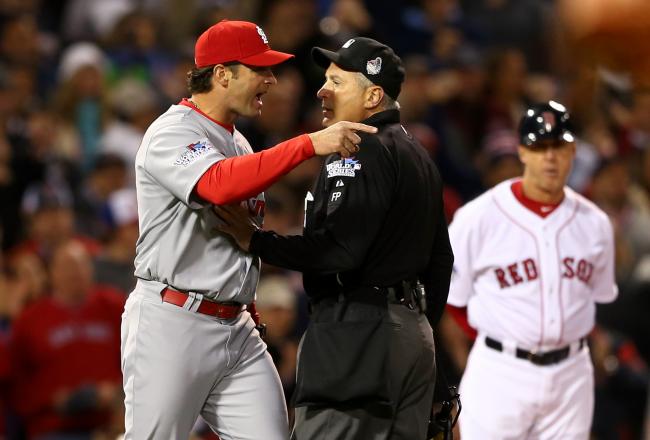
Last night, in Game 1 of the 2013 World Series, embarrassingly kicked away by the St. Louis Cardinals and won handily by some team called the Boston Red Sox,  an intricate ethics drama appeared, allowing us to see the painful process whereby a culture’s ethical standards evolve and change in response to accumulated wisdom, altered attitudes and changing conditions. An obviously mistaken umpire’s call was reversed by the other umpires on the field as the Cardinals manager argued not that the original call had been correct, but that reversing it was a violation of tradition, established practice and precedent….in other words, doing so was wrong, unfair, unethical because “We’ve never  done it this way,” a variation of the Golden Rationalization, “Everybody does it.”   You should not have to appreciate baseball (but if you don’t, what’s the matter with you?) to find the process illuminating and thought-provoking. Continue reading

The Klan’s Birthday Cake, Individual Boycotts And The Ethics Of Refusing to Give Service To Jerks

"Happy Birthday to You! Happy Birthday to You! Happy Birthday, Dear Racists..."

“Happy Birthday to You! Happy Birthday to You! Happy Birthday, Dear Racists…”

[UPDATE: Apparently, the “news story” that prompted this post is a fake. In that case, I want to thank the hoaxers for  inadvertently sparking a useful discussion—nothing in my post is dependent on the factual nature of the story. I wasn’t the only one fooled, and I originally noted the links on reliable sites. On the other hand, to hell with people who plant fake stories that are not obviously tongue in cheek or satirical: it’s a despicable practice, and abuse of the web, and right down there with public vandalism and creating computer viruses as unforgivable public conduct. I apologize to readers here for misidentifying a false story as true, but I’m not the unethical jerk involved. If anyone knows who that is, please forward their names. I have some choice words for them.]

As I wrote the first time I stuck my ethics big toe into this kind of controversy, I am conflicted over the current trend of forcing certain kinds of service providers to serve customers they just don’t feel like serving. I have consistently come down on the side of the rejected customer, even when the service, as in the case of bakeries and photography salons, edges perilously close to art. I think I am there still, but my resolve is weakening. I think. Let’s look at this again, in the context of the kind of recent case that always eventually occurs when one sits on the slippery slopes.

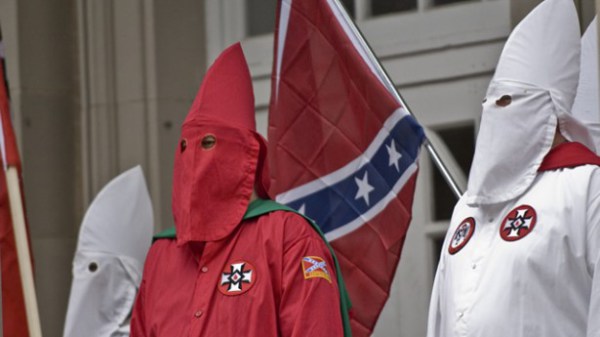
A three judge panel of a Georgia appellate court recently ruled in favor of Marshall Saxby, the Grand Wizard of a local KKK chapter, after he sued a local bakery for refusing to bake a cake for the KKK chapter’s  annual birthday party. Elaine Bailey, who owns Bailey Bakeries, said she rejected the Klan its activities violated her religious beliefs, and Saxby claimed that Bailey’s refusal of service discriminated against his religious beliefs.

The difficulty with making an ethical call on this case and others like it (and sort of like it, arguably like it or a little bit like it) is that the crucial question in ethics analysis, “What’s going on here?” cannot be answered with certainty or clarity. There are ethical arguments and ethical principles, on both sides, making the issue an ethical conflict (rather than an ethical dilemma). In an ethical conflict, we must prioritize among important ethical principles that are opposing each other.

Let’s answer “What’s going on here?” in some of the various ways this case allows, as if only one of these ethical principles were in play: Continue reading

War, Syria, Leadership and Ethics

Indecisiveness and narcissism makes great drama, bad leaders, and gets people killed , too.

Indecisiveness and narcissism makes great drama, bad leaders, and gets people killed , too.

I try to think about the ethics of war as little as possible, much less write about it. It is too frustrating, and ultimately a waste of time: the same debates and philosophical arguments have been made, eloquently and passionately, for not just hundreds but thousands of years, and only the mechanics of warfare have changed.

My father, a war hero and a man who would have loved to have devoted his life to the military if his wounds hadn’t prevented it, used to say that war was the stupidest of all human activities. “There is nothing good about war,” Dad said. “Yet it is sometimes necessary and unavoidable. And don’t ask me to reconcile those statements: I can’t. Nobody can.” I remember asking him about General Patton, who led my father and his comrades during the Battle of the Bulge. “Patton supposedly loved war,” I said. “He did,” my father replied. “He was insane.” He loathed Patton.

The Syria crisis has triggered all the same arguments again, and I want no part of them. Ethical analysis doesn’t work where warfare is concerned. The conduct of ritualized killing combatants and innocents is, at best, an extreme utilitarian act that always creeps into  ethically indefensible “the ends justify the means” territory before the end of hostilities. So many invalid rationalizations are used to justify killing—“It’s for a good cause,” or the Saint’s Excuse, prime among them, with “They started it!” following close behind—that it is useless to tote them up. The war most often cited as a “moral war,” World War II, still involved the killing of innocent non-combatants by the Allies. ( My father remained amazed at the efforts at “limited war” in Iraq, noting that Allied soldiers were expected to accept civilian deaths as unavoidable and not a matter of concern. He also felt that the current dedication to half-measures just guaranteed longer wars, more deaths, and less satisfactory results. “It’s war,” he said. “You can’t make it humane or sensible; you can only make it shorter. Telling the military that it has to waste time and military personnel to avoid civilian deaths makes no sense. There is no such thing as a humane war.” Naturally, he approved of Truman’s decision to drop the atom bomb, in part, he admitted, because he was slated to be in the Japanese mainland invasion force that was likely to sustain up to a million casualties.) The Allies engaged in atrocities too, such as the fire-bombing of Dresden.

You want to talk about the problem of supporting terrible people and factions to defeat another? World War II is the champion on that score. The U.S. partnered with Stalin, who was a greater mass murderer than Hitler, and defeated Japan, the enemy of China, allowing Mao, a greater mass murderer than Stalin and Hitler combined, to enslave a billion people. The peace negotiated after the Second World War was only slightly less destructive than the one that ended the First World War (and led directly to the Second): The U.S. handed over half of Europe to Communism, laying the seeds of the Cold War that only avoided ending humanity in a nuclear holocaust by pure moral luck. The fact that WWII is the “best” war powerfully makes the case: ethics and war have nothing to do with each other. Each renders the other useless and incoherent. Continue reading