As Close To An Ethics Hero As He’s Ever Likely To Get: Senator Ted Cruz

I never thought I would have occasion to place the term “Ethics Hero” anywhere near Ted Cruz’s name. Ted understands ethics (unlike Donald Trump), he just discards them at will, when an end he lusts for requires an unethical means. Last night, however, Cruz brushed up against ethics heroism. He took the podium at the Republican National Convention in prime time, and directed principled conservatives and Republicans not to vote for Donald Trump, though not in so many words. It took character, it took courage, and his message was the right one.

The Texas Senator and last Trump challenger standing congratulated Trump for winning the Republican nomination,  but never endorsed him. Then he closed by telling convention-goers and TV viewers to “vote your conscience” in November. The convention throng of Trump supporters erupted in jeers, as Cruz had to know they would, and Trump felt he had to appear on the floor to pull focus from his intransigent foe. Today on Fox News, the Fox Blondes and their harassers were slamming Cruz as a traitor and a fool.

Yeah, that was how the collaborators talked about De Gaulle in France during the occupation, too. Continue reading

Ethics Quote Of The Month: Ann Althouse

battery

“To everyone who likes that Lewandowsky got charged: Will you agree that everyone who does nothing more than that should undergo criminal prosecution? Are you willing to pay the taxes to cover that? Are you ready to find out that you’ve already done it and you’re going to be needing to hire a lawyer? Oh, but it’s so funny when it happens to somebody else, somebody you don’t like. If that’s what you think, please just admit to yourself that you are entirely morally corrupt.”

–Law professor and blogger Ann Althouse, taking the popular position among the talking legal heads on CNN and elsewhere that charging Trump’s campaign manager for the technical crime of battery for for what appears to be minor contact on videotape is an abuse of prosecutorial discretion.

Ann is playing law professor here, and it’s hard to tell if she is asking these questions to provoke thought from the knee-jerk partisans and virulent Trump-haters, or if she really believes everything she wrote. I;m a fan of Professor Althouse, so I want to find  a way to justify this post of her’s, which raises valid points and ignores others equally valid.

Do I “like” the fact that Lewandowsky was charged? I probably wouldn’t have charged him, but I’m not sorry he was charged. Why was a campaign manager grabbing a reporter? Why did the Trump organization react to the reporter’s complaint by attacking her honesty and character? I know the law shouldn’t be used to inconvenience people who act badly, and that doing this is usually an abuse of power. Still, do I like the fact that one of Trump’s thugs isn’t getting away with the thuggishness encouraged by his boss? Yes, I guess I do.

The charge can be justified on utilitarian grounds. Today I saw a cable TV news exchange regarding Fields’ complaint on CNN, where a lawyer explained that any unconsented touching is battery, and the interviewer was shocked. “What?” she said. Yes, I remember a lot of classmates in first year of law school being surprised at that too.

It’s the Common Law: nobody has a right to touch anybody else. I love that principle, myself: I don’t touch people unless I have permission, and they better not touch me. It’s  per se battery, and while we usually don’t press it, we might if the batterer is enough of a jerk, or does more harm than he intended. If charging Lewandowsky makes people think twice before laying their hands on me or anyone else, good. Sending a message to discourage others from wrongful acts is always a valid reason to charge someone. Continue reading

Tech And Terrorism Ethics: Apple Is Right. The Government Is Wrong.

FBI-APPLE

If, in some future nightmare scenario come true, the FBI needs to break the encryption on a private i-phone to find the secret code to defuse the Doomsday Machine  President Donald Trump set up after his mind finally snapped and he thought he was the Stay-Puft Marshmallow Man, I assume that Apple won’t stand on principle and will do what needs to be done to save the world. The current dilemma, however, is not that dire.

Although President Obama announced last year that he had decided not to pursue legislation requiring tech companies to give law enforcement access to users’ encrypted data, he proved once again that if you don’t like Obama’s promises, just wait a minute.  For last week, the FBI persuaded a judge to order Apple to create software that would help federal investigators crack into the iPhone 5C that terrorist Syed Rizwan Farook was using before he and his wife slaughtered guests at his company Christmas party in San Bernardino last December. Apple has vowed to defy the order.

Good. Continue reading

Ethics Quiz: The Barefoot Bandit Cashes In, Sort Of…

wanted_blog

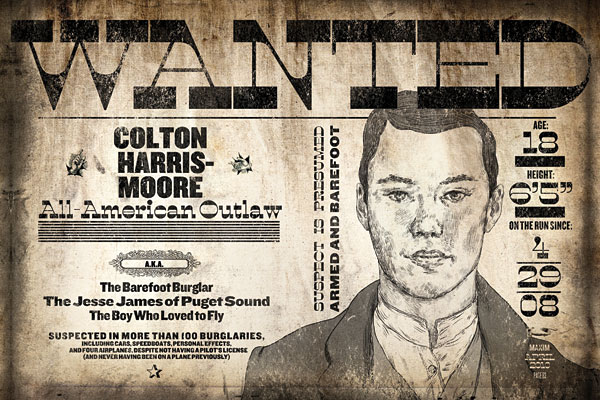
You may remember Colton Harris-Moore, aka “The Barefoot Bandit,” who while still a teen in 2009 went on a wild, two-year crime spree involving more than a hundred burglaries, thefts, and destruction, costing hundreds of thousands of dollars in cash and property, including a plane, a boat, and automobiles.  When Harris-Moore was sentenced to six and a half years in prison in 2012 , U.S. Attorney Jenny Durkan said, “The plea agreement makes very clear that he will not profit directly or indirectly nor will he help anyone else to profit from these crimes.”

I’d like to see the agreement. For Harris-Moore has signed a movie deal with 20th Century Fox, “waiving” the rights to his life story in exchange for the film company paying up to $1.3 million toward the $1.4 million he owes as restitution to his victims. Now I’d call this “profiting.” If someone pays what I owe on my mortgage, I benefit. I profit.

I’m sure the argument for permitting this deal, which is the kind most states and the federal government regard as contrary to public policy and prohibit with so-called “Son of Sam laws,” is that Barefoot’s victims are needy and innocent  beneficiaries, since it is unlikely that they would ever get much, if anything, in payments from the imprisoned felon. Thus the usual objective of keeping criminals from turning their crimes into cash and celebrity should yield to the greater good.

Today’s Ethics Alarms Ethics Quiz of the Day is…

Should the Barefoot Bandit be allowed to make this deal?

I’ll leave this one to you.

But I’m dubious.

The Unlikely Ethics Dunce, And Why Nobody Pays Attention To Ethicists And I Don’t Blame Them

Wait, how can the nation's most famous ethicist be an Ethics Dunce? It's not easy...

Wait, how can the nation’s most famous ethicist be an Ethics Dunce? It’s not easy…

Ethicists have managed to make ethics nearly invisible in our cultural debates, and nearly useless as a decision-making tool, when it ought to be the most useful tool of all. They accomplished this over centuries of work, making the discipline of ethics abstruse, elitist, abstract, and worse of all, boring. Nobody should be bored with ethics, hence my statement, “Ethics isn’t boring, ethicists are.” Once ethics was pigeon-holed in the realm of philosophy, however (it belongs with “crucial life skills” and “critical thinking”) and philosophy became associated with scholarship, advanced degrees and academia, the jig was up.

The problem is that academic ethicists teach and write about abstract ethics, and life is not abstract. Their quest is for one formula to determine right from wrong, and life and human beings are more complicated than any one formula can encompass. When I started this blog, I got a lot of grad students writing me who demanded to know whether I was a Utilitarian,  Kantian Deontologist, a follower of Natural Law Ethics,  a Virtue Ethicist or a devotee of Stakeholder theory. My answer was “all of the above and none of them.” All of these and more are useful tools of analysis, but none work all the time, and the amount of words loaded into jargon to explain and debate the nuances of any of them render them all useless except for  writing scholarly papers.

The ethics that the public learns, as a result, are what pop culture and society teach them, and most of that isn’t ethics at all. For example, in the cable series “The Affair,” a well-educated older man was advising a young woman, the mistress in the affair, about how to think about the illicit relationship that broke up he lover’s marriage. Wise and thoughtful, he described his own adulterous affair, and then said, “What you did wasn’t wrong. You didn’t kill anybody. You didn’t break any laws.  Don’t be so hard on yourself.”  There is no ethics in that statement. Itis just employs two popular and facile rationalizations (#4. Marion Barry’s Misdirection, or “If it isn’t illegal, it’s ethical,” and #22, the worst of all, #22. The Comparative Virtue Excuse: “There are worse things.”) with another lurking but unspoken one, the Cheater’s Special, #23. Woody’s Excuse: “The heart wants what the heart wants,’ underlying the whole scene.

That’s ethics, I would guess, to about 90% of the population. Scary. This is, however, where ethicists have taken us. They could be so important to the culture, if they would get their heads out of their asinine models and explain ethical principles that are relevant to real lives in a manner that doesn’t make normal people become hostile to the subject.

This brings us to Peter Singer, Princeton’s acclaimed professor of bioethics who has been called the most influential ethicist alive. It is admittedly faint praise, but probably correct. Continue reading

Worst Ethics Quiz Ever

 lifeboat test

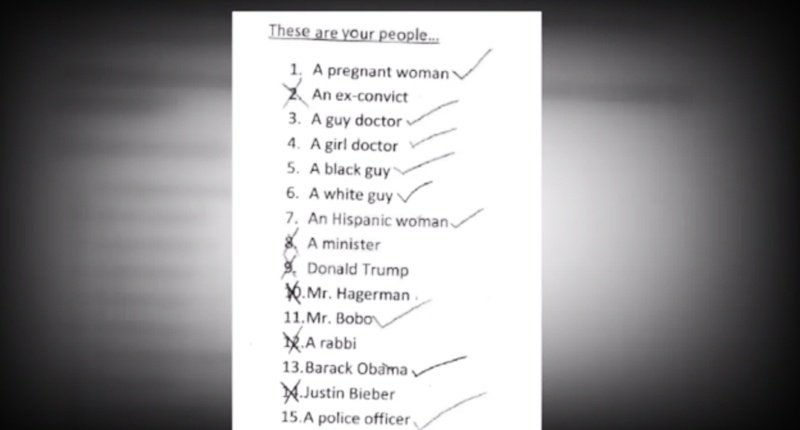
A teacher in the Hillsborough County School District gave students a “Lifeboat Quiz” asking students to choose who lives and dies during a hypothetical sea disaster.

They were told 15 people need to be saved but there was only room for nine people on the boat. They then had to choose among options including “the black guy,” “the Hispanic woman,” “the pregnant woman, ” and also Barack Obama , Donald Trump, and, uh, Justin Bieber.

The students were 11; this was the 6th grade in the Giunta Middle School in Riverview, Florida . A mother of one of the students turned this into news by claiming the test was racist—she knew the magic word, all right. It’s not racist at all. What it is is incompetent and inappropriate. Naturally, the debate has been immediately detoured into issues like diversity, which have nothing to do with what’s wrong with the test. I could imagine an excellent teacher steering the discussion of a lifeboat dilemma into a useful general discussion of bias and ethics. I cannot imagine anyone who would think this quiz could support such a discussion being skilled enough to teach such a lesson.  If the teacher told students that their choices should consider diversity quotas, she should be fired. What are the odds, do you think? Continue reading

Update: More Abortion Advocate Struggles With Ethics In The Midst Of The Planned Parenthood Videos Revelations

panda

As the pro-abortion lobby has rushed to defuse the ticking time bomb of comprehension that might make lazy and inattentive American think. “Wait, that’s what happens in an abortion?,” its dishonest, desperate, and unethical arguments have been as revealing as the videos themselves, and as damning.

Frankly, I’ve been surprised: they really don’t have much that makes ethical sense, just “it’s legal!” and “It’s Our Bodies And We’ll Kill If We Want To!” (a little known B-side flop by the recently departed Leslie Gore.)  I recently wrote about their defenses in the posts Planned Parenthood Videos Surprise: Forced To Defend Abortion Ethics Acknowledging The Existence Of A Second Human Life In The Equation, Advocates Run Out Of Arguments (Part One) and Part Two: Bad Analogies. As I wrote in the latter: “If an advocate has persuasive, honest, strong arguments not based on fallacies and rationalizations, I assume that those would be the ones he or she would use.”

More evidence that they don’t possess them and also don’t care to have an honest debate recently came to light.

The most bizarre was an article in the Washington Post ostensibly about the ongoing drama at the National Zoo in Washington, D.C. The female panda there gave birth to twins (“Awwwww!”) then abandoned and neglected the smaller one (“OH NO!!!”) which soon died. Before the little panda’s demise, those clever abortion advocates of the Post saw an opportunity, and had a female reporter, Sarah Kaplan, author an article which the Post titled “The perfectly sensible reason why panda mothers and other creatures selectively abandon babies.”

If you want to think it’s a coincidence, go ahead. I don’t. To Kaplan’s credit, she avoided any overt analogies to human beings, and played it straight, as she always does. (She’s a terrific reporter.) Still, there is that headline. It’s sensible to “abandon” babies that will be too difficult for the mother to care for, “abandon” in the wild being the equivalent of “kill.” This points to  Rationalization #51—the latest on the Ethics Alarms list-–as a defense for abortion: “It’s natural.” Continue reading

Planned Parenthood Videos Surprise: Forced To Defend Abortion Ethics Acknowledging The Existence Of A Second Human Life In The Equation, Advocates Run Out Of Arguments (Part One)

The Center for Medical Progress released a trailer yesterday promoting its yet to be released eighth undercover investigative video, this one, like the last, focusing on StemExpress, a biotech company in northern California, that has worked with Planned Parenthood to obtain aborted fetus tissue to be used in research. In the clip, StemExpress CEO Cate Dyer explains that her company receives “intact” aborted fetuses from the abortion clinics they work with.

“Oh yeah, I mean if you have intact cases – which we’ve done a lot – so we sometimes ship those back to our lab in its entirety,” Dyer says on the trailer.

Later, she jokes about shipping little aborted heads. “Tell the lab its coming,” she chuckles. “They don’t want to open the box, go, ‘Oh God!’”

I can’t wait.

Undoubtedly the allies of abortion-on-demand feminists and progressives will attack this video as they have the rest, focusing on anything and everything but the single powerful issue it raises that the abortion movement has successfully obscured, denied and obscured since Roe v. Wade and before. These are small, helpless, innocent human beings being killed, chopped up and distributed like prime beef, and the adults doing it and insisting on it have devolved into callous, cold-eyed mutants incapable of considering what their conduct is. They have not had the courage or integrity to confront the ethical conflicts that abortion raises. These videos are making that avoidance increasingly difficult. As I wrote yesterday, bravo for the The Center for Medical Progress and their allies, who are finally forcing the passive public and cynical political class to consider the issues.

The most fascinating revelation is how weak the case for abortion appears to be, once its advocates are required to stop pretending that there is only one human being—the mother—involved. We know it is weak because the attacks on the videos have largely not addressed the ugly fact on display in them—that human, unborn babies with beating hearts and functioning organs are being killed—nor found a persuasive justification for it.

They haven’t had to do either since Roe v. Wade. “It’s my right!” has been enough, though this is a rationalization that does not address the question of right and wrong. Meanwhile, by adopting the deceitful and misleading label “pro-choice,” aided by lazy and sympathetic journalists to facilitate a deceptive framing of the issue (we are seeing the same process now as “immigrant” is substituted for “illegal immigrant”), the pro-abortion lobby has warped all policy debates into a discussion of the effect of an unwanted pregnancy on women, and never about the effect of ending those pregnancies on the women’s’ off-spring. (They die.)
Suddenly, the videos have made the existence of other human beings in the abortion dilemma is unavoidable, so what are the pro-abortion advocates and their allies doing? Let’s survey them; I’m not going to rehash all the earlier deflections of the videos by Planned Parenthood and pundits (“All medical procedures are hard to look at!”) and the usual hyperbolic accusations of evil motives (“This is a war on women! They want to control our bodies!”). I’ve covered them before, and they should be self-rebutting anyway.

“The videos are illegal!”

Continue reading

Ethics Hero, Maybe For The Ages: The Center for Medical Progress

As I said with the release of the first surreptitious “sting video” of Planned Parenthood released under auspices of the anti-abortion group, the Center for Medical Progress, such videos are, in principle, unethical. However, while the unethical should be used in pursuit of a greater good only with great reluctance, moral certainty and a minimum of harm, there are instances when utilitarianism must apply.

This is one of them.

In the case of abortion, the prospect of saving the lives of millions of unborn is certainly worth the incursion on the ethical values of honesty and respect for privacy implicated by these videos. Indeed, it is worth a great deal more. With the seventh video, released yesterday, the conclusion is unavoidable that we, the public, the nation, and humanity, owe a debt of gratitude to the Center for taking radical action to force  confrontation with the reality of abortion so that there can be a real, open and honest debate  that doesn’t duck the central issue. That issue  is not women’s control over their lives, but the ethics of killing innocent human beings to achieve it.

The latest video, like the earlier ones, compels any fair, emotionally functioning and rational observer to accept the brutality and near complete callousness towards human life that the abortion machine creates and requires. In this respect the seven videos—with more to come— are abortion’s equivalent of “Uncle Tom’s Cabin,” forcing genteel, moral, good people by their own confident assessment to confront the horrors that have been occurring under their noses with their passive approval. Because they chose not to think about what abortion really involved, just as so many Americans had no idea what  slavery was like until Harriet Beecher Stowe forced them to consider it as more than an abstraction, abortion advocates, passive and active, have an ethical obligation to watch these videos. Those who refuse are admitting that they are incapable of letting facts disturb their ideologies. Continue reading

Ethics Quiz: Good Samaritan Drug Overdose Laws

heroinoverdoseI know how this one will break down, but it’s an interesting issue nonetheless. And it doesn’t involve Hillary, Donald Trump of Bill Cosby!

Many states have addressed drug-related deaths by allowing junkies using illegal drugs to call 911 for a fellow shooter or snorter in life-threatening distress and be immune from prosecution.   New Mexico passed a “Good Samaritan law” in 2007 that granted limited immunity from prosecution on simple possession charges for people who used 911 to report a drug overdose going on in front of them. The Drug Policy Alliance reports that 28 states and the District of Columbia have passed laws differing in exact provisions but providing limited freedom from prosecution in exchange for saving lives.

There is an explosion of heroin use nationwide, and therefore heroin deaths, right now. (The government abandoning its vital statements via law that drug use is wrong has a lot to do with causing this, but that is for another day.) As always, the first proposals to address a drug crisis involve loosening enforcement. Slate writes,

“In the end, of course, it doesn’t much matter how or why states pass these laws, as long as they pass them. A University of Washington study evaluating the initial results of Washington state’s Good Samaritan policy found in a survey that drug users who were aware of the law were 88 percent more likely to call 911 in the event of an overdose than before. “Despite lingering concerns about possible negative consequences of the new law, such as prosecutions being impeded, no evidence of negative consequences has been found to date,” the study concluded. Good Samaritan laws are humane and sensible. There are no compelling reasons to oppose them.”

Your Ethics Alarms Ethics Quiz of the Day:

Are there really “no compelling” ethical reasons to oppose such laws?

Continue reading