“The Only Answer”: An Ethics Hero, A Life Saved, And A Troubling Hypothetical

In this universe, a hero...and in an alternate one? I wonder...

In this universe, a hero…and in an alternate one? I wonder…

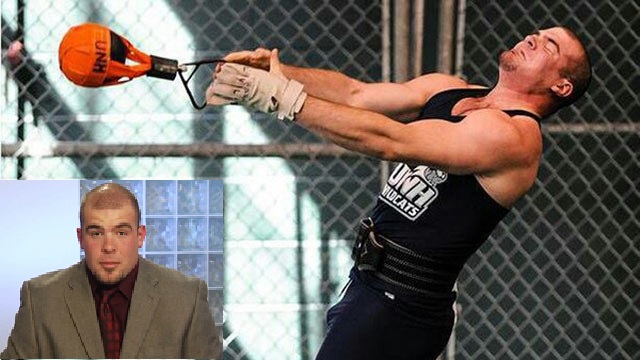
University of New Hampshire senior Cameron Lyle, a Division I college track and field competitor who excels in the shot put and hammer throw, has chosen to end his collegiate athletic career to save a stranger’s life.

He will donate his bone marrow today to a 28-year-old man suffering from acute lymphoblastic leukemia. Doctors told Lyle the man who will receive his marrow will live only six months without a transplant, and that there was a only one in five million chance for another non-family match. Yet the odds came up in his favor, thanks to  Lyle having his mouth swabbed to join a bone marrow registry two years ago. He was a perfect match.

Lyle says he never hesitated in his choice, once he was informed. “It’s just a sport,” he said. “Just because it’s Division I college level doesn’t make it any more important. Life is a lot more important than that, so it was pretty easy…It was kind of a no-brainer for a decent human. I couldn’t imagine just waiting. He could have been waiting for years for a match. I’d hope that someone would donate to me if I needed it.”

“He made his decision. He gave up his college season to do this. He’s a gentle giant,” Lyle’s mother said of her 6-foot-2-inch, 255-pound son. “He’ll do anything for anybody.”  Lyle’s coach Jim Boulanger, was also completely supportive, and, according to Lyle, came up with an instant Ethics Quote of the Month when the shot-putter told him of his plans.

“Here’s the deal,” Boulanger told Lyle. “You go to the conference and take 12 throws or you could give a man three or four more years of life. I don’t think there’s a big question here. This is not a moral dilemma. There’s only one answer.” Continue reading

Comment of the Day: “Annoying and Ill-Timed Tangential Issue Dept.: There’s Nothing Especially Virtuous About Running A Marathon”

Here is a helpful Comment of the Day from Rich Page, providing important perspective to the issue of marathoning and marathoners. I am especially grateful for comments like these, which add leavening to posts that can be a little more jarring than I intend, even though I know exactly how they will be taken when I post them. 

I didn’t want to get too deep into all the many reasons people run, so what was intended as an observation about many marathon and running enthusiasts could have been taken as a knock on running for fun, for example. Fun is important; fun is natural; fun is grand. I think fun is a wonderful reason to do anything. I do a lot of things just for fun, and always have—luckily, I find my various jobs fun, all of them. 

Rich’s post balances mine perfectly, and makes it whole and better. As to the timing—I agree, I wish I could have “hung it on a different hook,” and perhaps I should have waited for another one, since I have been waiting a while as it is.Perhaps my rule should be that if I can’t conceive of any graphic or photo that won’t risk being offensive to a lot of readers, that’s a strong indication that I should postpone the topic to another day.

This is the Comment of the Day on “Annoying and Ill-Timed Tangential Issue Dept.: There’s Nothing Especially Virtuous About Running A Marathon”: Continue reading

Annoying and Ill-Timed Tangential Issue Dept.: There’s Nothing Especially Virtuous About Running A Marathon

I sincerely apologize for the timing of this topic, which has actually been percolating in my brain for a while. I first considered it after finding myself annoyed by a commercial running on television of late, comparing various artists who completed major works after their 55th birthdays with a similarly aged woman who recently ran a marathon. Then, yesterday, in the wake of the terrorist attack on my home town, I read multiple Facebook posts from otherwise intelligent people expressing profound sadness for all the marathoners who trained so hard for Boston and were not able to finish. That did it.

I believe we can stipulate, can we not,  that any marathoner who returned home whole after watching fellow competitors having their arms and legs blown off  and complained that the race was terminated before he could finish would immediately be eligible for the Jerk Hall of Fame. If horror, grief and empathy for the victims, concern for the nation, and gratitude for the pure luck of being spared doesn’t wash such selfish thoughts right out of a runner’s mind, then that person needs to keep on running until he has left civilization. Meanwhile, the increasingly accepted cultural attitude that running a marathon or an iron man competition is especially admirable shows something is out of whack in our value system.

I didn’t feel like confronting my Facebook friends yesterday, but please tell me how being prevented from running in a race one has trained for is any more of a tragedy than a thousand other minor disappointments we all face every day, and far less worthy of sympathy than thousands of others. A while back I was blocked from giving a seminar in Tennessee that I had prepared for, because of a storm that grounded all usable flights. That cost my company $5,000. It meant that a lot of Tennessee lawyers had to hustle to find other ways to get their ethics credit, and the ways they found were going to be a lot more boring than I am. Those are real consequences, tangible and significant. What is the result of not being able to finish the Boston Marathon? Who is significantly harmed? Nobody. The marathoner is disappointed and inconvenienced, that’s all. There are other races. He or she is in shape, They did the best they could. The Marathon will be held next year. The terrorist attack is a tragedy. The fact that racers couldn’t cross the finish line is trivial. It just doesn’t matter very much, or shouldn’t.

I’m not condemning runners, any more than I condemn people who spend their spare cash on jewelry, summer houses and vacations instead of saving the whales: it’s their lives and and their priorities, not mine, and they can do what they choose. At the same time, the aura of virtue surrounding extreme runners and the popular myth that running a marathon is more ennobling than commonplace altruistic and practical uses of an individual’s time is bizarre. That commercial I mentioned speaks of being productive in latter years. Running a marathon doesn’t produce anything more than playing a videogame does. Picasso, whose late career artwork is mentioned in the spot, created something beautiful that will be enjoyed for centuries: now that’s productive, and also worthy of admiration and praise. Whose life is enriched by the completion of a marathon, other than the runner’s? It isn’t a communal act, a generous act, a productive, charitable, creative or selfless act. It is a completely self-absorbed and self-focused act, requiring many hours that could just as easily be used communally, generously, productively, charitably, creatively and selflessly. Again, it’s the runner’s life, and if he or she wants to use their brief time on earth to complete manufactured and artificial challenges that accomplish nothing tangible and leave the world no better than it was before, that’s an individual choice; running a marathon doesn’t harm anyone, either, unless it interferes with being a good and attentive father, spouse, and friend. Extolling this kind of activity, however, just distorts societal values, and bestows heroic status on the wrong people, for the wrong things.

Ethics Hero Emeritus: Annette Funicello

AnnetteAnnette died yesterday after a long, painful decline triggered by the onset of Multiple Sclerosis 25 years ago. To understand why she was an Ethics Hero, one need only read the New York Times obituary, which captures her essence well. One is an Ethics Hero if one goes through life caring about others, being loyal, responsible and fair, never inflating one’s own value and worth above those you live and work with, and having integrity.

If you can do all this while being a celebrity, TV star, teen idol, recording star,  movie star and adolescent lust object, you are more than an Ethics Hero. You are a miracle. That was Annette. Continue reading

Ethics Dunce: Susan A. Patton

Oh, yeah, ladies, if you can't hook one of these gems, you should just kill yourself...

Oh, yeah, ladies, if you can’t hook one of these gems, you should just kill yourself…

Ethics are built by values, and those whose values are warped and flawed are very likely to engage in unethical conduct consistent with their rickety ethical foundation. Thus it is that I have serious doubts about Princeton grad Susan A. Patton, who in a letter to the Daily Princetonian not only proclaimed her own lousy values but did so as “advice” to co-eds. (I hope the link starts working; it was not earlier today.) In her letter, she wrote…

“Forget about having it all, or not having it all, leaning in or leaning out … Here’s what nobody is telling you: Find a husband on campus before you graduate. Yes, I went there…. Men regularly marry women who are younger, less intelligent, less educated. It’s amazing how forgiving men can be about a woman’s lack of erudition, if she is exceptionally pretty. Smart women can’t (shouldn’t) marry men who aren’t at least their intellectual equal. As Princeton women, we have almost priced ourselves out of the market. Simply put, there is a very limited population of men who are as smart or smarter than we are. And I say again — you will never again be surrounded by this concentration of men who are worthy of you.”

How misguided, jaded and warped is this advice?

Allow me to take inventory. Continue reading

Ethics Hero: Matt Groening

Duff-Beer

Cashing in, selling out, maximizing income, monetizing assets: the crash of 2008 only accelerated what was already becoming a coarsening cultural trend in America, the mania of never, never allowing any opportunity to make money go unexploited. Every creation or idea is copyrighted or trademarked; every open space is marked with a billboard; every person, place or thing imaginable is sponsored or branded, every citizen who does something admirable or remarkable will sell his or her life story or hire someone to write a book. The effect of this on the community, on life itself, is toxic.

When everything is a potential cash cow, then our choice is to milk it or wait for someone else to steal the milk. A Profit Above All mindset turns everyone into a potential competitor, which means that trust becomes impossible. There are only two antidotes for this trend, which I fear is irreversible. One is for there to be so much money to go around that nobody worries about it any more, which is to say that there is really only one antidote. That one is for our society to evolve and reinforce a hierarchy of values in which money, wealth, profit and material things are not seen as ends, but as means to ends, and not the only means to those ends, either. Wealth can lead to freedom, for example, but only if it is joined with proportion, moderation, responsibility, modesty, and restraint. Otherwise, wealth and the pursuit of it can restrict choices and liberty as effectively as chains.

This is why a rare case where someone eschews the opportunity to make a lot of money for no other reason than that he thinks to exploit the opportunity will make the world a worse place is a qualification for the Ethics Hero designation.  I hate the speech in “Traffic” given by Seth Abraham, the loathsome preppy coke-head played by Topher Grace, about how suburban drug users corrupt the inner city:

“Ok, right now, all over this great nation of ours, ‘hundred thousand white people from the suburbs are cruisin’ around downtown asking every black person they see ‘You got any drugs? You know where I can score some drugs?’ Think about the effect that has on the psyche of a black person, on their possibilities. I… God I guarantee you bring a hundred thousand black people into your neighborhood, into fuckin’ Indian Hills, and they’re asking every white person they see ‘You got any drugs? You know where I can score some drugs? within a day everyone would be selling. Your friends. Their kids. Here’s why: it’s an unbeatable market force man. It’s a three-hundred percent markup value. You can go out on the street and make five-hundred dollars in two hours, come back and do whatever you want to do with the rest of your day and, I’m sorry, you’re telling me that… you’re telling me that white people would still be going to law school?”__

I hate it for two reasons. First, it is more or less true, and second, it is only true because the vast majority of people have such a weak commitment to behaving ethically and not selling out, because our culture reinforces healthy ethical values less and less effectively. It shouldn’t be true, and in a rational society, it wouldn’t be true.

So I am giving Matt Groening the Ethics Hero for something that is relatively minor and trivial, because, I guess, it gives me hope. Continue reading

Justin Bieber’s Tardiness: Calling Card Of The Unprofessional Jerk

Professional on the right, arrogant jerk on the left. Also, anyone next to Cary Grant looks like a troll...

Professional on the left, arrogant jerk on the right. Bonus: Anyone next to Cary Grant looks like a troll…

There is still some confusion how late pop sensation Justin Bieber was for a recent London concert. It may have been as much as two hours, and it may have been only 40 minutes. The ethical verdict on the conduct is the same, however: rude, disrespectful, irresponsible, unfair and arrogant…and inexcusable.

The tardiness is especially inexcusable because the singer didn’t even offer a plausible excuse or one that might prompt some sympathy. He was not kidnapped by terrorists, abducted by aliens, or cornered by a rampaging T-Rex from Isla Sorna. He wasn’t late because he single-handedly rescued a runaway school bus full of kids, or defused a ticking bomb in the London Tube. Justin Bieber was late because he’s an unprofessional jerk who knew that his fans would wait for him until he got there, and so he chose to to get drunk, or get laid, or sleep in, or play Words With Friends with Alec Baldwin, or whatever other selfish conduct suited him rather than meet his obligations as a performer. This is the Star Syndrome in its most obvious and obnoxious form. Continue reading

I’ve Always Said, If You Want To Know The Values of America, You Have To Watch “Family Feud”

Somehow I missed this significant moment, from 2011.

The clip doesn’t show it, I but I’m guessing “STDs” scored higher in the survey than either answer given.

<sigh>

___________________________

Pointer: Jo Ursini (Thanks, Jo!)

Ethics Hero: Christina Aguilera

In Jessica Simpson’s Weight Watcher’s TV ad, the former “Daisy Duke” appears only as a giant head, as if the spot was directed by Francis Ford Coppola and Jessica was a last minute stand-in for Marlon Brando.

“the horror…the horror…”

It is clear that Jess is not willing to show America her post-pregnancy body, even though she is telling the public to buy what she’s using to slim it. She is ashamed, in other words, and if a beautiful young woman like her believes that not being able to fit into Daisy’s cut-offs makes her hideous, just imagine how that makes the average woman feel.

Then there is Christina Aguilera. The former waifish “pop tart” who sang “Genie in a Bottle” is now an established pop music diva, and posed for photographers as she announced the American Music Awards Nominations in a throbbingly purple form-fitting dress that didn’t hide a single pound or curve, and showed that she has an abundance of both.

“We’re gonna need a bigger bottle…”

Christina’s not ashamed, nor should she be, and her willingness to look happy and confident regardless of her expanding figure is a boon to a culture that has been working overtime to make women of all ages feel unattractive unless they look like super-models. Continue reading

The Ethical Fate For Joe Paterno’s Statue

In the wake of the Freeh Report’s revelations regarding the extent of the late Joe Paterno’s involvement in allowing Jerry Sandusky’s child molesting appetites to be sated with Penn State’s  assistance, many are calling for the campus statue honoring the now-disgraced coach to be removed.

I am generally opposed to removing memorials and honors to historical figures according to the popular verdicts of the day, for several reasons. The main one is that every individual who ever achieved something worthy of such honor also was guilty of misconduct that someone could convincingly argue outweighs it on moral or ethical grounds. New facts are uncovered, cultural values shift, and over time, no revered figure is safe from deconstruction. The reverse is also inevitable: if a life can be judged unworthy of honor, subsequent generations may well disagree. The verdict of a community, a culture and an era should be given due weight and respect;  a statue, memorial or monument not only recognizes an individual but also represents the judgment of our predecessors. Leave their judgments alone, and if we disagree with them, try to make ours better. Continue reading