Comment of the Day: Anti-Bullying Mis-steps: The Perils of Changing Cultural Norms (Part 2)

From Penn, excellent and valuable insight on “The Hunger Games” controversy, going into relevant issues and facts that my post did not. Here is his Comment of the Day on the post, Anti-Bullying Mis-steps: The Perils of Changing Cultural Norms (Part 2):

“The purpose of this argument scares the hell out of me. As one press-screener’s review had it, and as the trailers make clear, “The Hunger Games” tells the story of a televised fight to the death between(sic) a group of youngsters in which only one can survive.” If I believed there were any merit to the MPAA system, yes, R is what it should be. [“This Film is Not Yet Rated” is the movie to see on this subject.] Continue reading

Anti-Bullying Mis-steps: The Perils of Changing Cultural Norms (Part 2)

If "Hunger Games" should be able to bypass the ratings because kids can learn from it, then why shouldn't a film like "A Clockwork Orange," a better film, should also get a pass?

When society decides makes altering attitudes about any conduct a priority,an immediate danger is that it will destroy other societal safe-guards and damage other valid cultural norms in its tunnel-vision.

“Hunger Games,” a film about the consequences of bullying based on a best-selling novel, is about to hit theaters with an R rating, meaning that teens, the prime target of the nation’s anti-bullying effort, can’t see the film without their parents’ permission. Katy Butler, a young bullying victim, has led a national effort to get the film’s ratings reversed. Predictably, politicians have jumped on the bandwagon.

“Over 13 million American youths will be bullied over the course of this year alone, making it the most common form of violence experienced by young people in our nation,” begins a letter from Rep. Mike Honda (D.- Calif.) to his colleagues, in support of Butler’s campaign. “We cannot hope to control this epidemic … without discussing tough issues publicly and bringing them to the forefront of the consciousness of the American public.”

“YES! RIGHT ON! OF COURSE!” Except that what Butler and Honda are proposing essentially undermines the entire purpose of movie ratings, and if their efforts succeed, there is no way anyone will be able to argue that the system has a shred of integrity at all. Continue reading

Self-Promotion Department

Fortunately, you won't have to look at me...

I’ll be “appearing” on NPR’s “Tell Me More” tomorrow with Michel Martin, discussing the NFL’s bounty scandal and maybe another issue or two. Check local times in your area, or just plan on rearranging your sock drawer.

The NFL, Battling Its Own Sick Culture

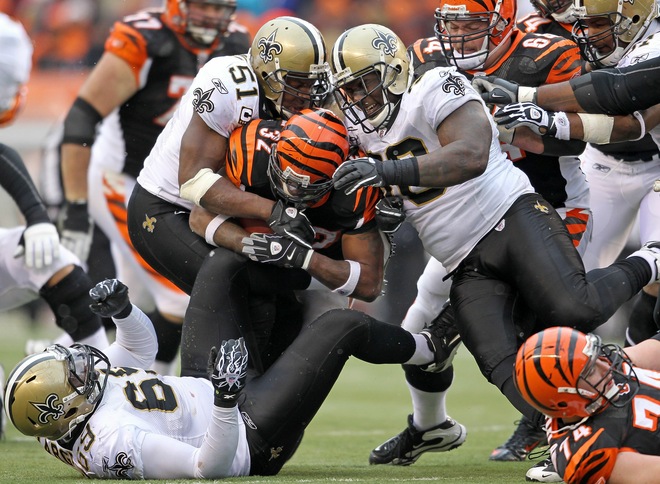
"OK, it's a deal then: we put this guy in the hospital, and split the bounty 50-50..."

The last Super Bowl was phenomenally successful, as its audience size shattered previous records. Yet for many years, I have not been able to enjoy the sport, because of the unethical conflict at its core. Pro football’s appeal and swagger is based on violence, and we now know that the violence damages its players to an unacceptable extent. The players are paid both to accept the crippling and often-life shortening abuse, as well as administer it. For this former fan, that makes football too close to boxing from an ethical perspective. If the NFL is paying  players to do permanent harm to each other, then so are the fans that pay the NFL.  Sorry: there are too many other forms of entertainment that don’t require me to endorse and subsidize brutality. Thus I was not surprised to read this, in the New York Times:

“During the past three seasons, while the National Football League has been changing rules and levying fines in an effort to improve player safety, members of the New Orleans Saints’ defense maintained a lucrative bounty system that paid players for injuring opponents, according to an extensive investigation by the N.F.L. The bounty system was financed mostly by players — as many as 27 of them — and was administered by the former defensive coordinator Gregg Williams, who also contributed money to the pool. The N.F.L. said that neither Coach Sean Payton nor General Manager Mickey Loomis did anything to stop the bounties when they were made aware of them or when they learned of the league’s investigation.  According to the league, Loomis did not even stop the bounties when ordered to by the team’s owner. “

This practice is not only unethical and against NFL rules, it is criminal.  Continue reading

Ethics Quiz: Mixing Math and Black Humor

[Yesterday I was en route to Las Vegas for a speaking engagement—actually one of my rock classic parodies musical legal ethics seminars with rock singer and guitarist Mike Messer—and essentially went from 7 hour trip to hotel to restaurant to bed last night, then to an all day session today. I’ll catch up: I’m not ignoring comments, just haven’t had the chance to read them.]

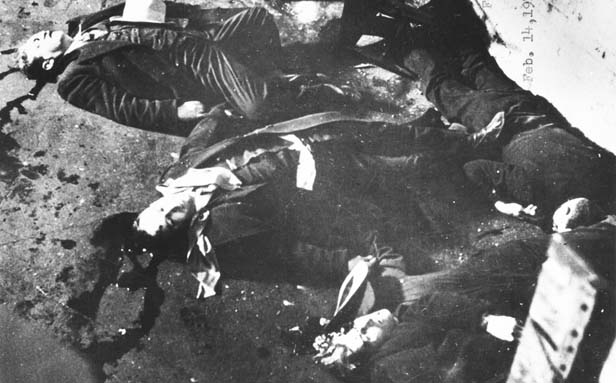
"If Bugs Moran has 276 gangsters, and Al Capone's men massacre 7 every Valentines day beginning in 1929, how many gangsters will he have left today?" Hey, math is fun!

At the Trinidad Center City Public Charter School in Washington, D.C., third graders have been given math problems like this…

  • “Tilda Tiger had many hungry children to feed on Thanksgiving Day. She caught 169 Africans, 526 Americans and 196 Indians. She then put the people equally into 9 enormous ovens to bake. How many desperate people were in each oven?” Not to mention…
  • “When I was sleeping in a forest last night, 2555 fire ants crawled up my nose and built a nest in my brain. I woke up screaming the next morning. My distraught mother rushed me to hospital for an emergency operation. The doctor was able to kill 1953 fire ants. The remaining ants in my brain formed themselves into 7 equal-sized groups and fled to 7 different organs in my body, one being my stomach. a) How many fire ants escaped? b) How many ants fled to my stomach?” As well as… Continue reading

School Insanity: A Warning From Canada…

Jessie Sansone and his trouble-making daughter

…And the warning is: the police and schools aren’t this crazy and irresponsible in the U.S. yet, but all the signs are present. From the news in Ontario:

Police arrested a Kitchener, Ont., father outside his daughter’s school because the four-year-old drew a picture of him holding a gun. Jessie Sansone told the Record newspaper that he was in shock when he was arrested Wednesday and taken to a police station for questioning over the drawing. He was also strip-searched.

“This is completely insane. My daughter drew a gun on a piece of paper at school,” he said.

Officials told the newspaper the move was necessary to ensure there were no guns accessible by children in the family’s home. They also said comments by Sansone’s daughter, Neaveh, that the man holding the gun in the picture was her dad and “he uses it to shoot bad guys and monsters,” was concerning.

Police also searched Sansone’s home while he was in custody. His wife and three children were taken to the police station, and the children were interviewed by Family and Children’s Services. Continue reading

Facebook’s Weird Ethical Standards

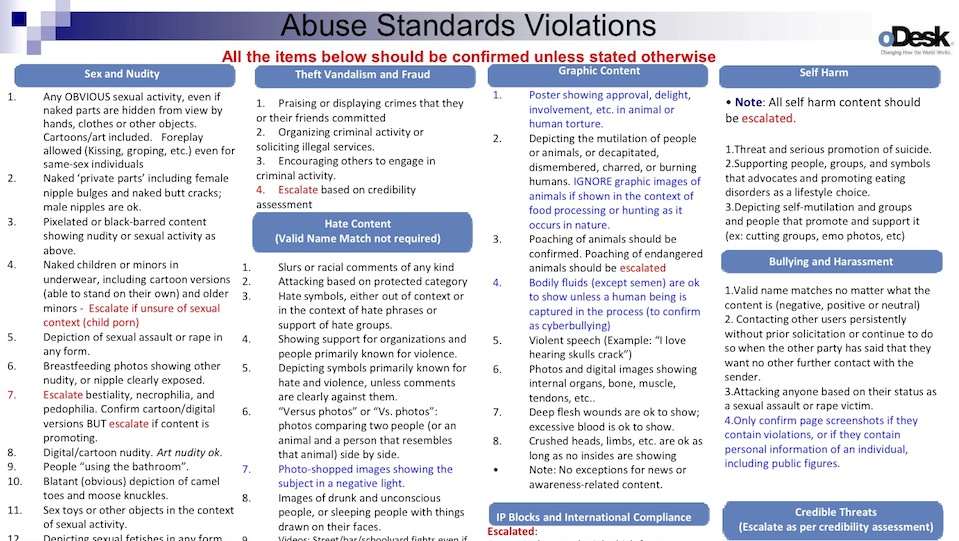
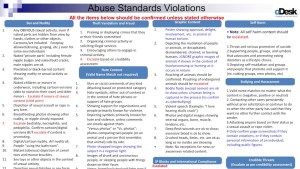
I know, they're too small to read. Never mind; they also don't make any sense

The idea of Gawker, a website that shares the ethical standards of the seamier denizens of “Rick’s” in “Casablanca,” doing a legitimate ethics expose gives me a brain cramp, but the gossip site has given a platform to a Facebook whistleblower, sort of.

I say “sort of,” because knowing Gawker, I wouldn’t be surprised to learn that he was paid to rat out his former employers-once-removed (he was hired by  Facebook’s outsourcing firm that handled his training—oDesk), making him ethically less of a whistleblower than a candidate for Gawker’s editorial board. The argument, I suppose, would be that a dollar an hour, which is what Gawker’s source says was his princely reward for doing Facebook’s dirty work, shouldn’t buy much loyalty and confidentiality, if any. Ethically, that’s false: you are obligated to abide by the terms of bad deals if you voluntarily agree to them. Practically speaking, it is true. A worker a company exploits is likely to harbor more animus than good will, and it isn’t the happy workers who blow whistles. Fine: neither Gawker’s source nor Gawker are ethically admirable. On to Facebook.

The whistleblower is Amine Derkaoui, a 21-year-old Moroccan who was recruited by an outsourcing firm to screen illicit Facebook content. This is what he was paid a dollar an hour for, which, when one considers the news reports flying around recently about how rich Mark Zuckerberg is, and after the company filed its record $100 billion IPO, seems unequivocally exploitive. His real exposé, however, involves what he was paid to do, which was to be Facebook’s censor. Derkaoui supplied Gawker with a bootleg copy of part of Facebook’s abuse standards, which lays out what the company believes is appropriate and what it believes should be banned from the web. Thus it is Facebook’s morality, revealing the ethical standards that the company embraces. Continue reading

America Is Severely Confused About Domestic Abuse

John Wayne paddling his wife (Maureen O'Hara) in "McClintock!" I love ya, Duke, but this isn't funny any more....if it ever was.

Violence inflicted by one partner in a relationship upon another is absolutely unethical, yet it is one of those embedded cultural habits from the bad old days that still flourishes. Over at the Whitney Houston post, where I am being over-run by the drug-legalization zealots, sicced on me by a sad website where people indulge their dreams of legally de-braining themselves on a regular basis, there is widespread contempt for the concept  that cultural norms of what is right, wrong and worthy of shame controls our worst impulses. That contempt is as crippling as it is ignorant, for controlling behavior is what cultures do, and why they are essential. And our culture is still giving confusing signals about domestic abuse. Two recent examples: Continue reading

Judging McQueary: Child Rape Bystander Ethics

You have no excuses, Kal-El. But the rest...

“It was cowardly for a 6′4″ graduate assistant to witness the rape of a child by an older man and not only take no action to stop it but also not even call the police,” writes David French in the National Review.

He is, of course, referring to Mike McQueary, then a 28-year-old graduate student assistant coach for Joe Paterno at Penn State. Others have declared that it was an “absolute moral imperative” that McQueary physically intervene to stop the sexual assault.

It is interesting that the absolute moral imperative is nonetheless linked to qualifiers. French references McQueary’s size and the fact that the alleged assailant, Jerry Sandusky, is older. Some critics have focused on his gender. Still others, making the argument that McQueary failed to intervene because he didn’t take a child rape seriously enough, have suggested that he would have acted differently had Sandusky been beating, rather than raping the child. Of all the ethical debates surrounding the Penn State scandal, the question of how much scorn should be heaped on McQueary for not acting immediately to stop the rape in progress has been the most fascinating, and to my mind, the most disingenuous. It appears that every commentator, male or female, young or old, fat or fit, is convinced that would have charged in and battled the 57-year-old former wide-receiver, pummeling him into wet submission while the child escaped. Maybe. Studies and anecdotal evidence indicate that in fact, most people wouldn’t physically intervene. Perhaps sportswriters and op-ed writers are made of sterner stuff that the rest of the public.

Yes, that must be it.

None of this is to suggest that physically stopping a child rape in progress isn’t the right thing to do; it is. For his part, McQueary reputedly didn’t take any action to stop the assault,* which in order of effectiveness would be… Continue reading

Scott Olsen, The “Occupy” Movement and The Protest Dilemma

The critics of the various Occupy Wall Street demonstrations are hustling to defuse the backlash from an incident that took place this week in Oakland, where a confrontation between police and Occupy Oakland protesters not only led to many arrests, but also a severely injured protestor. Iraq war veteran Scott Olsen is hospitalized with a fractured skull as a result of being hit by a projectile directed by police, probably a tear gas canister.

In the age of YouTube, the various images of Olsen’s injury were quickly exploited by protest organizers, as should be expected and is entirely fair. All demonstrations and protests are ultimately about public relations: if the protesters manage to be viewed more sympathetically than the group they are protesting against, then they attract sympathy and support. They win. If the protesters become unsympathetic, then they lose. All intense demonstrations eventually become a game of chicken between demonstrators and the government’s law enforcement force, be it police or National Guard. The demonstrators refuse to clear out of an area where they do not have a right to be, either because of the lack of a permit, or because they are disrupting the public peace, safety and welfare. They will try to provoke police without appearing so violent, unruly or scary that they lose public support. The police (or National Guard) have a job to do—they also have their own physical safety to protect—and yet they have to avoid making martyrs out of the demonstrators by appearing too militaristic, and also to make sure that their efforts don’t evoke images of police state oppression. Continue reading