Oh Look, What a Surprise…California is Considering Another Law Sticking the State’s Nose Where It Doesn’t Belong

I don’t understand why anyone continues to live or work in California, a state with a culture that lurches between stupid, irresponsible and deluded.

The headline above does not refer to the recent, bone-headed decision to give fast-food workers up to a 25% raise, with cooking Big Macs the minimum wage jumping to $20 an hour in that sector next week. “It’s a big win for cooks, cashiers and other fast-food workers ” says taxpayer-funded progressive propaganda organ NPR. Right. Fast food wages have been growing at a faster clip than almost any other sector since the pandemic, with the result that more outlets are moving to automation, which means, as has happened every time the minimum wage jumps, lower-paid workers—whose skills often aren’t worth the minimum wage— will lose their jobs. Meanwhile, fewer people with strained budgets will buy fast food because of the duel problems that it’s no longer fast, and is absurdly expensive, and California is already one of the most expensive states.

Oh, who knows: maybe all those vegans and health nuts in the Golden State want to wreck the fast food business. More likely, however, it’s just that legislators there—Suspense! Will they actually vote to make all Californians-of-the-right-color millionaires?—don’t understand economics, cause-and-effect and reality.

But I find the proposed law this post concerns more offensive from an ethics point of view if less destructive. California Assemblyman Matt Haney wants California to be the first in the country to give employees the legal right refuse to respond if their superior calls after hours. Then the law would permit workers to ignore emails, texts and other work-related communications until the next day after the work day has begun. “People now find themselves always on and never off,” the Nanny State fan said. “There’s an availability creep that has reached into many people’s lives, and I think it’s not a positive thing for people’s happiness, for their well-being, or even for work productivity.”

Oh, shut up. The law aims to give workers a legal right to be unprofessional. If you have a job and believe in ethical work values, you believe in diligence, responsibility and self-sacrifice. If you believe in personal autonomy and character, you believe that human beings need to be able to make intelligent choices about their life, including their careers, without being bolstered by the legal right to stand up to bullies, jerks and unreasonable supervisors.

Continue reading

Case Study:”When Ethics Fail, The Law Steps In”— The 2023 Major League Baseball Season

After the Arizona Diamondbacks win tonight, everything but the World Series will has been settled in the 2023 MLB season. (The Texas Rangers had already defeated the cheatin’ Houston Astros for the American League pennant, thus proving that the Baseball Gods read Ethics Alarms.) The season will be most noted in history notable for the fact that several game-changing new rules were introduced, all designed to cut down on dead time and speed up the games, which had gradually stretched out to an average of more than three hours.

MLB had tinkered around the edges of the rules in recent years in an effort to fix the dragging games problem. It (finally) banned one-batter mid-inning pitching changes, a curse visited on baseball by a combination of statistics-obsessed managers and the rise of left-handed pitching specialists, by requiring relief pitchers to face a minimum of three batters. It also made intentional walks automatic, with batters being sent to first with pitchers actually having to throw four balls outside the strike zone (that one shaved about 3 seconds off the average game time, maybe).

These new rules had little measurable effect, however, so for 2023, baseball dropped The Big One by instituting a pitch clock that limited the time pitchers had to throw a pitch to 15 seconds with the bases empty and 20 seconds with runners on base. Rules were attached limiting the number of time-outs a batter could call during his at-bats to one and requiring batters to step up to the plate when a pitcher was ready to throw the ball, thus ending psychological stalling tactics. Baseball had always taken pride in the fact that it was the one major sport without time limits, but that virtue had become a liability as players increasingly abused the privilege. Another rule stopped more tactical abuse: pitchers had begun throwing alleged pick-off throws to first base sometimes for no apparent reason, again, stalling to compose themselves are to unsettle the batter. Starting in 2023, a pitcher got three shots at trying to pick-off a baserunner, and if the third failed, the runner advanced to the next base anyway.

Continue reading

“When Ethics Fails, The Law Steps In”…Or In This Case, Technology

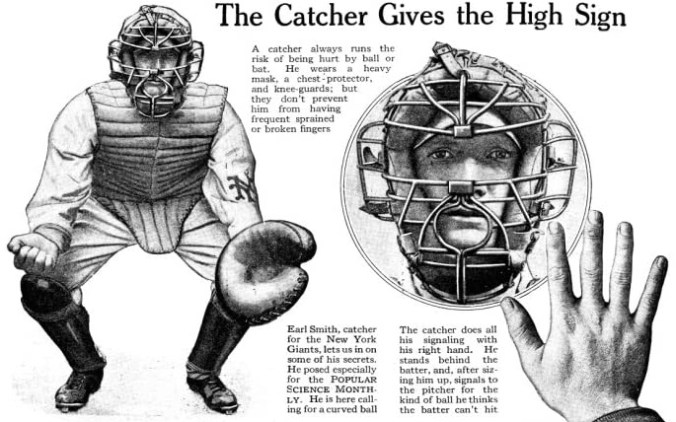
That’s part of a feature from a 1920’s magazine about how catchers and pitchers communicate regarding pitch selection in baseball. (I had Earl Smith on one of my favorite Strat-O-Matic teams, the 1922 Giants!) Trying to steal signs so a batter would know what pitch was coming—a huge advantage—was long part of the game and considered legal and fair, as long as the efforts came on the field. Once a team started using  spies in the stands and secret relay systems not involving players, the practice became unethical.

In 2017, as exhaustively discussed here in these posts, the Houston Astros used a technology-assisted system of sign stealing to win their division, the American League play-offs, and the World Series. It was one of the three most significant scandals in the history of the sport, trailing only the Black Sox World Series fixing plot in 1919 and the steroid scandal on the Nineties. Baseball, as a sport that values continuity and nostalgia, hates to change, but as with its acceptance of replay challenges to over-turn bad calls by umpires, the sport cannot pretend that technology hasn’t rendered some aspects of the game obsolete. There are too many ways to use technology to steal signs now.

Major League Baseball, following the Ethics Alarms motto that when ethics fails, the law steps in (and usually makes a mess of things), tightened its rules and penalties for illegal sign-stealing, but wisely recognized that rules wouldn’t be enough. Baseball managers, coaches and player are not known for well-functioning ethics alarms, and the financial benefits of cheating can be substantial: several Astros players had spectacular years at the plate in 2017 far beyond what they achieved before or since. All of them are many millions richer for it.

And thus it is that Major League Baseball announced yesterday that teams this season will begin using electronic devices that transmit signals from catchers to pitchers. Continue reading

When Ethics Fails, The Law Steps In, And Often Makes An Ass Of Itself…

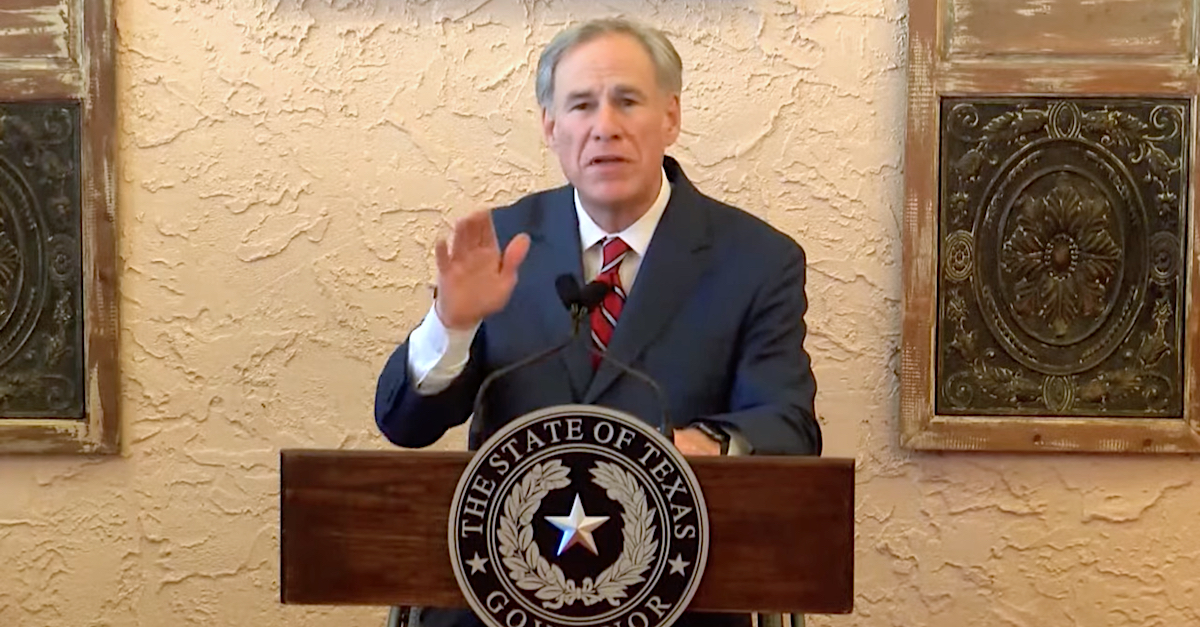
Greg-Abbott

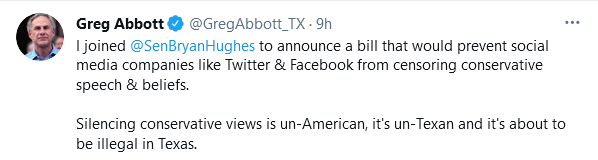
There is no excuse for this:

Abbott tweet

Well, let me clarify that a bit. Anger, frustration, outrage at the open attack on democracy and a level playing field in the marketplace of ideas are all legitimate reasons for someone to default to “there ought to be a law!,” but there is no excuse for elected officials like Abbott and Texas legislators displaying such ignorance of the Bill of Rights.

Stipulated: what Big Tech and the social media platforms are doing right now, deliberately and brazenly attempting to slam their fists down on the scales of democracy to make it as difficult as possible to communicate opinions, news and other expression that our rising woke dictators find inconvenient, is a genuine threat to the nation’s values and existence. However, those same values will be weakened if laws mandating companies to be fair and ethical undermine the First Amendment. As the giddy AUC and my Trump Deranged Facebook friends immediately reply to any criticism of the growing censorship of conservatives and especially President Trump, a private company has a nearly absolute right to decide who has access to its free services. As the social justice crusaders don’t say, but prove every time they make this kneejerk observation, they are thrilled to see their fellow citizens muzzled this way, since it advances their own interests. Big Tech and the social media companies have the right, but it is not right for them to abuse it this way when they have so much control over public debate and information.

Continue reading

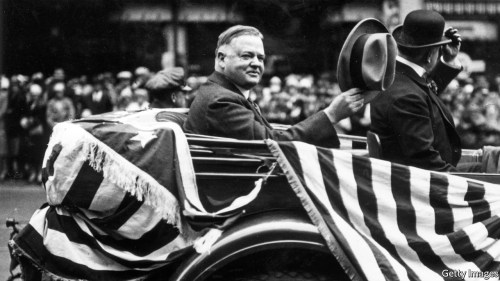
Sunday Evening Ethics Review, 6/3/18: A-Rod, Obama, And Herbert Hoover

Good evening….

1. Why is Alex Rodriguez on the ESPN Sunday Night Baseball broadcasting team? I’m watching the game (Boston at Houston), and I’m wondering, “There weren’t any ex-players who weren’t suspended for a full season for cheating with PED’s (banned performance enhancing drugs)?  There aren’t any ex-players who didn’t repeatedly lie to fans and sportswriters, and generally behave like a loathsome creep both on and off the field?”

Rodriguez will be up for membership in the Hall of Fame shortly, and he falls so short of the minimal requirements of the museum’s character clause that if it were a contest between A-Rod and Barry Bonds, Bonds would win in a landslide, and his election would provoke a major protest among living Hall members.

What kind of values does employing Rodriguez convey to kid viewing the game? What does it say about ESPN’s values, or Disney’s, its parent? Why does Major League Baseball allow a sociopath like A-Rod to represent the game on television?

2. And you thought Trump was a raging narcissist…Maureen Dowd has a damning column about Barack Obama that she muffles with equivocation, perhaps out of fear that Times readers can’t handle the truth, just like they can’t handle the results of Presidential elections. Some excerpts…

Shortly after Donald Trump was elected, Rhodes writes in his new book, “The World as It Is,” Obama asked his aides, “What if we were wrong?”But in his next breath, the president made it clear that what he meant was: What if we were wrong in being so right? What if we were too good for these people? “Maybe we pushed too far,” the president continued. “Maybe people just want to fall back into their tribe.”

This from the most tribe-obsessed, intentionally divisive U.S. President in memory.

“Sometimes I wonder whether I was 10 or 20 years too early,” Obama mused to aides. We just weren’t ready for his amazing awesomeness.

Ack. Gag. Obama was a largely incompetent President and ineffectual leader, and yet he accepts no accountability whatsoever. His failures were everyone else’s fault. Yecchh. The man’s character is  as offensive as Trump’s, just different.

“I couldn’t shake the feeling that I should have seen it coming,” Rhodes writes about the “darkness” that enveloped him when he saw the electoral map turn red. “Because when you distilled it, stripped out the racism and misogyny, we’d run against Hillary eight years ago with the same message Trump had used: She’s part of a corrupt establishment that can’t be trusted to change.”

Bad time to figure that out.

Ya think? Especially since Obama ‘s administration was corrupt itself, as Hillary’s prominent role in it amply demonstrated.

Obama did not like persuading people to do what they didn’t want to do. And that is the definition of politics. He wanted them simply to do what he had ascertained to be right. President Obama could be deliberative, reticent and cautious to a fault, which spurred an appetite for a more impulsive, visceral, hurly-burly successor.

Translation: Obama was weak, and Americans prefer strong Presidents.  He paved the way for Trump. And he doesn’t understand at all, because his courtiers and the suck-up news media would only tell him that he was wonderful…for eight years. Continue reading

Morning Ethics Warm-Up, 2/5/18: Churchill, Philly, Trump, Uma, And The FBI

Good Morning, Philadelphia!

Now sober up and clean up the mess…

1 This has little to do with ethics, except that it proves I wasn’t watching the Super Bowl, but…Here’s my report on “The Darkest Hour,” which my family saw last night in an almost empty theater. Apparently most people would rather see young men risk future dementia than celebrate a great man who may have saved civilization.

[ Aside: On that question, this article in the Federalist says in part, “Super Bowl Sunday seems the appropriate day to bring you the cheerful news that football is doomed. The sport is dying and cannot be saved, at least not in America, its traditional home. The cause of death is science. Simply put, football is a sport in which the audience entertains itself by watching men violently turn each other’s brains to mush…What happens if football becomes a game where white middle-class people pay millions to watch poor and minority kids bang up each other’s brains? I don’t think that’s going to be tenable….That means it’s only a matter of time before participation rates drop off precipitously and it no longer seems like the cool thing to do.The science has turned against football, and it can’t last. So enjoy today’s game, while you still can.” ]

You can skip to the next item if you don’t like your ethics polluted by film reviews.

The film is very good; not “Best Picture” great, I think, but very good. It did a better job making clear what was going on and the stakes at Dunkirk than “Dunkirk,” for which I’m grateful; maybe thay should show the two movies as a double feature. The last fade-out shot was “The Natural”-style over-the-top, out of whack with the style of the rest of the film and it left a sour taste, I thought. Artistic integrity would be nice. It reminded me of ET’s spacecraft leaving a rainbow trail

I’ve now seen four Churchill portrayals recently: Albert Finney’s in the 2002 HBO film “The Gathering Storm,” Brian Cox in “Churchill,” Gary Oldman, and John Lithgow in “The Crown.” My ranking: would also be in that order: Finney, Cox, Oldman and Lithgow lagging far behind. I’m a big Lithgow fan, but he looks and sounds so little like Winston (and so much like himself) that he just can’t measure up to the other three..

Finney, Cox and Oldman were all excellent: it’s very close. Oldman has by far the best part of the story to work with (the chronological order is Finney, Oldman, Cox and Lithgow) and the best screenplay, though “The Gathering Storm” is also strong. Oldman’s scene in the “Tube” is the best scene in any of the productions. It probably didn’t happen, but Churchill was known to wander around London talking to Londoners during the Blitz, so it COULD have happened.

All of the top three Winstons had moments when I forgot the actor and really believed I was watching the historical figure, my test in biographical films. This was something Lithgow couldn’t pull off for a second.  (Actors who could in other historical movies: Paul Scofield as Thomas More, Daniel Day Lewis as Lincoln.) Finney’s big advantage over Cox and Oldman, I think, is that he is a star as well as a great actor, and Churchill, as a Great Man, needs to radiate that presence and star quality too. Oldman feels small physically (though he’s actually taller than Churchill was, and no shorter than Finney), and his voice is light; there’s nothing he can do about that. I could make a strong argument that Brian Cox, who is one of the most under-rated actors around, was the best Winston, but the film itself was unforgivably careless and ahistorical.

If you haven’t seen Finney’s performance, which won him several awards, you should. It was probably his final great turn, since he’s in his 80s now and hasn’t made a movie since “Skyfall” in 2012.

Finney’s Clementine, Vanessa Redgrave, wins the award for that role, though her daughter, Miranda Richardson, was also fine in the same role with Cox. Apparently every actor who plays King George is great, but “Churchill”‘s King, James Purefoy, was wonderful (he’s another under-rated actor) and in a fair world, would be looking at an Academy Award nomination for Supporting Actor. The acting in that film is so excellent; it’s a shame its history is so messed up.

2. From the “When Ethics Fail, the Law Must Step In” file: Continue reading

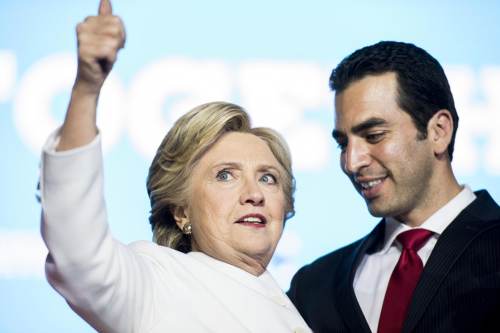
The Rep. Kihuen Matter And The Trouble With Witch Hunts

Accused Congressman with unidentified woman…

After last week’s appearance on an NPR panel on sexual harassment, hosted by Michel Martin, I posted some important aspects of the topic that I felt needed to be covered, but were not because of time constraints. I wrote in part…

[T]hese accusations can be weaponized, just like rape accusations on campus. Sexual harassment law can be used as a sword as well as a shield, and if provided the chance, I can explain how and give real life examples. One is Anita Hill…

The fact that sexual harassment has to be unwelcome sexual attention in the workplace is not generally understood. It also is unique: what other acts are deemed unlawful, regardless of intent, based on how the object of those acts chooses to react? This feature is why sexual harassment law is viewed by many women and men as inherently unfair. It literally means—I have a skit I use in training that illustrates this—that if actors George Clooney and Steve Buscemi behave exactly the same toward an object of their affections in a workplace setting, and the woman involved finds George attractive and Steve not so much, Steve has engaged in sexual harassment, but George hasn’t.

“When ethics fail the law steps in,” and this is a case where the law is a terrible substitute for ethics. Men like George, and, yes, Trump and even Harvey, are convinced that their touches, hugs, gropes and kisses won’t be unwelcome, and so they don’t think of themselves as harassers. For poor Steve, Al, Louis and other homely non-billionaires, it’s worth a shot, in their mind.

Meanwhile, what is “welcome”? … Is the conduct by a man with a grope or a kiss sexual harassment whenever the woman decides she would have rather it hadn’t happened? That is the issue raised by these late allegations. Let’s say a woman was [ spontaneously ] kissed by Donald Trump, and afterwards, she said to her friends, “That was cool! Donald Trump kissed me, just like that!” Then he’s running for President, and everyone she knows hates the guy, and now she thinks, “Yuck! That creep kissed me! I was one of those women he was bragging to Billy Bush about! He harassed me!”

Is that fair? Is that right? Can a man be retroactively guilty of sexual harassment because a woman’s perception of what happened changes over time?

These and other issues were just raised in one of the latest witch hunt accusations, the claim by a former 2016 campaign staffer of Rep. Ruben J. Kihuen (D-Nev), once a rising Democratic Party star,that he harassed her.

Unlike many of the other notable men who have been run down by the Harvey Weinstein Ethics Train Wreck, Kihuen, at least so far, has been accused of the most common and least horrible form of sexual harassment. The allegations would support the case that Kihuen created a hostile work environment for his subordinate by unwelcome sexual advances.  “Samantha” says that she rejected multiple sexual overtures by Kihuen, including once when when he suggested they get a room together in a hotel. She also says that in two instances he began touching her thigh, and asked if she was open to cheating on  her boyfriend. She says these attentions made her  so uncomfortable—that’s a hostile work environment!—that she quit as his campaign finance director after only five months on the job.

If an employee made these complaints to a business’s HR department, there would be an investigation. No job action could be taken against a supervisor based on her word alone. If there was no substantiation,  the supervisor denied it and no similar accusations had been made by other employees, no company could or should fire the accused individual. Moreover, until an investigation is complete, the position must be that the supervisor is innocent, and will not be penalized pending an investigation. Any other handling of such an episode is unethical: unfair, harmful, and wrong.

Kihuen denies that he engaged in harassment. Yet Nancy Pelosi, she who insisted less than a week ago that “due process” must play out before Rep. John Conyers should have to resign after multiple accusations from women, now says that Kihuen must resign based on one woman’s allegation, before any investigation.

This is true witch hunt stuff. Nothing has been proven. By this standard, a woman can kill a man’s career with an accusation. That is a lot of power. Power corrupts. Pelosi wrote, Continue reading

The NPR Panel On Sexual Harassment And What Didn’t Get Said

My segment on an NPR panel yesterday regarding the sexual harassment issue was cut short because “All Things Considered” had to wedge in a report on the terror attack in Egypt. I get it: it’s live radio, and its a news show. Still, one can question whether dealing with such a difficult and complex issue in so little time—three of us plus ace moderator Michel Martin ended up splitting less than 10 minutes among us–does more harm than good. Farajii Muhammad, who was in the studio with me and whom I had a chance to chat with at length, said that he was interested in having me on his own show to discuss the issue. We shall see.

Here’s the transcript: Continue reading

Morning Ethics Warm-Up, 9/16/17: Amazon Purges Reviews For Hillary, Equifax Must Die, Making Literature More Diverse, And The Red Sox Get Away With It…

GOOD MORNING!

1 “It would be wonderful, wouldn’t it?”

This is the response that the widow of writer Roald Dahl to a reporter’s suggestion that Charlie, the hero of Dahl’s “Charlie and the Chocolate Factory” (aka “Willy Wonka and the Chocolate Factory:) should be made black in a future “reworking” of the book. Recently Mrs. Dahl has claimed that Charlie was originally supposed to be black, but that her husband changed the character before the book was published. She blames his agent, who was, she says (none of this is more than hearsay) afraid that the book wouldn’t sell as well in American with a black hero. She blames “American sensibility.”

No, it wouldn’t be wonderful to start changing the races (and inevitably, genders and sexual orientations) in “reworkings” of literary classics. It would be unethical and irresponsible, as well as a defilement of the author’s visions and creations. Whatever the reason was, and we cannot know it regardless of what Mrs. Dahl now claims, Charlie was white in Dahl’s book. If he had wanted his book to be about a black child, or a little girl, or a Muslim transsexual, the author would have made it so. If someone obsessed with tribal identity politics wants to write a new adaptation under their own name so we can jeer and mock him or her, swell. But it isn’t any more “wonderful” to “rework” Dahl’s own story this way than it is to make Bob Cratchit black, or Captain Ahab black, or Bigger Thomas in “Native Son” Asian-American.

Of course, a stage or film adaptation of the book can cast it any way it chooses.

2 The major business ethics story this past week has been that data security breach by credit giant Equifax. An estimated 143 million Americans now face identity theft for the rest of their lives because the company wasn’t competent to be in the business it was in. It’s that simple. The ways in which Equifax blundered into allowing all this data to be hacked are legion, with more revelations almost daily. My personal favorite is that it neglected to install a patch that would have made its files more secure, delaying for months for no good reason.

Business analysts point out that despite this massive demonstration of ineptitude, the company is not likely to suffer more than the cost and inconvenience of a class action lawsuit or five. The companies that pay Equifax weren’t harmed by the breach, just the lives of the credit-seekers who they use Equifax to check. Nobody seems to think that even this massive misconduct will put Equifax out of business.

The company has dumped some executives, and will probably dump some more, reorganize, and padlock that barn door securely now that the horse has fled. TooLate. The company is untrustworthy, and more than that, companies like Equifax that gather personal information about innocent citizens need to be scared sick about what will happen to them if they can’t keep the information from falling into malign hands. Equifax needs to be put out of business. Its leaders and management need to be imprisoned, fined so severely that they are reduced to eating cat food, or blacklisted so their future employment is limited to bait shops and traveling carnivals. Continue reading

Morning Ethics Warm-Up: 6/21/17

1. No, there is nothing “ironic” about Rep. Steve Scalise being shot. I finally lost my restraint and pointed out to a gaggle of left-wing Facebook friends that their writing that Scalise’s shooting was “ironic” because he opposes gun control, or because one of his rescuers was gay (because he opposes gay marriage) was as much a of a hateful comment as saying that it was “karma” (another popular sentiment from progressive friends) or that he “reaped what he sowed” (yet another). They protested loudly and angrily that this was an unfair rebuke on my part, that they were not cheering the crime, just observing that the shooting was “ironic” which, they insisted, it was.

Disingenuous and evasive.

The seriousness,  criminal, hateful and absolutely inexcusable nature of Scalise’s shooting had absolutely nothing to do with his political beliefs unless you agree with the shooter, who used those beliefs as his motive. Karma, “reaped what he sowed” and irony (which implies an amusing or humorous nature) all signal and are intended to signal the same sentiment in the Facebook echo chamber—“It’s a shame that he got shot, but in a way he asked for it.” Oh, how those who sought to signal their virtue and their dislike of Scalise just hated to be called on the ugly impulses behind their words, and how they wriggled and spun to deny it.

What made the shooting ironic? Why, Scalise opposes gay marriage, I was informed. That’s neither a logical nor a justified answer. Although gays find it satisfying and expedient to automatically attach the label of  homophobia to those who haven’t yet adapted to one of the fastest cultural paradigm shifts in U.S. history, there is no evidence that Rep. Scalise believes that LGBT individuals cannot or should not be medical or law enforcement professionals. Scalise’s position on gay marriage is irrelevant to his shooting, unless that position—the same position Barack Obama and Hillary Clinton held for a very long time—makes you think his shooting and the subsequent assistance of gay citizens is somehow deserved and funny. Similarly, the fact that Scalise was shot does not undermine the justification for his support of the Second Amendment, except in the closed minds of Second Amendment opponents. Nor does that make his shooting “ironic,” except to those whose gut reaction was “He was shot? Serves him right. Let’s see how he likes it.”

So many progressives have become so instinctively hateful and bitterly partisan that they are incapable of realizing it.

2. Are there any ethics takeaways from last night’s Republican victory in Georgia’s 6th District? Pundit Charles Glasser wrote that “Ossoff raised $23.6 million to make a symbolic run against President Trump, most of it from Marin County, California and Martha’s Vineyard in Massachusetts. Running the numbers, Democrats might have been better off considering that same amount would have bought 855,072 school lunches (at $2.76 each); 236,000 elementary school textbooks (at $100 each) or even 956 Priuses (at $24,685 each). Max Weber said that the purpose of a bureaucracy is to maintain or expand its own power. Who cares about children, education or the environment when there’s power to be grabbed?”

As a rule I object to the “spending money on A is unethical because you could have spent it on B” line of reasoning, since it can be applied to almost any purchase. Nonetheless, that’s a lot of money to be used by outsiders to influence a local election, particularly when the donors also decry the effect of money in politics. And as with Hillary Clinton’s defeat, this result suggest that money isn’t nearly as decisive as those who want to constrain political speech think it is. Continue reading