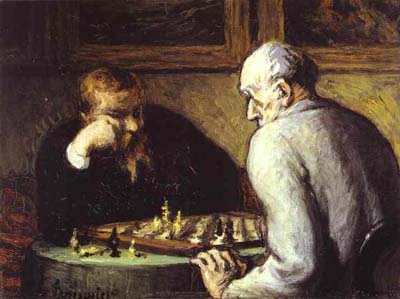
 The French chess federation has suspended three of its best chess players for cheating in a tournament last Fall. Sébastien Feller, a 20 years old grandmaster, Cyril Marzolo, and Arnaud Hauchard, who is the French team captain, secretly used a computer to feed them moves during their matches. The games were broadcast over the Internet, and a confederate fed the game positions into a computer with a sophisticated chess-playing program (computers beat the world’s best human player very regularly now). Once the computer made its move, the confederate sent it to the human grandmaster using a text message. The three French chess whizzes matched the computer almost move for move.
Amazing. Cheating in tournament chess was once unheard of, partially because there weren’t many opportunities to cheat. There were practices regarded as bad sportsmanship, and sometimes those could get a player in trouble, but players always made their own moves. Now the chess establishment is suddenly thrust into what is an all too common task in other fields: foiling cheaters.
I remember the best player on my high school chess team used all sorts of obnoxious psychological tactics that unsettled his opponents. Playing touch chess (if you touched a piece, you had to move it; if you took your hand off a piece after a move, you couldn’t take the move back), he would let his hand hover over a piece he had no intention of moving, then suddenly touch it saying “J’adoube!” (“I adjust!”), which meant that he was simply moving a skew piece into the center of its square, a little mid-game housekeeping permitted by the rules. Sometimes, in a tense moment, he would adjust every piece on the board (“J’adoube...j’adoube…oh, another j’adoube…might as well j’adoube this one too…”) just to be annoying (serious chess players are notoriously high strung.) Sometimes when an opponent made a move after long consideration, my friend would chuckle gleefully, as if it were the stupidest move imaginable, or shout “Yes!” or otherwise make the player think he had made a terrible blunder. He also specialized in supposedly involuntary wheezes, hums and other noises while his opponent was considering his next move. This nonsense was about as close as players came to cheating for hundreds of years. Chess acquired the reputation of being an honorable game played by (mostly) honorable individuals.
It appears, however, that chess players were only honest because there weren’t opportunities to be dishonest, a situation remedied by the availability of chess grandmaster level computers and new communications technology. This is both disappointing and perplexing. Chess is famous for being a direct battle of skill and ego; the enjoyment in chess combat comes from beating another fine player using one’s guile, accumulated mastery of the game and creativity. If a computer is providing the moves, one barely needs to know how to play chess at all to win; an eight-year-old of normal intelligence could read the text messages and follow the computer’s directions. Why spend years honing one’s ability to play chess at World Championship levels only to resort to this dishonest tactic to win? The result is a loss on all sides: the debasement of the game itself, the unfair treatment of the opponent, and the rejection of the reasons the cheating player sought to master chess in the first place.
The best that can be said of this unfortunate development in one of civilization’s oldest and best games is that perhaps the fact that chess players are so unaccustomed to cheating explains why their first serious foray into it is so spectacularly stupid.
 Ethics Alarms
Here’s an old chess favorite, although it is recounted in two ways, with impressive substantiation in both directions.
In the New York chess tournament of 1927, the temperamental Russian grandmaster Aaron Nimzovitch was playing a game against the Slovenian Milan Vidmar, a very good friend of his away from the table. Vidmar pulled out his cigar case and put it on the table, and Nimzovich immediately complained to Geza Maroczy (Hungarian), the tournament diretor and a player known for his equanimity. Maroczy asked Nimzovich what the problem was, since Vidmar was not actually smoking. Nimzovitch replied either (1) “No, but chess players know that the threat is stronger than the execution!” or (2) “No, but he looks as if he wants to!” I like (2) better, although realistically speaking, (1) is more likely.
In either case — any unethical behavior by anyone here?
What was Maroczy’s ruling on the complaint, is it written somewhere? Thank you.
General question: can readers think of any human game, sport or pastime which is absolutely cheat-proof? I suspect not, since the rules of the game, sport or pastime were invented by human beings.
Tic Tac Toe. Paper-Stone-Scissors. Chess was pretty close before the computer technology revolution.