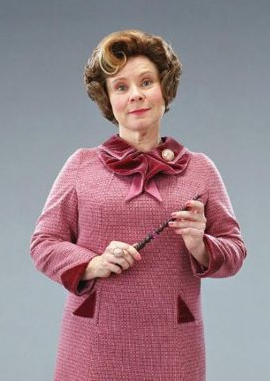
Read the Code, Miss Umbridge!
I don’t believe that the outrageous stories I read almost every day about incompetent, abusive, irresponsible teachers necessarily prove that there is a higher percentage of teachers who got their credentials straight from Hell today than in past generations, though I strongly suspect that is the case. In the days before the internet, horror stories stayed local, and seldom even made the paper. Thus we didn’t hear about the kind of student-terrorizing episodes that have turned up over the last few days, such as….
…..The fourth grade teacher whose brilliant idea to explain the Civil War was to have a slave auction in class, with the white students bidding on the non-white students.
…..The kindergarten teacher who reportedly told students to encircle a classmate, call him a pig and make pig noises because the boy was “messy.”
…..The third and fourth grade special-education teacher who ordered students to remove their underwear to determine which child soiled his pants.
…..The high school math teacher who asked an overweight student if he had eaten his homework.
I have a novel idea that might begin to reduce the frequency of these incidents. Why don’t schools actually make certain their teachers read their own Code of Ethics?
There are many teacher codes of ethics, actually…maybe too many. All that is needed is one, and virtually all of them have a section like this, from the American Association of Educators code:
PRINCIPLE I: Ethical Conduct toward Students
The professional educator accepts personal responsibility for teaching students character qualities that will help them evaluate the consequences of and accept the responsibility for their actions and choices. We strongly affirm parents as the primary moral educators of their children. Nevertheless, we believe all educators are obligated to help foster civic virtues such as integrity, diligence, responsibility, cooperation, loyalty, fidelity, and respect-for the law, for human life, for others, and for self.
The professional educator, in accepting his or her position of public trust, measures success not only by the progress of each student toward realization of his or her personal potential, but also as a citizen of the greater community of the republic.
1. The professional educator deals considerately and justly with each student, and seeks to resolve problems, including discipline, according to law and school policy.
2. The professional educator does not intentionally expose the student to disparagement.
3. The professional educator does not reveal confidential information concerning students, unless required by law.
4. The professional educator makes a constructive effort to protect the student from conditions detrimental to learning, health, or safety.
5. The professional educator endeavors to present facts without distortion, bias, or personal prejudice.
Call me crazy, but I think those provisions pretty clearly rule out making kids pull down their pants to see who pooped, treating them as slaves, having classmates oink at them, or accusing an overweight child of eating his homework.
This thing is, you have to read and understand them. Better yet, perhaps administrators should hire teachers who don’t need a code of ethics to know that it is wrong to humiliate children.
 Ethics Alarms
In my brief and unpleasant sojourn into public school, I had a 4th grade teacher who gave me an F for not responding to a name she decided was my “real” one. The name I would have answered to, she considered a shortened form of the legitimate one, and therefore unacceptable. The principal agreed. The teacher was, he explained in the letter I took home for my parents’ acquiescent signatures, the authority in the classroom. It was her duty to instill obedience and good manners in her pupils, and to brook no argument. My father, powerful enough in the community that he could have joined in my disobedient and mannerless outrage — I wanted him to ‘smack her right in the kisser’– and leaned heavily on the administrator, opted for the politic thing: he brought my birth certificate to school. (Little did he think that I might be eligible to run for President some day!) Both principal and teacher examined the paper. My father was then advised that he should have my name changed legally to be what it should so that I would not have to suffer disrespect going through life with an obvious nickname and — heaven forbid! — be burdened with an impediment to a good marriage.
On the face of it, my experience can’t compare with your examples, Jack. And in fact, it became one of those funny family stories that everyone clucked and chuckled over. I continued with much success in an excellent private school and never again had a non-academic contretemps with an instructor. The incident even became the basis, I believe, of making me particularly sensitive to personal issues with my own students some twenty years later. But she (referring with disdain to a woman as “she” — the cat’s mother — was the worst insult I could come up with then) she was messing with my pride, my self-esteem, my belief in my parents’ omnipotence (which was meant to last at least another three or four years in those days), and my classmates’ ability to avoid joining in the humiliation. She was messing with my identity.
If I still take umbrage* at such behavior, considered ETHICALLY correct at the time, what do the victims of today’s teacher-torture have in store? As the honored headmaster of Hogwarts Albus Dumbledore said it: “Of course it is happening inside your head, Harry, but why on earth should that mean that it is not real?”
Penn…the EXACT same thing happened to me, and more than once. In a Catholic community, I was told by more than one teacher that my name was a nickname, nor a real name, and that I should answer to John. I refused. The first time, my Dad (also Christened Jack) thought it was funny, and sent a note to the teacher, which solved that incident. The second time, he was ticked off, and as a member of the town’s board and on the school committee, recruited the Superintendent of Schools to get the word out that this wasn’t to happen again, to his son or anyone.
Gee, I’m sorry, Jack. But what WAS your grandfather thinking, christening his son with a nickname???
Like so many professional standards, that of the educators has devolved into mere words on a musty tableau.
I dunno. I’ve taught for 20 plus years, Jack, and I can count on the fingers of one hand, OK, maybe both hands, the number of humiliations of which I personally became aware. I sure hope you’re wrong about these horrendous incidents being on the increase. We already have enough horror in our public schools. (Have you ever read, it’s a comic book, Yay! School is Hell by Matt Groening? If you haven’t, you are in for a real treat. Check out this panel… http://tinyurl.com/4xrdoy5)
When can we begin to hold our STUDENTS and their PARENTS to standards?